Get new episodes in your feed. Follow us on:ThreadsBluesky
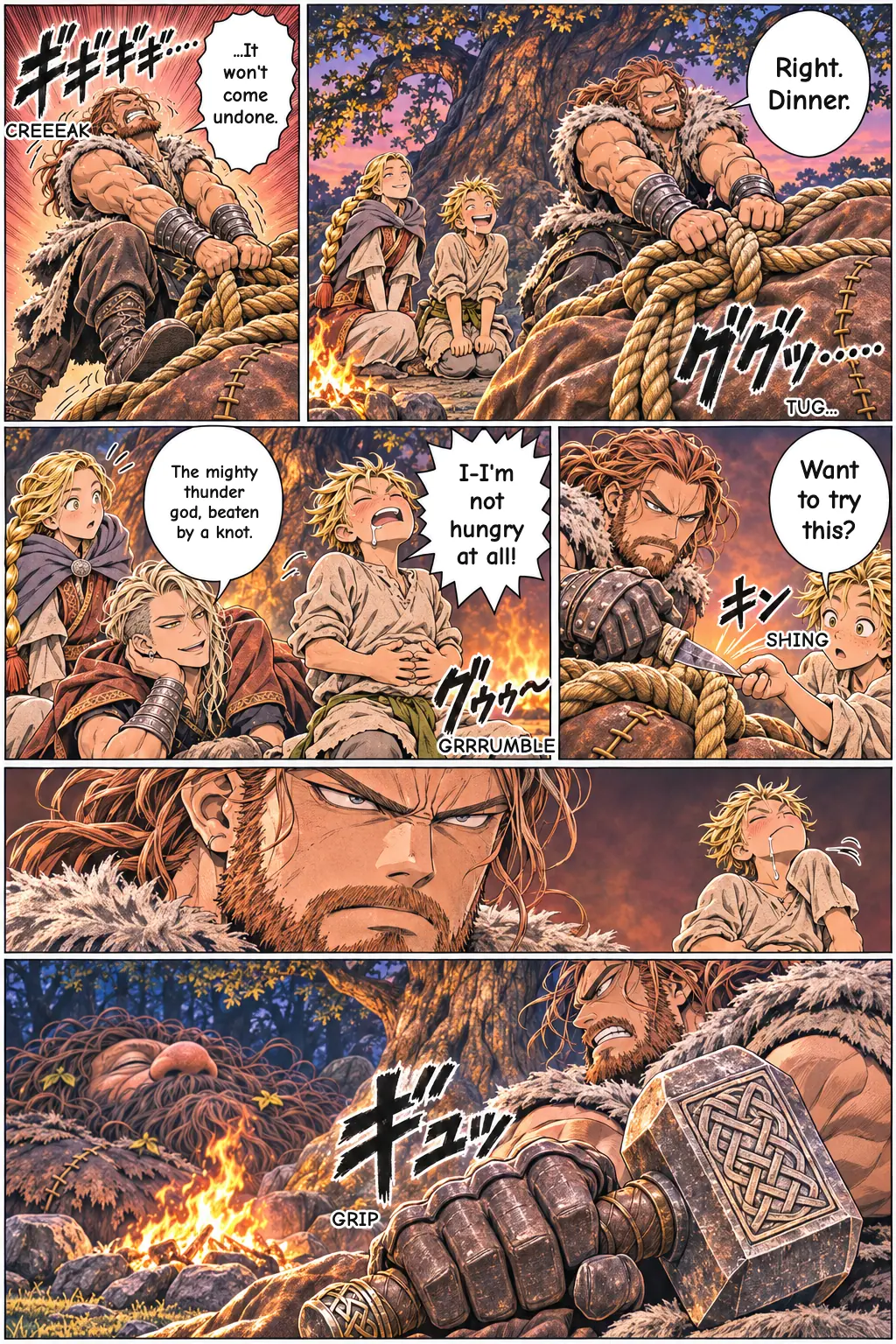
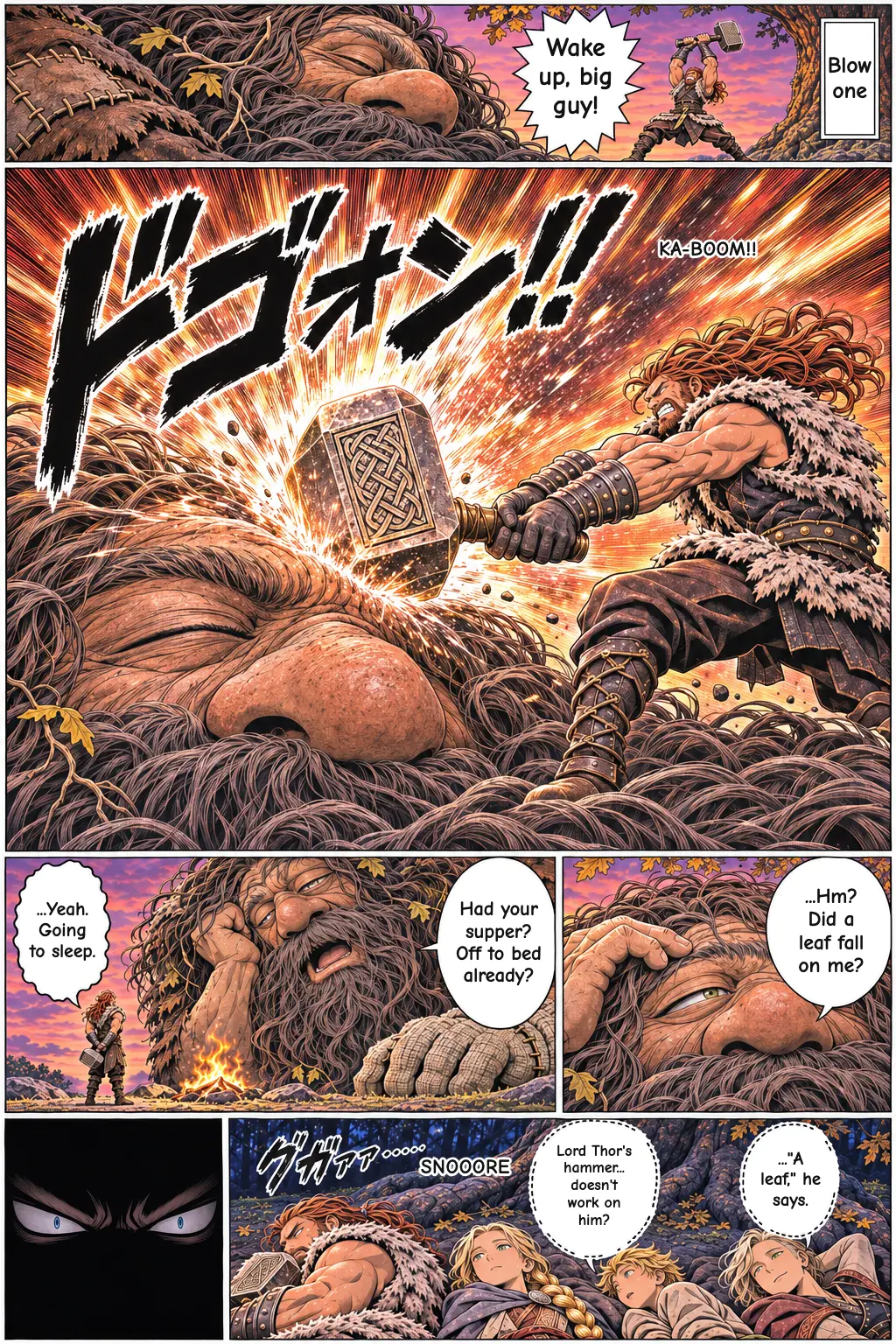
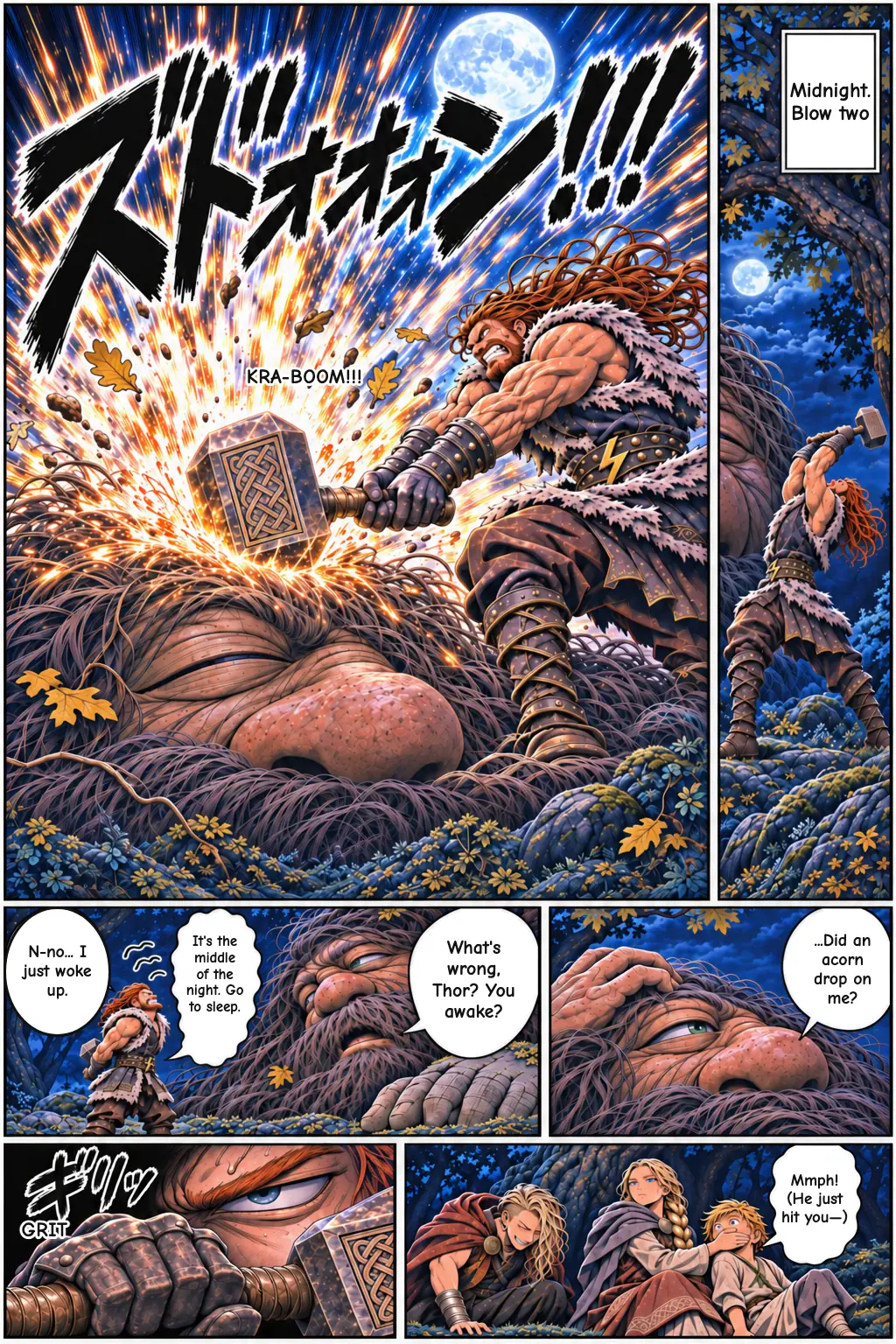
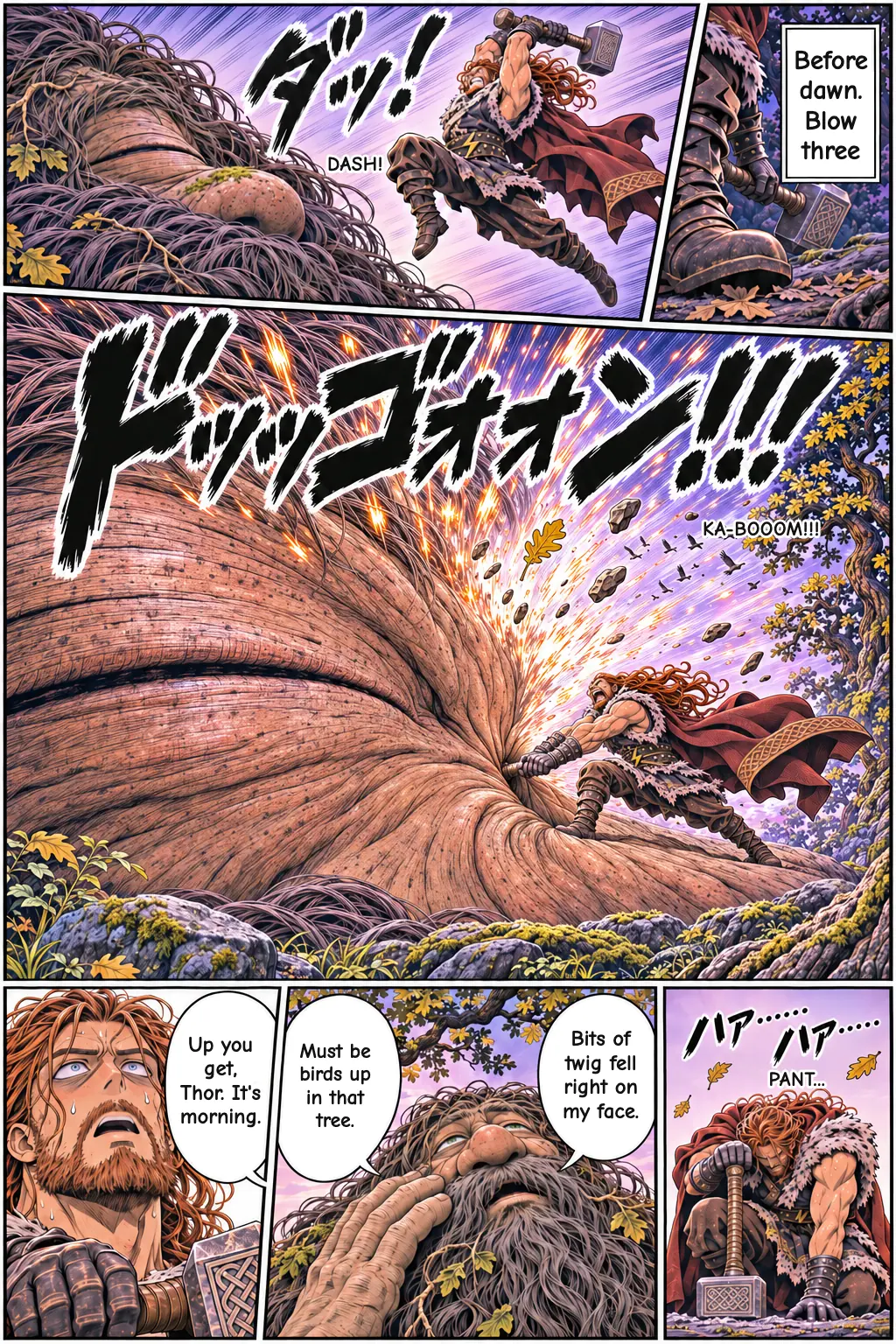
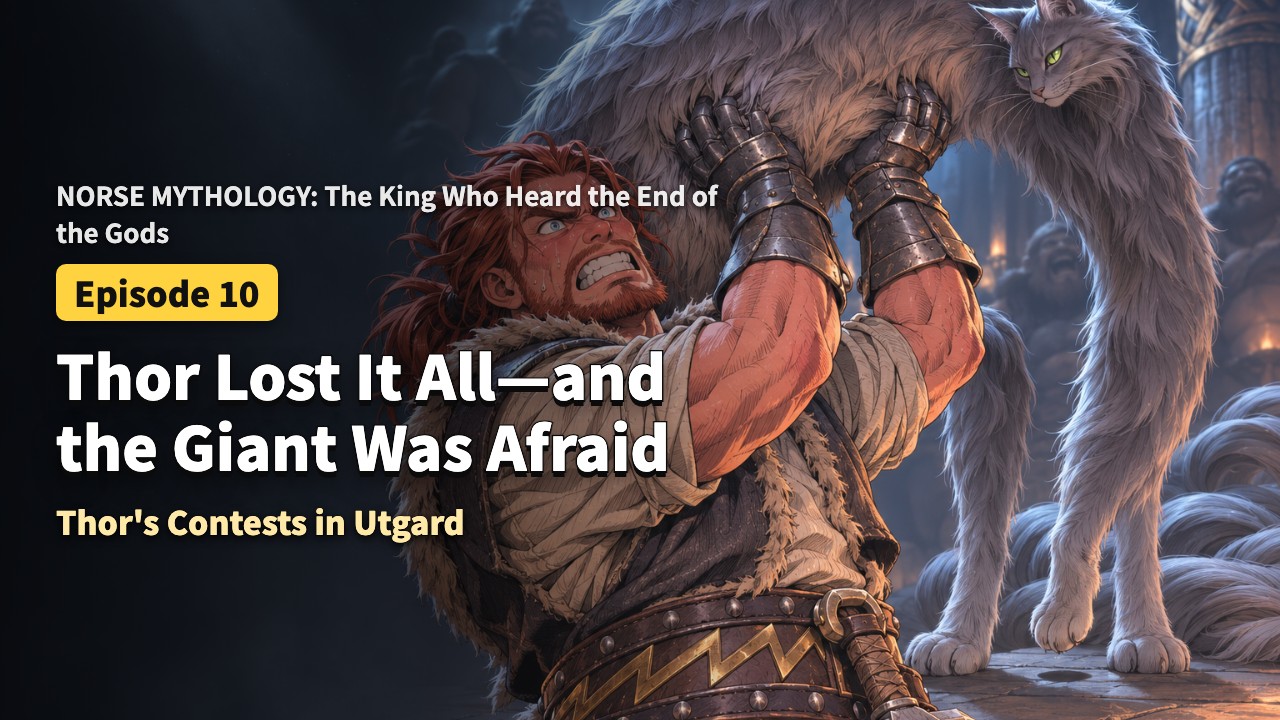
Thor heads into the forests of giant country, taking along the boy who cracked his goat's bone and the boy's sister to make up for it. The "house" where they spent the night turns out to be a giant's glove. Thor swings his hammer at full strength three times, and all the giant says is, "Did a leaf fall on me?" Part one.
Story summary
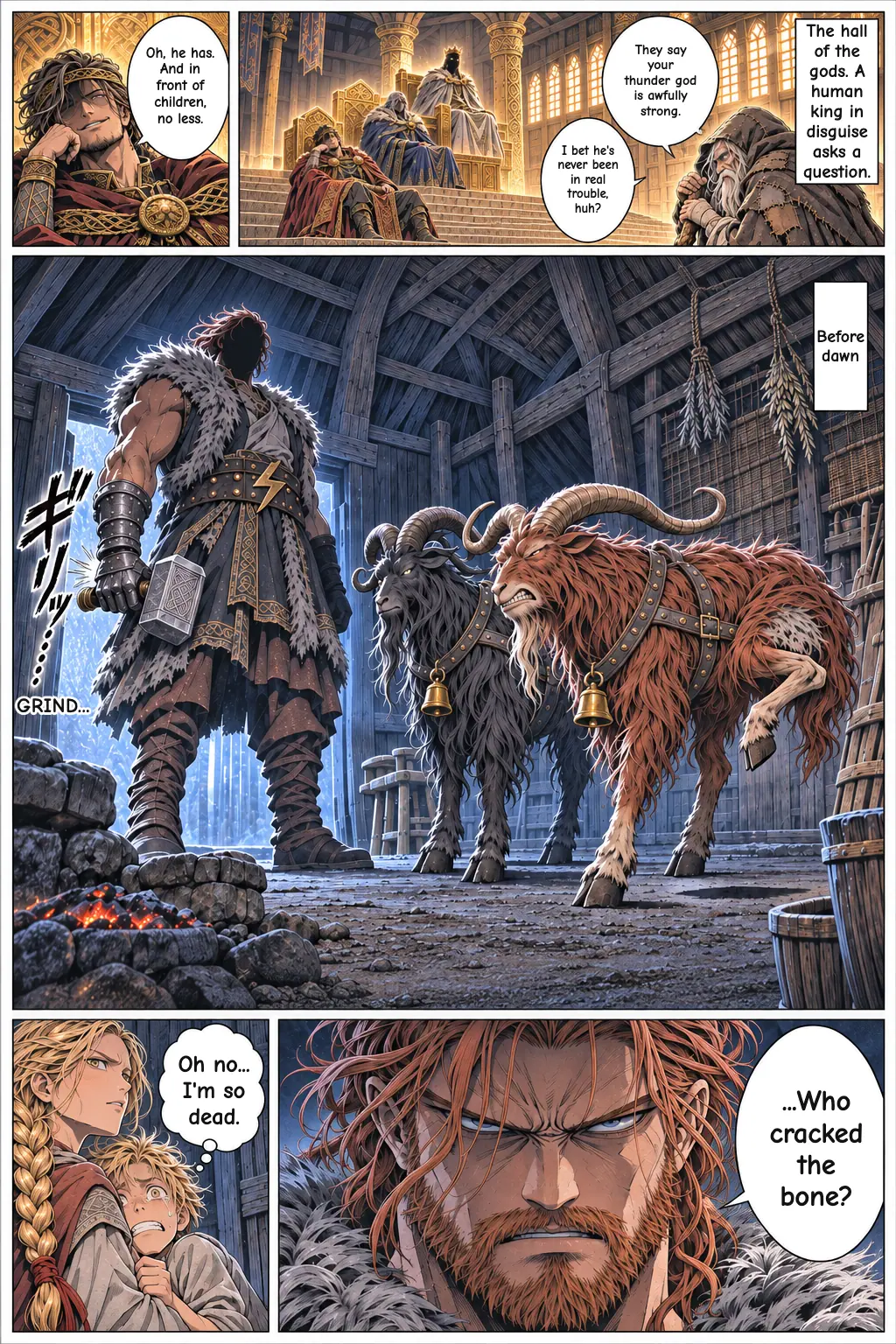
The story comes from Gylfaginning ("The Tricking of Gylfi"), the first part of the Prose Edda, written in Old Norse by the Icelandic scholar Snorri Sturluson in the early 13th century. A disguised Swedish king, Gylfi, calling himself Gangleri, questions three mysterious figures about the gods. One of them, High (Hár), answers by telling a tale in which even mighty Thor ran into trouble. Depending on the edition, this part falls in chapters 44 to 45. Thor sets out in his chariot pulled by goats, with Loki, the trickster, along for the ride.
Thor and Skrymir: The Giant's Glove and Three Hammer Blows (Norse Myth Summary)
In short: This is the first half of Thor's journey to Utgard, told in Snorri Sturluson's Prose Edda (Gylfaginning). The thunder god Thor takes a farmer's two children as servants after one of his magic goats is lamed. In giant country he meets the enormous giant Skrymir, who sleeps through three full-strength hammer blows and only asks whether a leaf has fallen on him.
The Original Myth: Thor's Road to Giant Country
The story comes from Gylfaginning ("The Tricking of Gylfi"), the first part of the Prose Edda, written in Old Norse by the Icelandic scholar Snorri Sturluson in the early 13th century. A disguised Swedish king, Gylfi, calling himself Gangleri, questions three mysterious figures about the gods. One of them, High (Hár), answers by telling a tale in which even mighty Thor ran into trouble. Depending on the edition, this part falls in chapters 44 to 45.
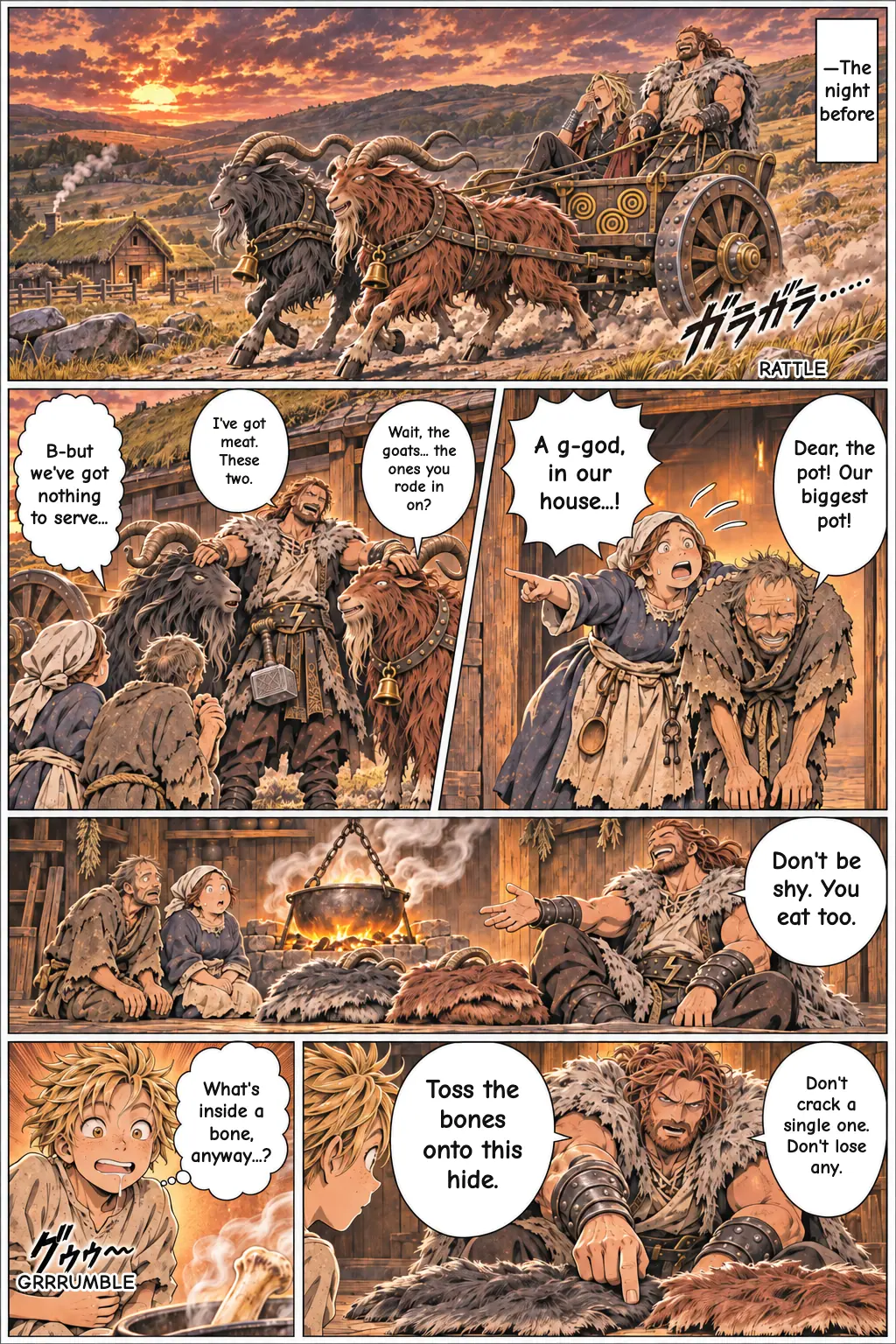
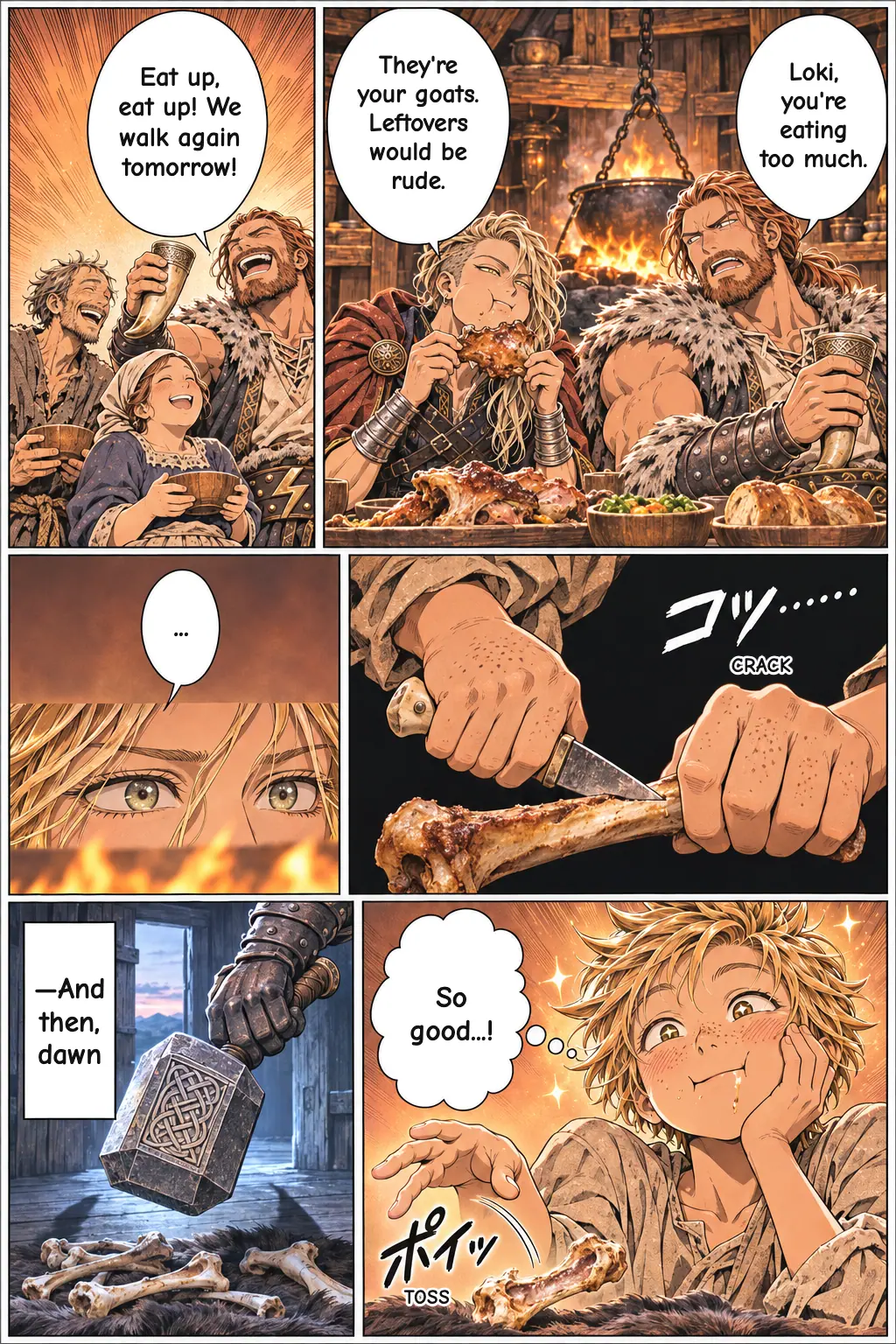
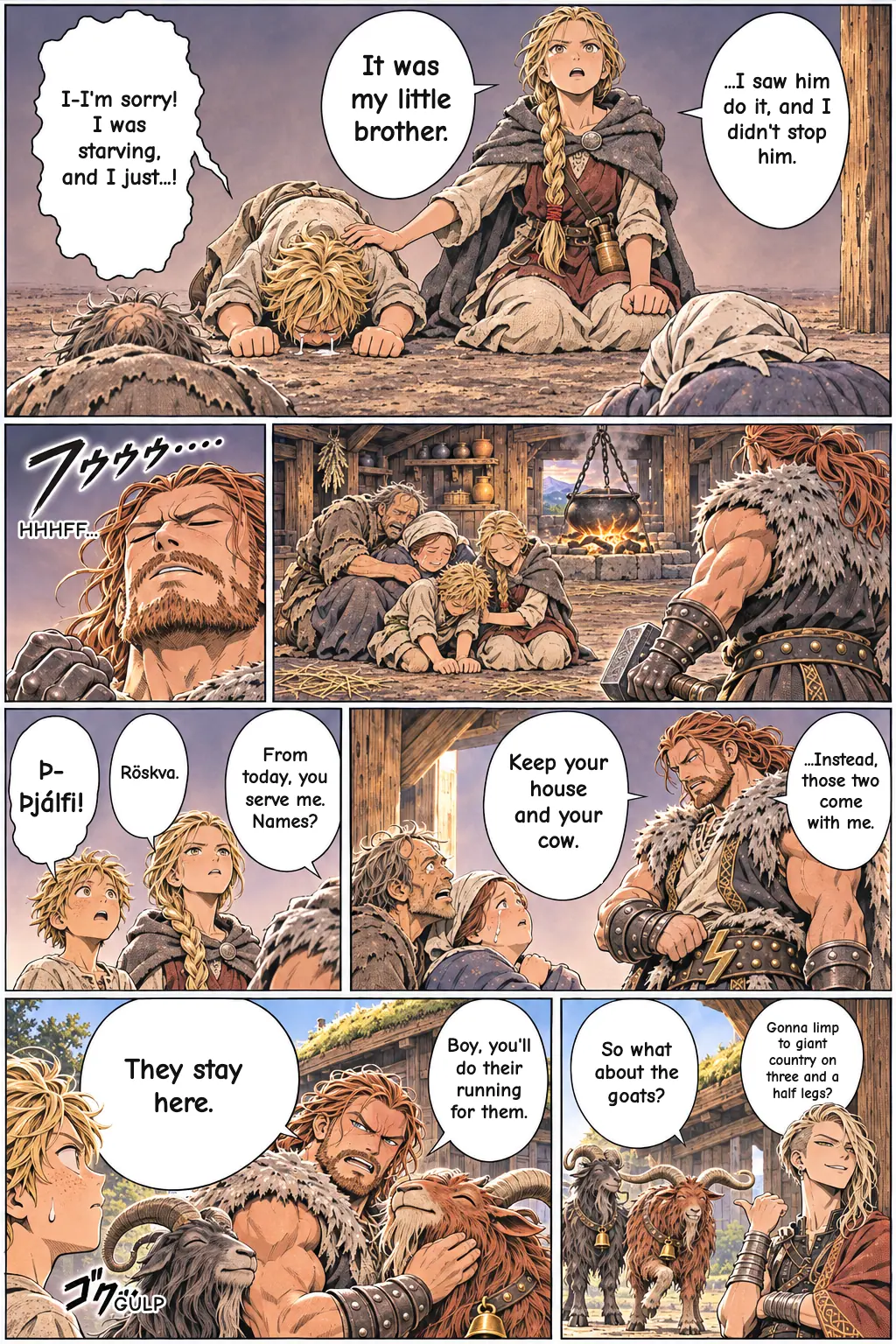
Thor sets out in his chariot pulled by goats, with Loki, the trickster, along for the ride. At evening they stay with a farmer whose name is never given. Thor slaughters both goats, cooks them, and invites the farmer, his wife and their two children, Thialfi and Röskva, to eat. He spreads the goatskins away from the fire and tells everyone to throw the bones onto them. But Thialfi splits a thigh bone with his knife to get at the marrow.
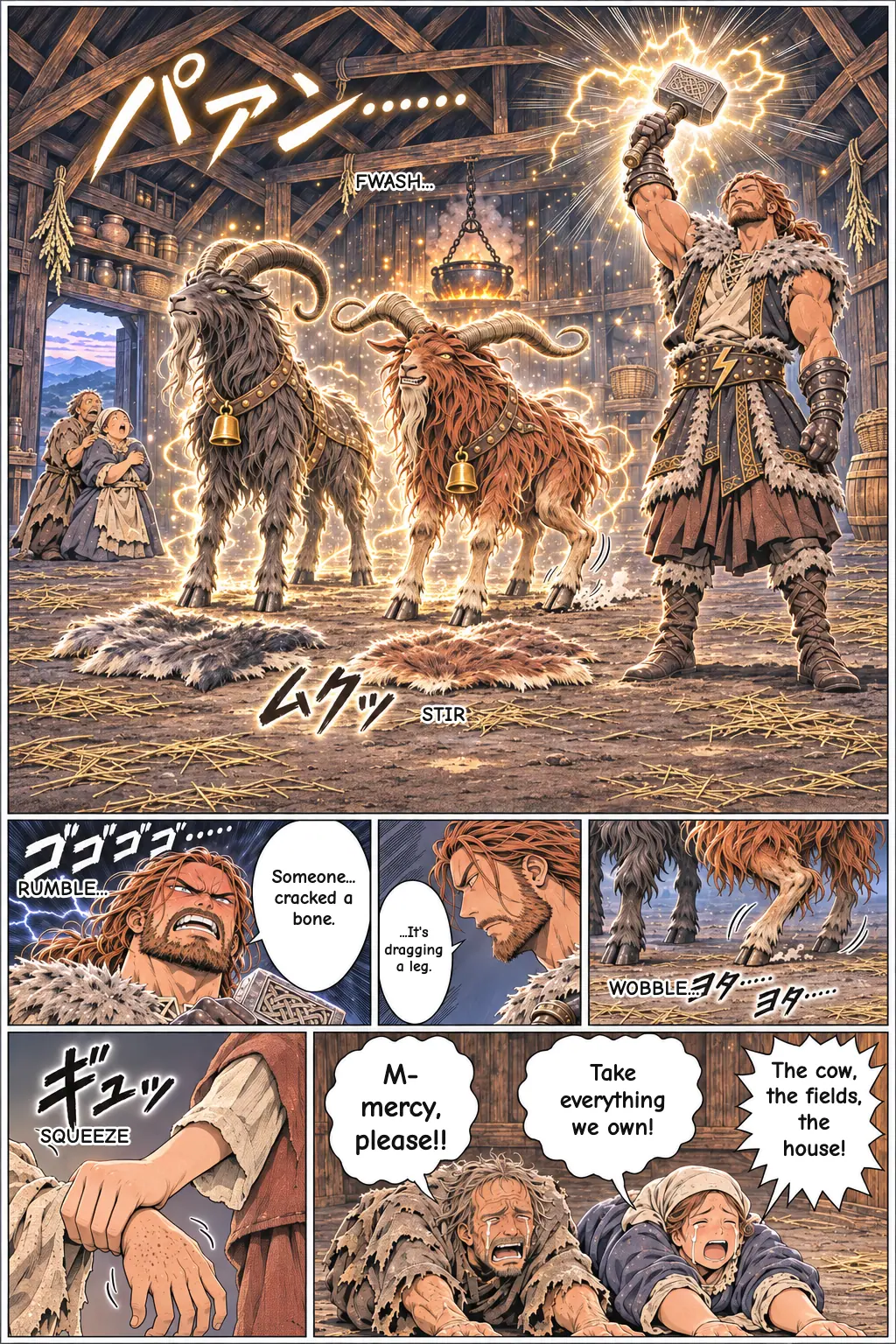
Before dawn Thor raises his hammer, Mjölnir, and hallows the skins. The goats stand up alive, but one limps on a hind leg. Thor knows someone has mishandled the bones. His brows sink over his eyes and his knuckles whiten on the hammer handle. The terrified family begs for mercy and offers everything they own. Seeing their fear, Thor calms down and accepts the two children as payment. From then on, Thialfi and Röskva serve him.
The Glove-Hall and the Three Blows
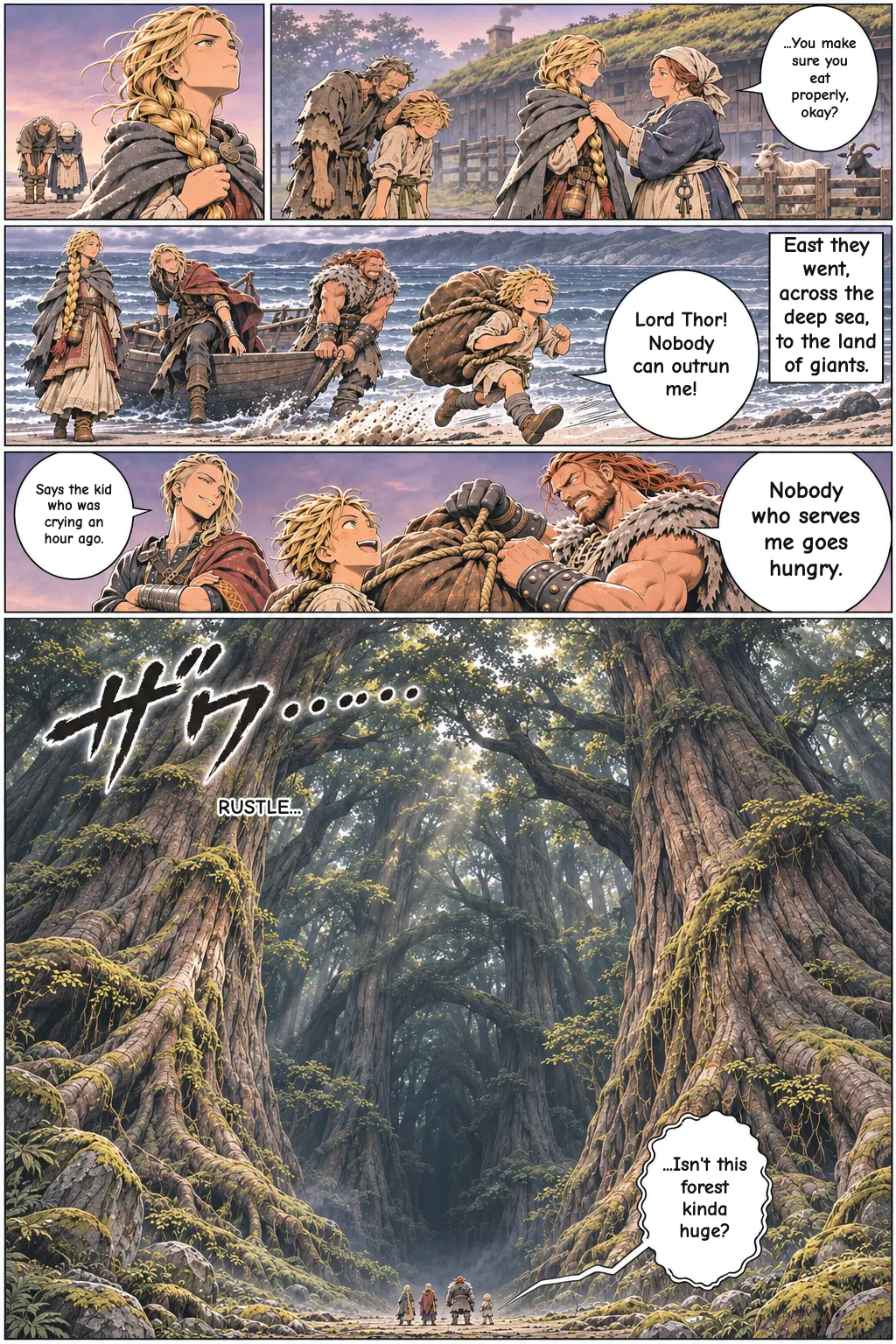
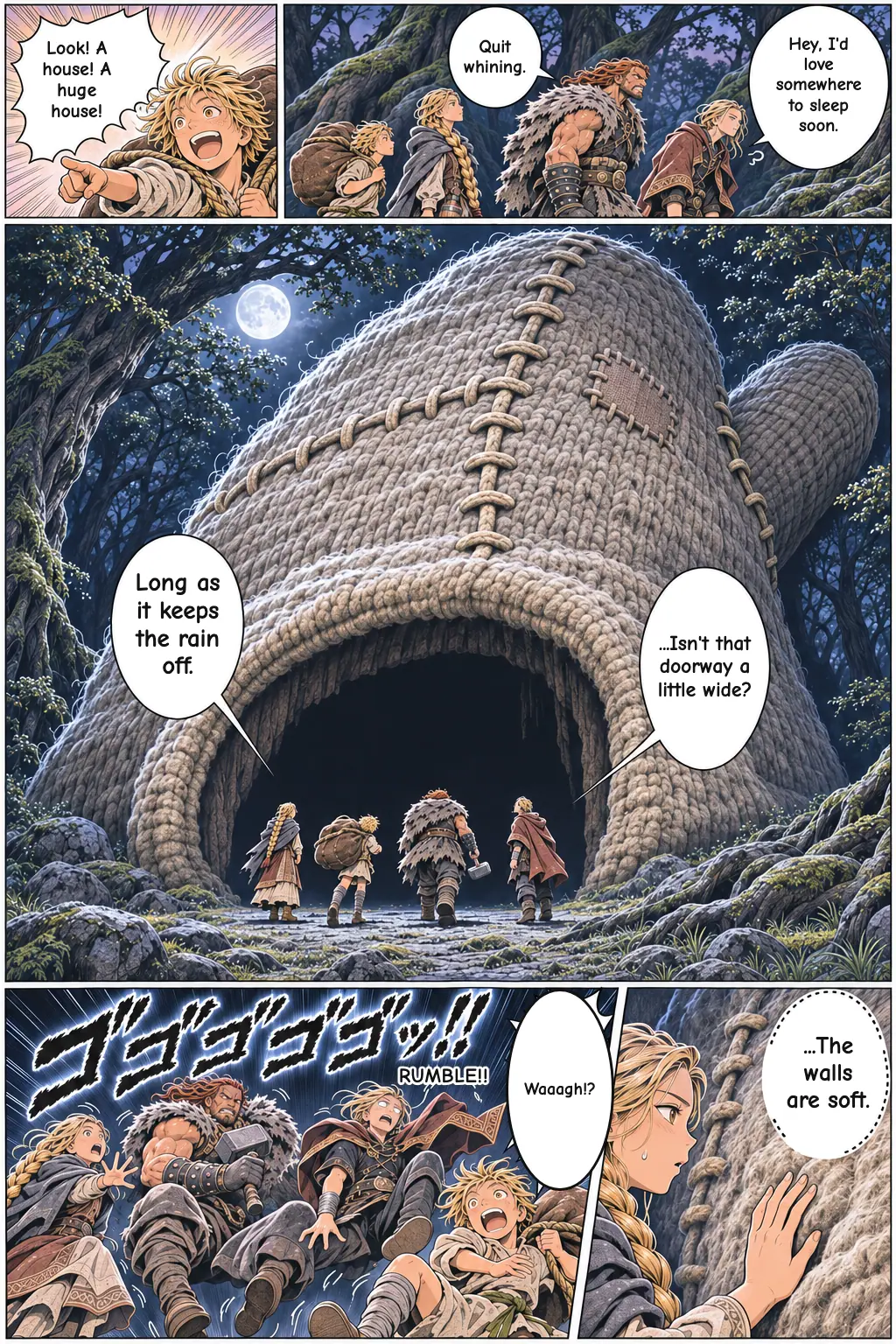
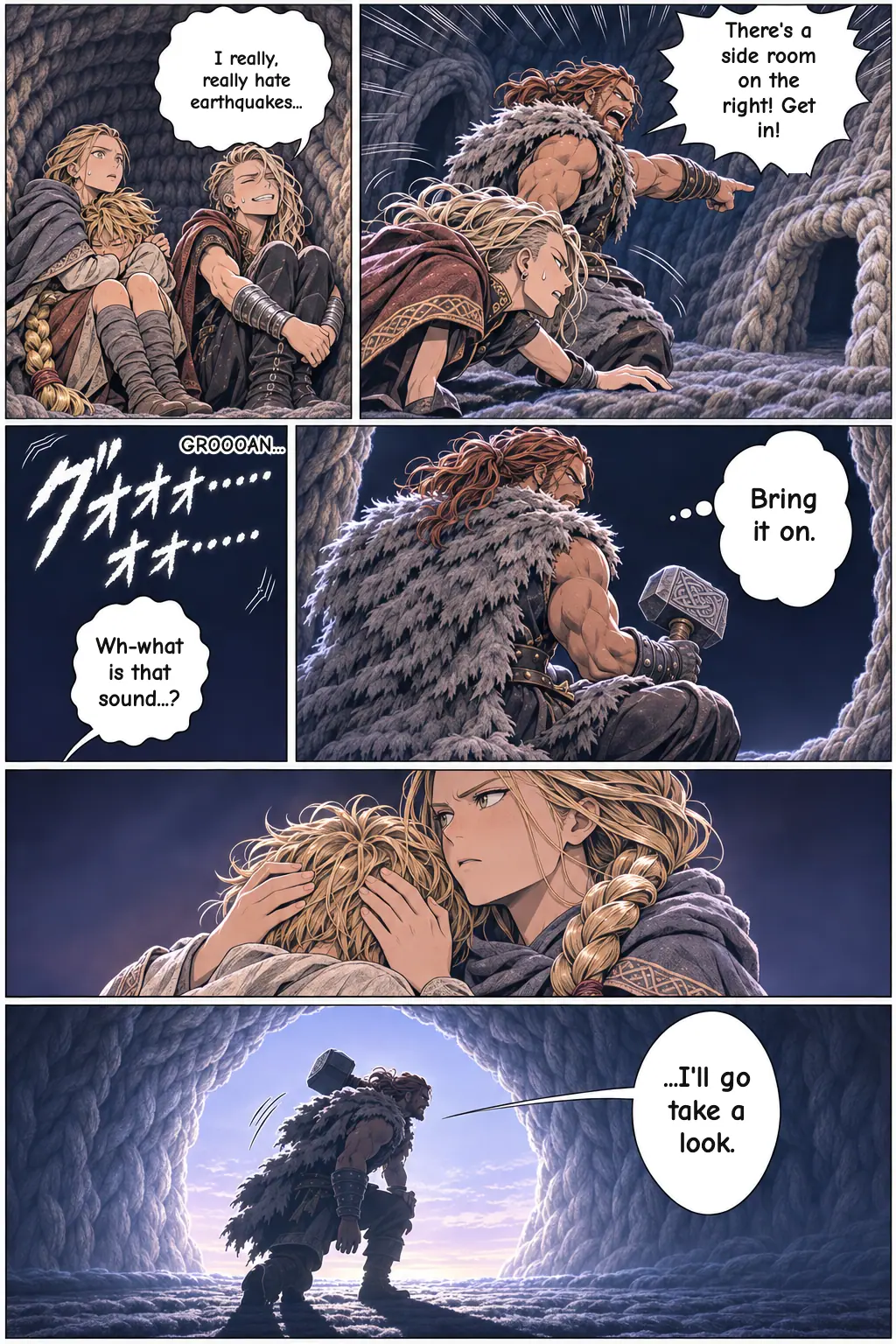
Leaving the goats behind, the group travels east, crosses a deep sea, and enters a vast forest in Jötunheim, the land of the giants. Thialfi, the fastest runner of all humans, carries Thor's food bag. At nightfall they find a huge hall with an entrance as wide as the building. At midnight the ground shakes, and they shelter in a side room while Thor guards the doorway, hammer in hand.
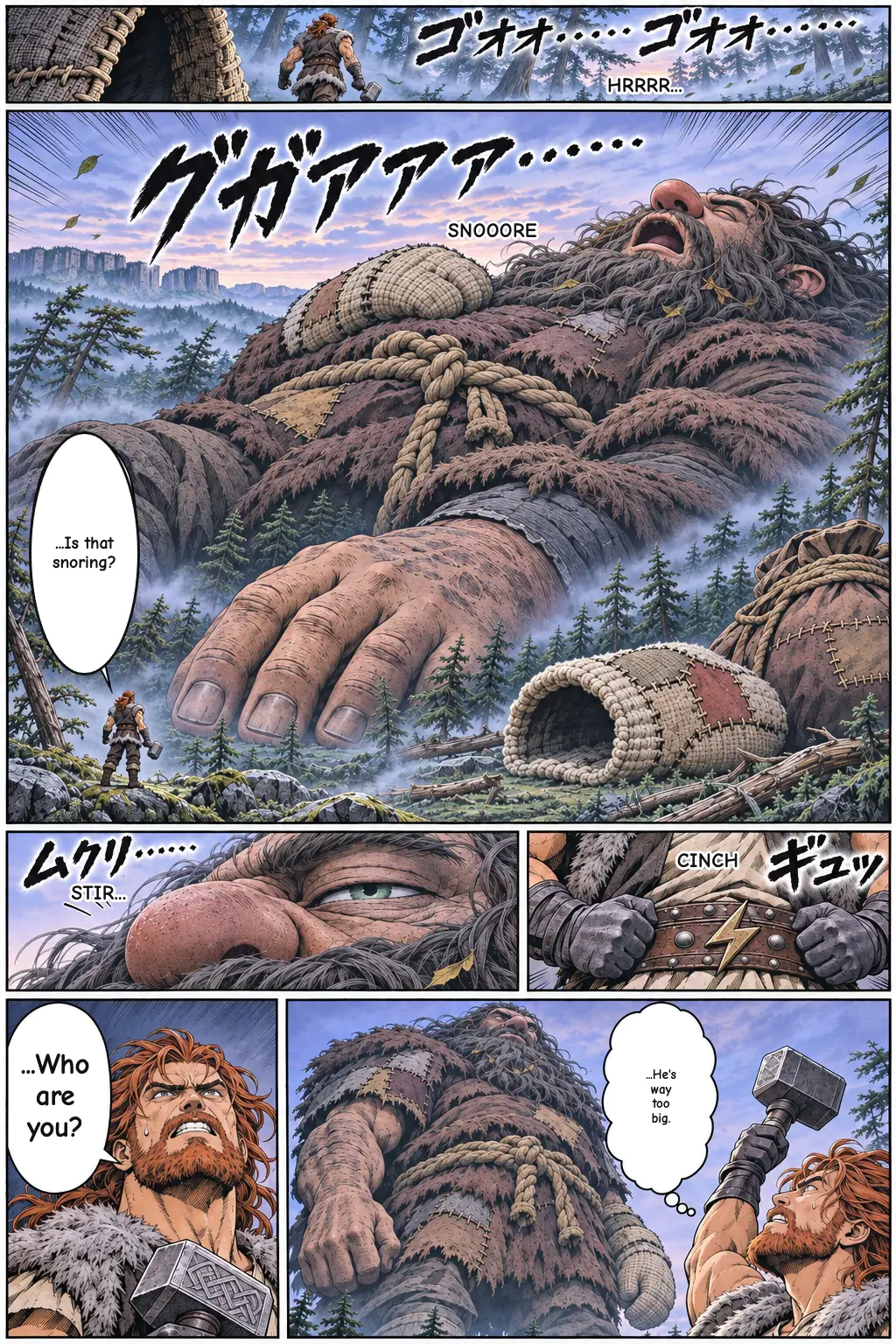
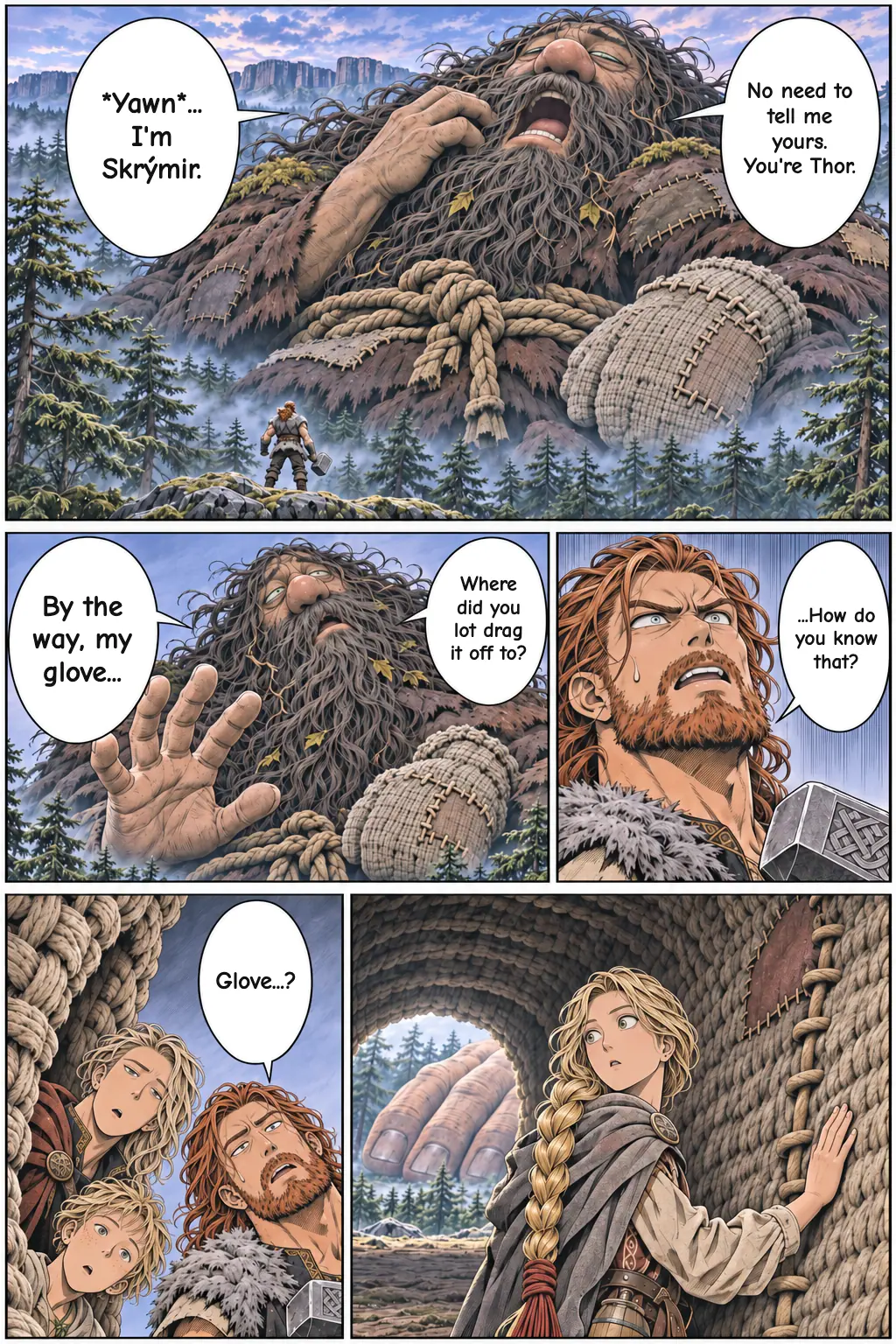
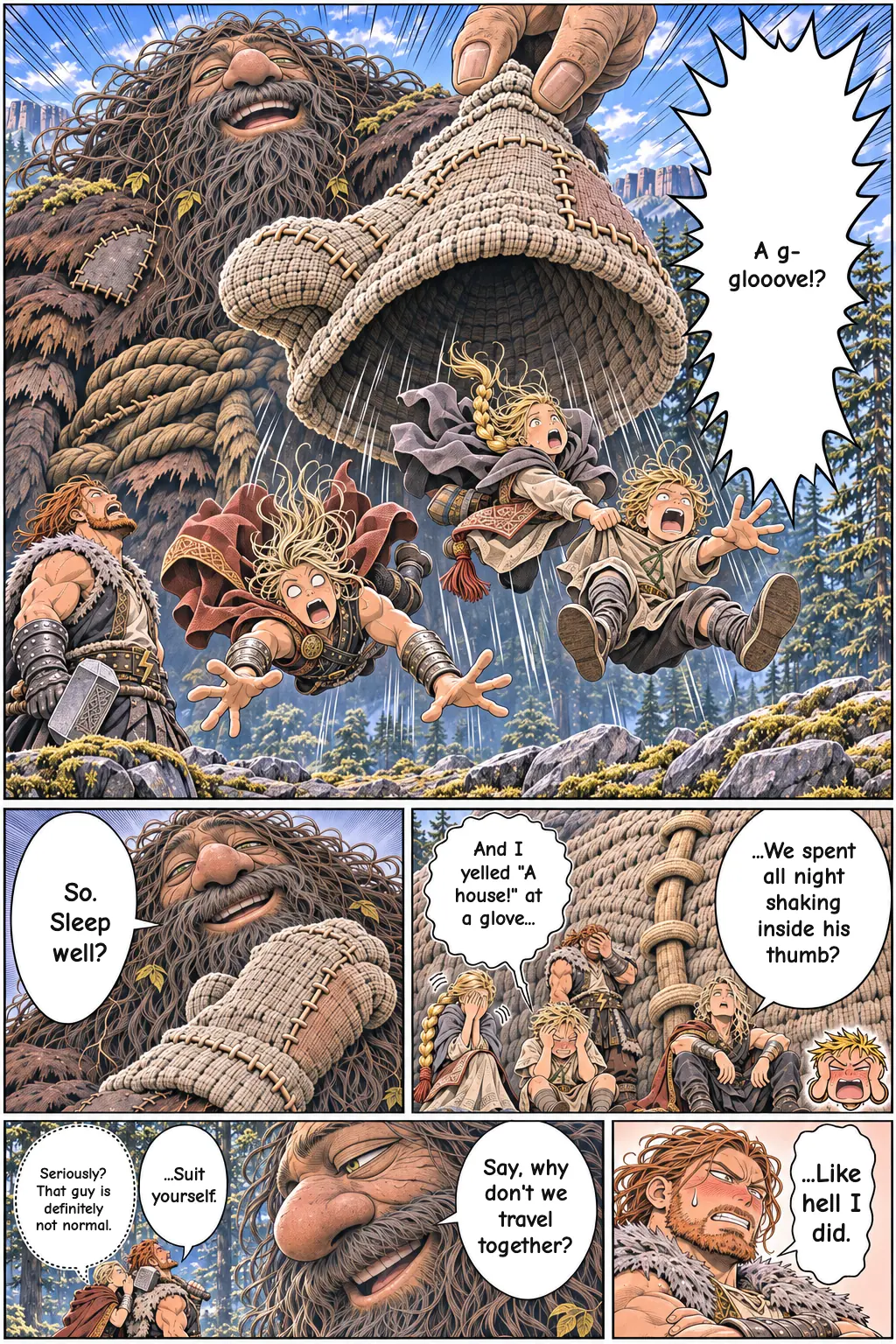
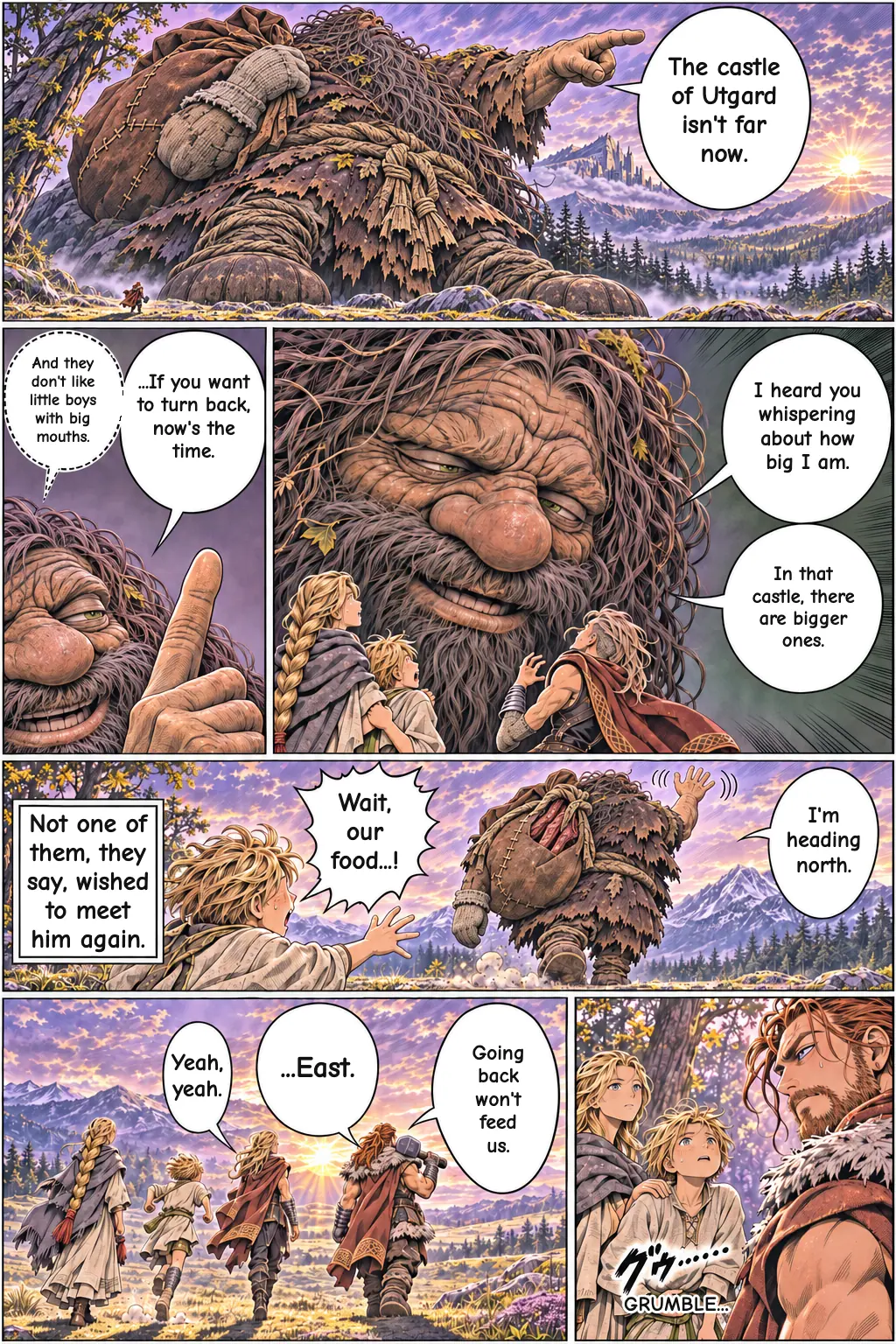
At dawn Thor finds a gigantic man snoring in the forest. The "earthquake" was his snoring. Thor buckles on his belt of strength, but when the giant wakes, Thor for once holds back and asks his name. It is Skrymir, and he already knows who Thor is. He picks up his glove: the hall was the glove, and the side room was its thumb.
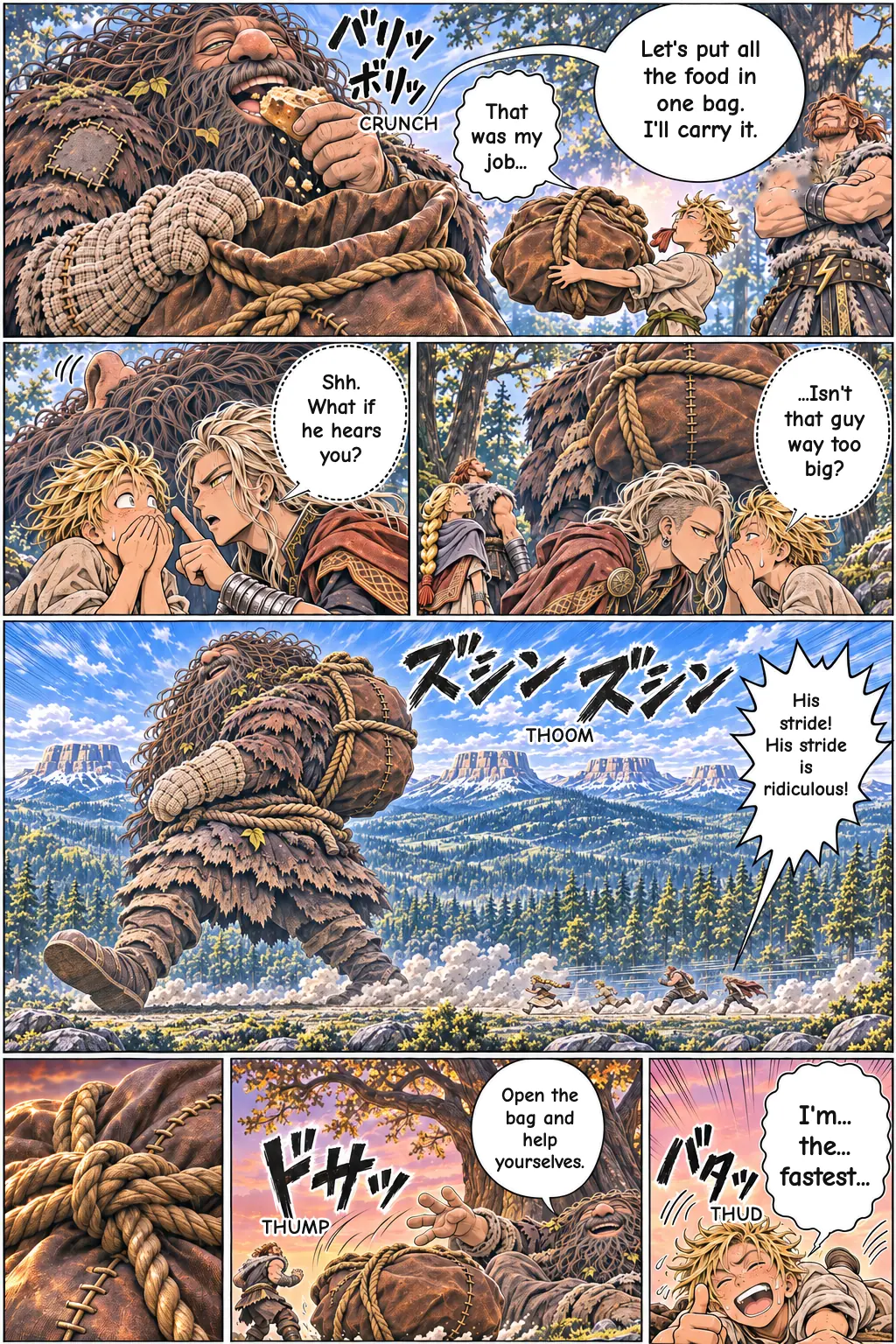
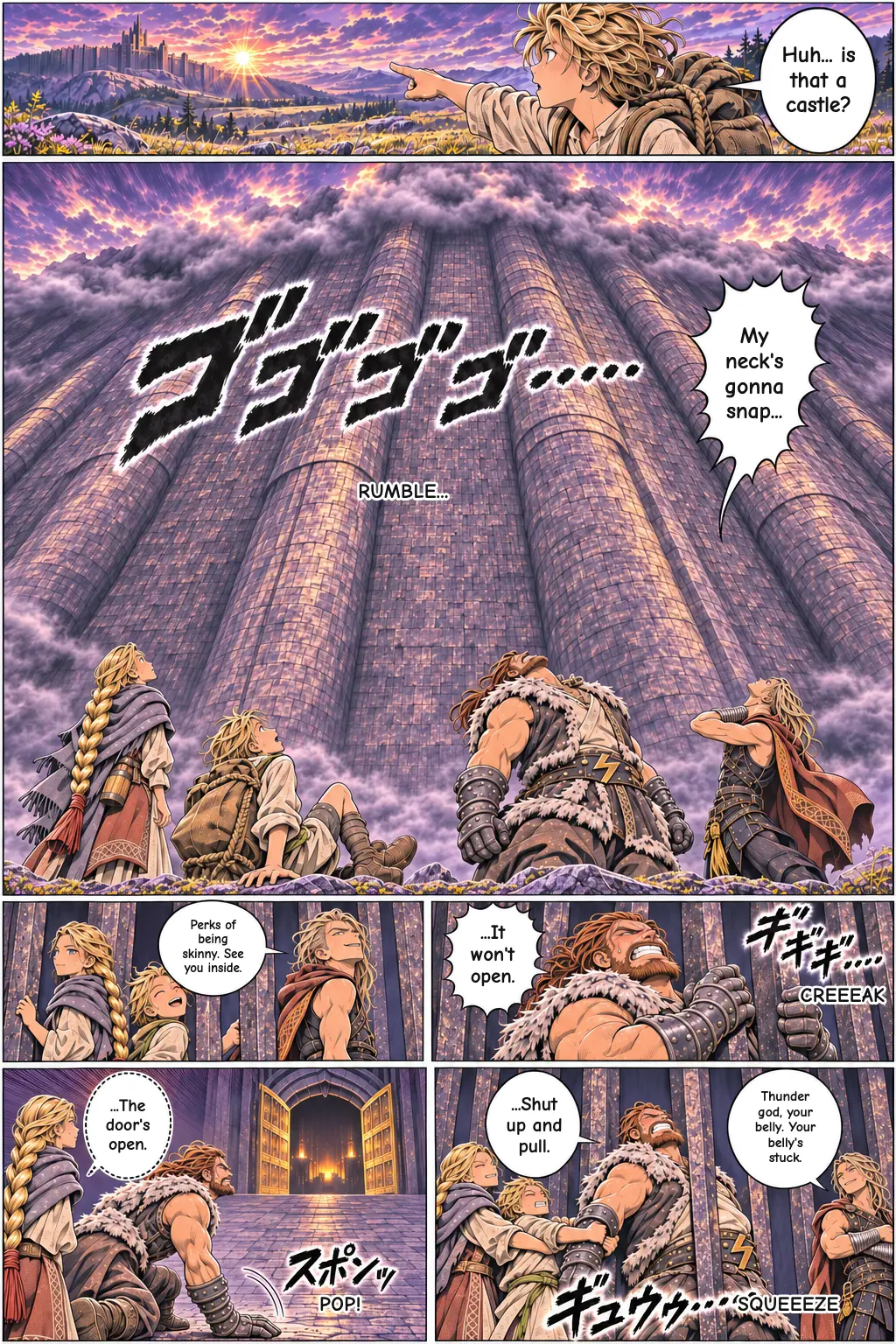
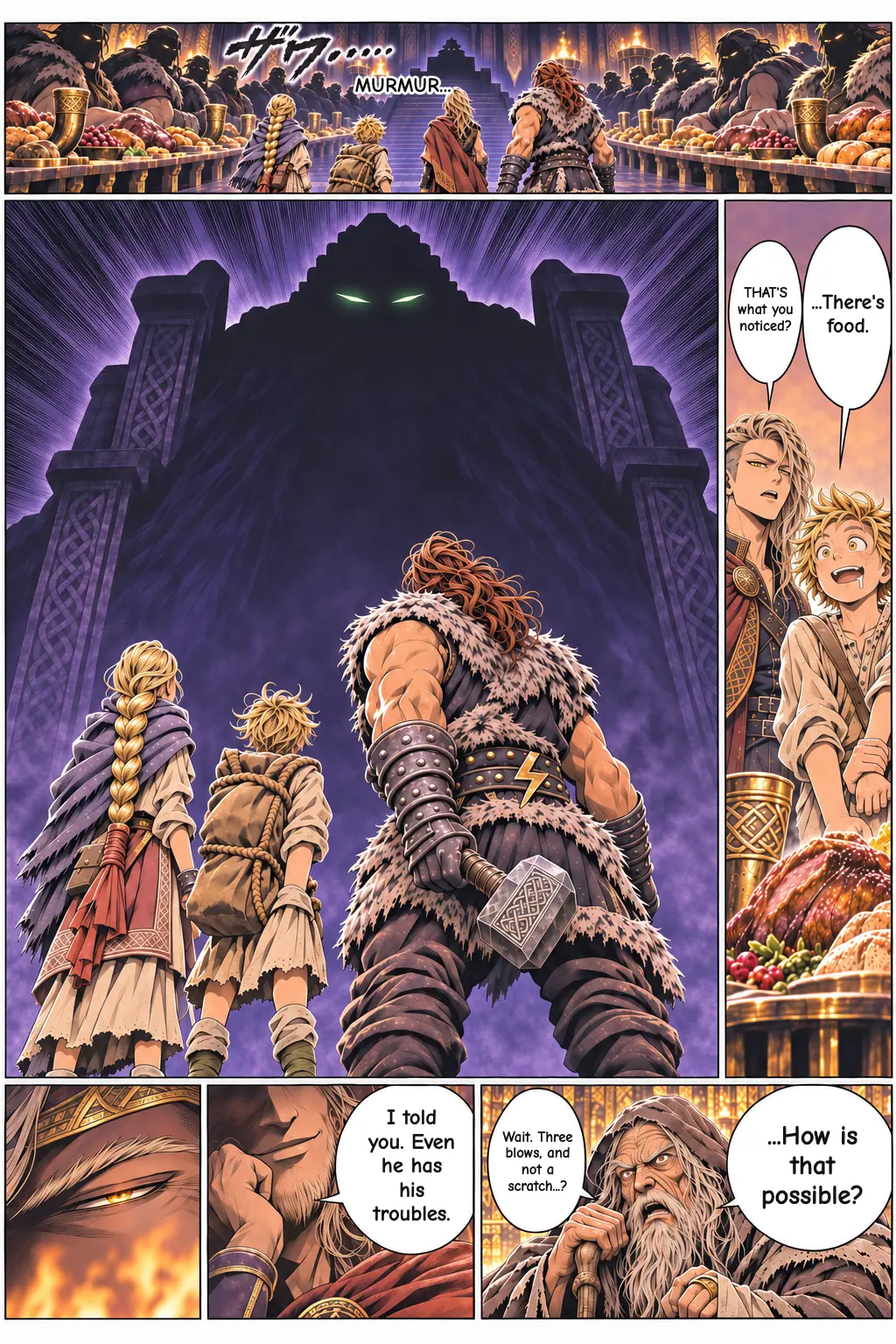
Skrymir joins them and carries all their food in one bag. That night, under an oak, Thor cannot loosen a single knot of the bag. In anger he strikes the sleeping giant's head. Skrymir wakes and asks whether a leaf fell on him. At midnight Thor strikes again, sinking the hammer deep, and the giant wonders about a falling acorn. Thor pretends he has only just woken. Near dawn, a third blow sinks to the handle into Skrymir's temple. The giant just rubs his cheek and blames a bird dropping twigs. He warns them not to boast at Utgard-Loki's court, then heads north. The travelers reach a castle so tall they must bend their heads back to see the top, and squeeze between the bars of its locked gate.
What the Story Says About Norse Culture
Thor was the protector of gods and humans, and many myths show him smashing giants. This tale is unusual because the strongest god looks helpless and a little foolish. Medieval audiences likely enjoyed the comedy of a hero meeting something bigger than himself, and the scene sets up a question: is Thor really losing, or is something strange going on? The answer comes later in the same story.
The goat episode also shows a world of strict rules and payment for harm. A guest-gift of food turns into a debt, and the debt is settled by service rather than violence. Some readers see the reborn goats as linked to old ideas about sacrifice and renewal, but that is an interpretation, not something Snorri states. Snorri also never explains why Thialfi broke the bone. In a related Eddic poem, Hymiskviða, a goat is lamed in a similar way and Loki is blamed.
What the Manga Changes
Snorri gives only a bare outline, so the manga fills in what the source leaves blank. The farm family's daily life, Thialfi's reasons for cracking the bone, Röskva's personality and dialogue, and the moment the children leave home are creative additions. In the original, Röskva has no lines at all, and the text does not say which sibling is older.
Loki is almost silent in this part of the source, so any comments he makes on the journey are new. The look of Thor, Skrymir, the forest, the sea crossing and the castle gate are also the manga's own designs. The goats' names, Tanngnjóstr and Tanngrisnir, come from an earlier chapter of Gylfaginning, not from this episode. The main events stay faithful to Snorri: the lamed goat, the children taken as servants, the glove-hall, the unopened food bag, and the three blows answered with a leaf, an acorn and twigs.
Where to Read It
If you want the original, look for a modern English translation of the Prose Edda. The translations by Anthony Faulkes and by Jesse Byock are widely available. Read the Thor and Utgarda-Loki chapters near the end of Gylfaginning.
If you would rather see the giant's glove and the three hammer blows in pictures first, Episode 9 of NORSE MYTHOLOGY: The King Who Heard the End of the Gods tells this part of the story as a manga. Every episode on Manga Portal is free to read, with no sign-up needed, and the next episode continues to Utgarda-Loki's hall.
Characters in this episode
Thor
The Norse thunder god with the hammer Mjölnir, who travels into giant country and meets a giant he cannot hurt.
Loki
The trickster god who travels with Thor but stays mostly silent in this part of the story.
Thialfi (Þjálfi)
The farmer's son who cracks a goat's thigh bone, becomes Thor's servant, and is the fastest runner among humans.
Röskva
The farmer's daughter who becomes Thor's servant along with Thialfi; the source tells almost nothing else about her.
Skrymir
A colossal giant whose glove is mistaken for a hall and who shrugs off Thor's three hammer blows.
The farmer
An unnamed man who hosts Thor for the night and gives up his two children to make amends for the lame goat.
FAQ
Who is Skrymir in Norse mythology?
Skrymir is a gigantic giant Thor meets in the forests of Jötunheim on his way to Utgard. His glove is so large that Thor's group spends the night inside it, thinking it is a hall. Later in the same story it is revealed that Skrymir was Utgarda-Loki in disguise.
Why did Thor's goat limp?
Thor brought his goats back to life by hallowing their skins and bones with his hammer. The farmer's son Thialfi had split one thigh bone to eat the marrow, so that goat came back lame. Snorri does not say why Thialfi did it.
Who are Thialfi and Röskva?
They are the son and daughter of the farmer who hosted Thor. To make up for the lamed goat, Thor took them as his servants, and they followed him from then on.
Why couldn't Thor hurt Skrymir with his hammer?
In this part of the story the reason is kept secret, and Skrymir simply acts as if a leaf, an acorn and some twigs fell on him. The explanation comes at the end of the Utgarda-Loki tale in Gylfaginning, where it turns out that magic and illusion were involved.
Where does the story of Thor and Utgarda-Loki come from?
It comes from Gylfaginning, the first part of the Prose Edda, written by Snorri Sturluson in Iceland in the early 13th century. The story is told as one of High's answers to the questions of the disguised King Gylfi.