EnglishChoose language

Episode 7Gone Seven Years. Her Lamp Still Burned.Tales of Moonlight and Rain: \"The House Amid the Thickets\"

19 pagesFree · No sign-up

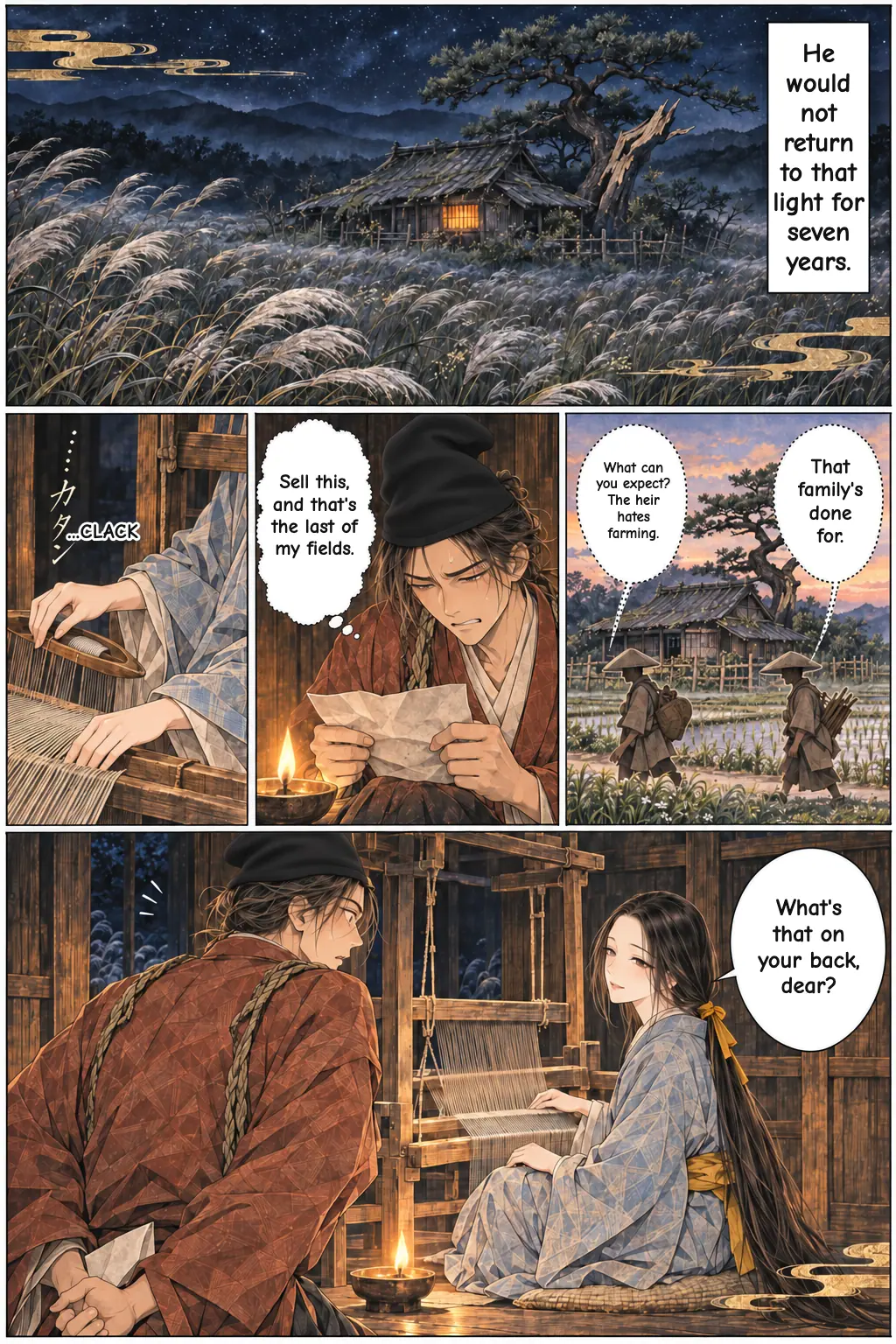
Page 1: He would not return to that light for seven years. That family's done for.
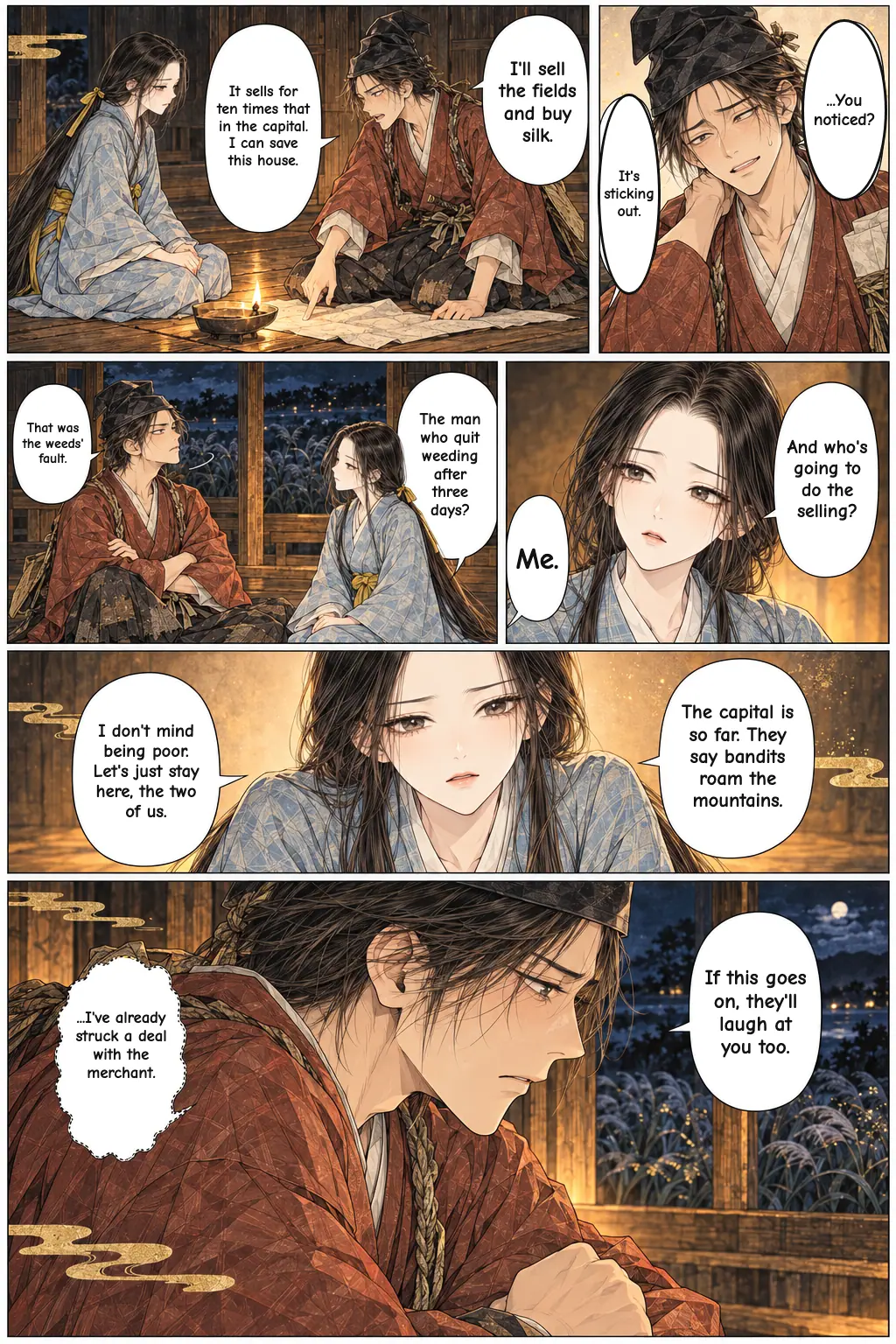
Page 2: ...You noticed? It's sticking out.
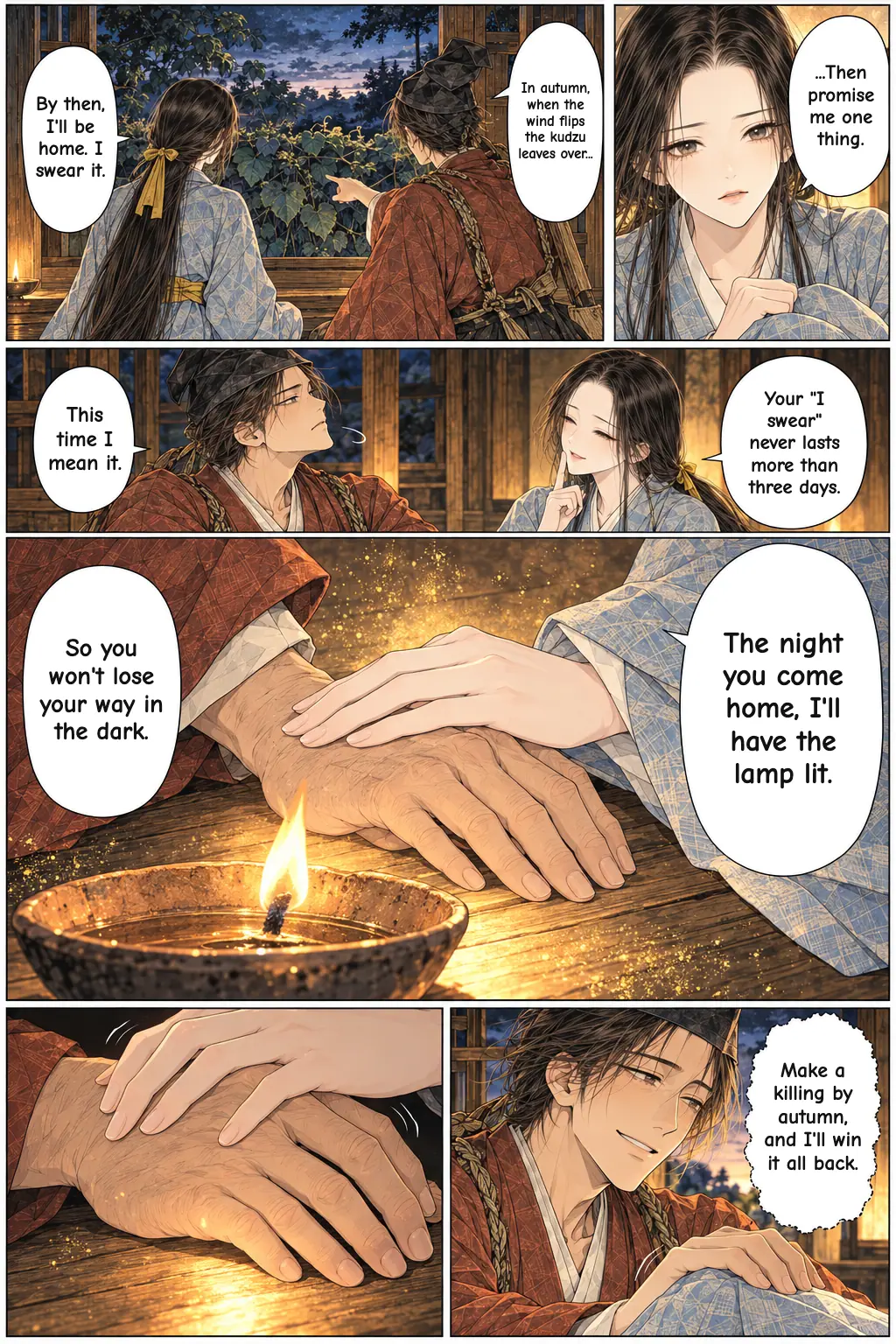
Page 3: ...Then promise me one thing. In autumn, when the wind flips the kudzu leaves over...
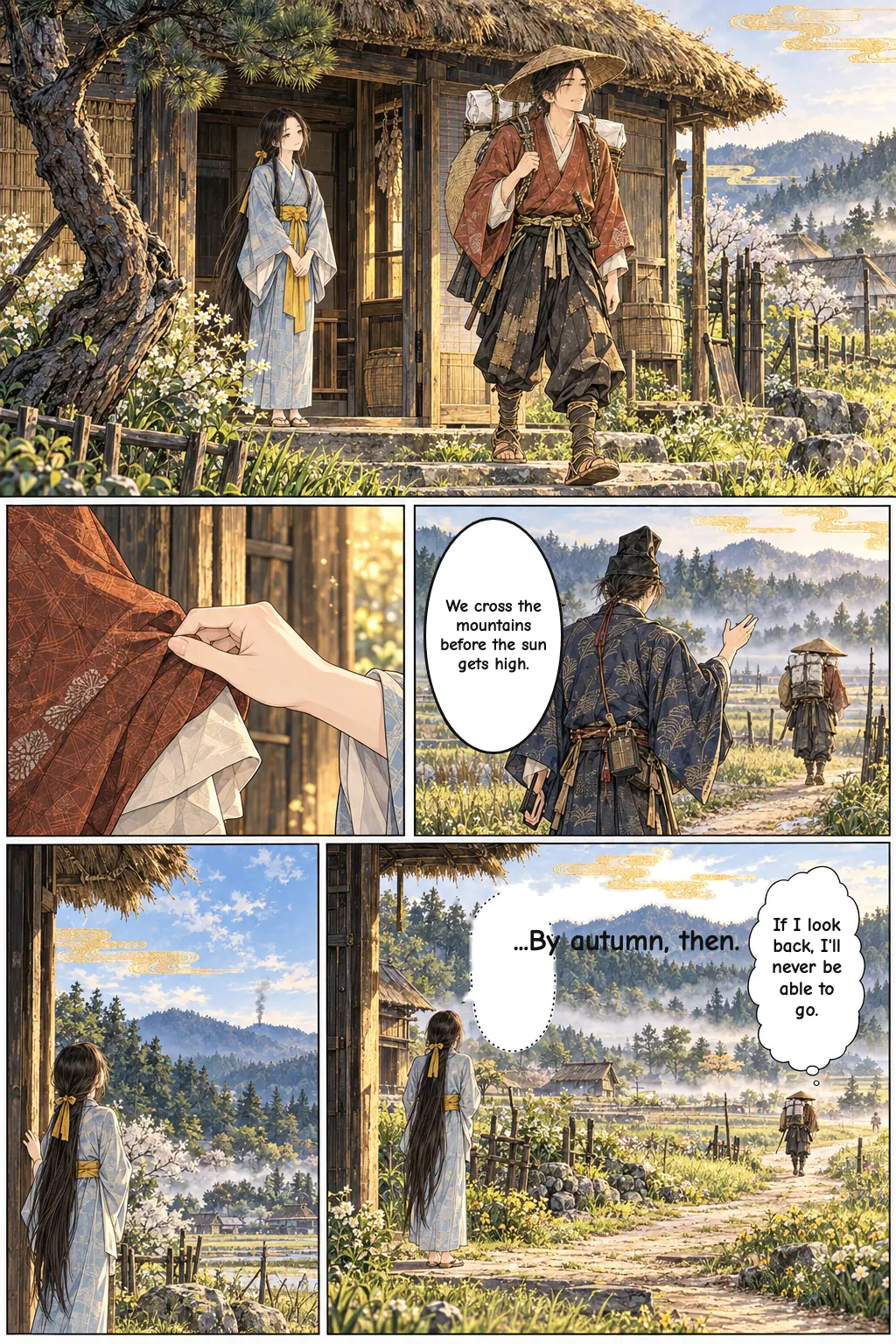
Page 4: We cross the mountains before the sun gets high. If I look back, I'll never be able to go.
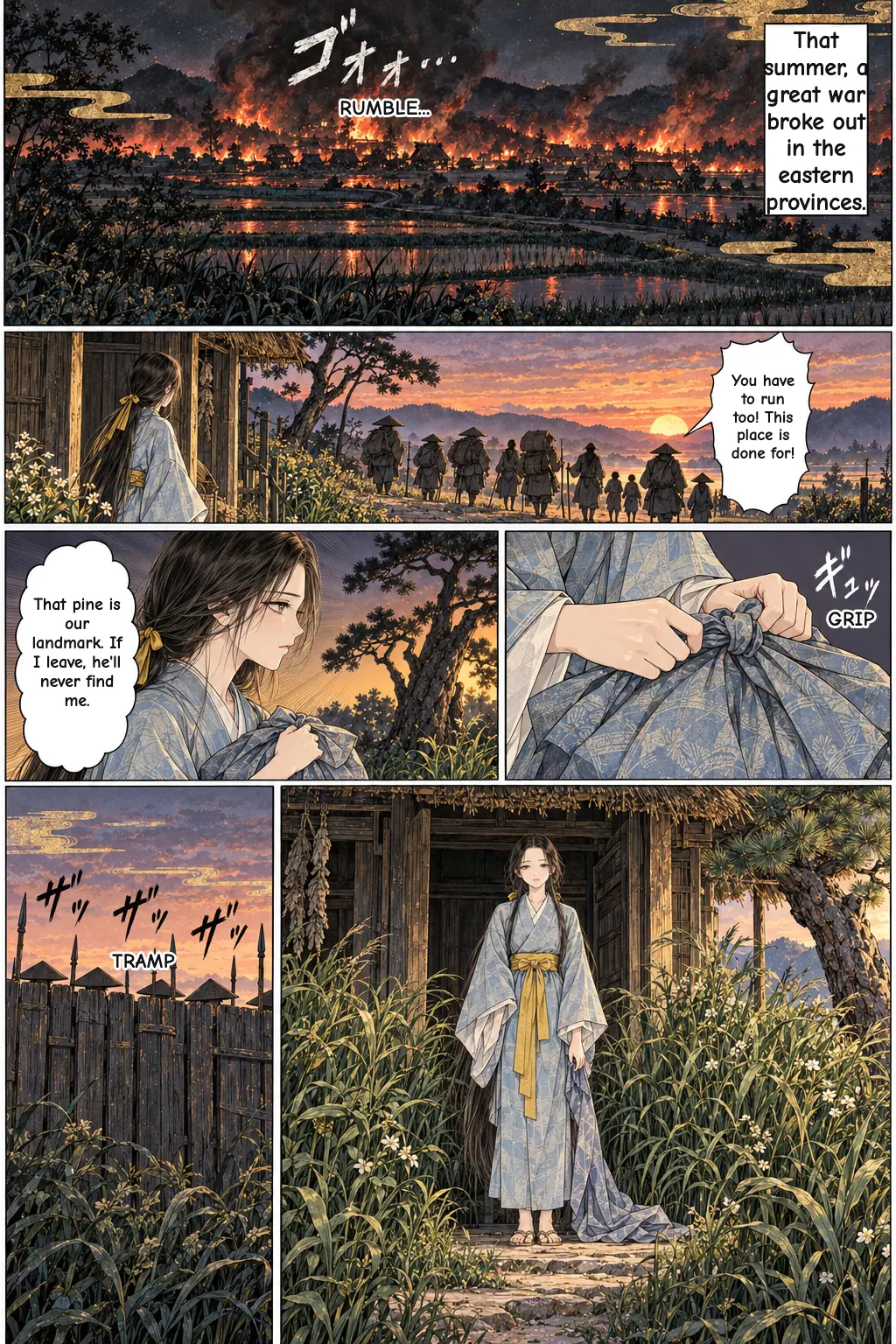
Page 5: That summer, a great war broke out in the eastern provinces. You have to run too! This place is done for!
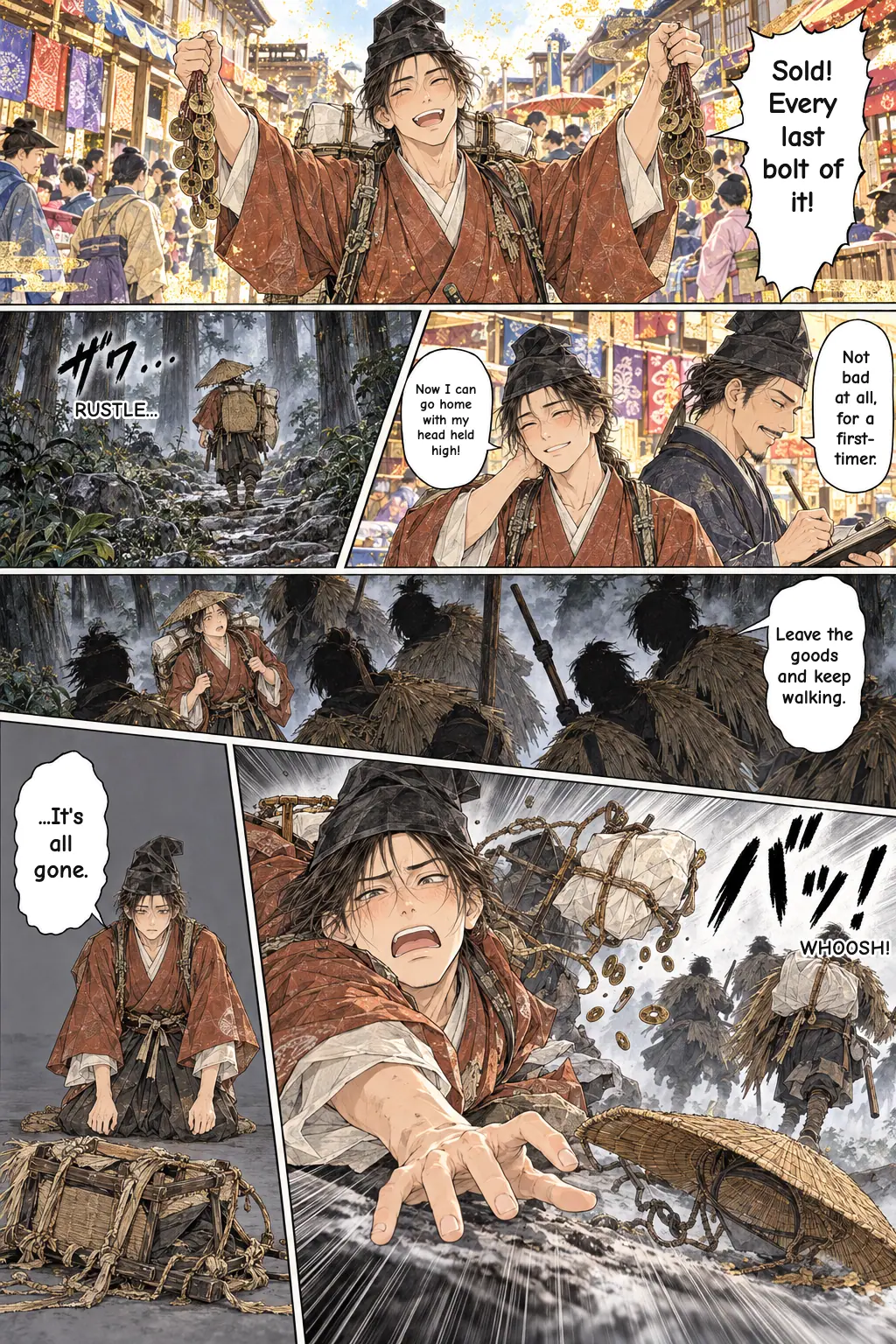
Page 6: Sold! Every last bolt of it! Not bad at all, for a first-timer.
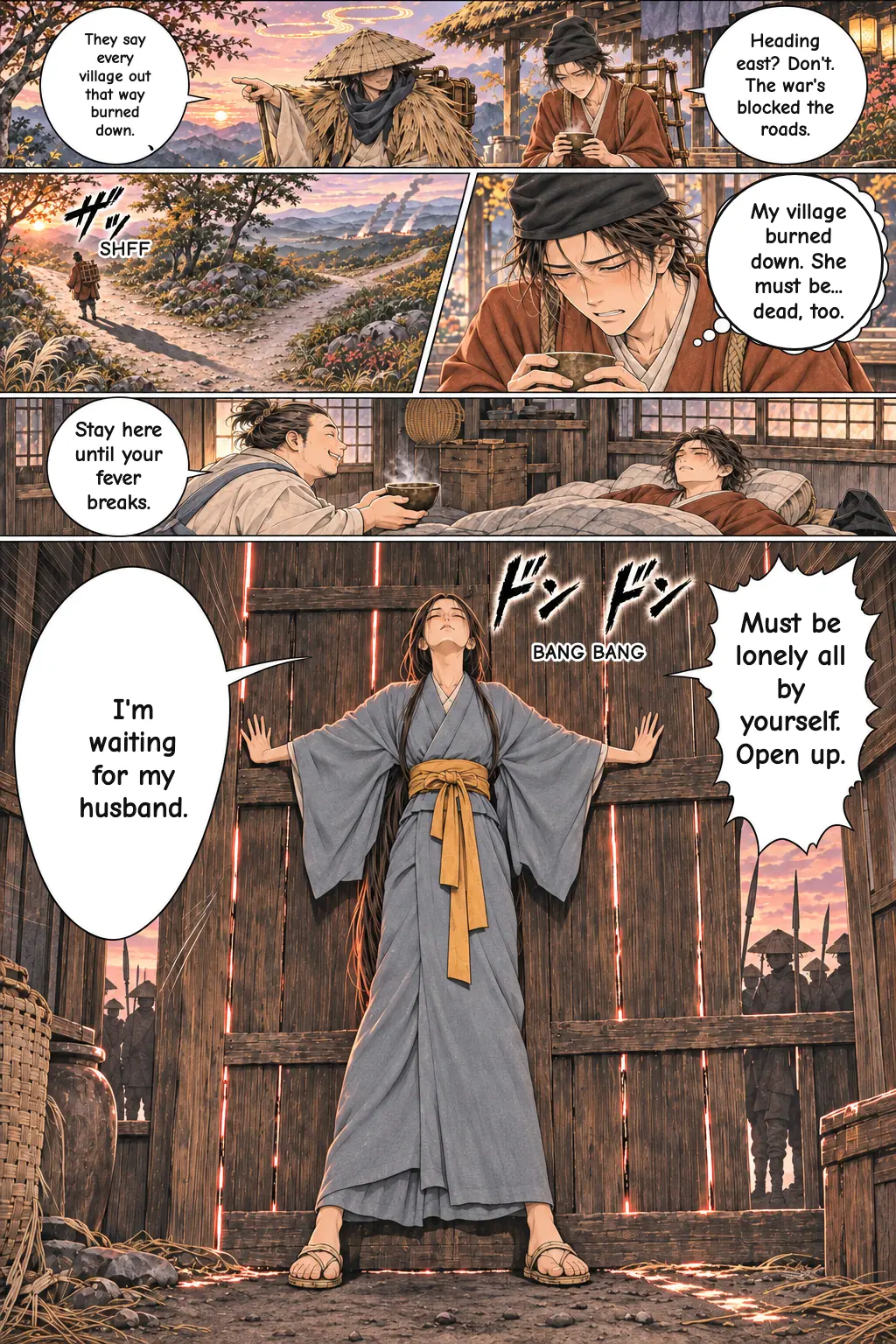
Page 7: Heading east? Don't. The war's blocked the roads. They say every village out that way burned down.
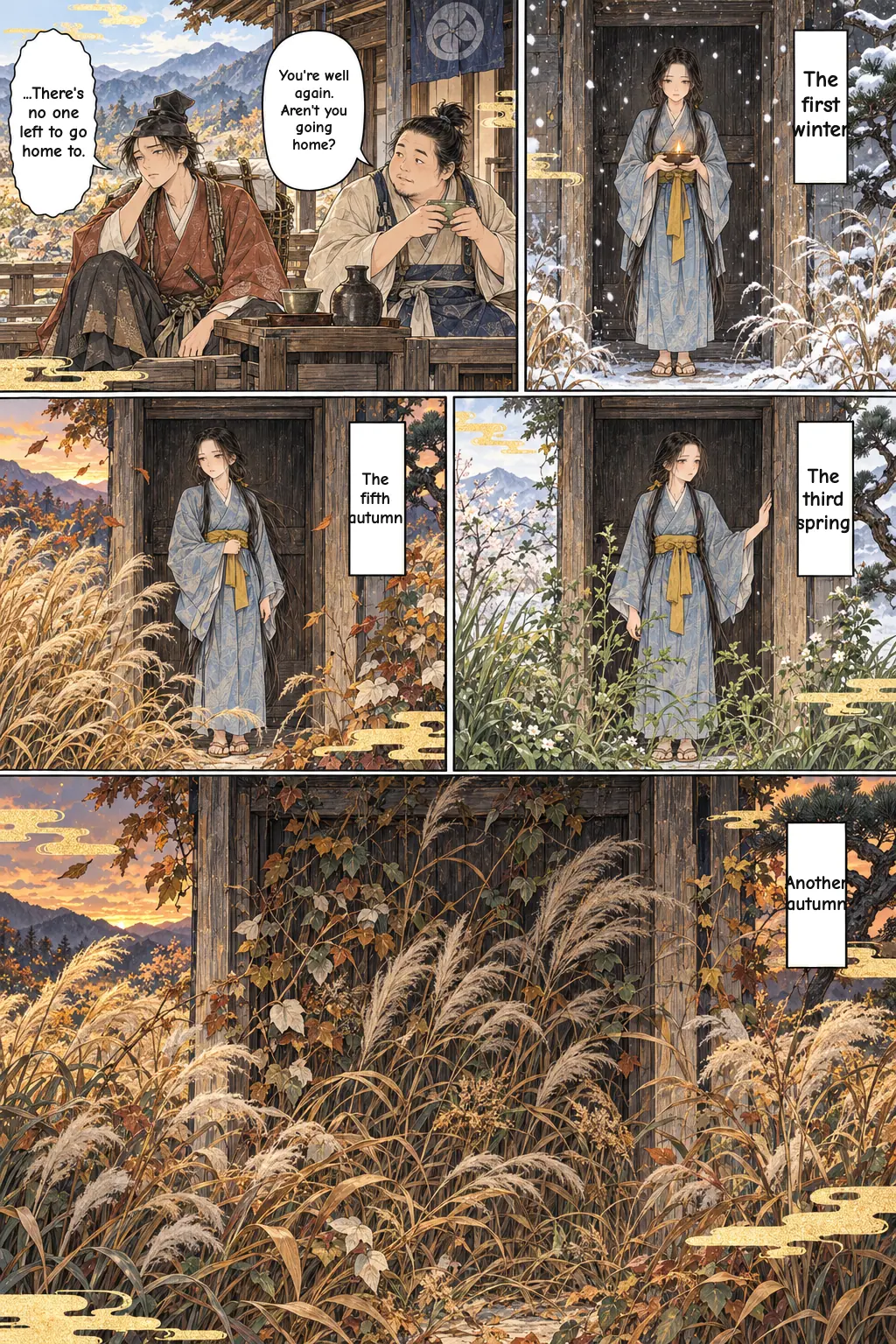
Page 8: The first winter You're well again. Aren't you going home?
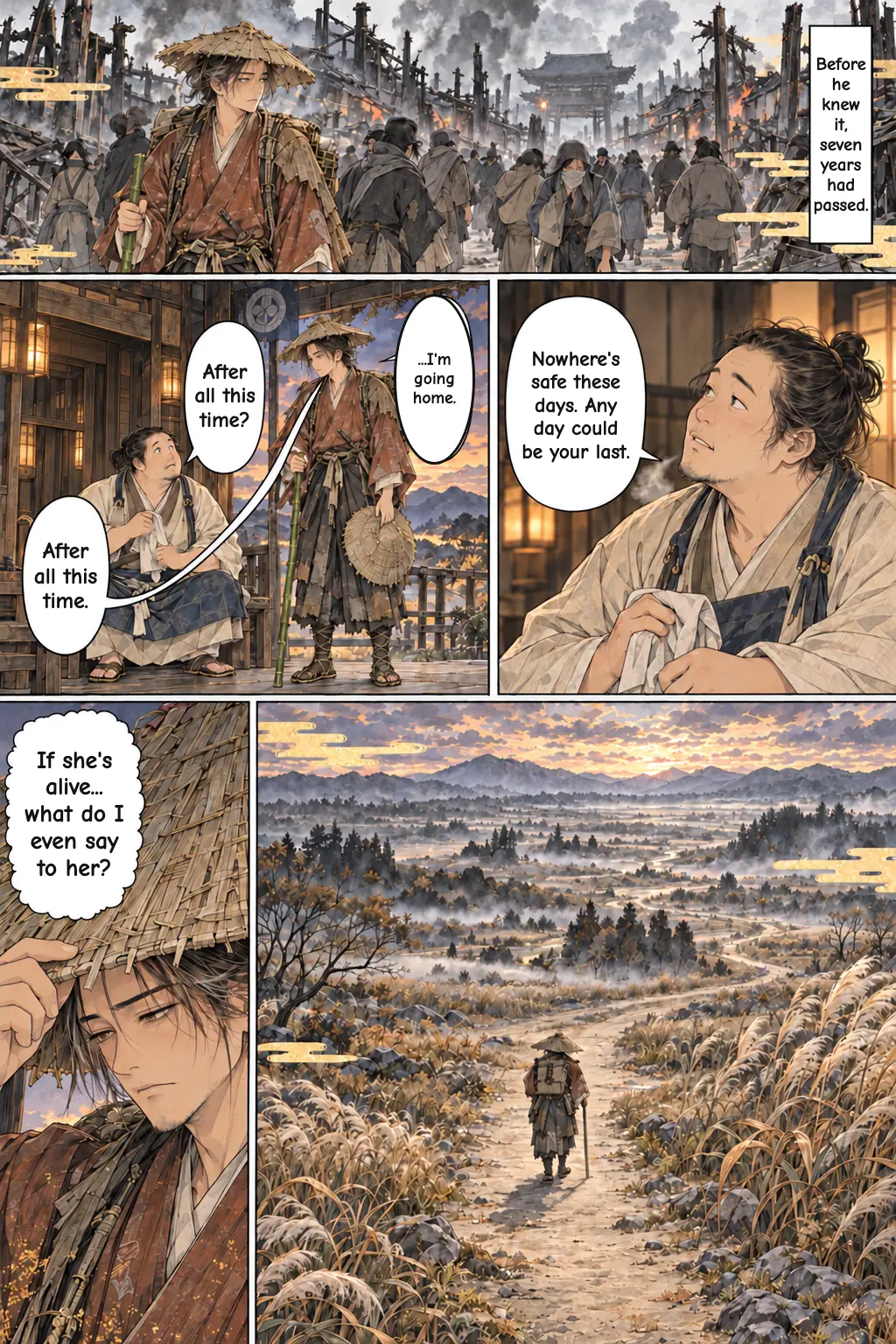
Page 9: Before he knew it, seven years had passed. Nowhere's safe these days. Any day could be your last.
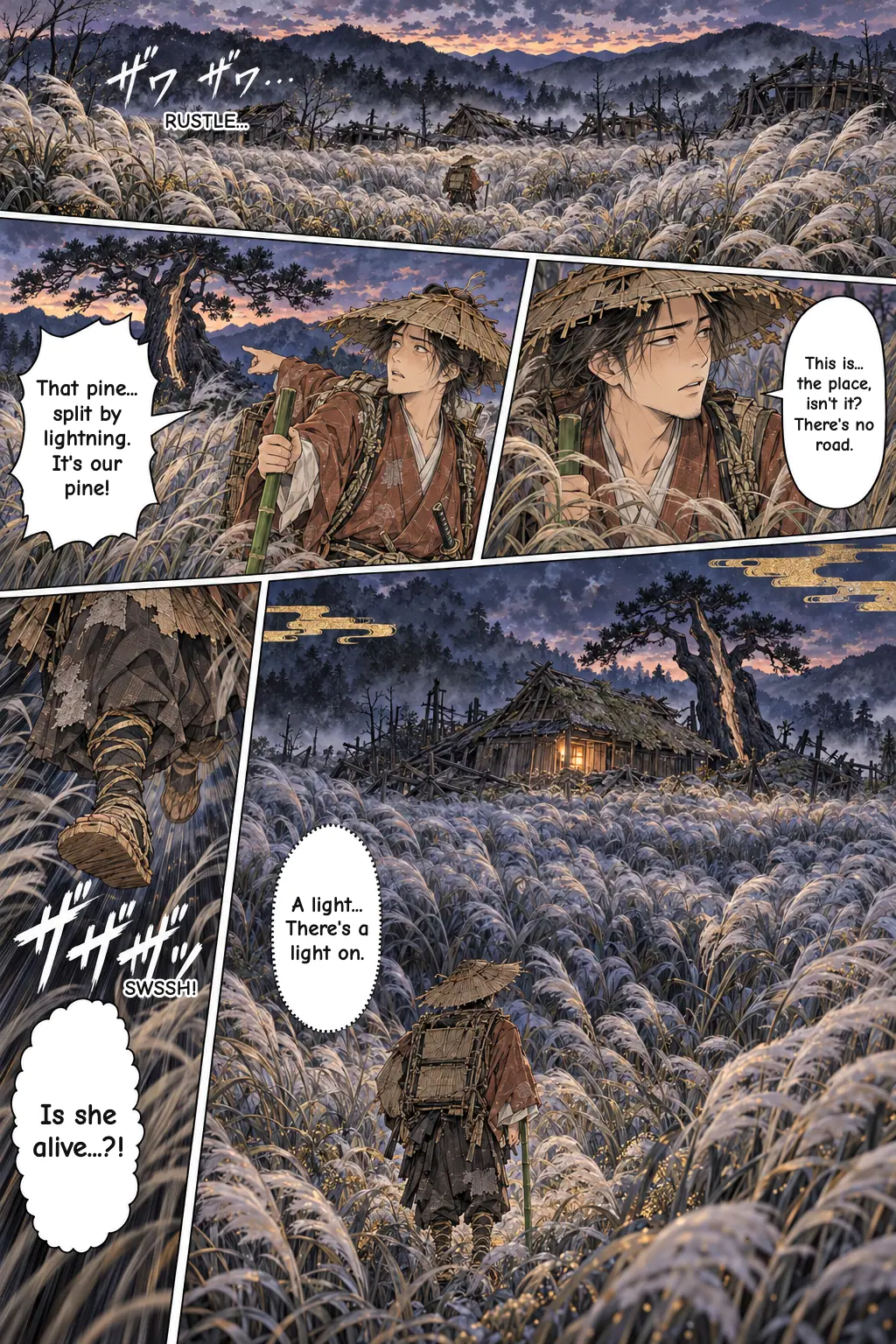
Page 10: This is... the place, isn't it? There's no road. That pine... split by lightning. It's our pine!
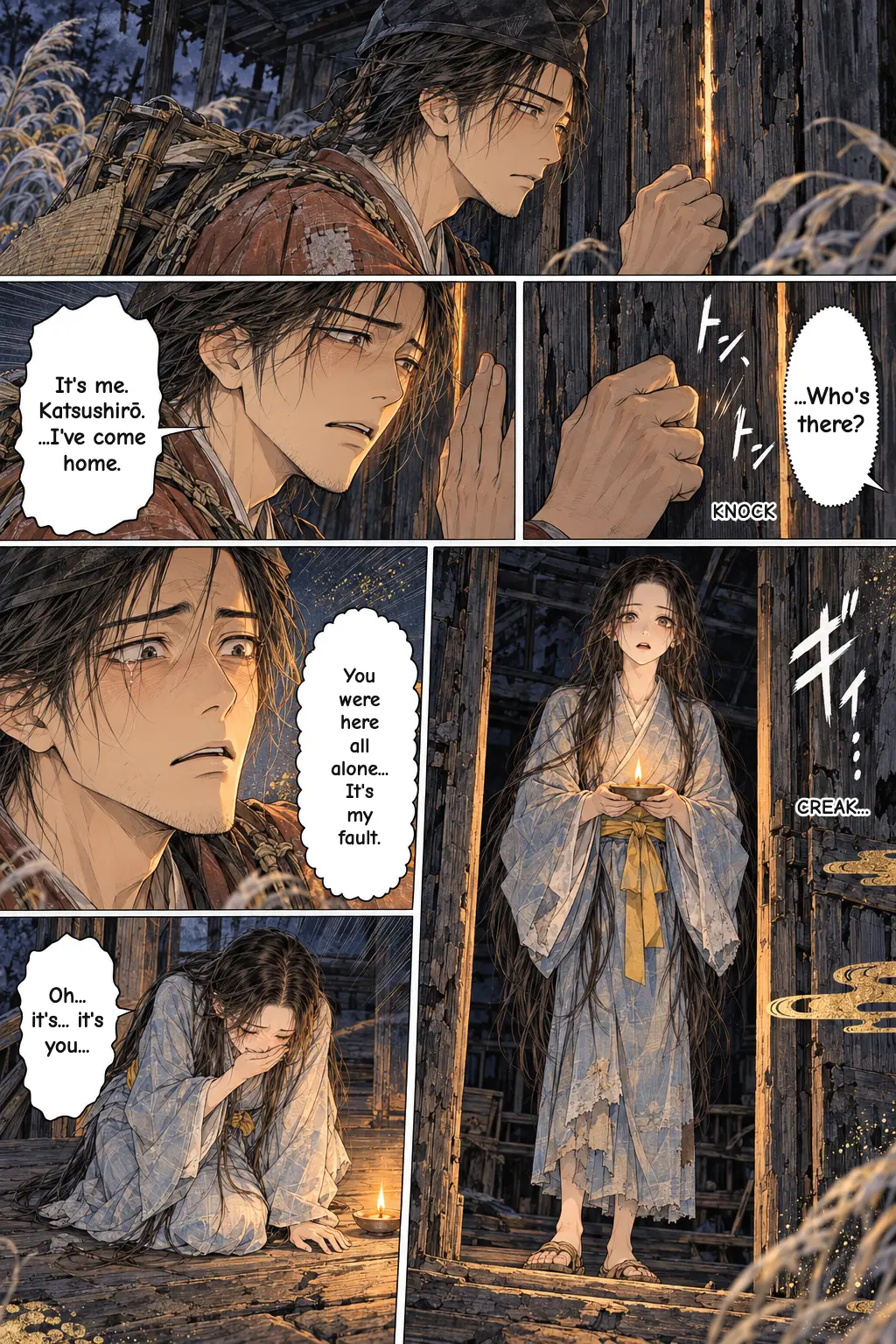
Page 11: ...Who's there? It's me. Katsushirō. ...I've come home.
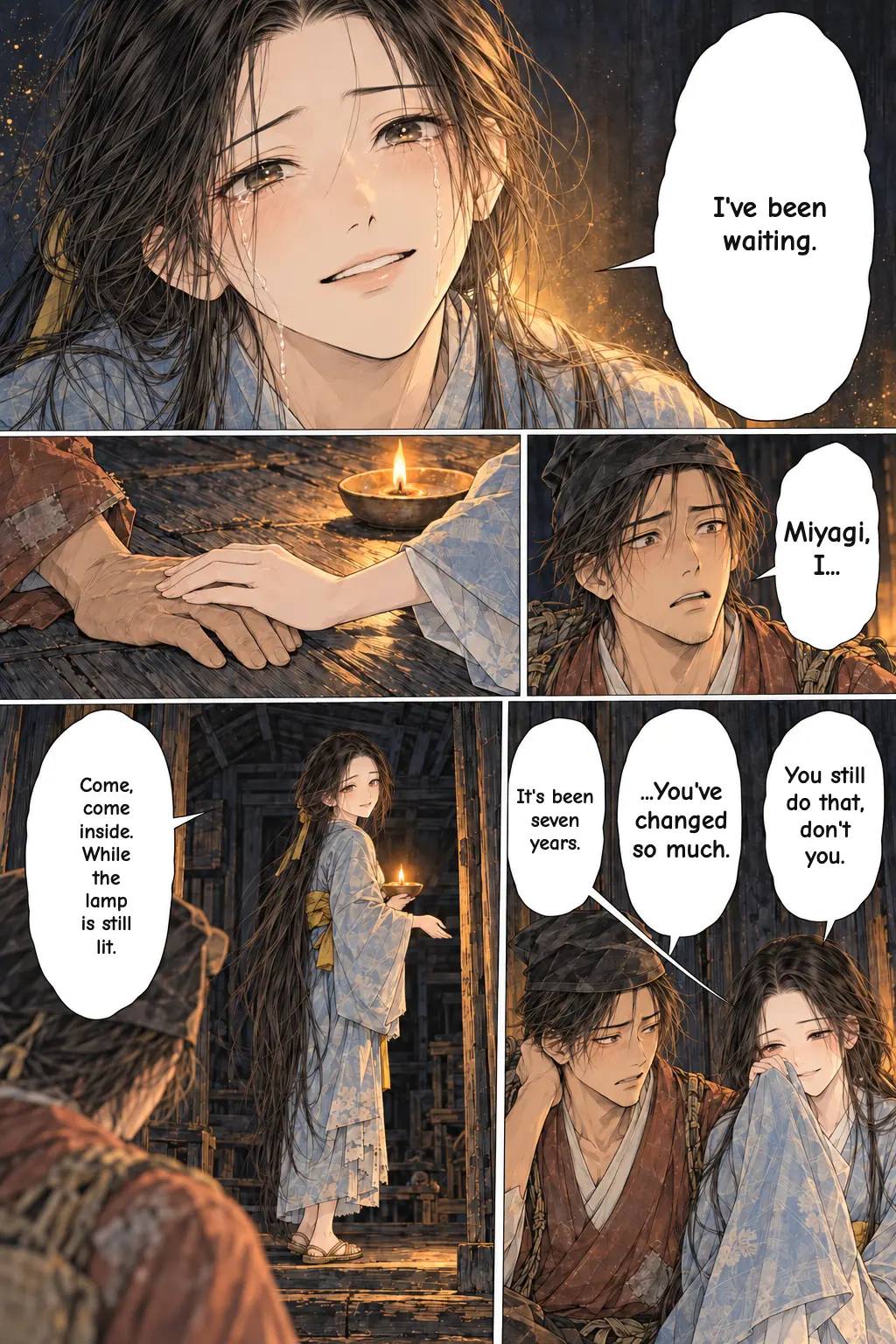
Page 12: I've been waiting. Miyagi, I...
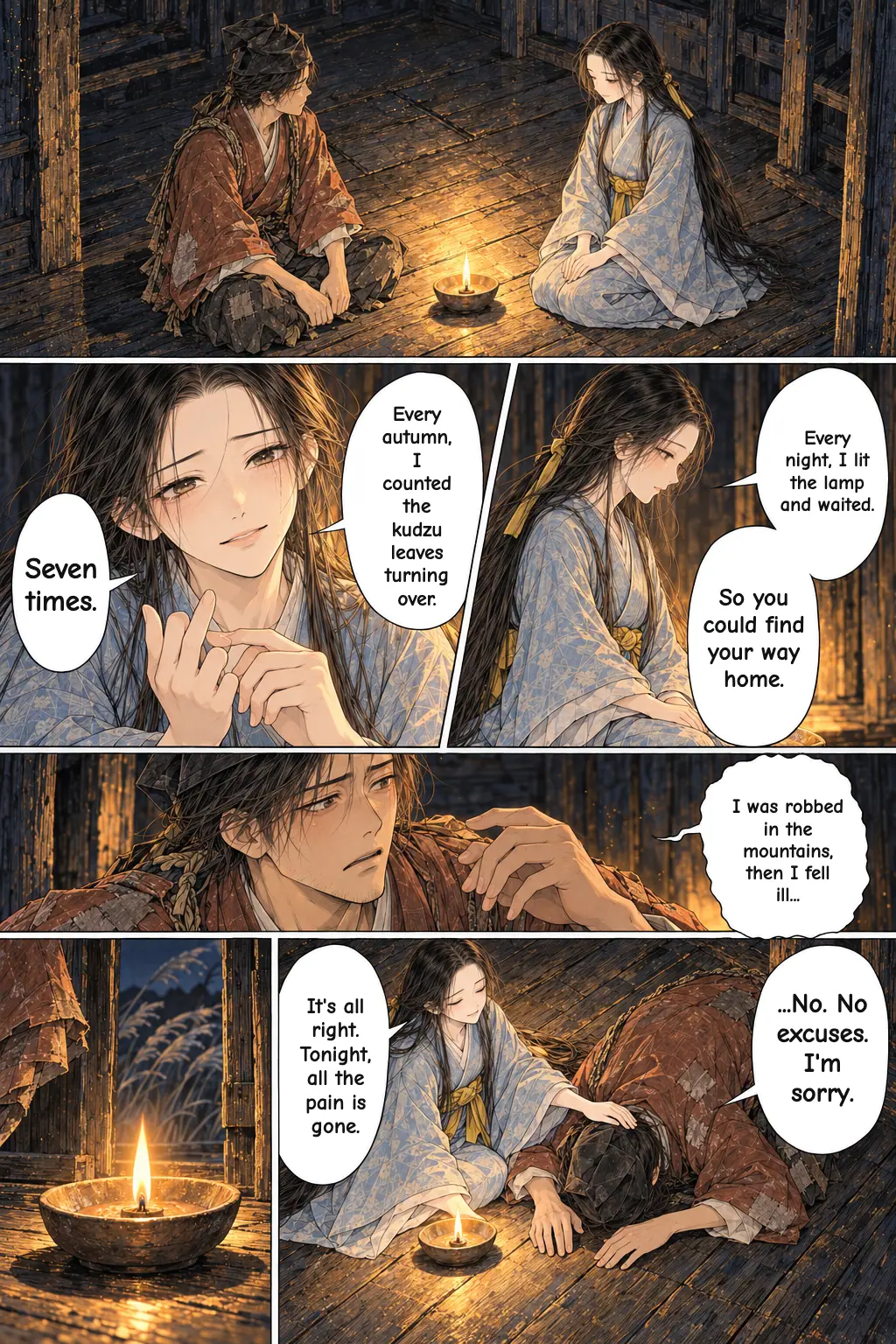
Page 13: Every night, I lit the lamp and waited. So you could find your way home.
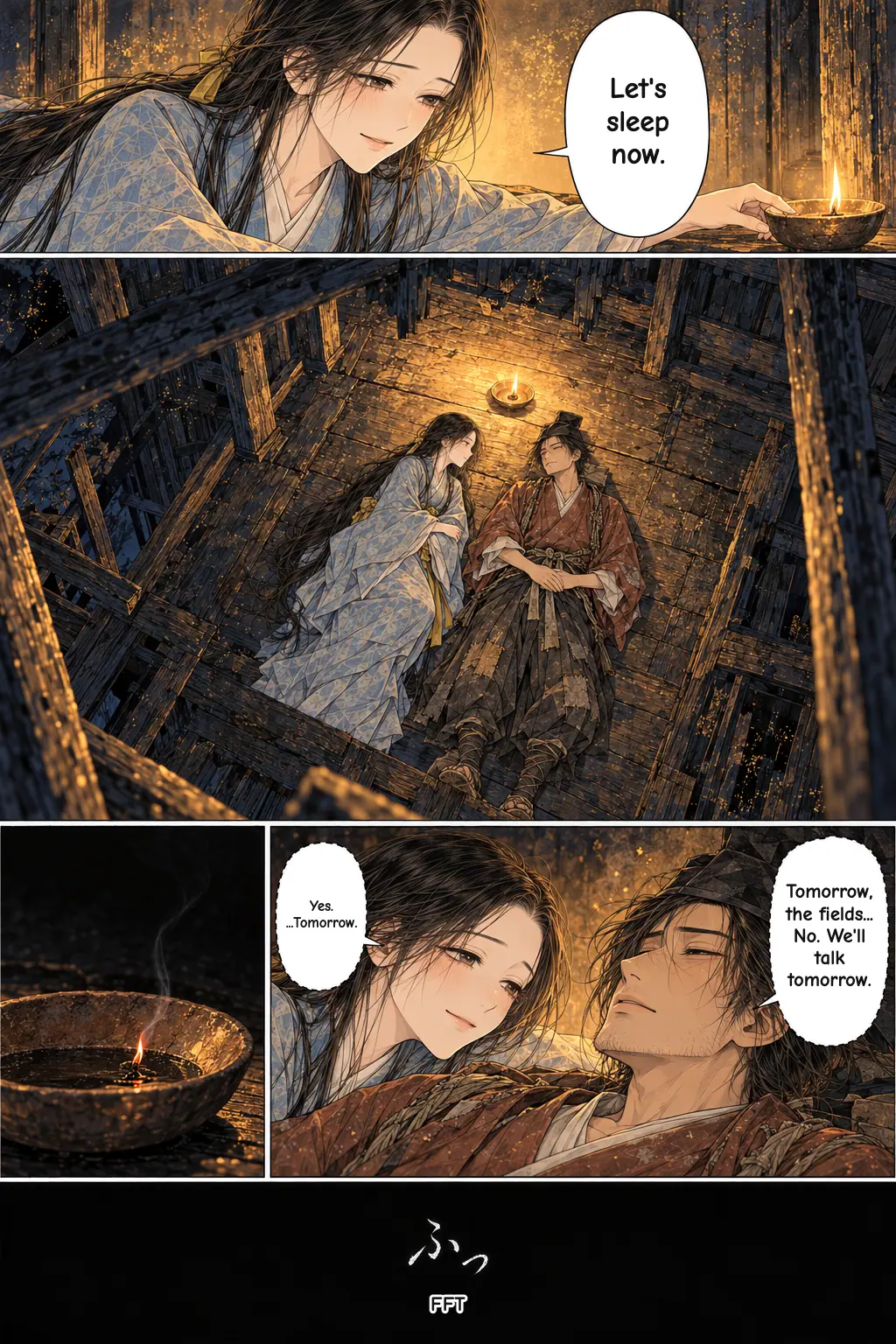
Page 14: Let's sleep now. Tomorrow, the fields... No. We'll talk tomorrow.
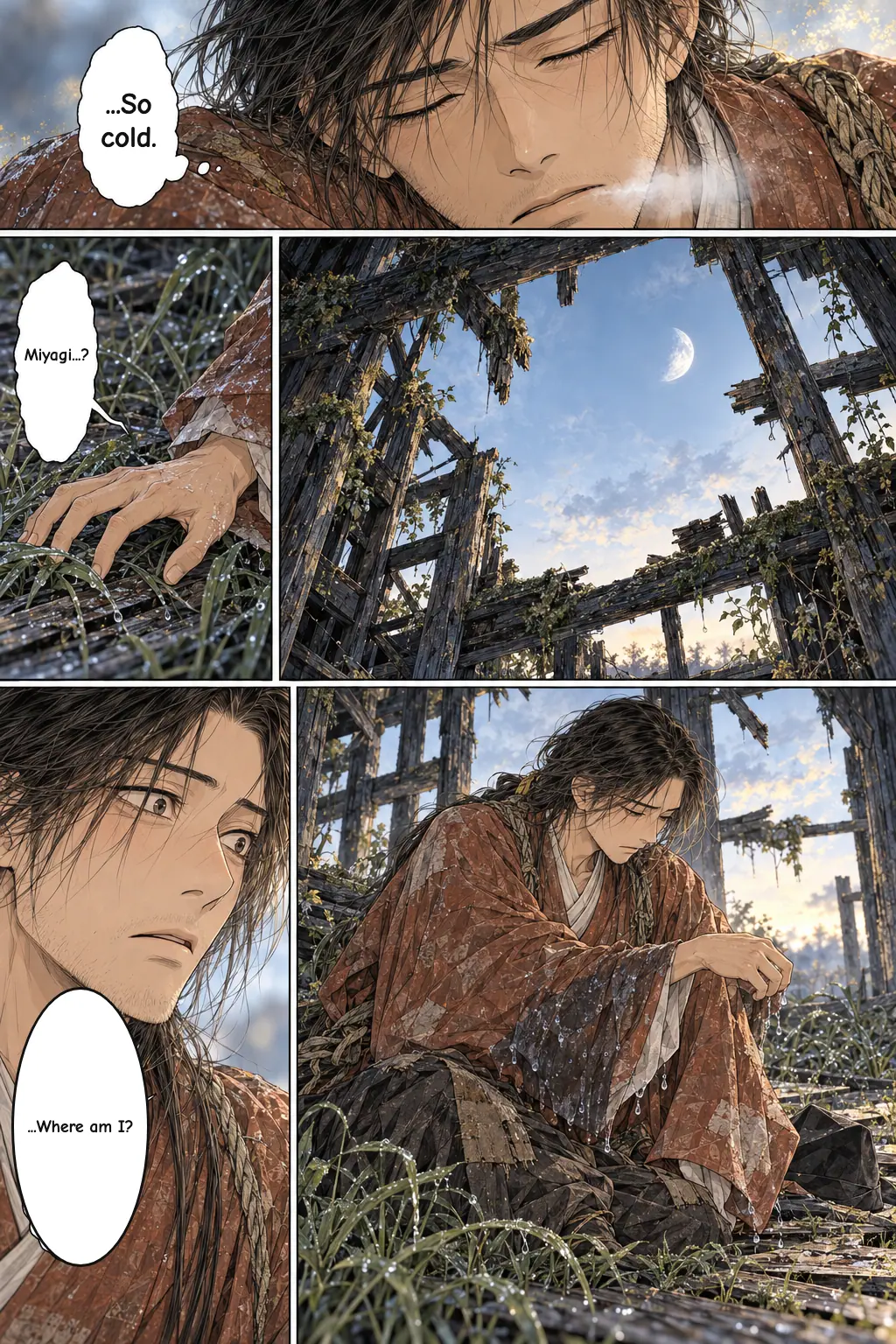
Page 15: ...So cold. Miyagi...?
16 / 19
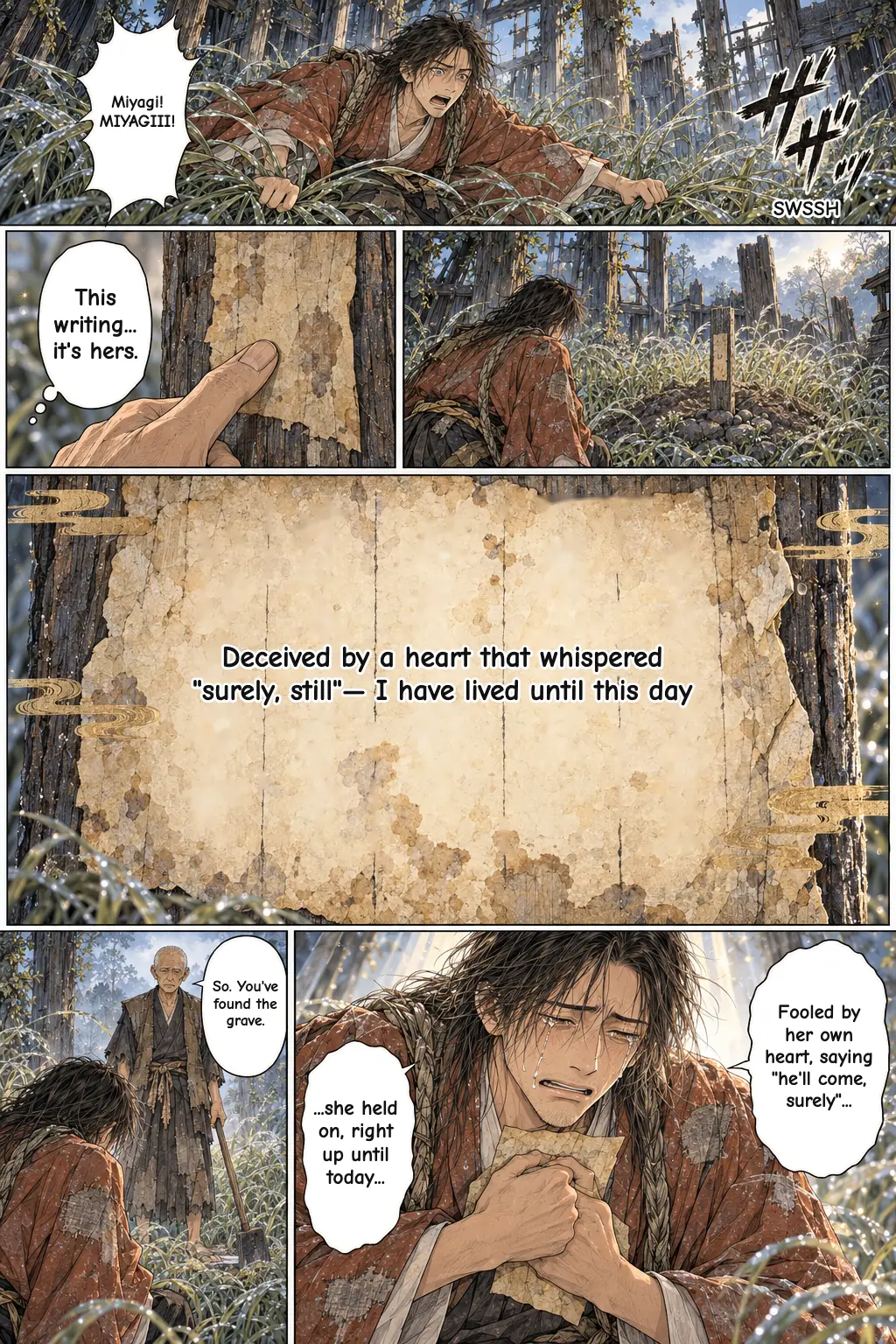
Page 17: Miyagi! MIYAGIII! This writing... it's hers.
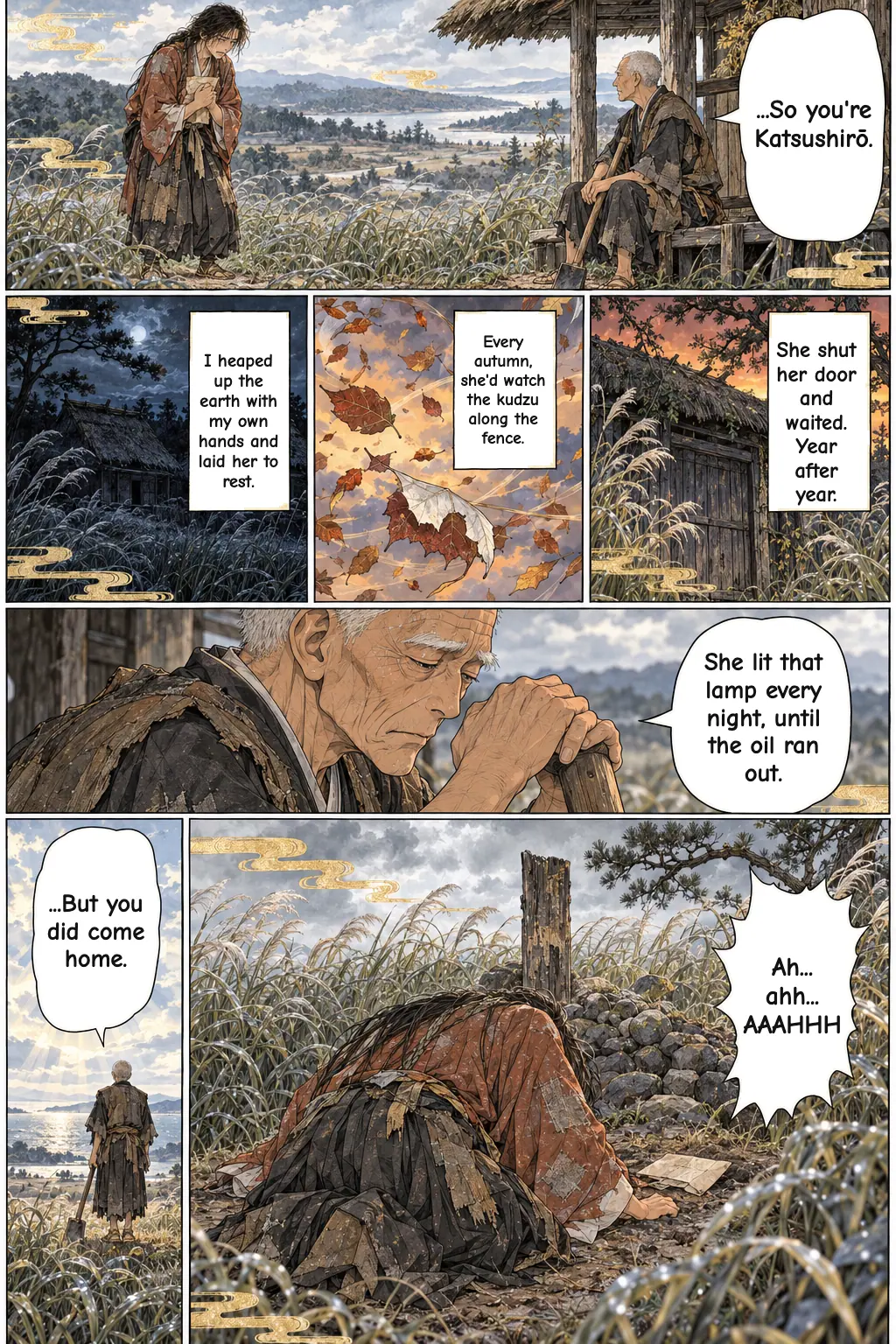
Page 18: ...So you're Katsushirō. She shut her door and waited. Year after year.
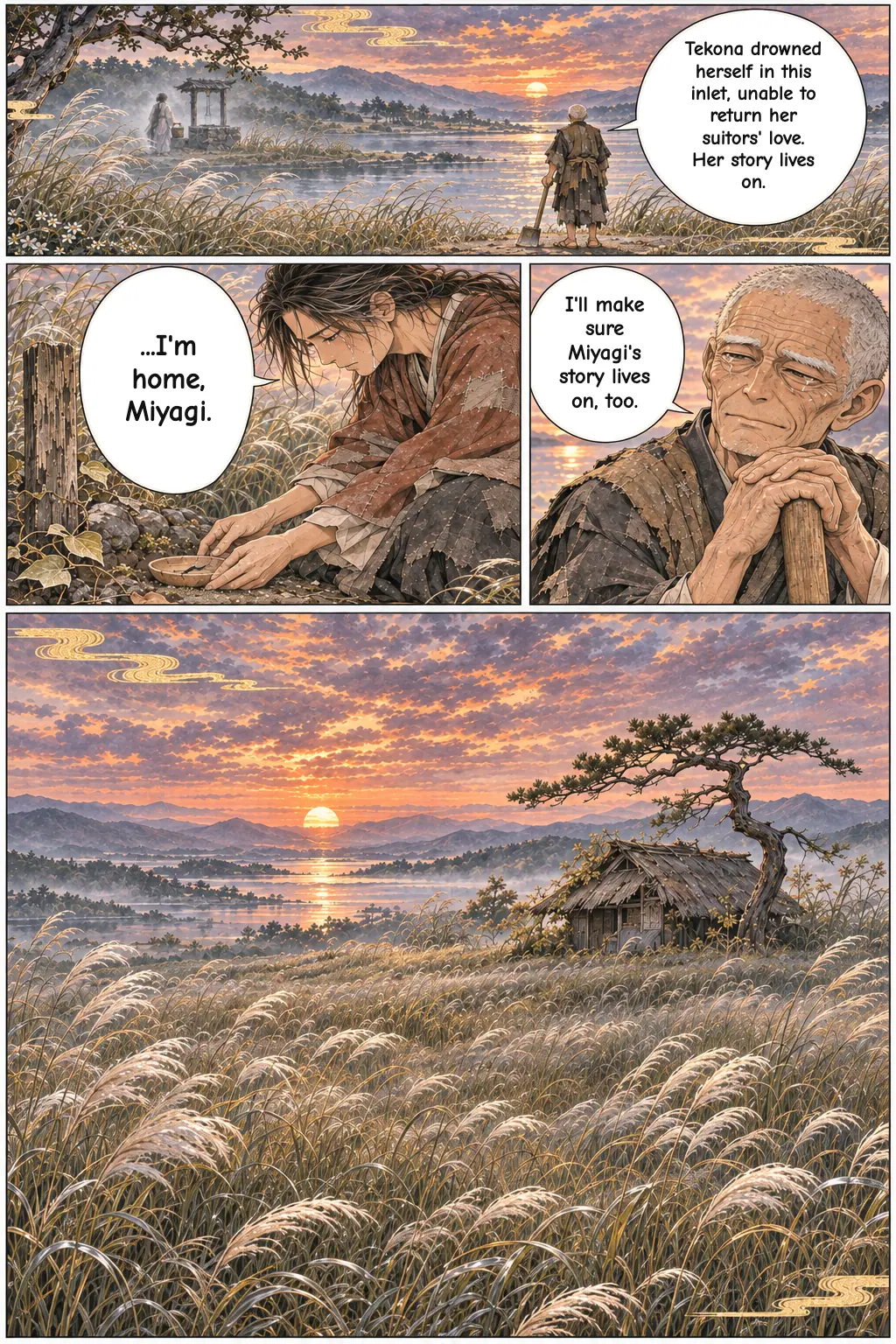
Page 19: Tekona drowned herself in this inlet, unable to return her suitors' love. Her story lives on. I'll make sure Miyagi's s…

Thanks for reading!

Keep readingEpisode 8One Night, She Was Suddenly Out of ReachThe Tales of Ise: "Is This Not the Moon?"Read Episode 8

Bookmark the series page so you can jump back in when the next episode is out: LOVE & ALLURERSS for this series

Get new episodes in your feed. Follow us on:ThreadsBluesky

Story summary

A man leaves his wife, swearing he'll be home by autumn, and sets off for the capital to sell silk. One reason not to return piles on another until seven years have gone by. When he finally reaches his village, it's buried in grass, and only his house has a light in the window.

SourceLove & Allure: Classic Japanese Tales of Romance — Japan · Heian period (10th–12th century: Ise Monogatari, The Tale of Genji, Izumi Shikibu Diary, Konjaku Monogatari-shū) and Edo period (1776: Ugetsu Monogatari). Printed editions used: 1610–1930

Also available in:日本語简体中文繁體中文한국어EspañolFrançais

Episode script

Page 1

He would not return to that light for seven years.

The Villagers of Mama: That family's done for.

The Villagers of Mama: What can you expect? The heir hates farming.

Katsushirō: Sell this, and that's the last of my fields.

Miyagi: What's that on your back, dear?

Page 2

Katsushirō: ...You noticed?

Miyagi: It's sticking out.

Katsushirō: I'll sell the fields and buy silk.

Katsushirō: It sells for ten times that in the capital. I can save this house.

Miyagi: And who's going to do the selling?

Katsushirō: Me.

Miyagi: The man who quit weeding after three days?

Katsushirō: That was the weeds' fault.

Miyagi: The capital is so far. They say bandits roam the mountains.

Miyagi: I don't mind being poor. Let's just stay here, the two of us.

Katsushirō: If this goes on, they'll laugh at you too.

Katsushirō: ...I've already struck a deal with the merchant.

Page 3

Miyagi: ...Then promise me one thing.

Katsushirō: In autumn, when the wind flips the kudzu leaves over...

Katsushirō: By then, I'll be home. I swear it.

Miyagi: Your "I swear" never lasts more than three days.

Katsushirō: This time I mean it.

Miyagi: The night you come home, I'll have the lamp lit.

Miyagi: So you won't lose your way in the dark.

Katsushirō: Make a killing by autumn, and I'll win it all back.

Page 4

Sasabe no Sōji (the Kyoto Merchant): We cross the mountains before the sun gets high.

Katsushirō: If I look back, I'll never be able to go.

Miyagi: ...By autumn, then.

Page 5

That summer, a great war broke out in the eastern provinces.

The Villagers of Mama: You have to run too! This place is done for!

Miyagi: That pine is our landmark. If I leave, he'll never find me.

Page 6

Katsushirō: Sold! Every last bolt of it!

Sasabe no Sōji (the Kyoto Merchant): Not bad at all, for a first-timer.

Katsushirō: Now I can go home with my head held high!

The Bandits: Leave the goods and keep walking.

Katsushirō: ...It's all gone.

Page 7

Traveler on the Pass: Heading east? Don't. The war's blocked the roads.

Traveler on the Pass: They say every village out that way burned down.

Katsushirō: My village burned down. She must be... dead, too.

The Innkeeper of Ōmi: Stay here until your fever breaks.

Suitors and Soldiers of the War: Must be lonely all by yourself. Open up.

Miyagi: I'm waiting for my husband.

Page 8

The first winter

The Innkeeper of Ōmi: You're well again. Aren't you going home?

Katsushirō: ...There's no one left to go home to.

The third spring

The fifth autumn

Another autumn

Page 9

Before he knew it, seven years had passed.

The Innkeeper of Ōmi: Nowhere's safe these days. Any day could be your last.

Katsushirō: ...I'm going home.

The Innkeeper of Ōmi: After all this time?

Katsushirō: After all this time.

Katsushirō: If she's alive... what do I even say to her?

Page 10

Katsushirō: This is... the place, isn't it? There's no road.

Katsushirō: That pine... split by lightning. It's our pine!

Katsushirō: A light... There's a light on.

Katsushirō: Is she alive...?!

Page 11

Miyagi: ...Who's there?

Katsushirō: It's me. Katsushirō. ...I've come home.

Katsushirō: You were here all alone... It's my fault.

Miyagi: Oh... it's... it's you...

Page 12

Miyagi: I've been waiting.

Katsushirō: Miyagi, I...

Miyagi: You still do that, don't you.

Katsushirō: ...You've changed so much.

Miyagi: It's been seven years.

Miyagi: Come, come inside. While the lamp is still lit.

Page 13

Miyagi: Every night, I lit the lamp and waited.

Miyagi: So you could find your way home.

Miyagi: Every autumn, I counted the kudzu leaves turning over.

Miyagi: Seven times.

Katsushirō: I was robbed in the mountains, then I fell ill...

Katsushirō: ...No. No excuses. I'm sorry.

Miyagi: It's all right. Tonight, all the pain is gone.

Page 14

Miyagi: Let's sleep now.

Katsushirō: Tomorrow, the fields... No. We'll talk tomorrow.

Miyagi: Yes. ...Tomorrow.

Page 15

Katsushirō: ...So cold.

Katsushirō: Miyagi...?

Katsushirō: ...Where am I?

Page 16

Page 17

Katsushirō: Miyagi! MIYAGIII!

Katsushirō: This writing... it's hers.

Deceived by a heart that whispered "surely, still"— I have lived until this day

Katsushirō: Fooled by her own heart, saying "he'll come, surely"...

Katsushirō: ...she held on, right up until today...

Old Man Uruma: So. You've found the grave.

Page 18

Old Man Uruma: ...So you're Katsushirō.

She shut her door and waited. Year after year.

Every autumn, she'd watch the kudzu along the fence.

I heaped up the earth with my own hands and laid her to rest.

Old Man Uruma: She lit that lamp every night, until the oil ran out.

Katsushirō: Ah... ahh... AAAHHH

Old Man Uruma: ...But you did come home.

Page 19

Old Man Uruma: Tekona drowned herself in this inlet, unable to return her suitors' love. Her story lives on.

Old Man Uruma: I'll make sure Miyagi's story lives on, too.

Katsushirō: ...I'm home, Miyagi.

RSS

The original story behind this episode

The House Amid the Thickets (Asaji ga Yado) Summary: Ugetsu Monogatari's Ghost Wife Story

In short: "The House Amid the Thickets" (Asaji ga Yado) is a ghost story from Ueda Akinari's Tales of Moonlight and Rain (Ugetsu Monogatari, 1776). Katsushirō leaves his wife Miyagi to sell silk in Kyoto and promises to come home by autumn. War and bad luck keep him away for seven years. When he finally returns, Miyagi welcomes him and they spend one night together. At dawn he learns she died long ago while still waiting for him.

The original story: a summary

The story takes place in the village of Mama, in Katsushika District of Shimōsa Province, near present-day Ichikawa, just east of Tokyo. Katsushirō comes from an old family that used to be well off. He hates farm work, and his carelessness has left the household poor, so his relatives look down on him. He wants to restore his standing. A Kyoto merchant named Sasabe no Sōji comes to the area every year to buy Ashikaga silk, and Katsushirō decides to go into the trade with him. He sells his last fields, buys silk, and gets ready to leave for the capital.

His wife Miyagi is beautiful and wise. She begs him not to go, but he gives his word that he will be back by autumn. The original plays on the word for kudzu leaves turning over in the autumn wind, which sounds like the word for coming home. That summer, in 1455, fighting breaks out between the Kamakura lord Ashikaga Shigeuji and the Uesugi family, who held the post of shogun's deputy in the east. This conflict is known as the Kyōtoku War. Young men are taken into the armies, and the old and the young run to the hills. Miyagi thinks about fleeing too, but she trusts her husband's promise and stays. Autumn comes and goes without him. She turns away the men who come courting, locks her door, and waits alone after even her servants have left.

Katsushirō sells his silk at a profit in Kyoto. On the way home, bandits on the Kiso road take everything he has. He hears that the checkpoints to the east are closed because of the war, and he decides his village must have burned and his wife must be dead. He falls ill with a fever at Musa in Ōmi Province, where a kind man named Kodama Kahei takes him in. He stays in the region for seven years. Around 1461, war and plague around the capital push him to finally go home.

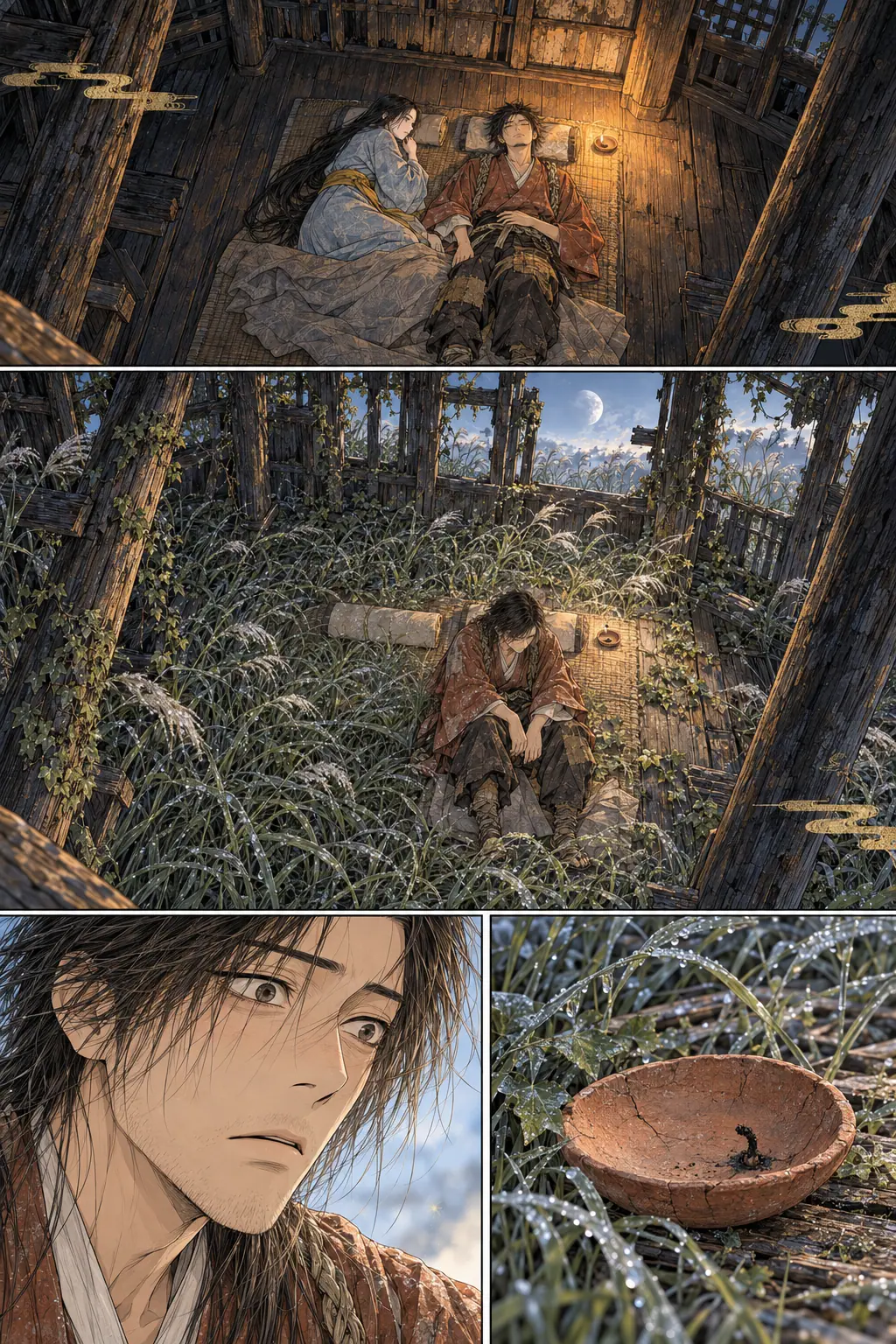
He reaches Mama at dusk. The village is overgrown with wild grass, and he can barely tell where the paths and houses used to be. He finds his own home by a pine that lightning had struck, and a lamp is burning inside. Miyagi comes to the door, thin, unwashed, and with tangled hair, and she weeps when she sees him. They tell each other everything that happened, then go to sleep. When the cold wakes him before dawn, the roof is gone and he can see the pale morning moon through it. The doors and floor have rotted away, and Miyagi is gone. Where their bed had been there is a burial mound, and next to it is an old paper with a farewell poem in her handwriting. In it she wonders how she managed to live this long on nothing but hope. An old villager, the elder of Uruma, tells Katsushirō that Miyagi stayed faithful until she died and that he buried her himself. He also tells the old legend of Tekona of Mama and says Miyagi's heart was truer still. Katsushirō writes a poem of his own and weeps for her.

Main characters

Katsushirō is easygoing and proud, and he wants to save face. He is not a villain. His failing is that he too readily believed his wife was dead, and he let the years go by. Miyagi is the moral center of the story. She keeps faith through war, hunger, and loneliness, and her love outlasts her own death. The elder of Uruma is the only one who knows the truth, and his account changes the night's reunion into a story about grief.

What the story is about: war, waiting, and faithfulness

Ueda Akinari (1734–1809) wrote Ugetsu Monogatari as a collection of nine supernatural tales in a polished literary style. Scholars often say that "The House Amid the Thickets" is partly adapted from a Chinese tale of a faithful wife in the Ming-era collection Jiandeng Xinhua. Akinari moved the story into Japanese history and set it during real fifteenth-century wars.

The title comes from asaji, a low wild grass that takes over abandoned land. In Japanese poetry it stands for neglect and the passing of time. The ending also brings in Tekona of Mama, a local legend that goes back to the eighth-century poetry anthology Man'yōshū. She was a beautiful girl courted by so many men that she drowned herself in an inlet. By putting Miyagi next to Tekona, the elder praises a woman who stayed loyal to one man. Readers can also take the story as quiet criticism of the husband who left her to wait alone. Many readers see both meanings.

The story also helped shape modern film. Mizoguchi Kenji's 1953 film Ugetsu combines it with another tale from the same collection.

What the manga changes

The manga keeps the main events of the original: the promise to return by autumn, the war, the bandits and the illness, the seven years, the lamp in the ruined village, the night together, the mound and the poem at dawn, and the elder's story. Several things in the manga are invented, though. Akinari gives almost no physical description, so Miyagi's face, age, and clothes, and the layout of the house, are the artist's own design. Scenes of Miyagi's seven years alone, such as the changing seasons, her weaving, and her watching the road, are imagined, as are the faces and lines of the men who court her. Katsushirō's time in Kyoto and Ōmi is condensed into a few panels.

Miyagi's death is shown through the elder's account and images of the seasons, not drawn directly. The dialogue on the reunion night is written in modern language, but it keeps what she says in the original: the terror of the war, her refusal of other men, and both her bitterness at waiting and her joy that he came back. The manga also chooses for itself how many hints to give that she is a ghost, and it adds a short closing image of Tekona's legend.

Where to read it

This story is Episode 7 of LOVE & ALLURE: Classic Japanese Tales of Romance on Manga Portal. You can read every episode free, with no sign-up. If you know how the story ends, go back to the reunion scenes and look for the hints about Miyagi that are hidden in them. The other episodes retell more of Japan's classic love stories, both ordinary and supernatural.

Characters in this episode

Katsushirō
A proud, careless villager from Mama who leaves to sell silk in Kyoto and does not come home for seven years.
Miyagi
Katsushirō's beautiful, faithful wife, who waits for him through war and loneliness and greets him one last time as a ghost.
Sasabe no Sōji
A Kyoto merchant who buys Ashikaga silk and takes Katsushirō to the capital.
Kodama Kahei
A kind man in Ōmi who takes Katsushirō in and nurses him through a fever.
The elder of Uruma
An old villager who stayed behind, buried Miyagi, and tells Katsushirō the truth.
Tekona of Mama
A girl from a local legend that goes back to the Man'yōshū, courted by so many men that she drowned herself; the elder compares Miyagi to her.

FAQ

What is the story of Asaji ga Yado?

A man named Katsushirō leaves his wife Miyagi to trade silk and promises to be home by autumn, but war and misfortune keep him away for seven years. When he returns, she welcomes him in their house. At dawn he finds out she died years earlier and that he spent the night with her ghost.

Who wrote Tales of Moonlight and Rain (Ugetsu Monogatari)?

Ueda Akinari wrote it. It was published in 1776 and is a collection of nine supernatural stories. It is one of the best-known works of Edo-period fiction.

Was Miyagi a ghost?

Yes. Katsushirō wakes up in a ruined house next to her grave, and an old villager tells him she died while waiting for him. The woman he spent the night with was her spirit.

Why did Katsushirō take seven years to come home?

On his way home, bandits robbed him and he heard the roads east were closed by war. He assumed his village had burned and his wife was dead, then fell ill in Ōmi and stayed there. He only went back after war and plague reached the capital.

Is the film Ugetsu based on this story?

Partly. Mizoguchi Kenji's 1953 film Ugetsu combines "The House Amid the Thickets" with another tale from the same collection.

Read the manga from the start (free)