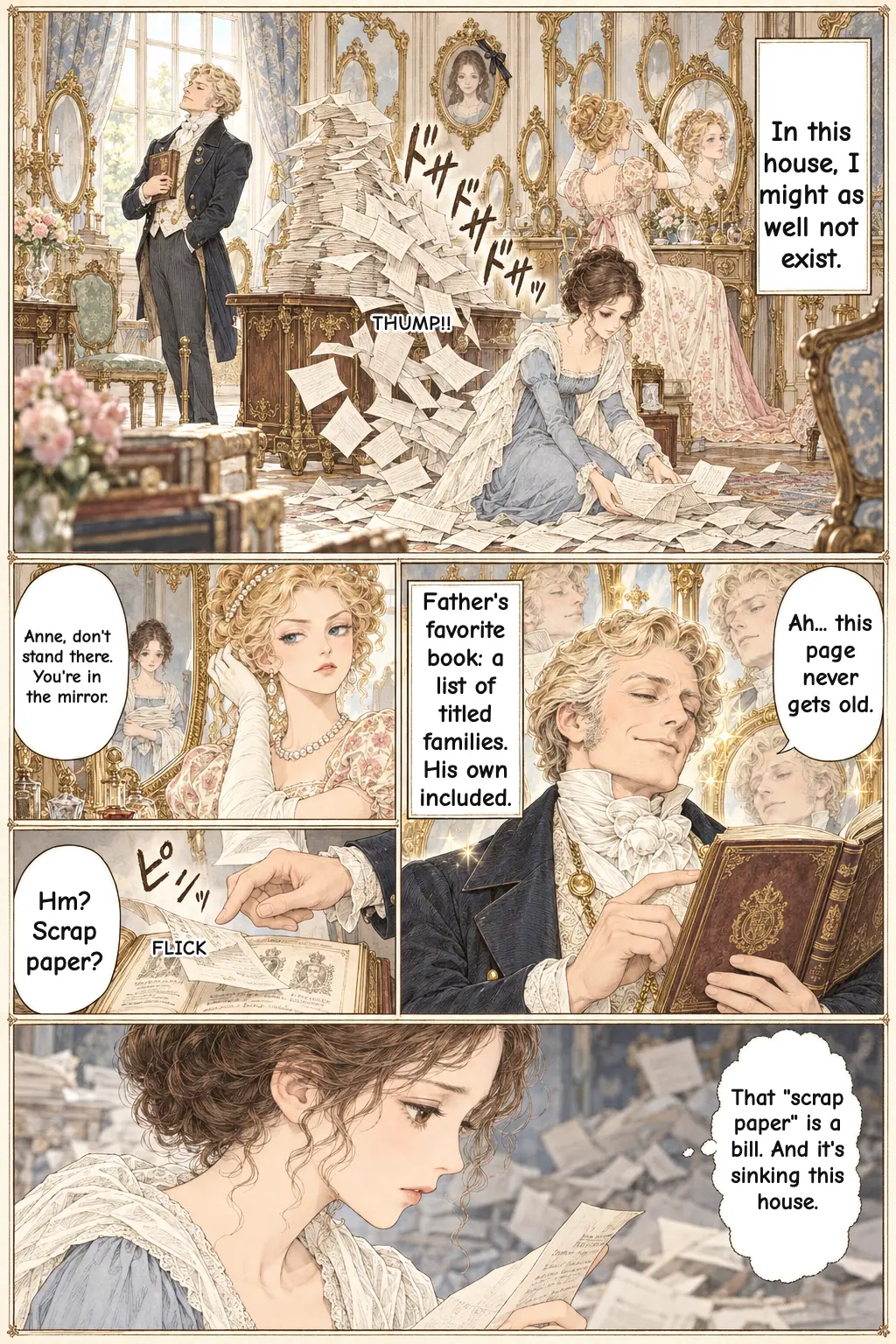
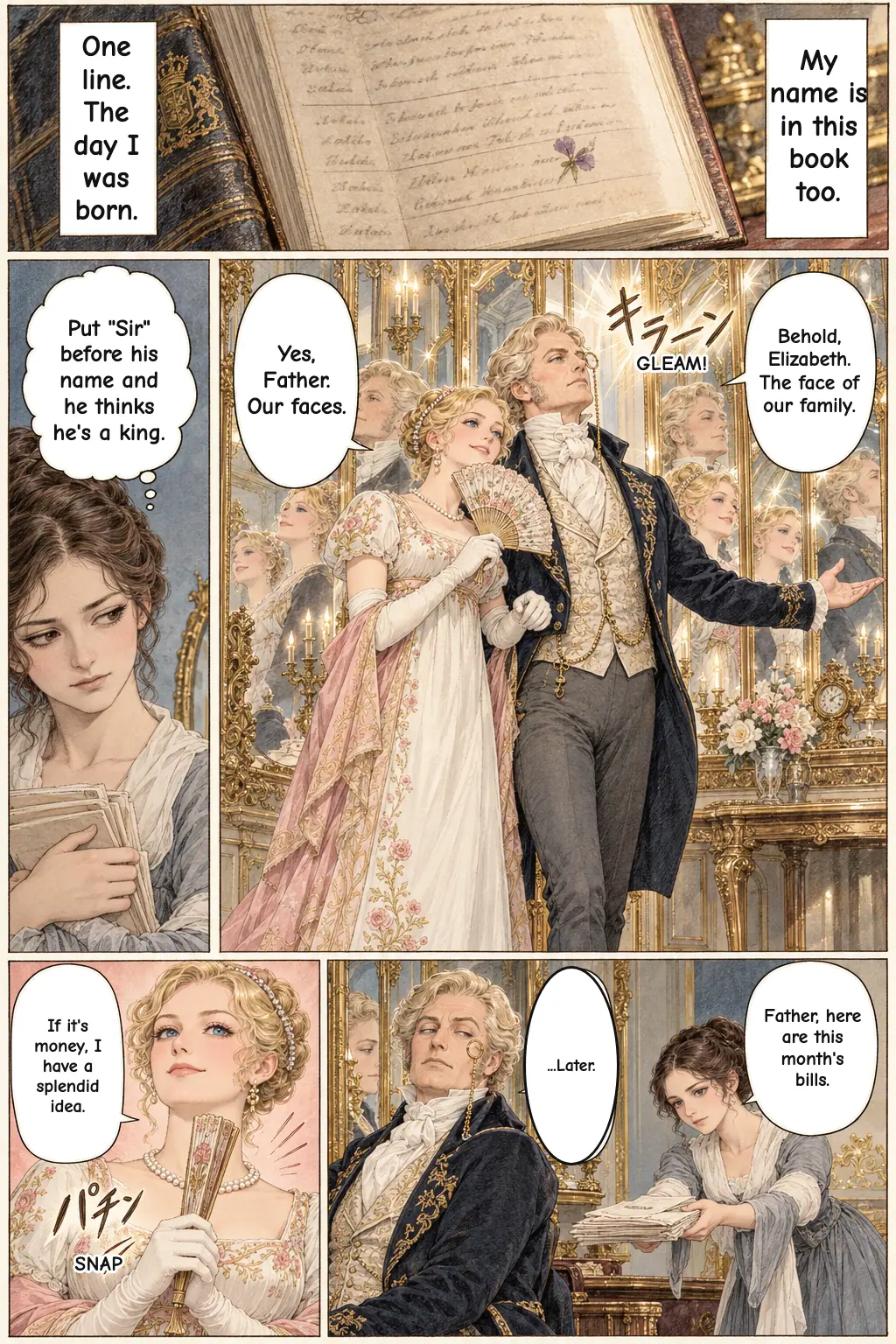
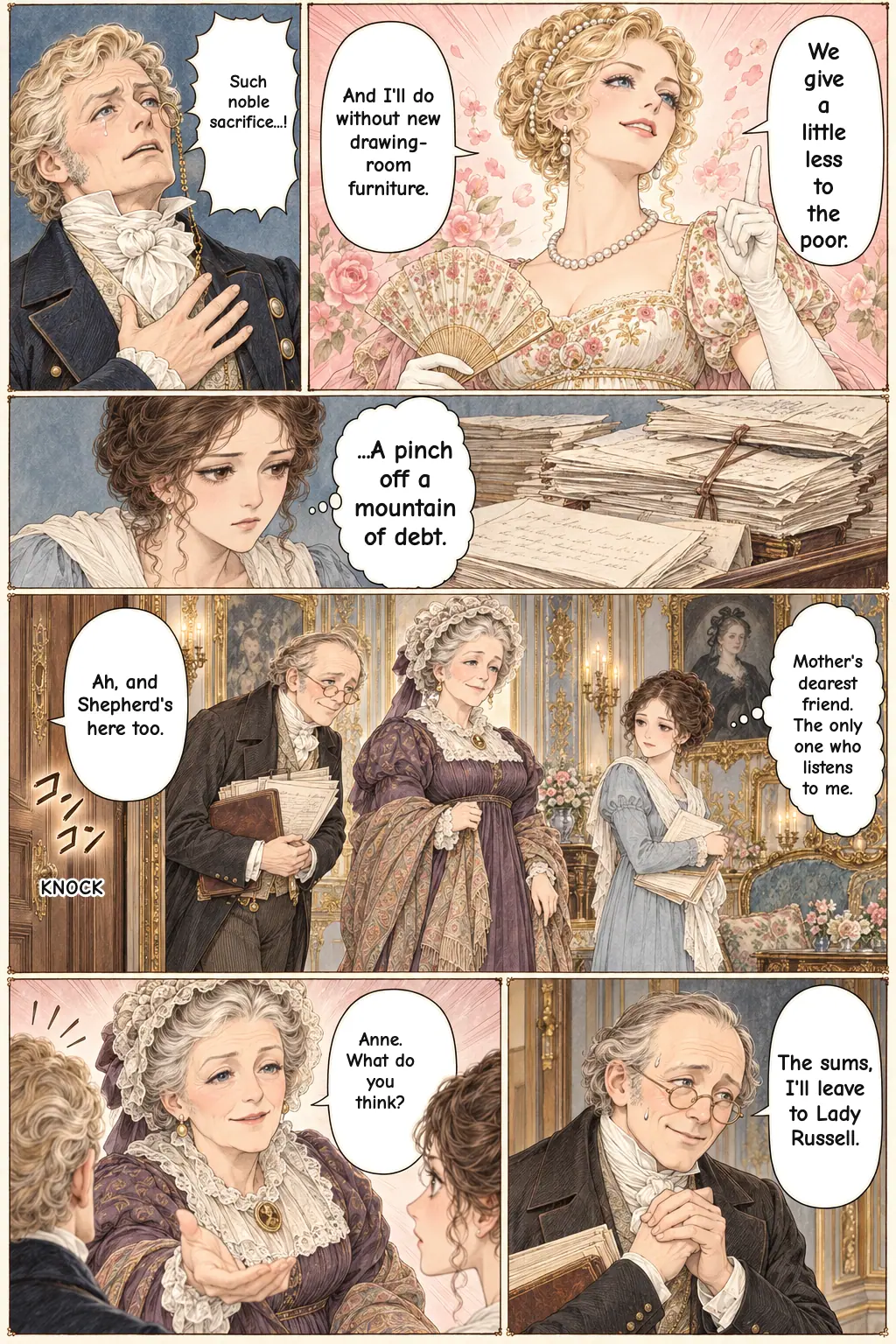
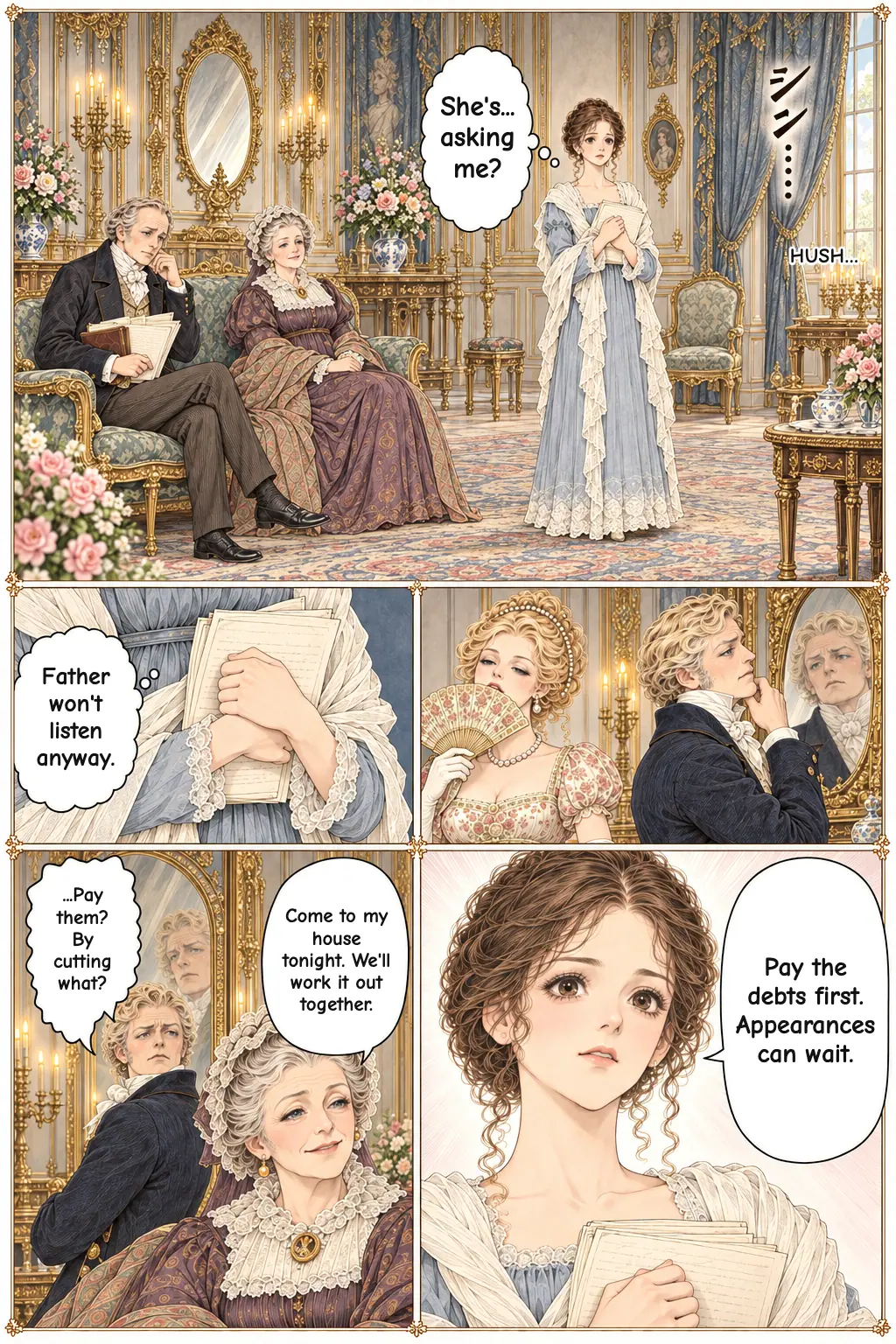
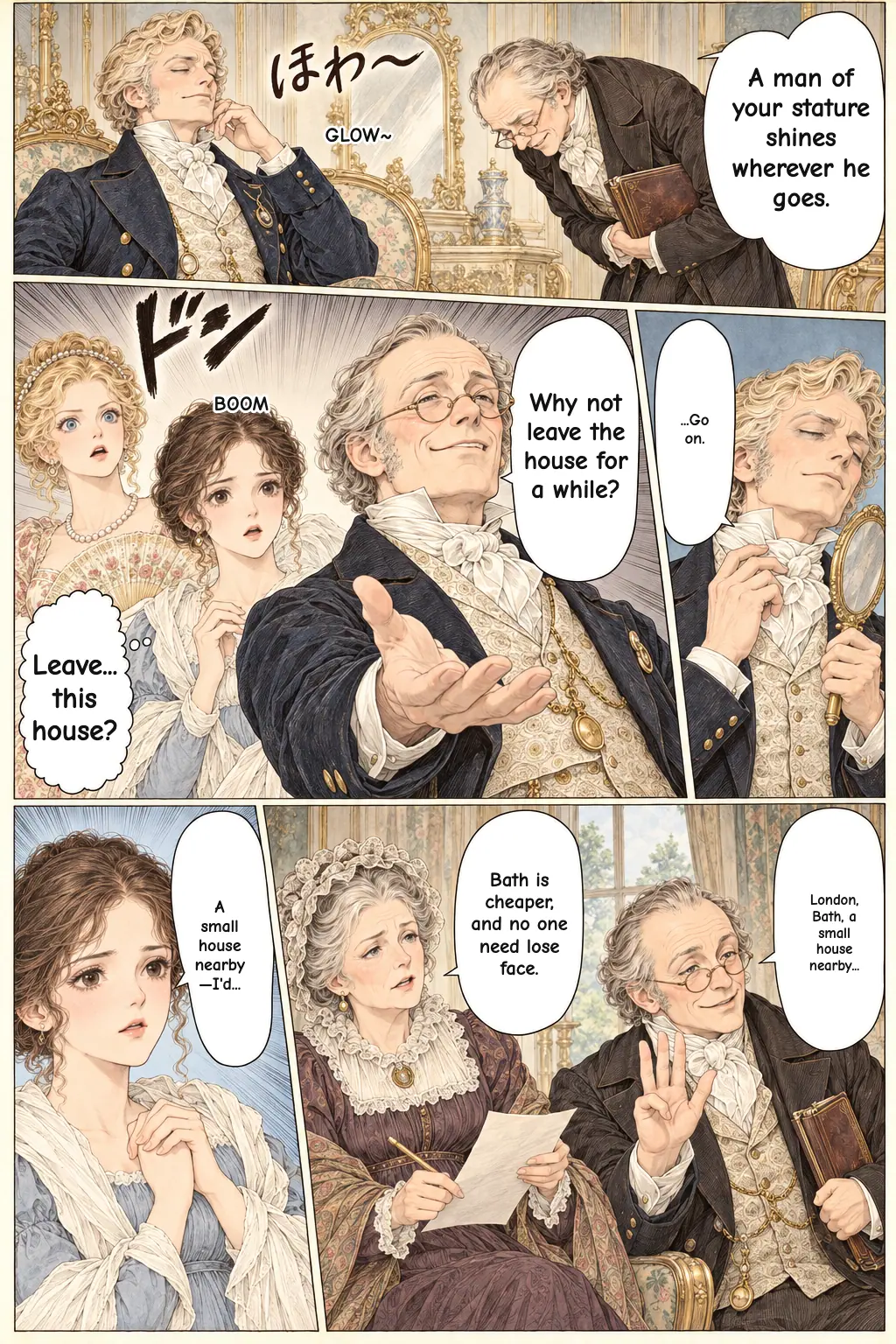
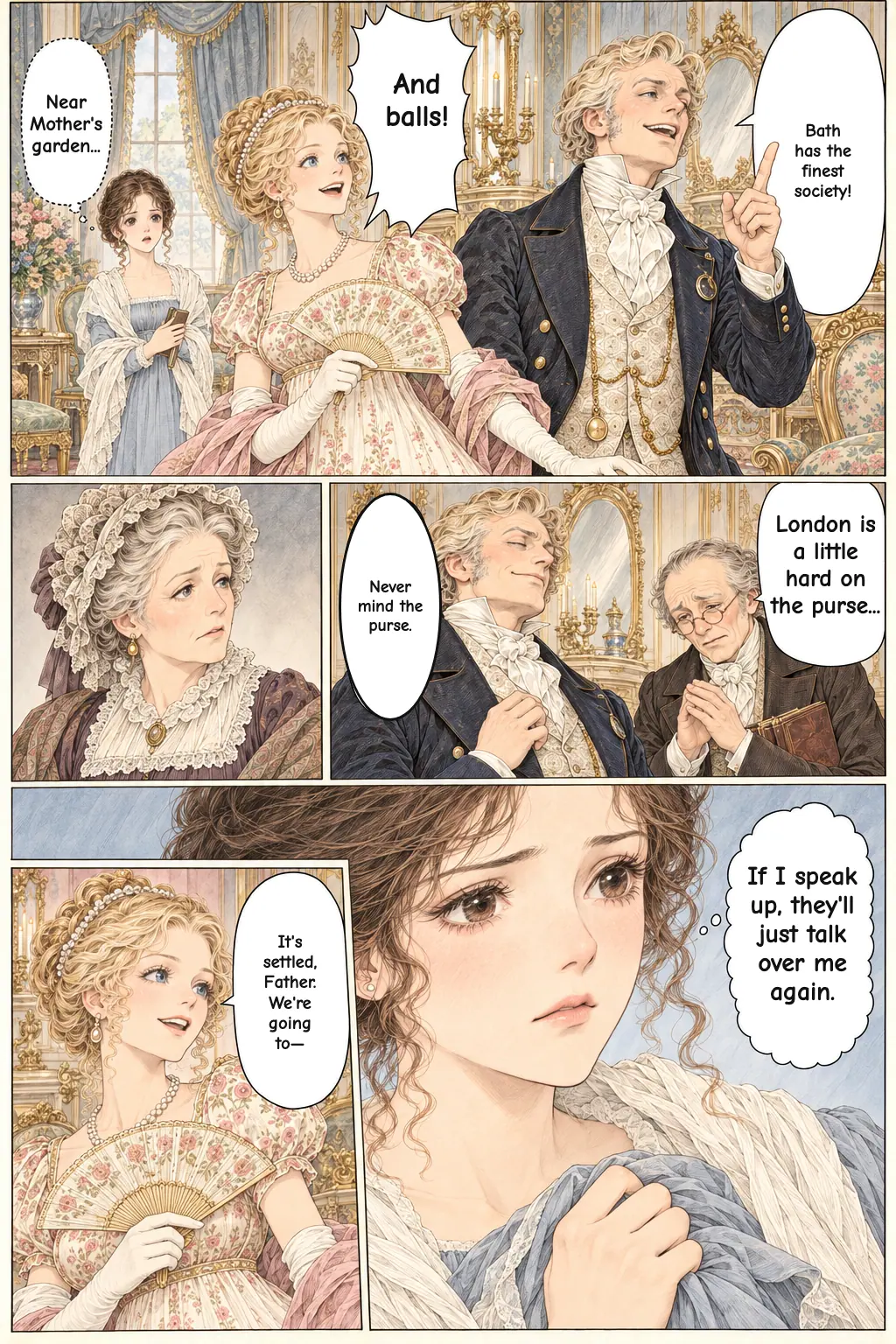
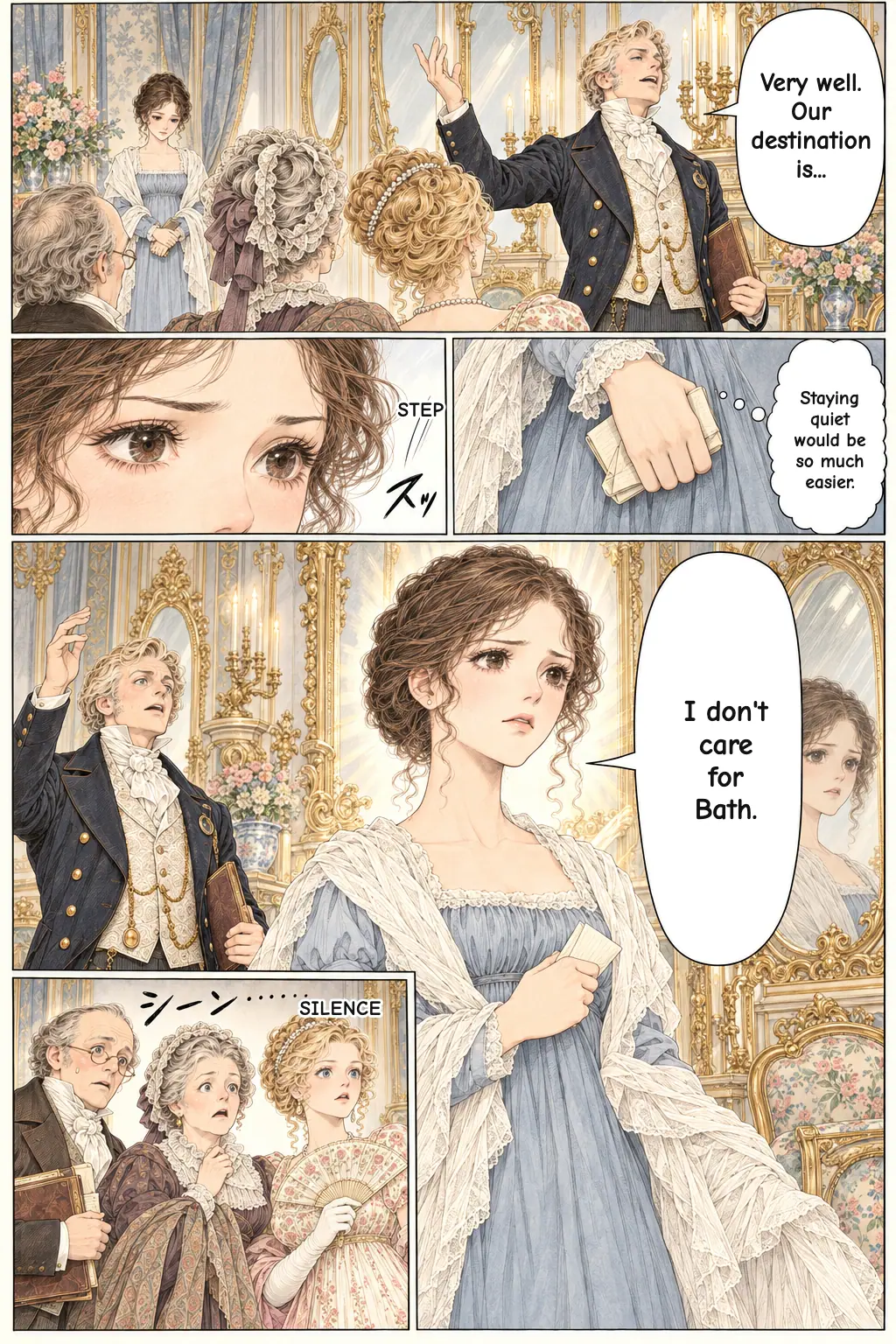
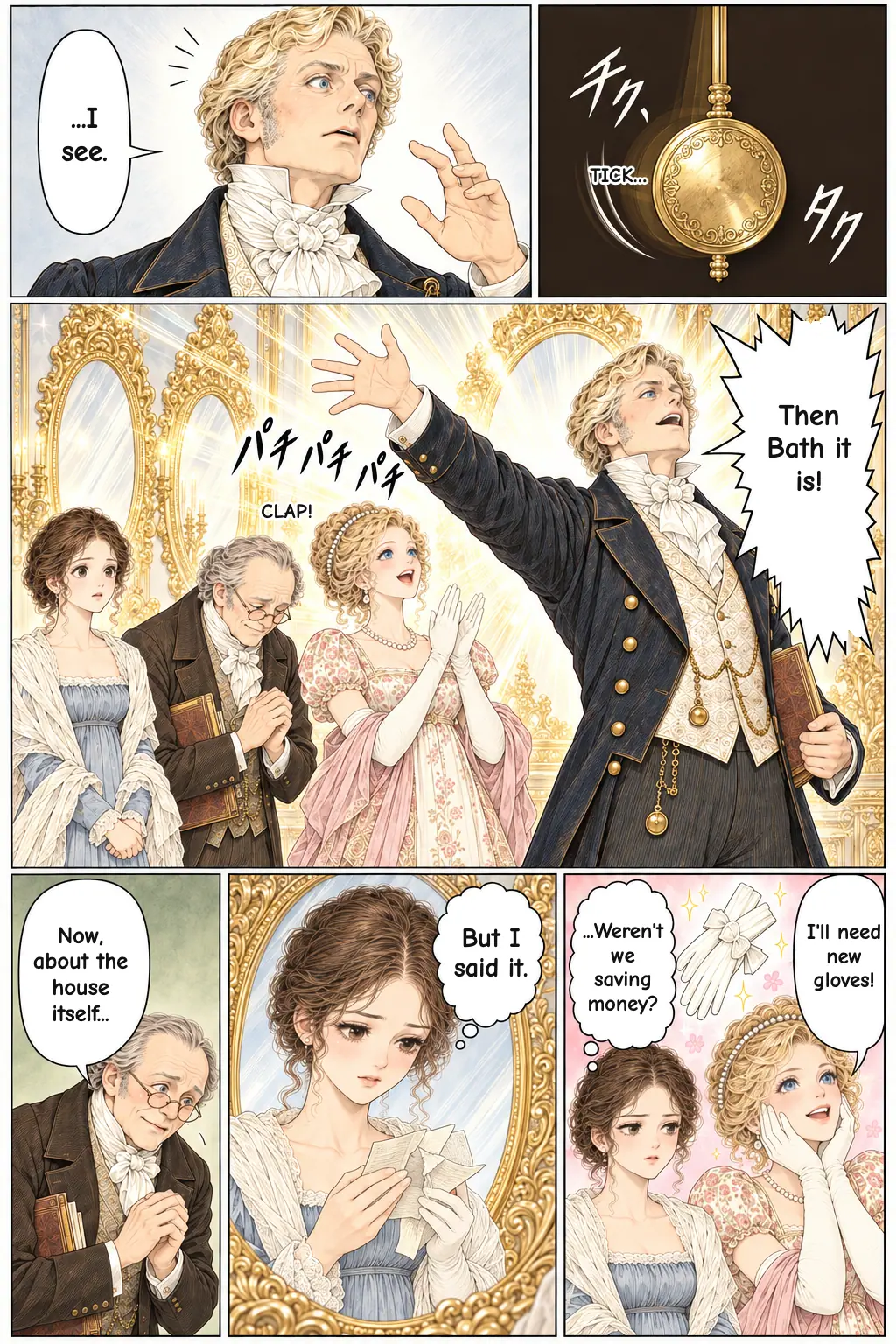
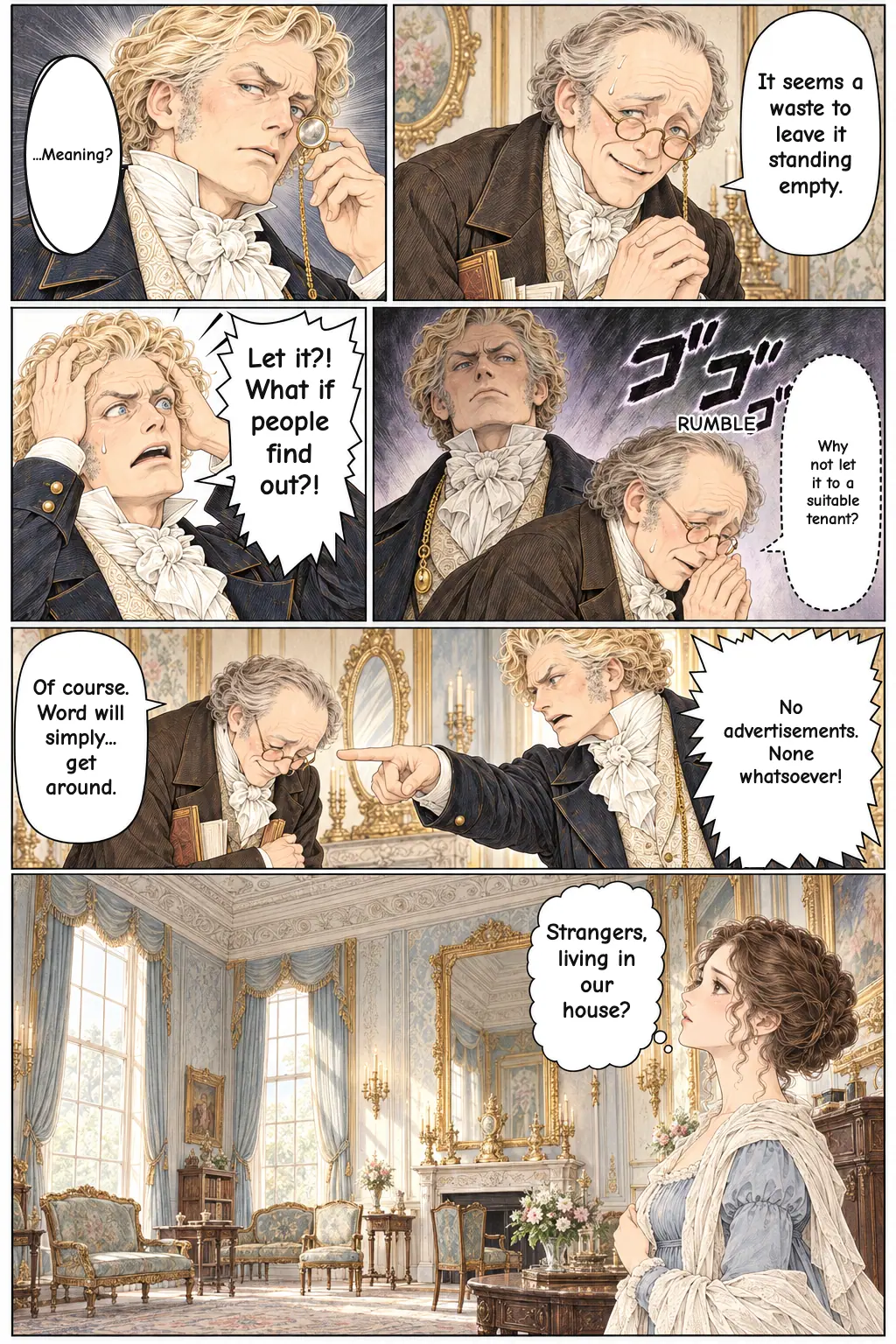
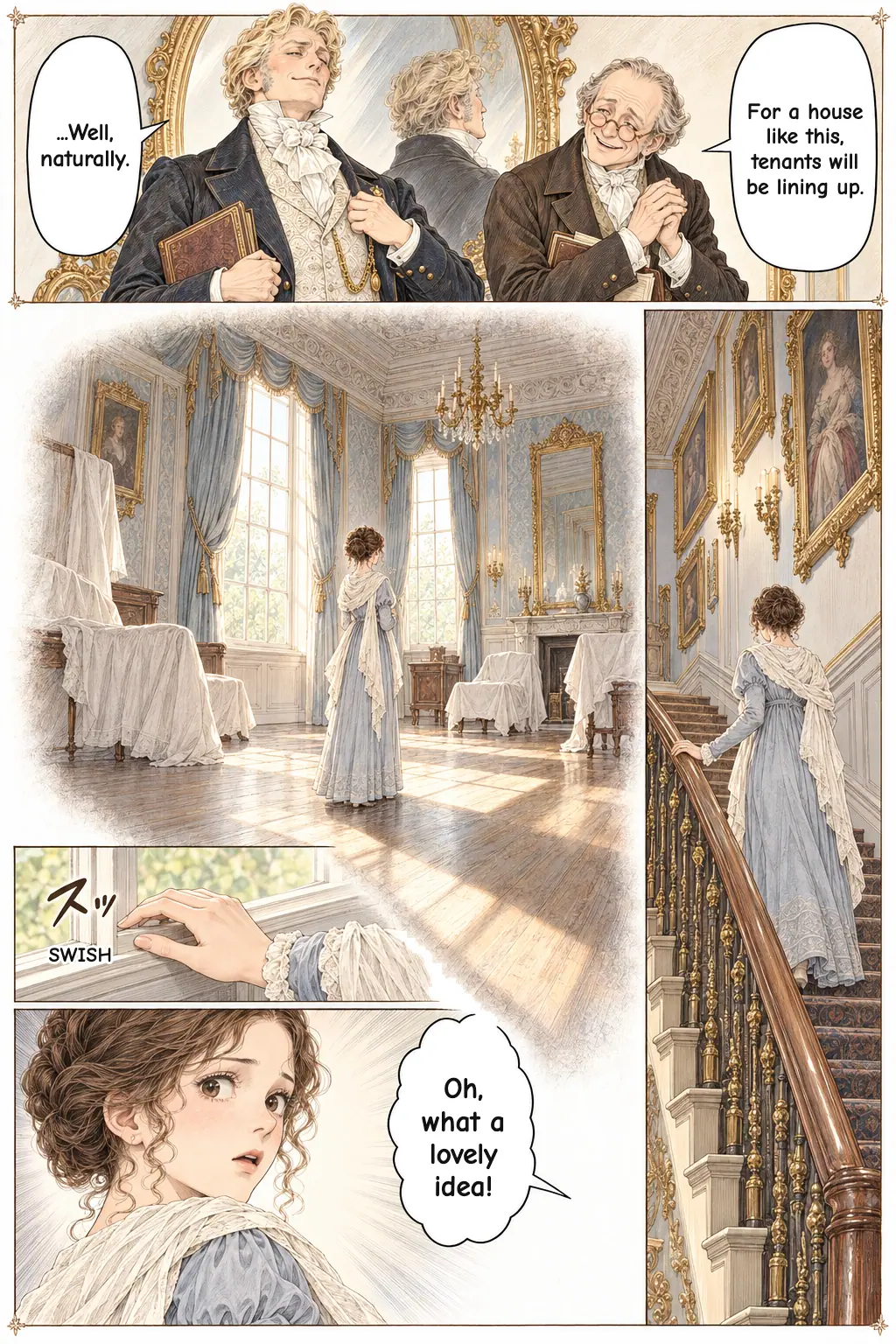
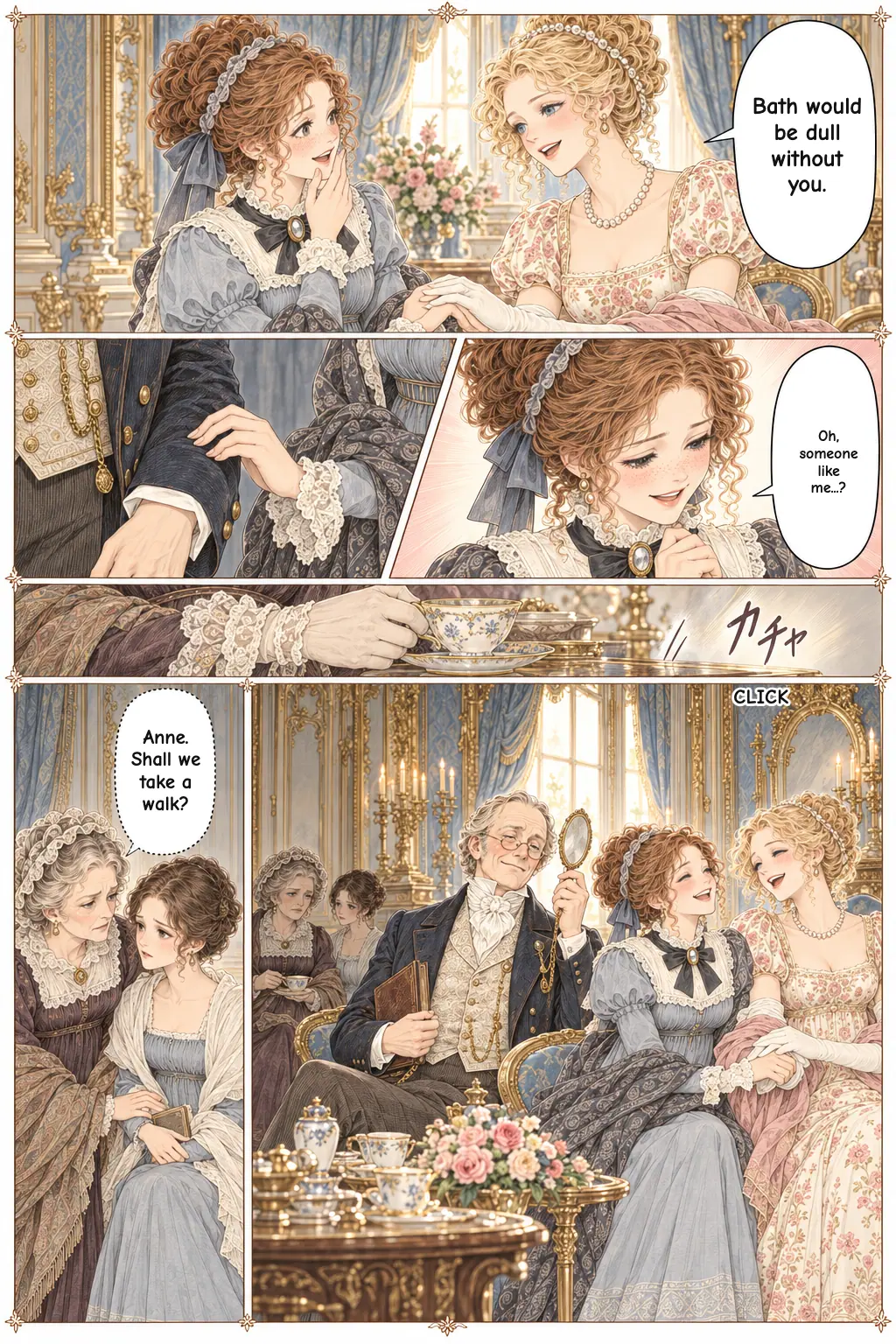
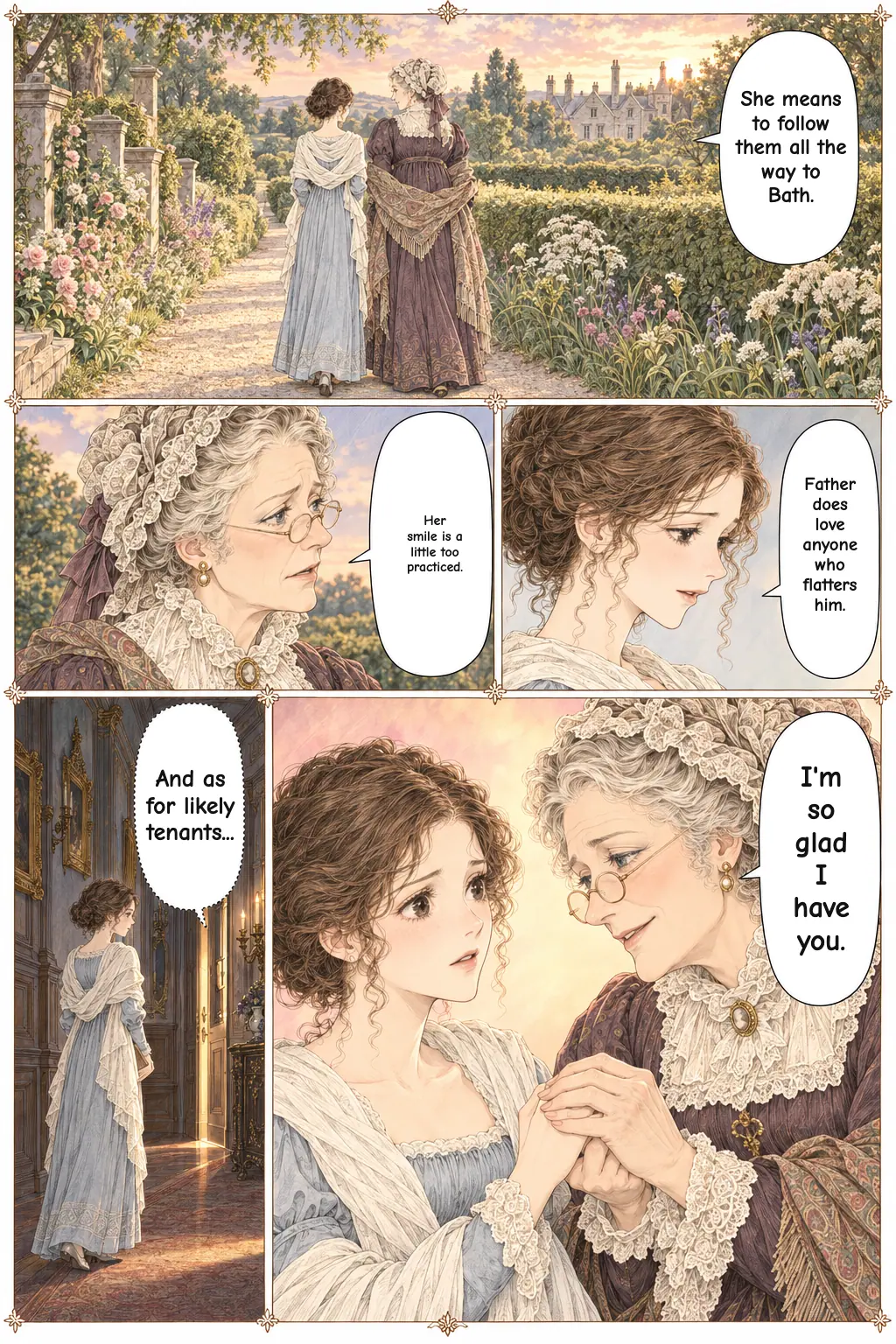
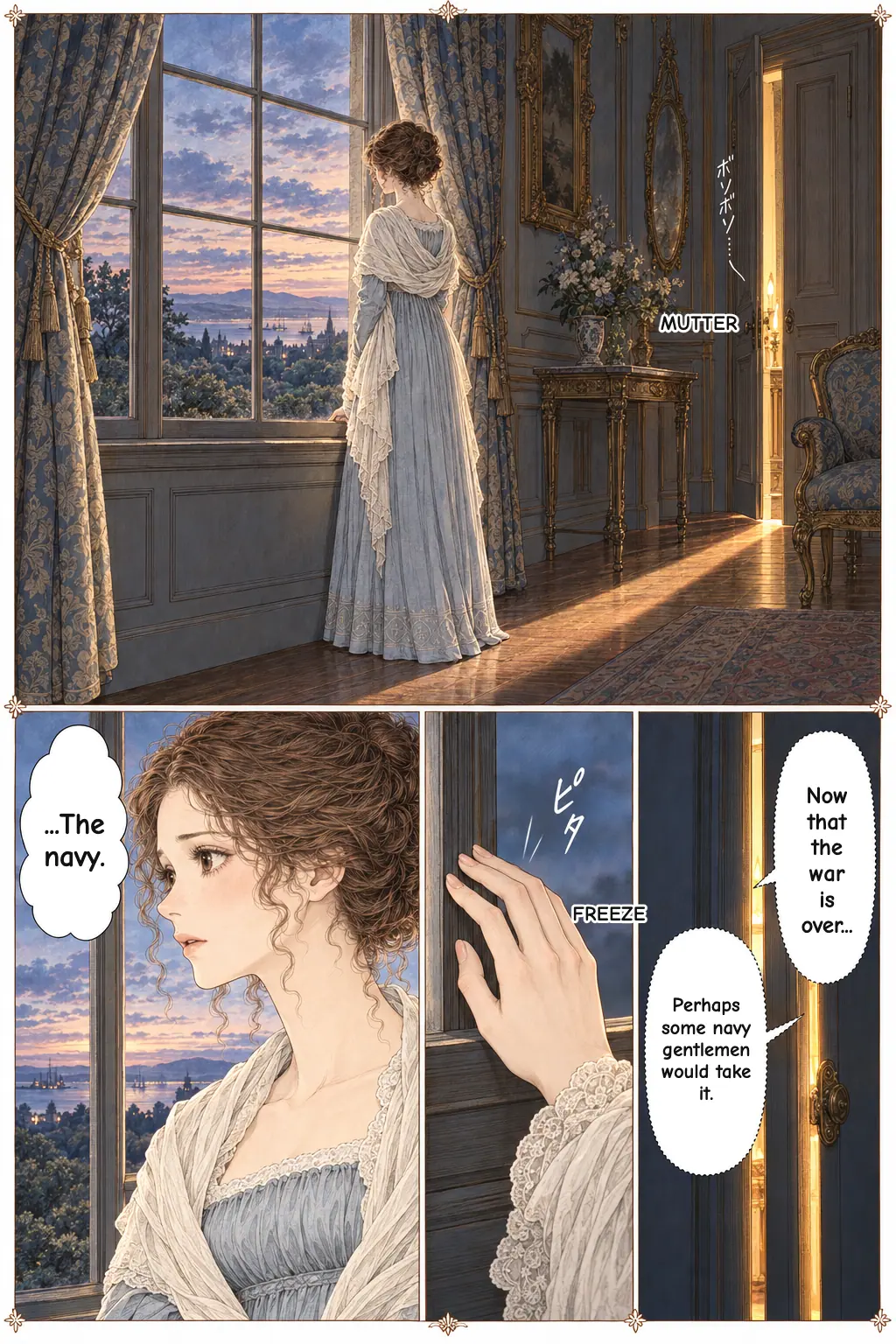
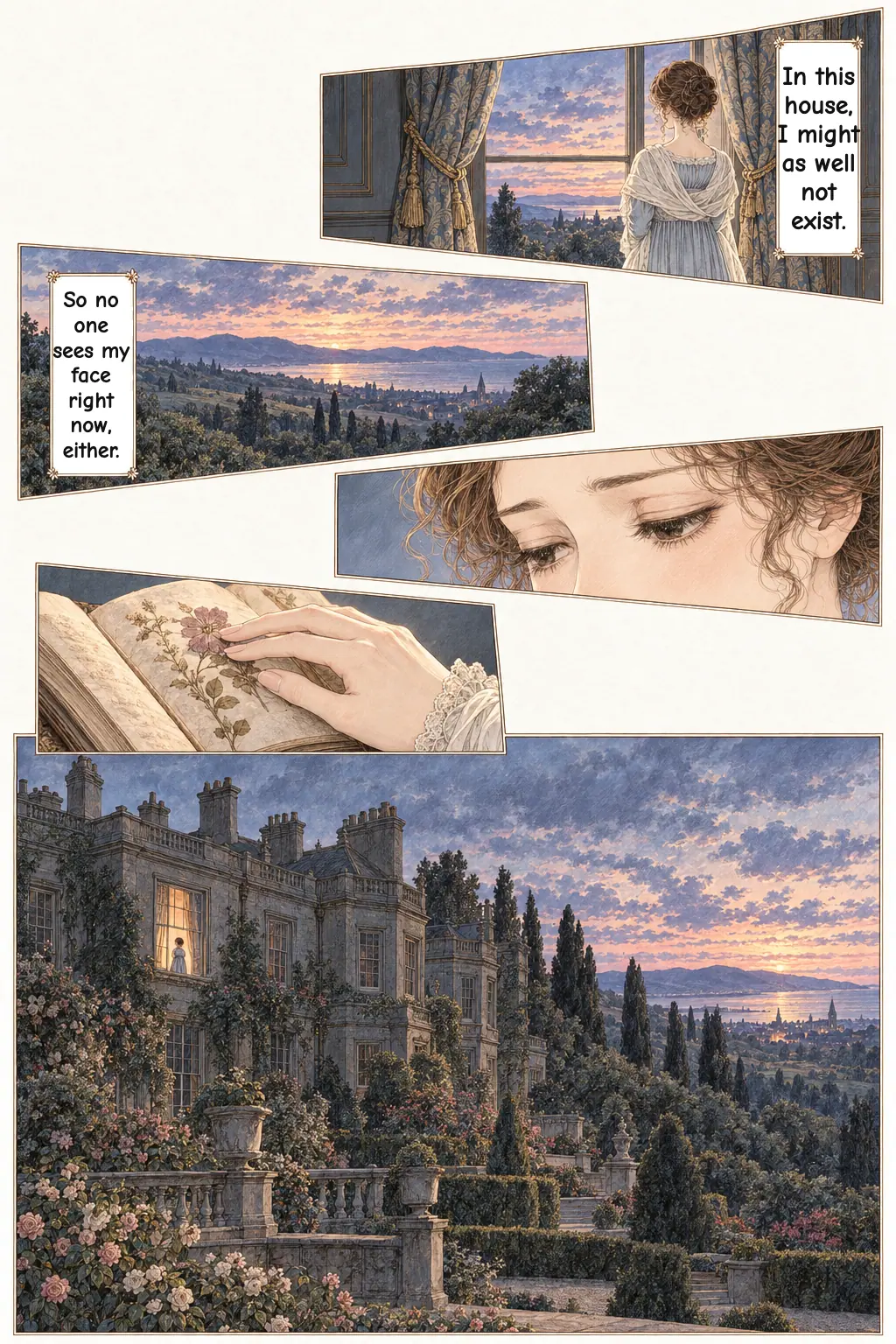
In a grand house sinking under debt, Anne Elliot, the middle daughter, is the one no one in her family listens to. Her vain father and older sister insist they can't possibly give up a single horse or servant. In the end the family decides to let the house and move to Bath. Then, at dusk, a single word drifts through a doorway — "navy" — and for one moment, Anne's eyes waver.
19 pagesFree · No sign-up
In short: The opening of Persuasion follows the Elliots of Kellynch Hall, a proud baronet's family that has run deep into debt, and Anne, the sensible middle daughter whose advice nobody takes. Her vain father, Sir Walter, refuses to cut back properly, so the family decides to rent out their ancestral home and move to Bath. This is Volume I, Chapters 1–2 of Jane Austen's Persuasion, published in late 1817 after her death.
Persuasion opens not with its heroine but with her father. Sir Walter Elliot, a baronet (a hereditary title just below the nobility) who lives at Kellynch Hall in Somerset, has one favorite book: the Baronetage, a reference guide to titled families. He likes to open it at his own family's entry and read about himself again and again. Austen tells us plainly that vanity is the whole of his character: he is proud of his good looks and proud of his rank, and very little else interests him. His wife, Lady Elliot, was a sensible, capable woman who kept the household within its income.
Persuasion Summary (Ch. 1–2): Anne Elliot, Debt & the Move to Bath
The Original Story: Chapters 1–2 of Persuasion
Persuasion opens not with its heroine but with her father. Sir Walter Elliot, a baronet (a hereditary title just below the nobility) who lives at Kellynch Hall in Somerset, has one favorite book: the Baronetage, a reference guide to titled families. He likes to open it at his own family's entry and read about himself again and again. Austen tells us plainly that vanity is the whole of his character: he is proud of his good looks and proud of his rank, and very little else interests him.
His wife, Lady Elliot, was a sensible, capable woman who kept the household within its income. She died thirteen years before the story begins, leaving three daughters in the care of her close friend Lady Russell, a widow who lives in the nearby village. Since then, Sir Walter has spent more than he earns, and the debts have grown to the point where they can no longer be ignored.
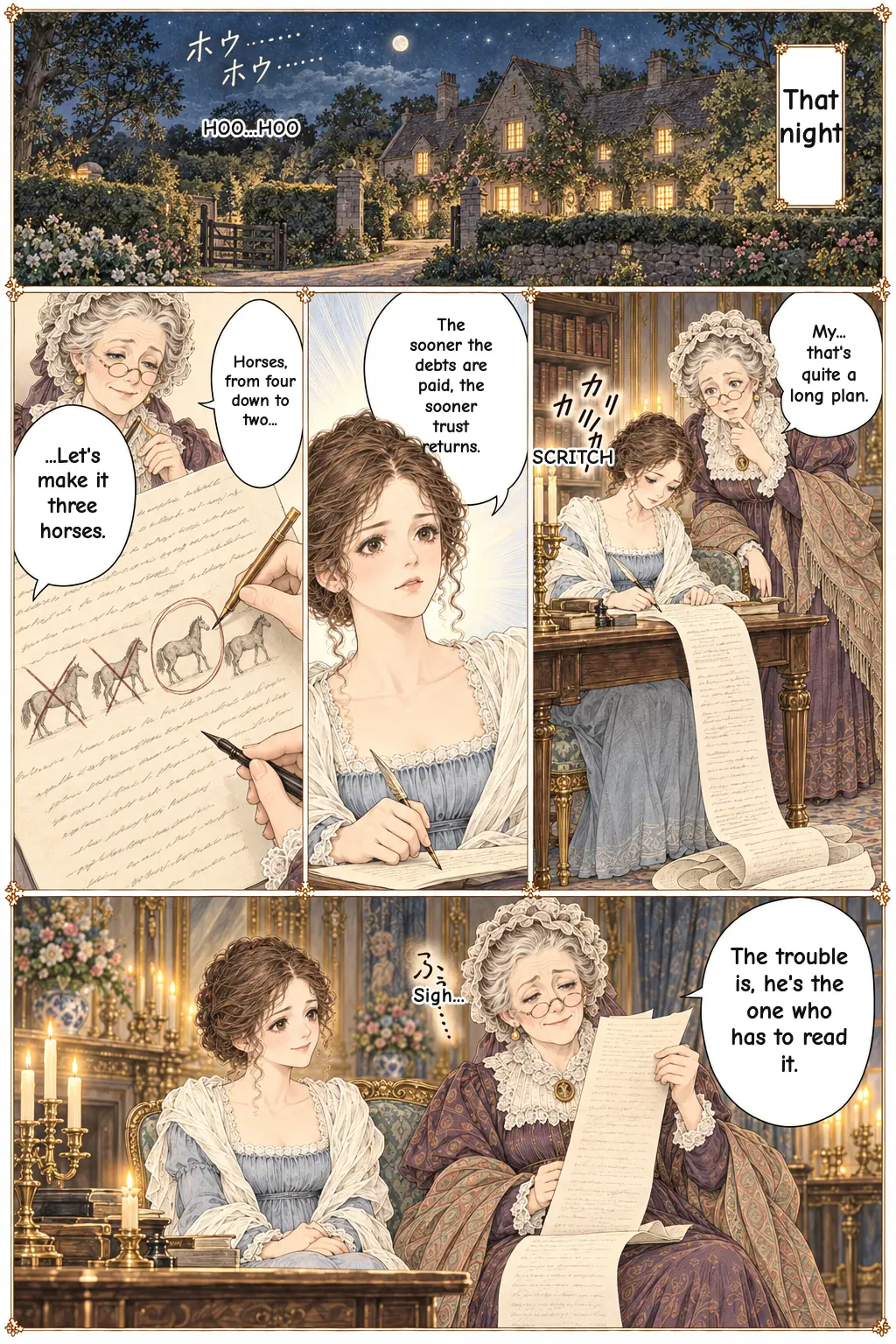
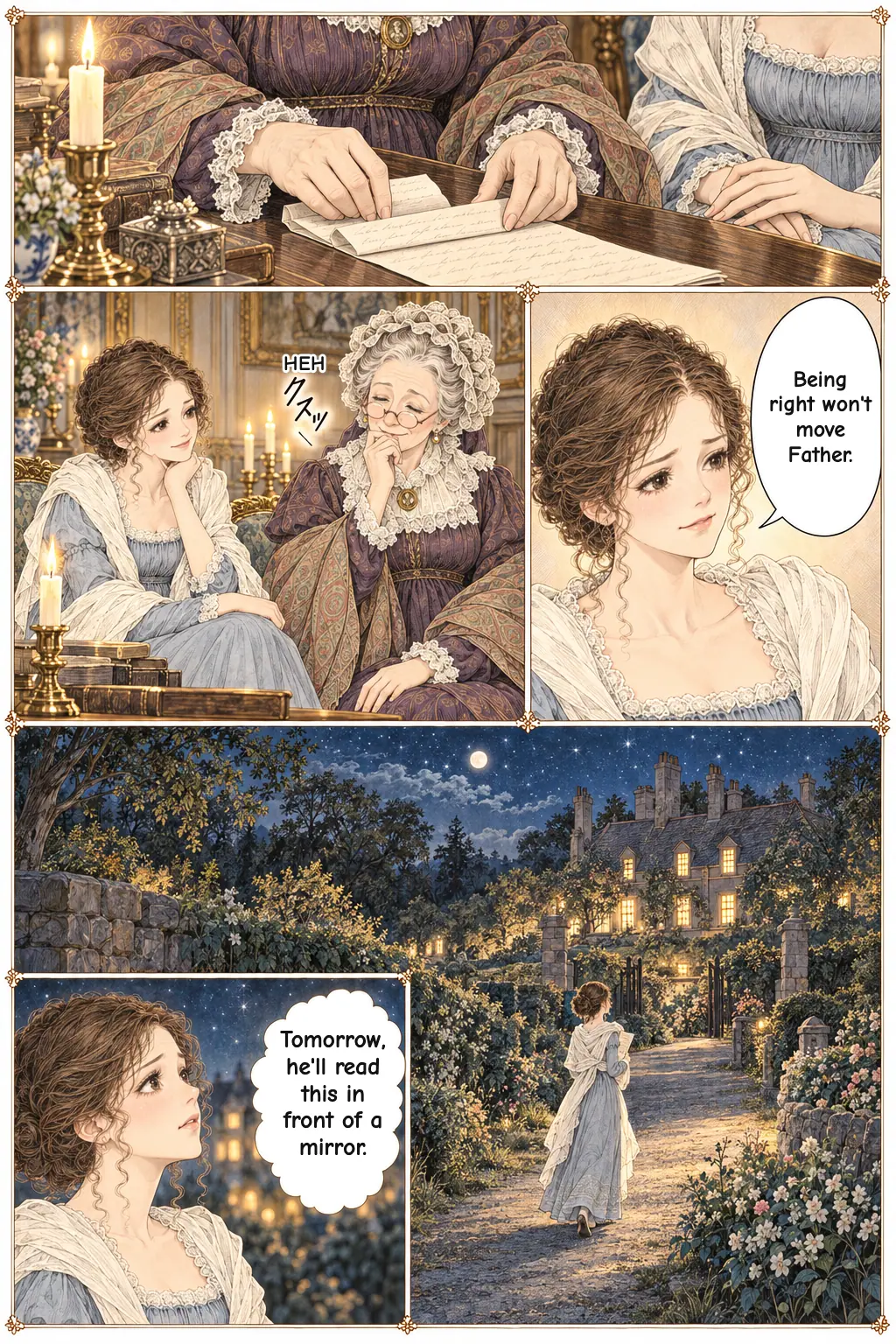
When the problem finally has to be faced, his eldest daughter Elizabeth can only suggest small savings, such as giving less to charity or not buying new furniture. The family lawyer, Mr. Shepherd, avoids saying anything unpleasant himself and leaves the hard advice to Lady Russell. She draws up a serious plan of economy, and she asks for Anne's opinion while doing so. Anne's view is that honesty matters more than appearances: the debts should be paid off as quickly as possible, even if that means living more simply.
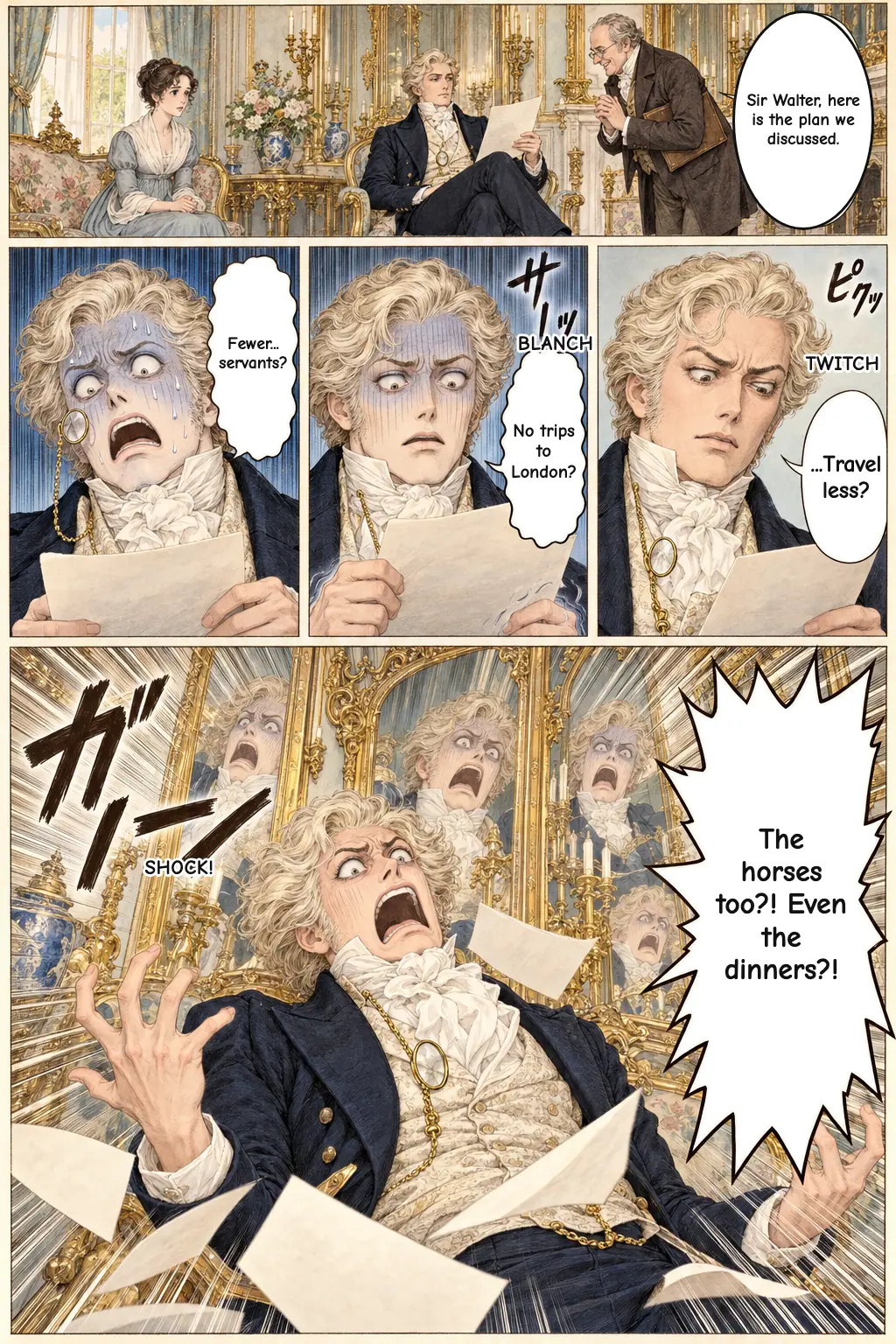
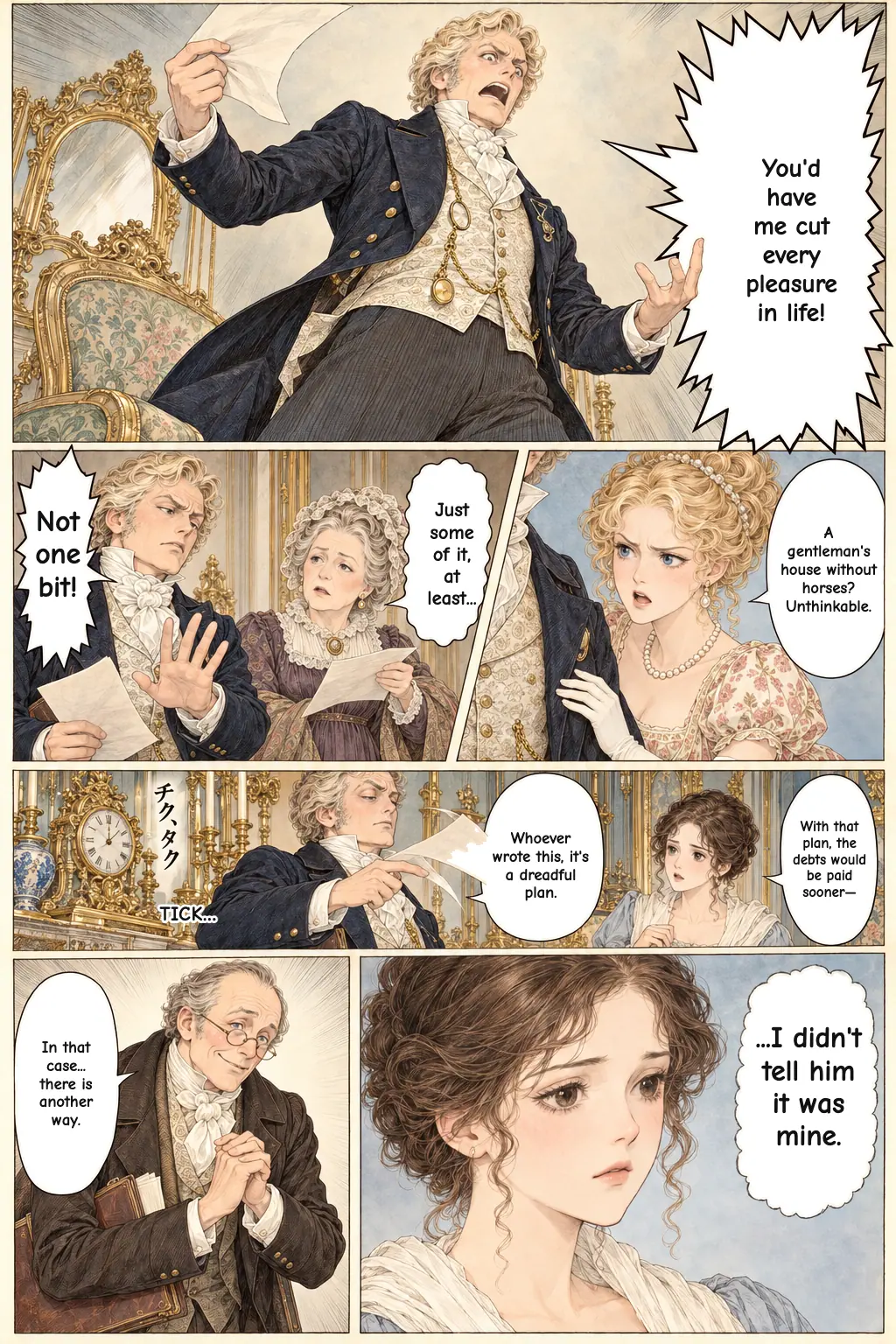
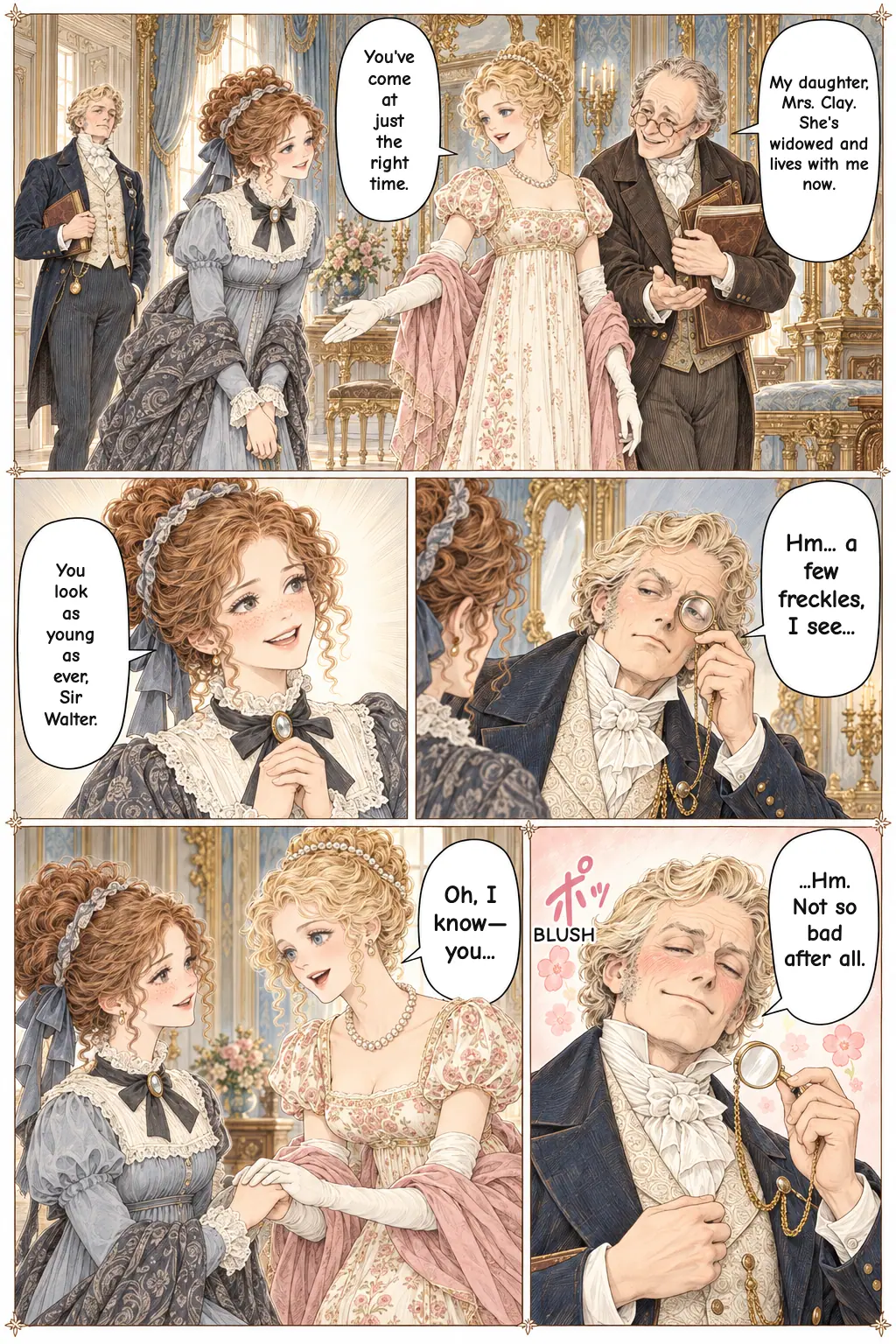
Sir Walter rejects the plan outright. He cannot imagine giving up his travel, his trips to London, his servants, his horses or his table. Since he will not cut his spending enough to stay at Kellynch, the only remaining option is to leave it. Mr. Shepherd carefully hints that the house could be let to a tenant, though Sir Walter hates the idea of anyone knowing. London, Bath and a smaller house nearby are all considered. Lady Russell and Mr. Shepherd favor Bath, which is cheaper than London but still respectable. Anne would have preferred a modest house in the neighborhood; she does not like Bath. As usual, her wishes count for nothing, and Bath it is. The chapter closes with a worry: Elizabeth has become close friends with Mr. Shepherd's daughter, Mrs. Clay, a widow who has returned home with two children, and Lady Russell thinks the friendship unwise.
Main Characters
Anne Elliot, the middle daughter, is intelligent, kind and refined, yet to her father and older sister she simply does not matter. Her words carry no weight at home. She was pretty when she was younger but lost her bloom early, and she is now about twenty-seven. Only Lady Russell truly values her.
Around her are Sir Walter, the vain baronet; Elizabeth, the beautiful eldest daughter who has run the house for thirteen years and is beginning to worry about being unmarried at twenty-nine; Lady Russell, wise and well-meaning but also respectful of rank; Mr. Shepherd, the cautious, polite lawyer; and Mrs. Clay, his clever daughter who knows how to please. The youngest sister, Mary, is already married to Charles Musgrove of Uppercross. The heir to the title, a distant cousin named William Walter Elliot, appears only in conversation: Elizabeth once hoped to marry him, but he married a wealthy woman of lower birth instead and was reported to have spoken slightingly of the family.
What the Story Says: Rank, Money and Being Overlooked
Austen wrote Persuasion near the end of her life; it was published in late 1817, a few months after her death, and is set around 1814. In the England of this period, a baronet's status depended on land, title and appearances. Sir Walter's debts are a comedy of misplaced pride: he would rather leave his family's home than live without the outward signs of rank. Moving to Bath, a fashionable spa town, lets him save money while still looking important.
Against this, Anne stands for quieter values: honesty, good sense and paying what you owe. The first two chapters set up the novel's central contrast between people who care about how things look and people who care about what is right. They also establish Anne's painful position. She is the most capable person in the family, yet the least heard, which makes the reader eager to see whether anyone will ever recognize her worth.
What the Manga Changed or Added
The family's debt, Sir Walter's love of the Baronetage, the rejected economy plan and the decision to move to Bath all come straight from Austen. Some things were added to make the story work visually. Anne's short opening monologue about being invisible in her own family is a dramatization of how the narrator describes her. The piles of bills, the specific lines given to each character in the family meeting and the panels where Anne speaks but nobody listens are the manga's invention, built on what the novel tells us.
The room full of mirrors is borrowed from much later in the book, where a new tenant remarks on how many mirrors Sir Walter keeps; here it appears only as a light visual joke. Interiors, costumes and faces are drawn from general Regency-era research, since Austen describes very little. Any hint that Elizabeth wants to take Mrs. Clay to Bath is a preview: in the novel that is settled only in Chapter 5. Finally, the closing moment, when the word "navy" makes Anne's eyes waver, is a deliberate teaser. In the original, naval officers are first discussed as possible tenants in Chapter 3, and the reason the subject matters to Anne is revealed in Chapter 4.
Where to Read It
Persuasion is in the public domain, so the full English text is freely available, for example on Project Gutenberg (eBook #105). If you'd like to meet Anne Elliot in a quicker, more visual way first, Manga Portal's PERSUASION: A Second Chance at Love adapts the novel episode by episode. Every episode is free to read, with no sign-up required, so you can follow Anne from this quiet beginning to the story's heart at your own pace.
Characters in this episode
Anne Elliot
The thoughtful, kind middle daughter and heroine, whose good advice her family ignores.
Sir Walter Elliot
Anne's father, a vain baronet who has fallen into debt but refuses to give up his comforts.
Elizabeth Elliot
The beautiful, proud eldest daughter and her father's favorite, mistress of Kellynch Hall for thirteen years.
Lady Russell
A sensible widow, the late Lady Elliot's best friend, who values Anne above her sisters.
Mr. Shepherd
Sir Walter's cautious lawyer, who prefers to let others deliver bad news and hints at renting out the house.
Mrs. Clay
Mr. Shepherd's widowed daughter, whose close friendship with Elizabeth worries Lady Russell.
FAQ
What happens at the beginning of Persuasion?
Sir Walter Elliot, a vain baronet, has spent his family into debt. When he refuses a sensible plan to cut costs, the family decides to rent out Kellynch Hall and move to Bath, overriding the wishes of his daughter Anne.
Why do the Elliots move to Bath?
They can no longer afford to live at Kellynch Hall the way Sir Walter insists on living. Bath was cheaper than London but still fashionable, so he could save money without appearing to lose status.
Who is Anne Elliot?
Anne is the heroine of Persuasion, the intelligent and kind middle daughter of Sir Walter Elliot. She is about twenty-seven at the start of the novel and is largely overlooked by her father and older sister.
When was Persuasion published?
Persuasion was published in late 1817, a few months after Jane Austen died in July of that year. It is her last completed novel.
Why is the novel called Persuasion?
The title points to a decision in Anne's past that she was persuaded to make, which the novel reveals in Chapter 4. The first chapters only set the stage for it.