Get new episodes in your feed. Follow us on:ThreadsBluesky
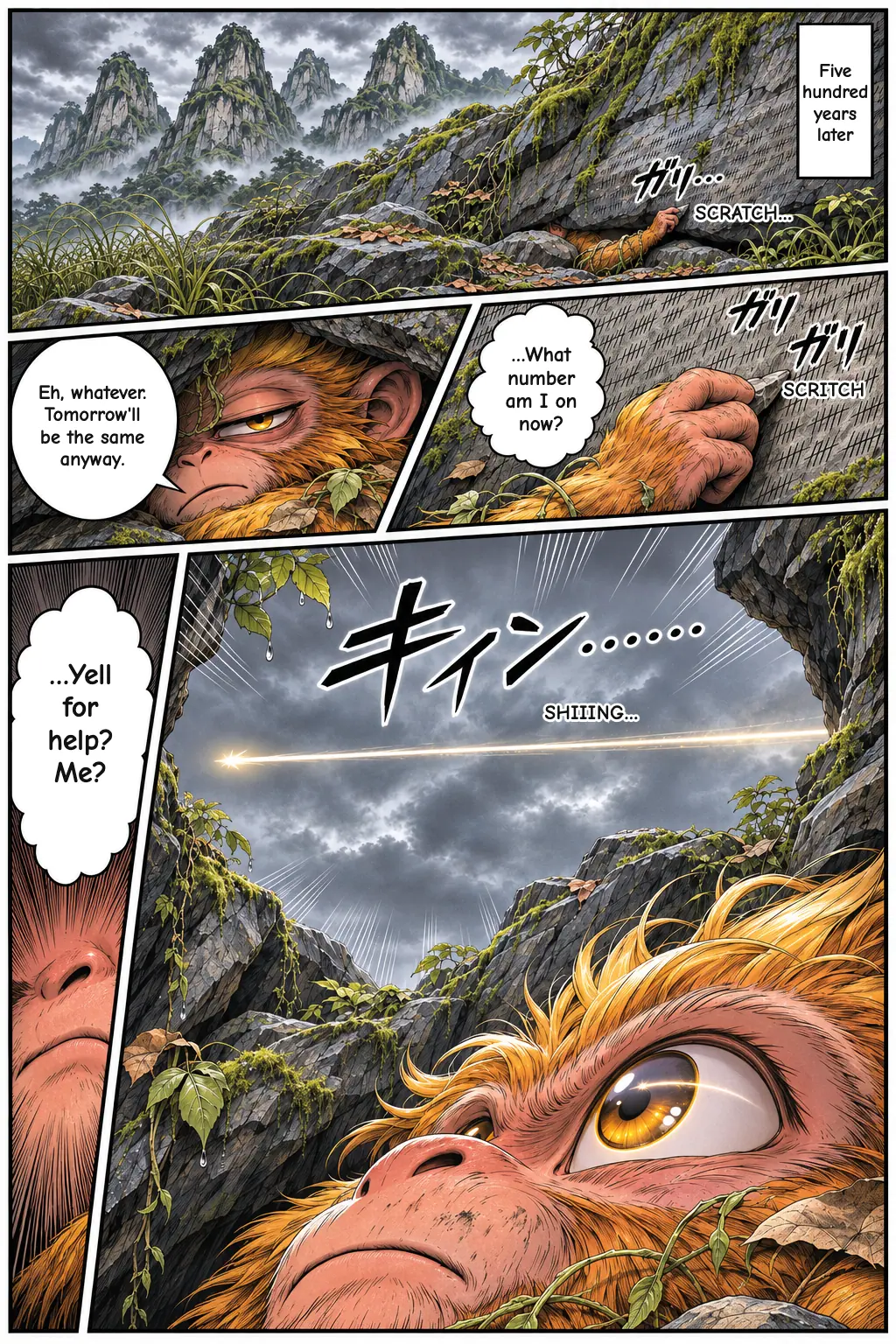
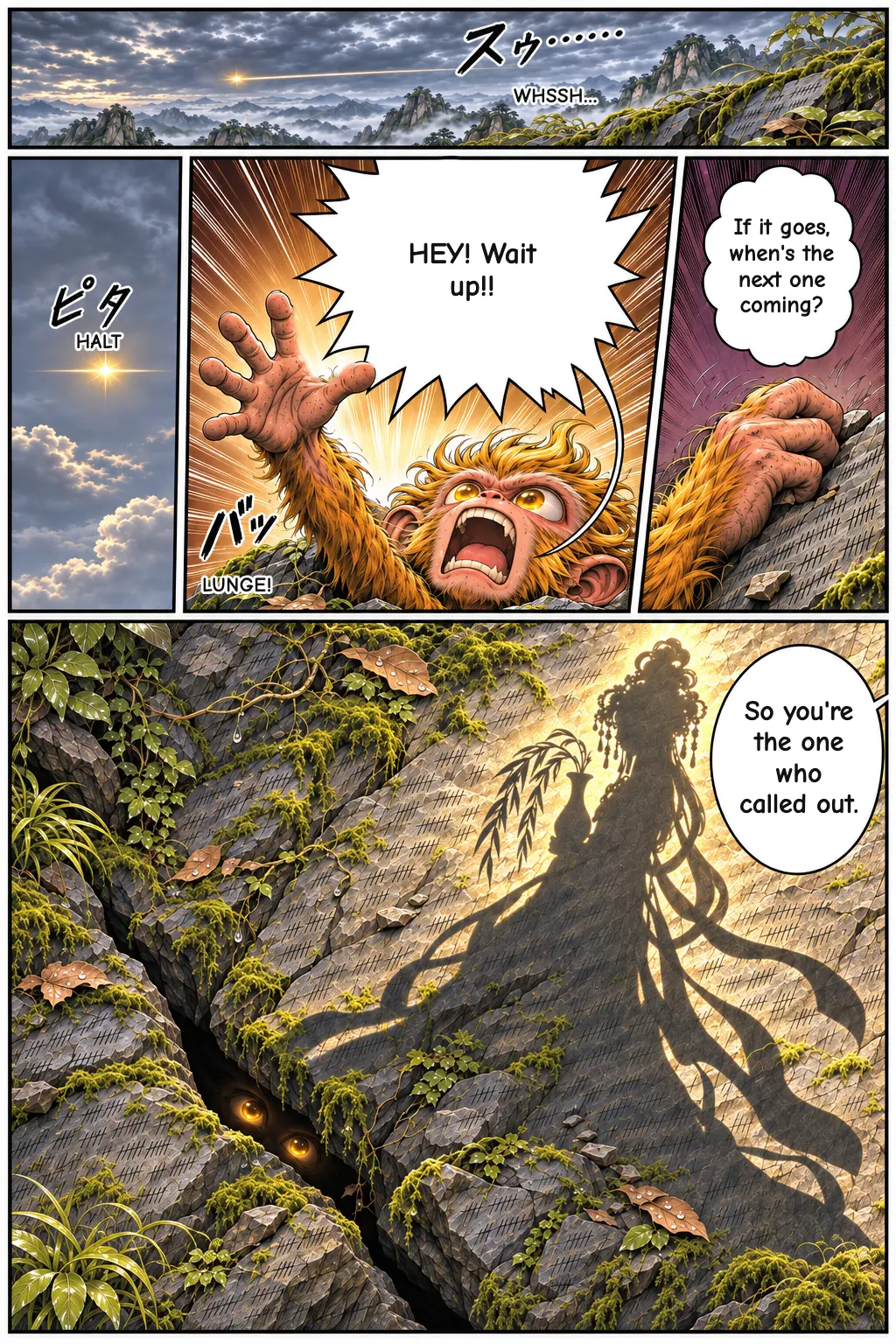
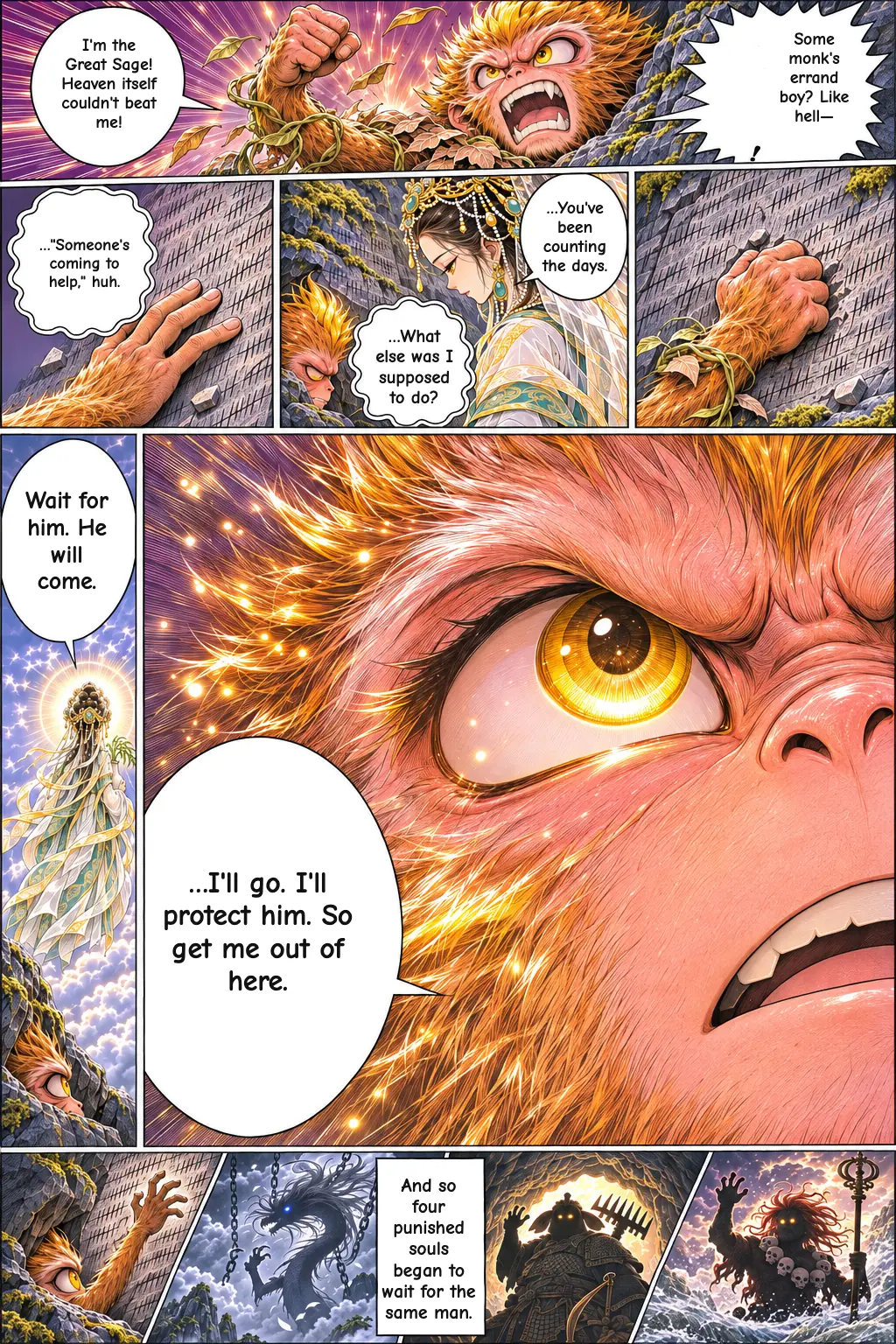
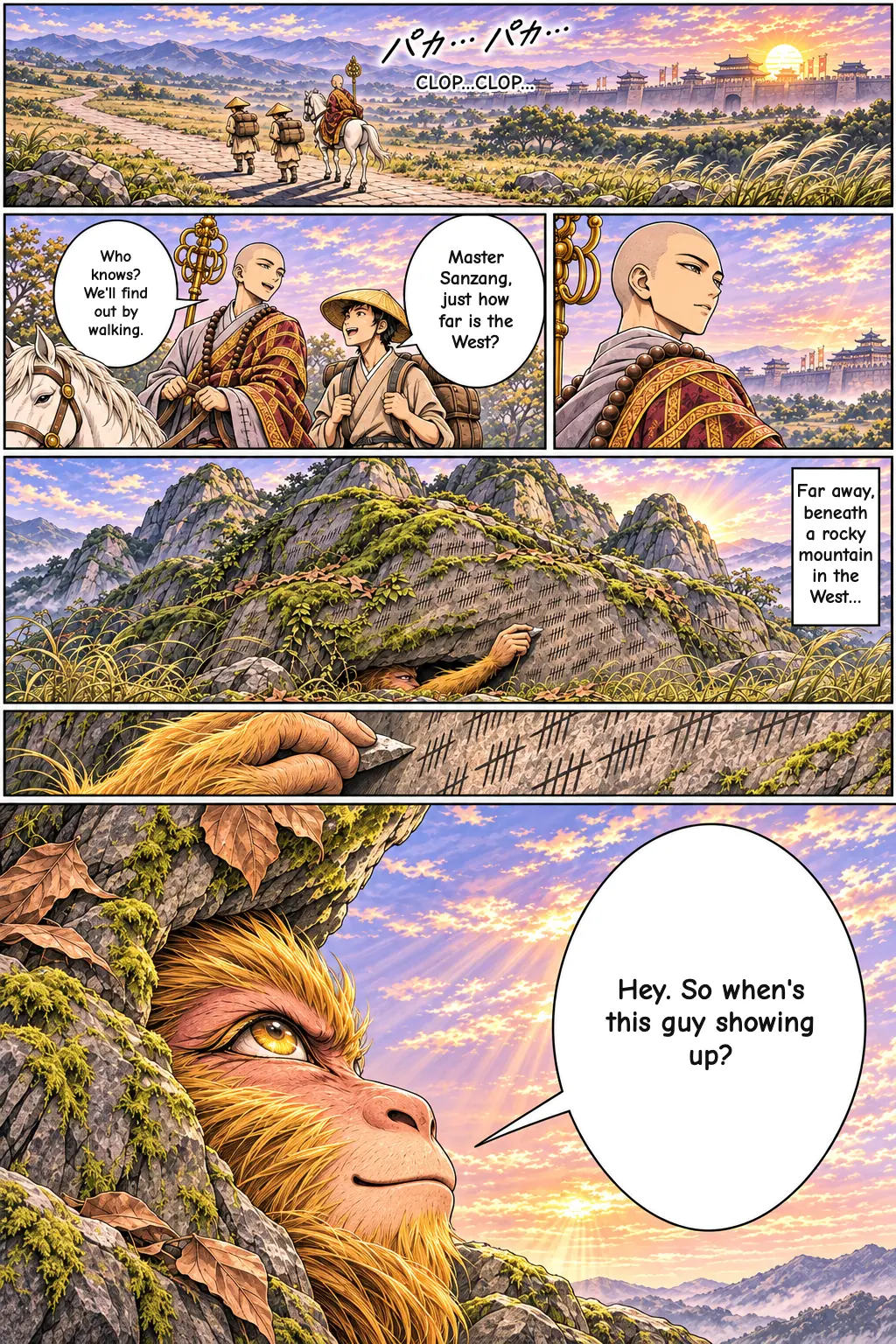
For five hundred years, Sun Wukong has scratched the days into the rock that pins him down, until a single beam of light passes overhead. The light belongs to Guanyin Bodhisattva, who tells four punished souls to wait for a certain monk. In Chang'an, a young monk with no special powers steps forward to make the journey west, not knowing that anyone is waiting for him.
Story summary
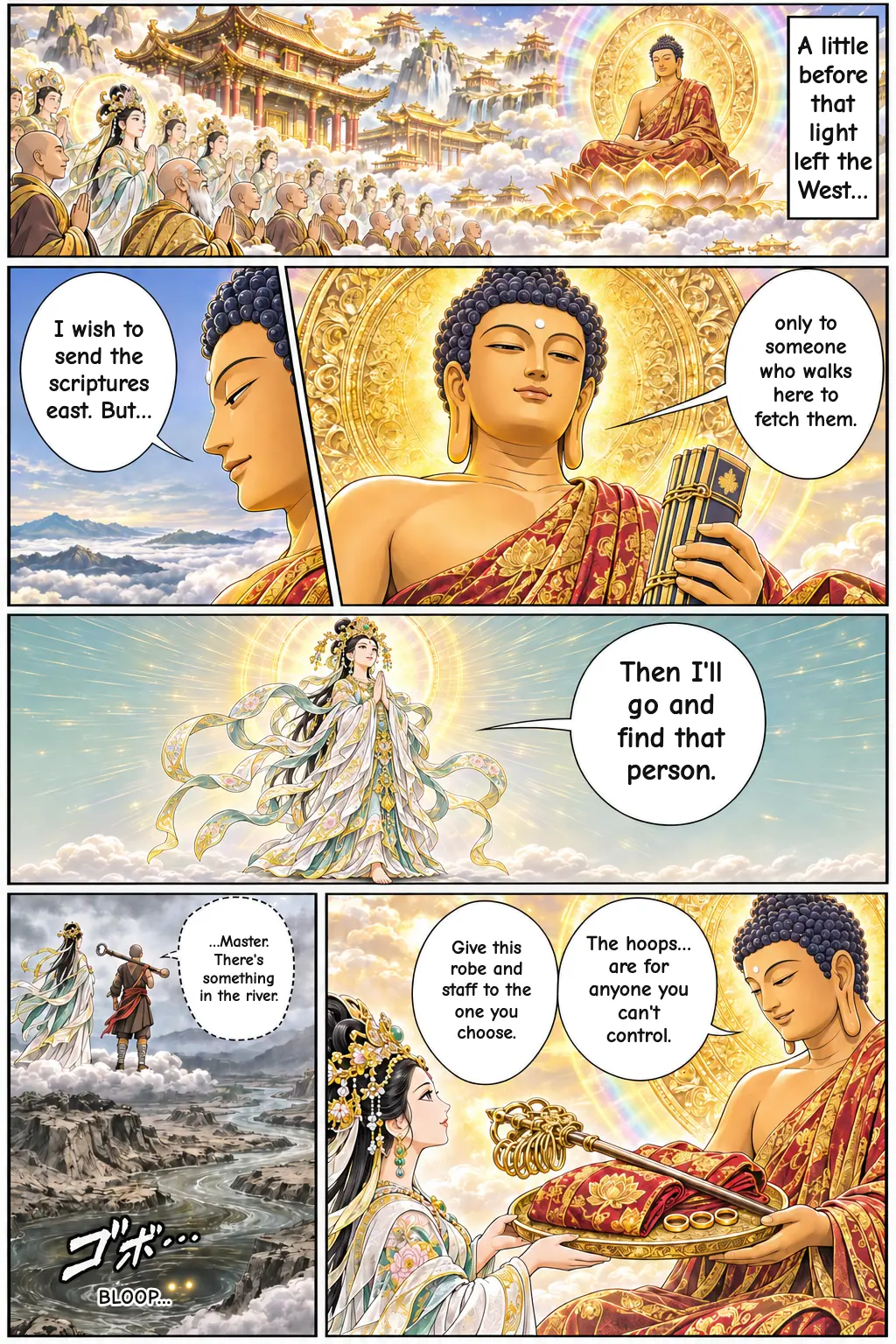
About five hundred years after Sun Wukong, the Monkey King, was pinned under the Mountain of Five Elements for rebelling against Heaven, the Buddha holds a feast at his paradise on Vulture Peak. He looks over the four great continents of the world and grieves over the southern one, where China lies: its people are greedy, quarrelsome and quick to kill. He has scriptures that could lead them toward goodness, the Tripitaka, or "three baskets" of teachings, divided into law, treatises and sutras. But the Buddha will not simply send them.
Journey to the West Summary: Guanyin, the Caged Monkey, and Tang Sanzang's Journey Begins
In short: In Journey to the West, the pilgrimage begins when the Buddha decides that his scriptures must be fetched from the west by someone who suffers to earn them, and sends Guanyin, the bodhisattva of compassion, east to find that person. On the way, Guanyin promises four punished beings, including Sun Wukong, who has been trapped under a mountain for 500 years, that they can earn forgiveness by guarding the pilgrim. In Chang'an, the monk Xuanzang volunteers, receives the name Sanzang, and sets out. This happens in chapters 8–13 of the Ming novel Journey to the West (1592 edition).
The original story: why someone has to walk west
About five hundred years after Sun Wukong, the Monkey King, was pinned under the Mountain of Five Elements for rebelling against Heaven, the Buddha holds a feast at his paradise on Vulture Peak. He looks over the four great continents of the world and grieves over the southern one, where China lies: its people are greedy, quarrelsome and quick to kill. He has scriptures that could lead them toward goodness, the Tripitaka, or "three baskets" of teachings, divided into law, treatises and sutras.
But the Buddha will not simply send them. Scriptures handed over for free, he says, would be treated lightly. Someone from the East must cross a thousand mountains and ten thousand rivers to come and ask for them. Guanyin (the bodhisattva of compassion) offers to go and find that person. The Buddha gives her a jeweled brocade cassock and a nine-ringed monk's staff for the pilgrim, plus three magic headbands with their spells, to be used if a disobedient demon ever becomes the pilgrim's disciple. Guanyin sets off with her disciple Huian (also called Muzha), traveling low through the clouds so she can learn the road.
The four who are told to wait
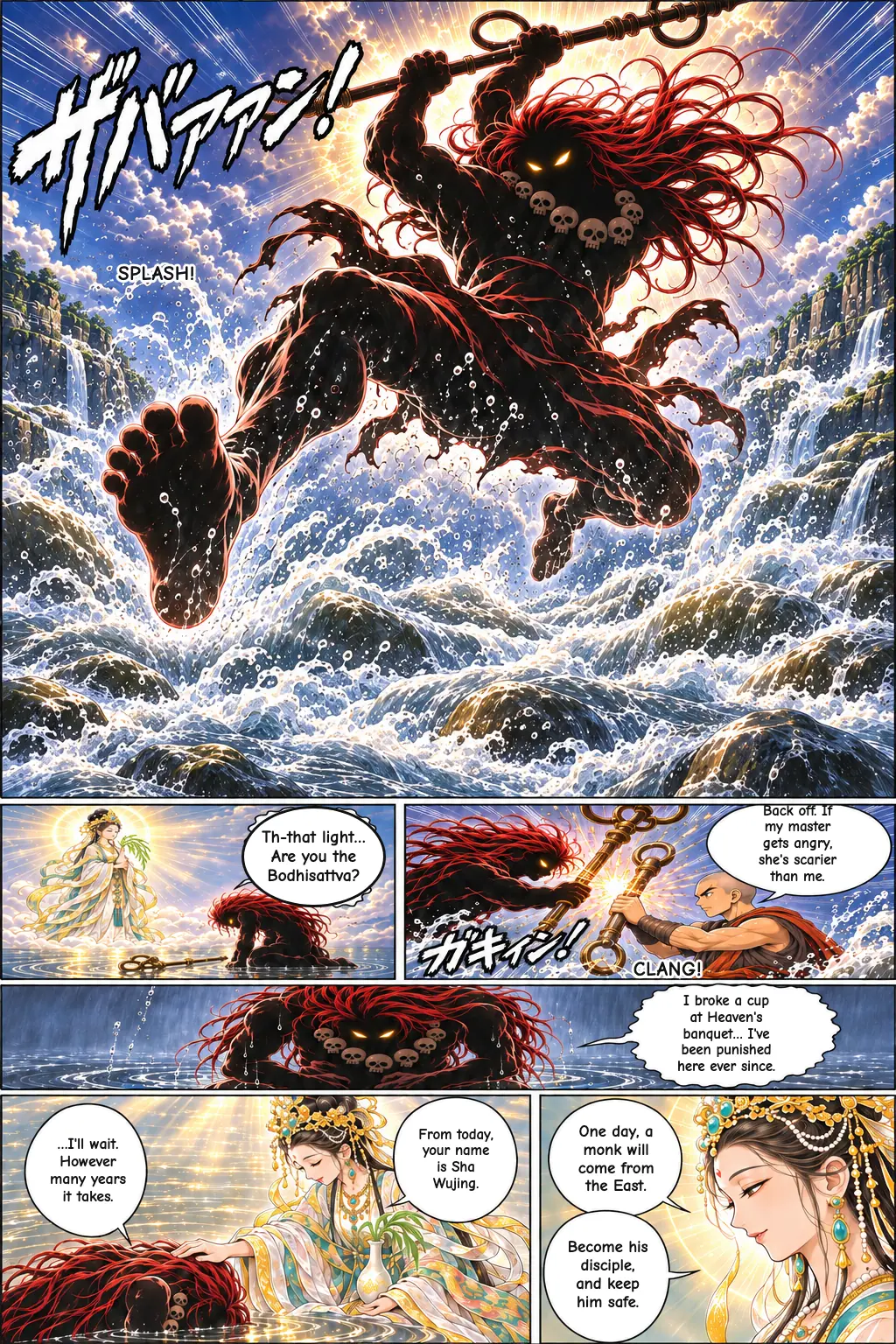
Guanyin's trip east is a recruiting journey, although nobody she meets knows the pilgrim yet. At the River of Flowing Sand, a monster wearing a necklace of nine skulls attacks, fights Huian, then surrenders when he learns who Guanyin is. He was once a general in Heaven, thrown down to earth for breaking a crystal cup at the Peach Banquet, and he is stabbed in the side with a flying sword every seven days. He has been eating travelers, and the nine skulls belonged to earlier pilgrims that would not sink. Guanyin gives him vows and the name Sha Wujing.
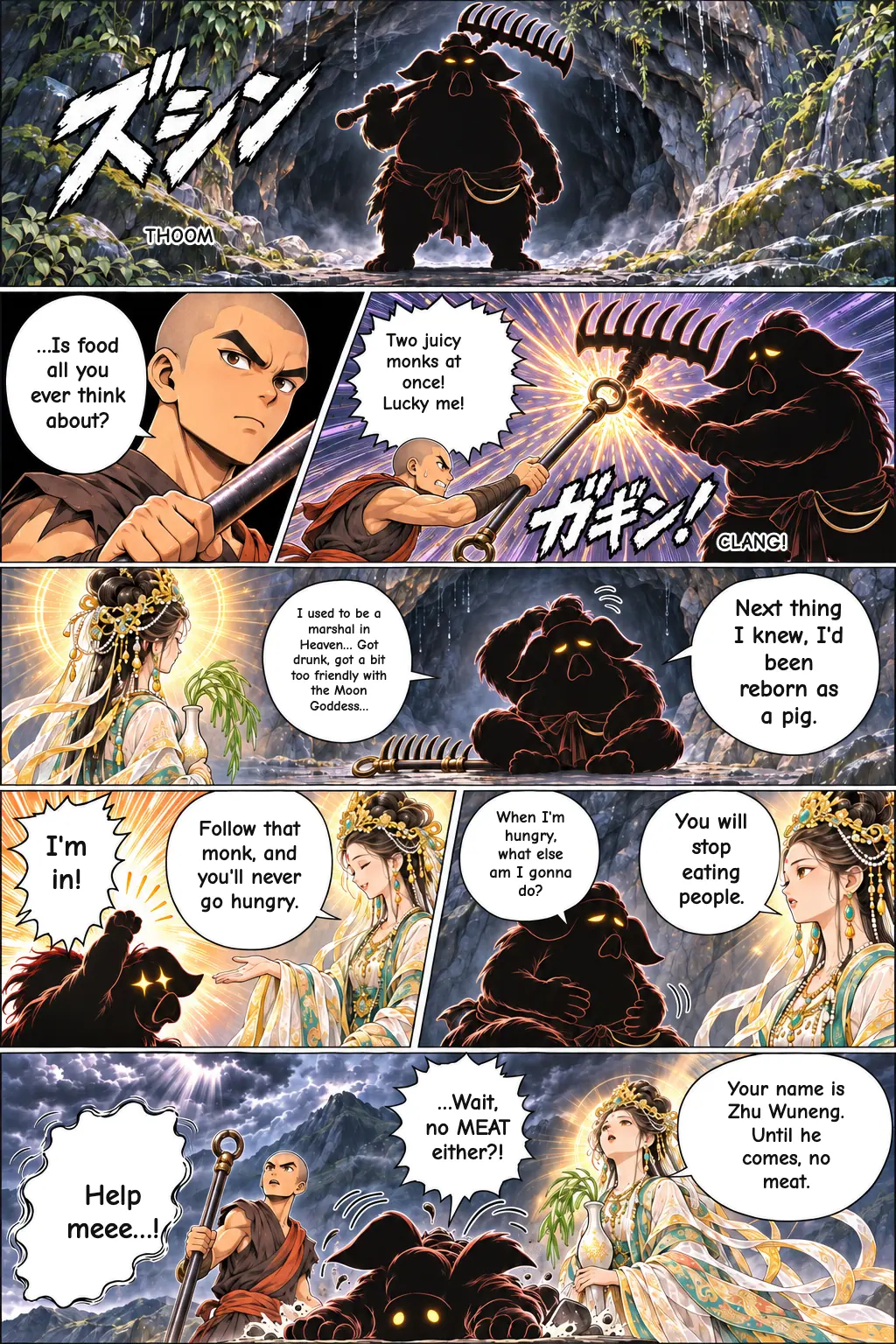
At Fuling Mountain she meets a pig-faced monster with a nine-toothed rake. He was once Marshal Tianpeng, commander of Heaven's river forces, exiled for drunkenly flirting with the moon goddess Chang'e, and he was mistakenly reborn from a sow's womb. Guanyin names him Zhu Wuneng and tells him to give up eating people. Readers know him better by his later name, Zhu Bajie (Pigsy), which the monk gives him in chapter 19.
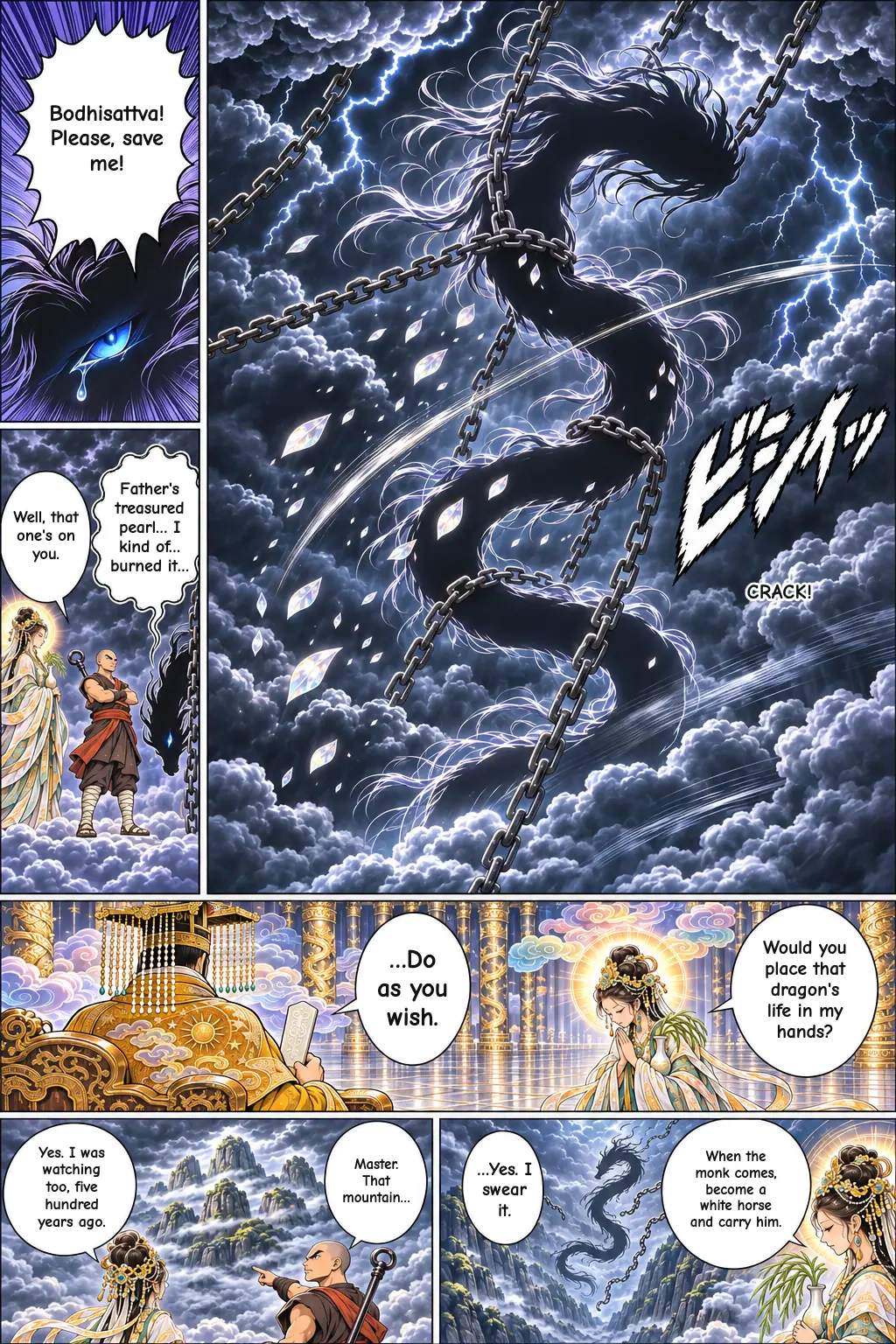
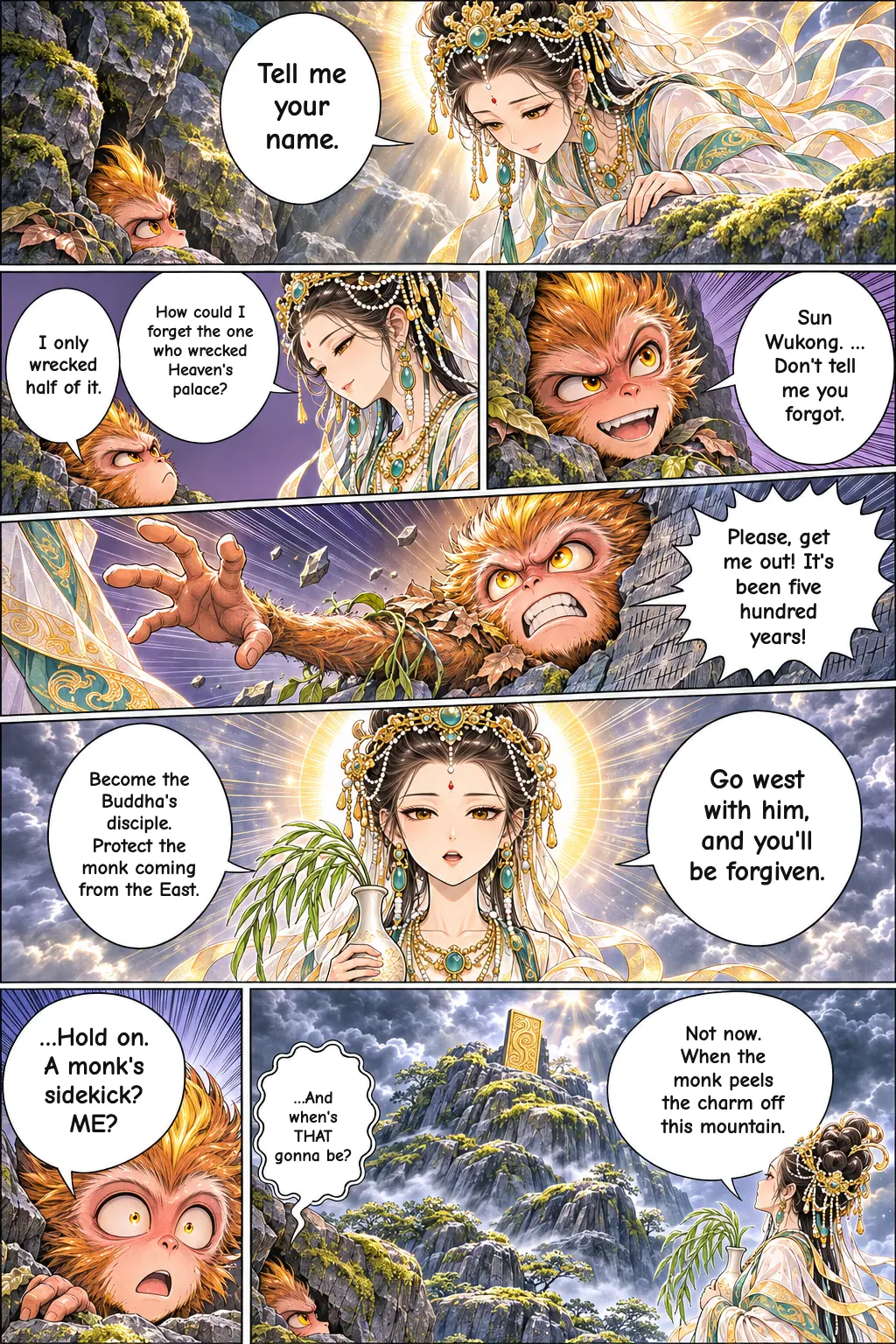
Next she finds a dragon prince, son of Ao Run, the Dragon King of the Western Sea. He is hanging in the sky waiting to be executed for burning a pearl in his father's palace. Guanyin asks the Jade Emperor to pardon him, and he is told to wait in a ravine and become the pilgrim's horse. Last of all, at the Mountain of Five Elements, Sun Wukong begs for help. Guanyin promises he will be freed if he becomes a Buddhist and protects the pilgrim all the way west, and he agrees.
Chang'an, the Grand Mass, and a monk with no powers
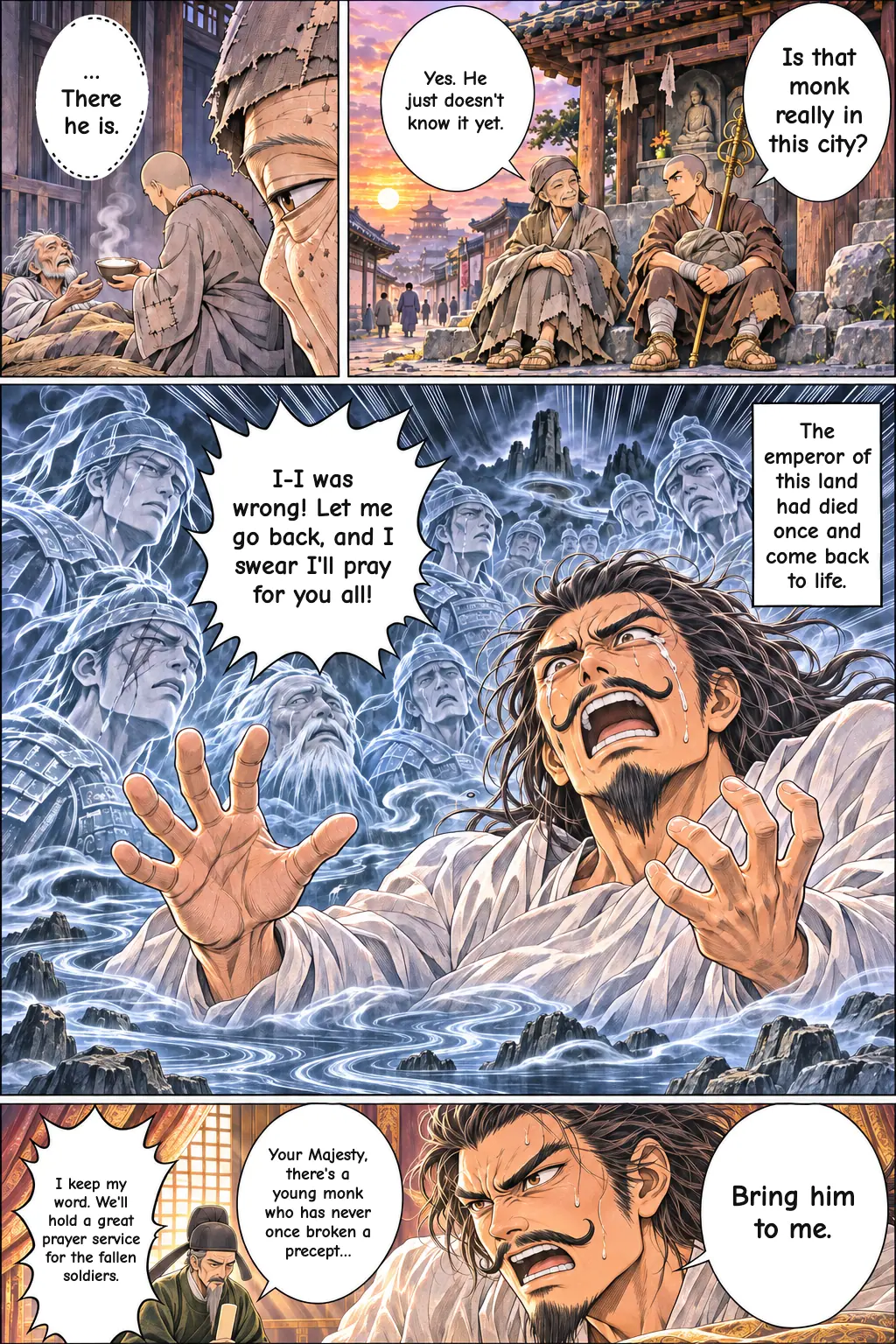
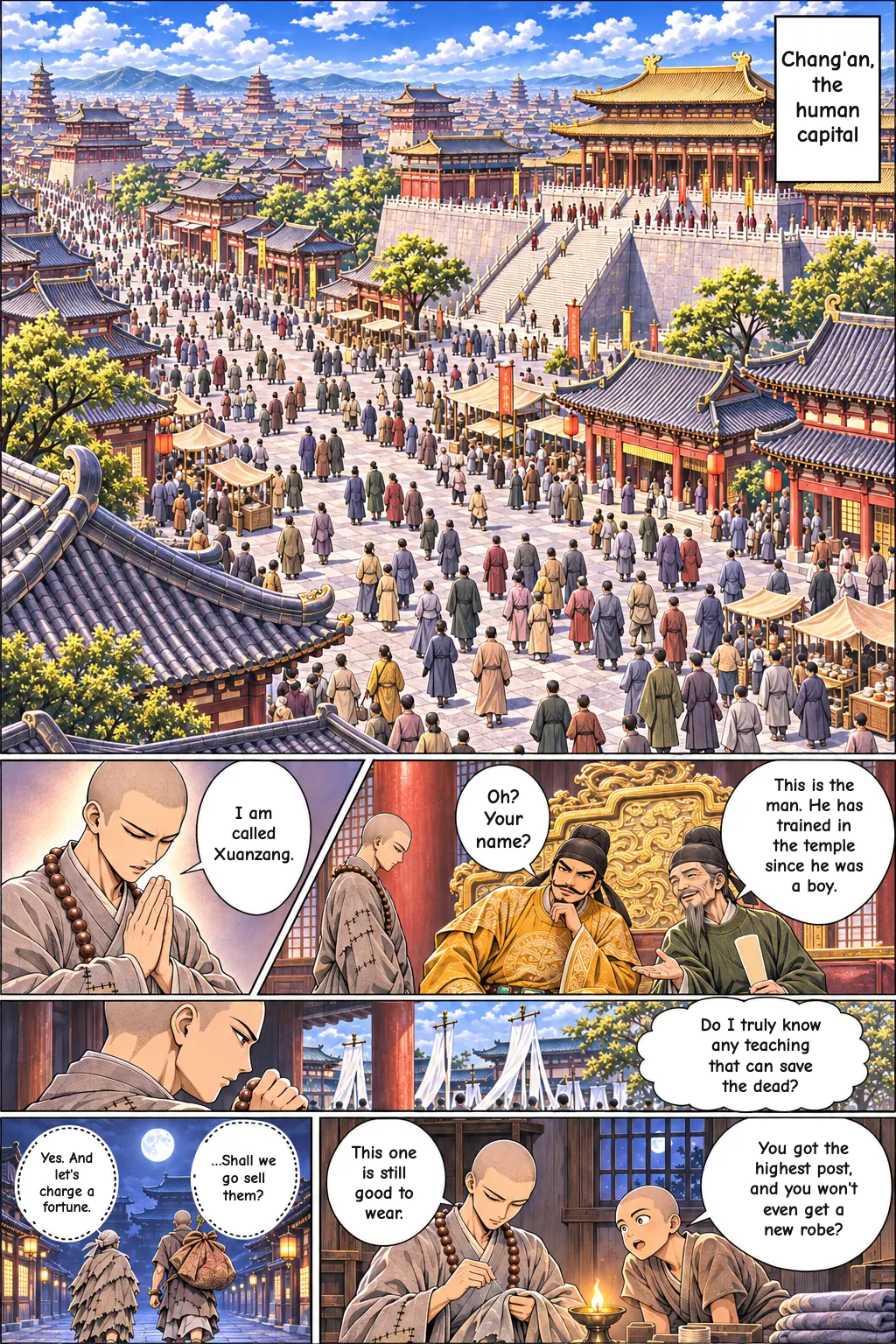
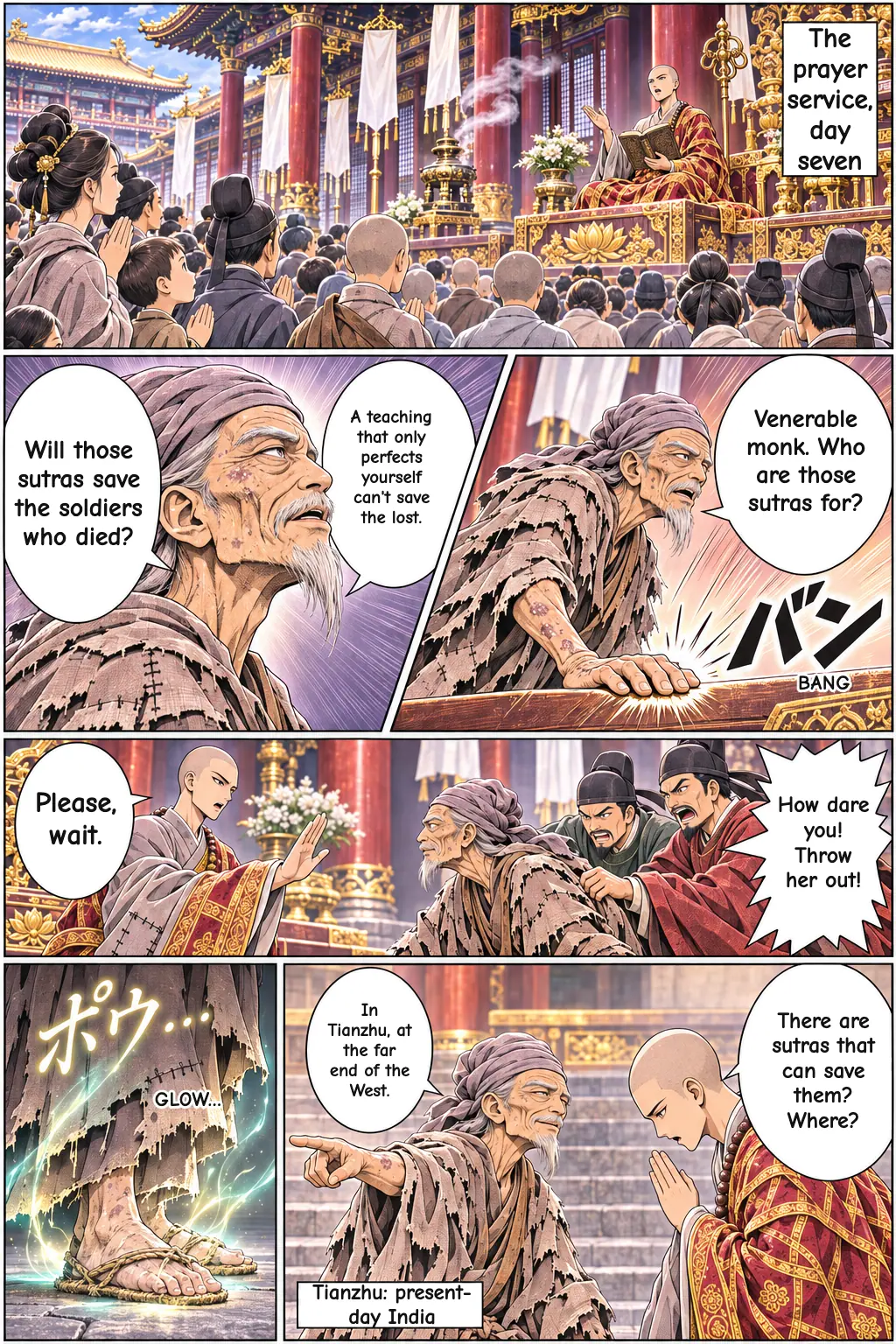
Chapters 9–11 explain why China's capital is ready. The Dragon King of the Jing River breaks Heaven's orders about rain and is sentenced to be beheaded by the minister Wei Zheng. Emperor Taizong of Tang fails to save him, dies, and tours the underworld, where the ghosts of men killed in his wars surround him. He is sent back to life with twenty extra years and promises to hold a great mass for the dead. The monk Xuanzang, a reincarnation of the Golden Cicada, a disciple of the Buddha who was sent to be reborn for neglecting the teachings, is chosen to lead it.
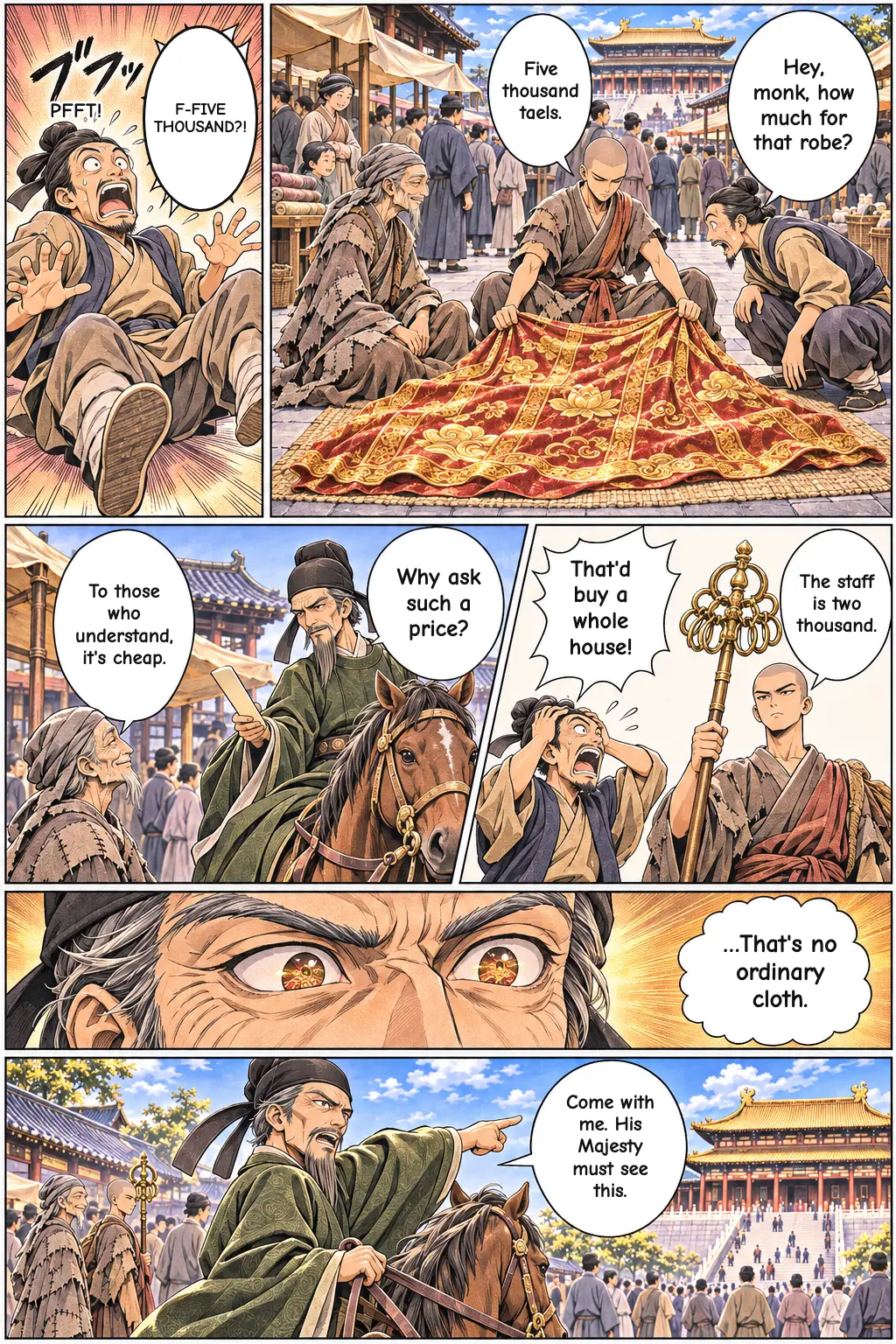
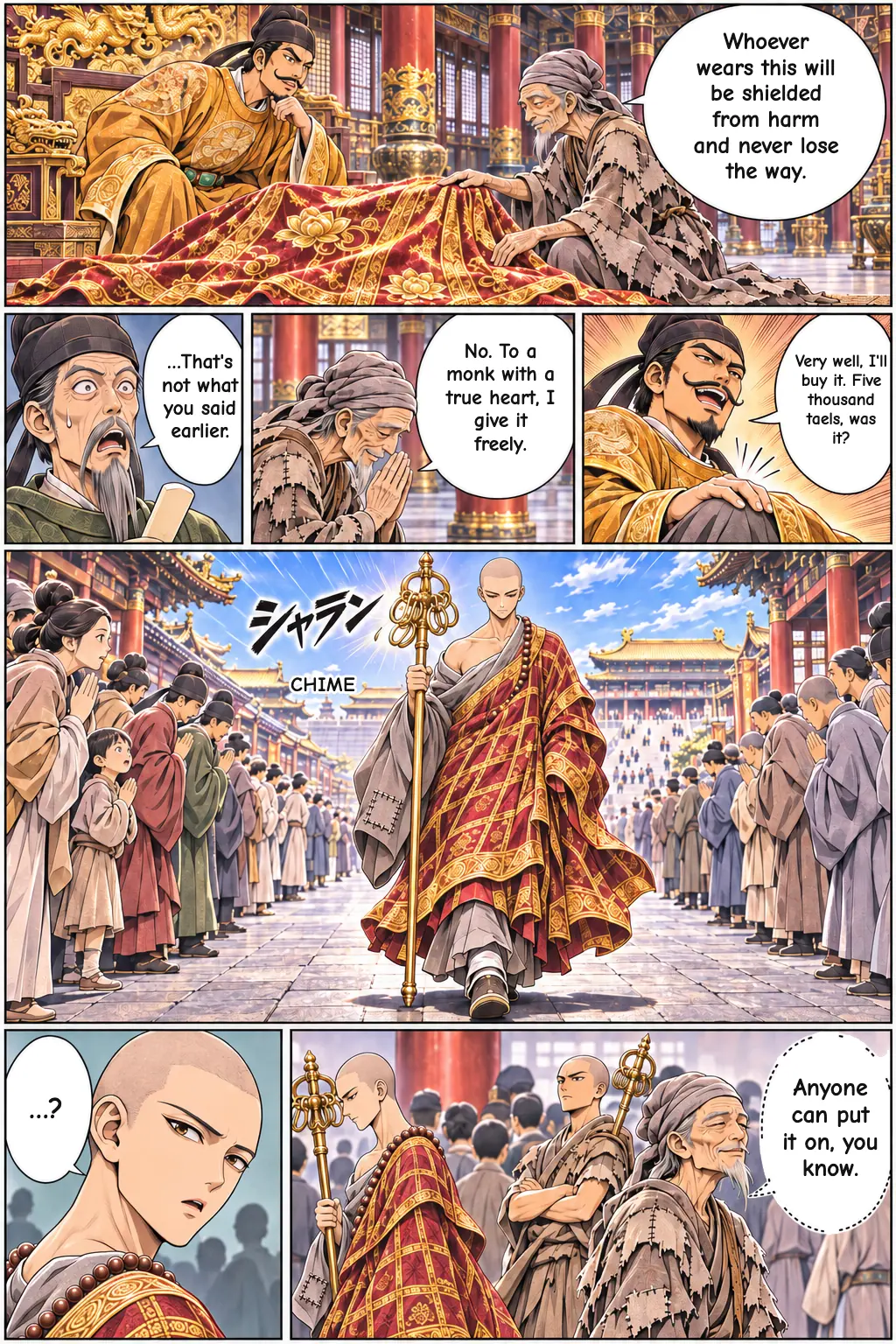
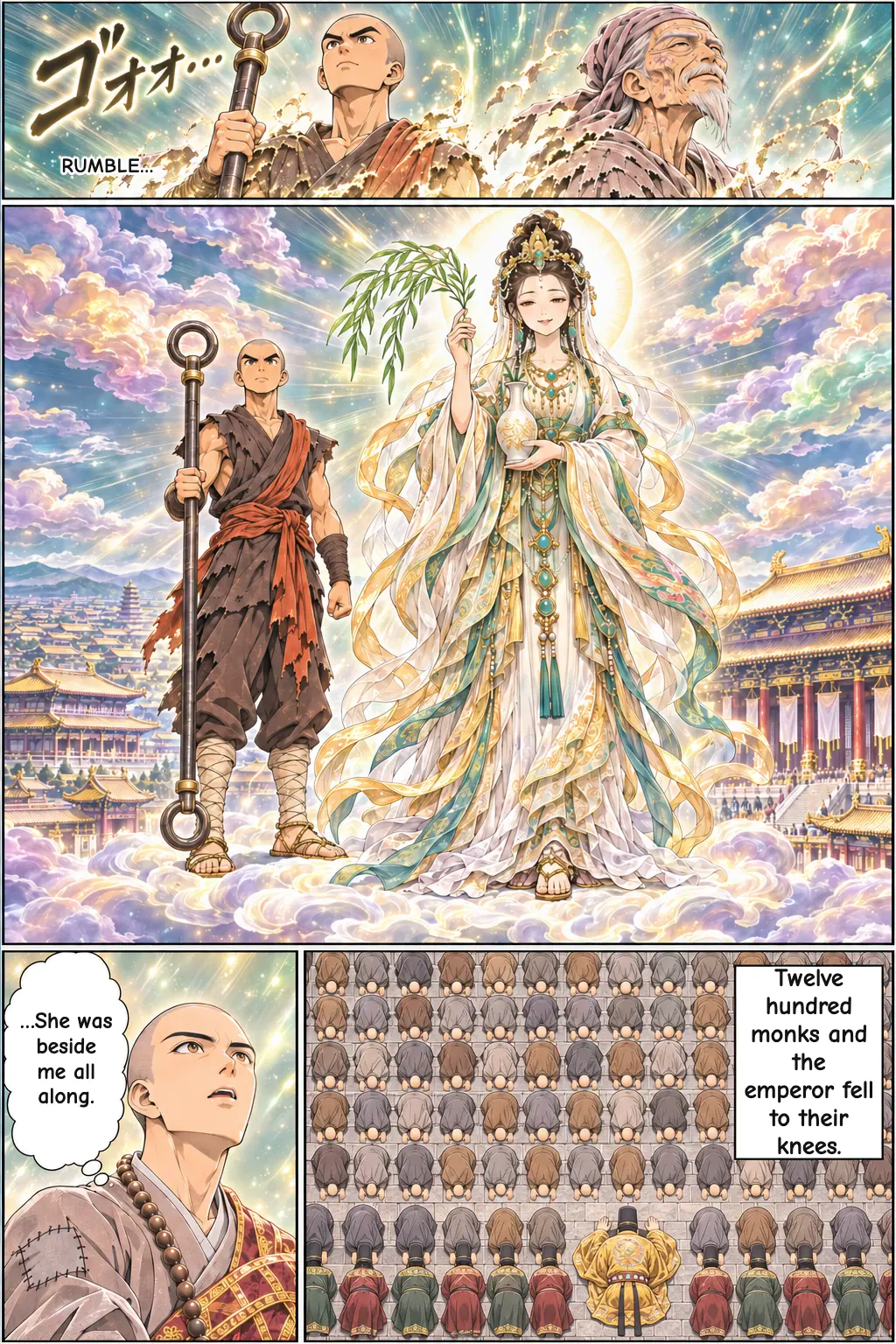
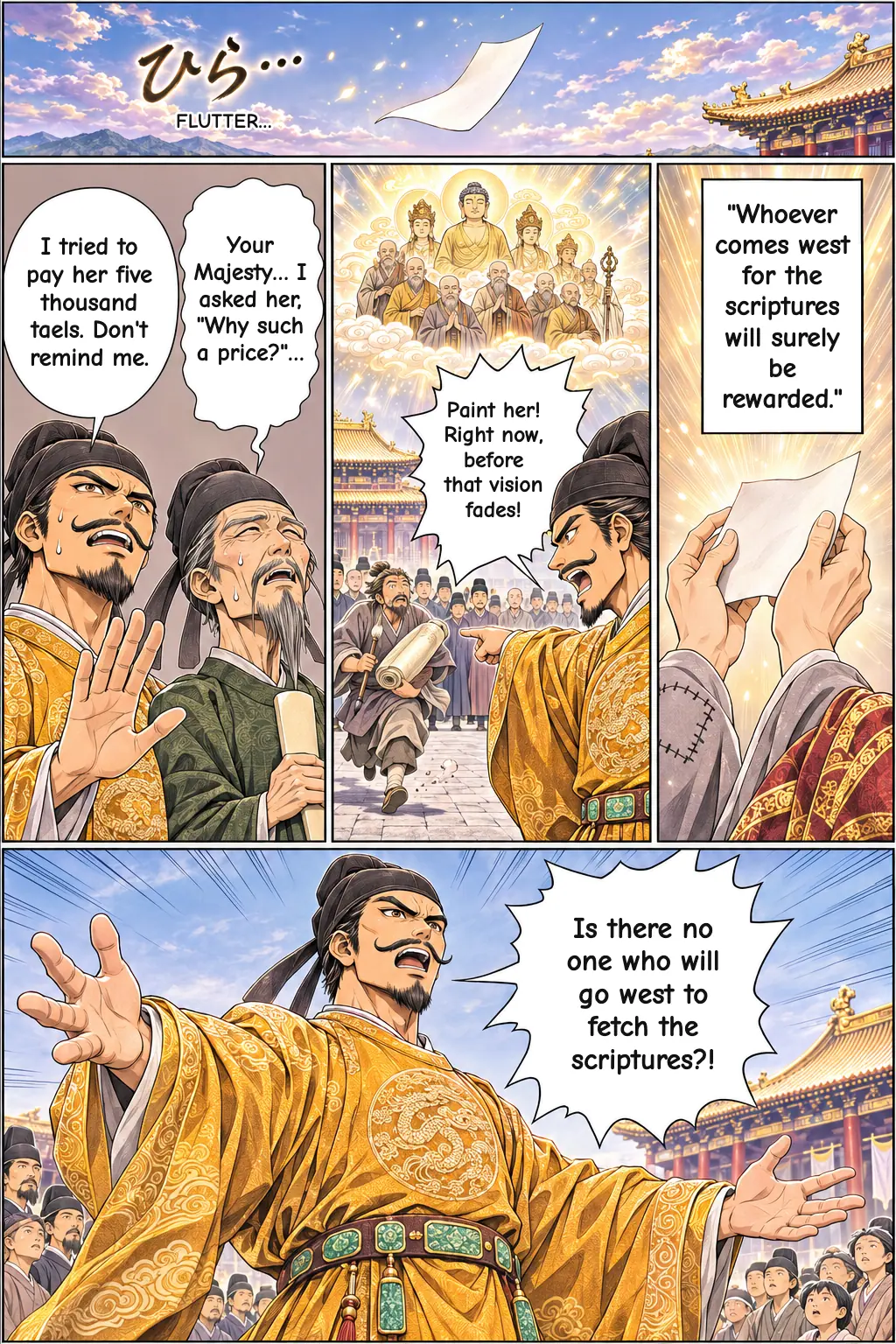
In chapter 12, Guanyin and Huian, disguised as scabby, ragged monks, offer the cassock and staff for sale at outrageous prices. The minister Xiao Yu brings them to the emperor, and Guanyin gives both treasures to Xuanzang for free. At the mass she challenges him: he teaches only the "Small Vehicle" (Hinayana), which cannot save the dead, while the "Great Vehicle" (Mahayana) scriptures wait in the far west. Then she rises into the sky in her true form, holding a willow branch and a vase of pure water.
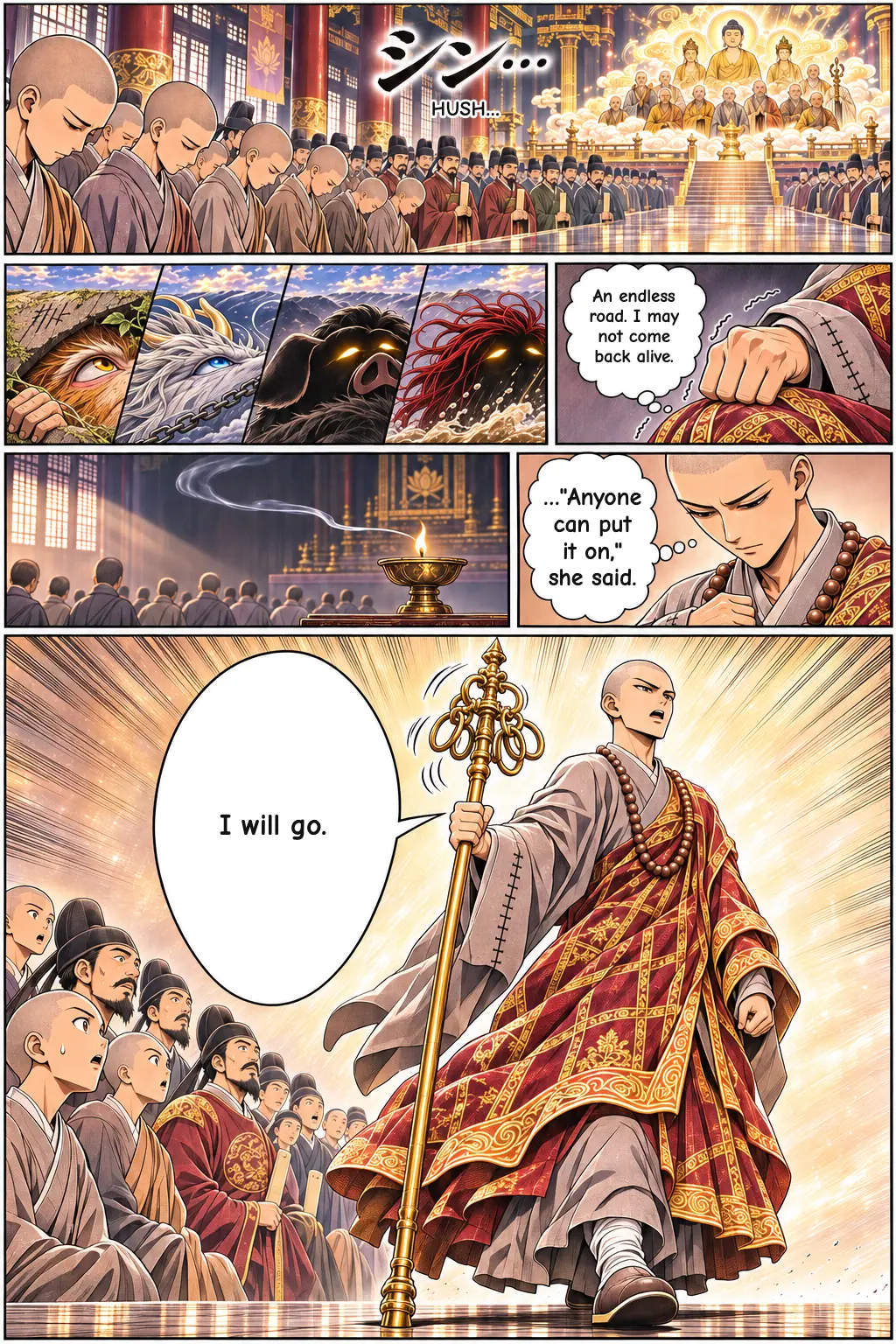
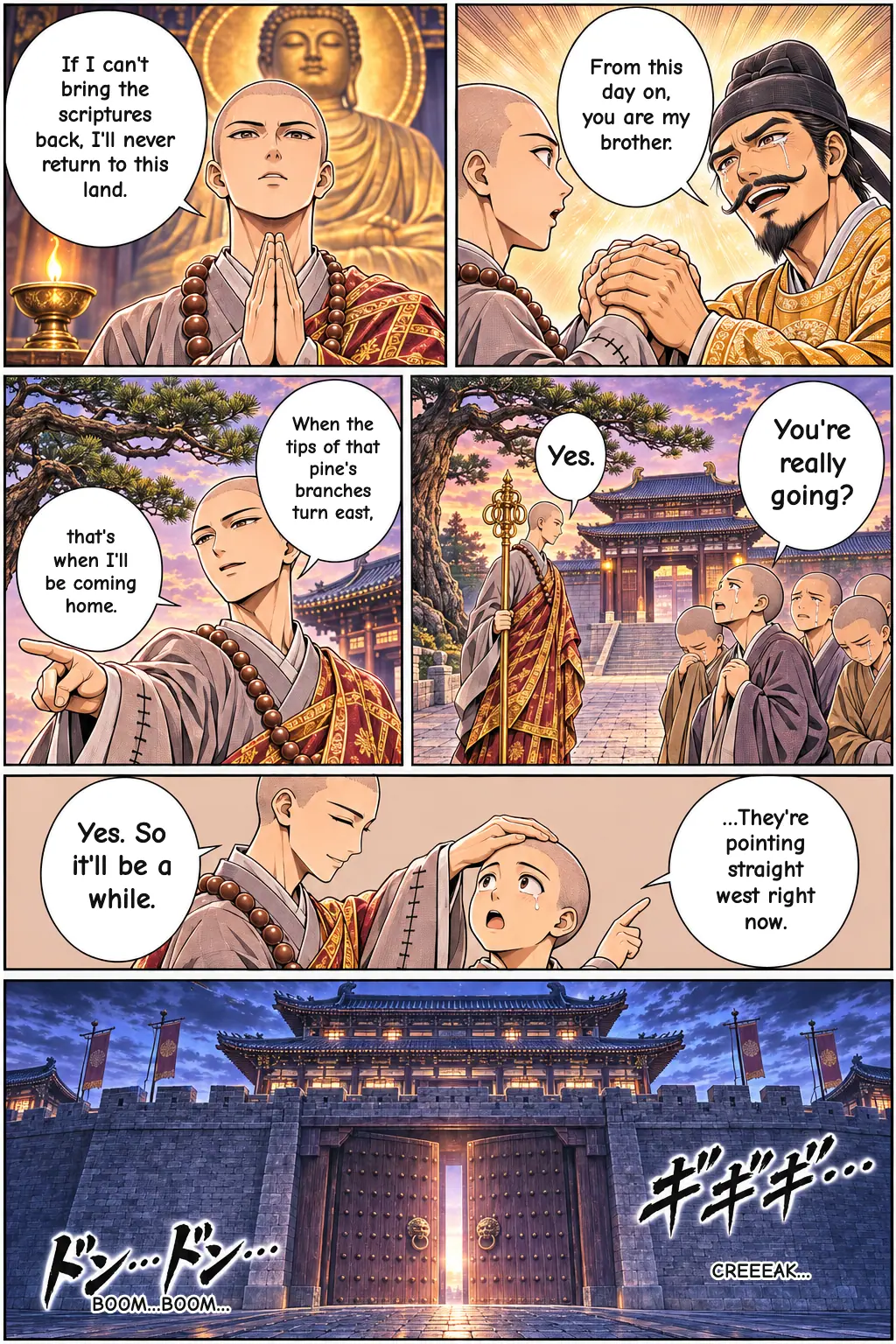
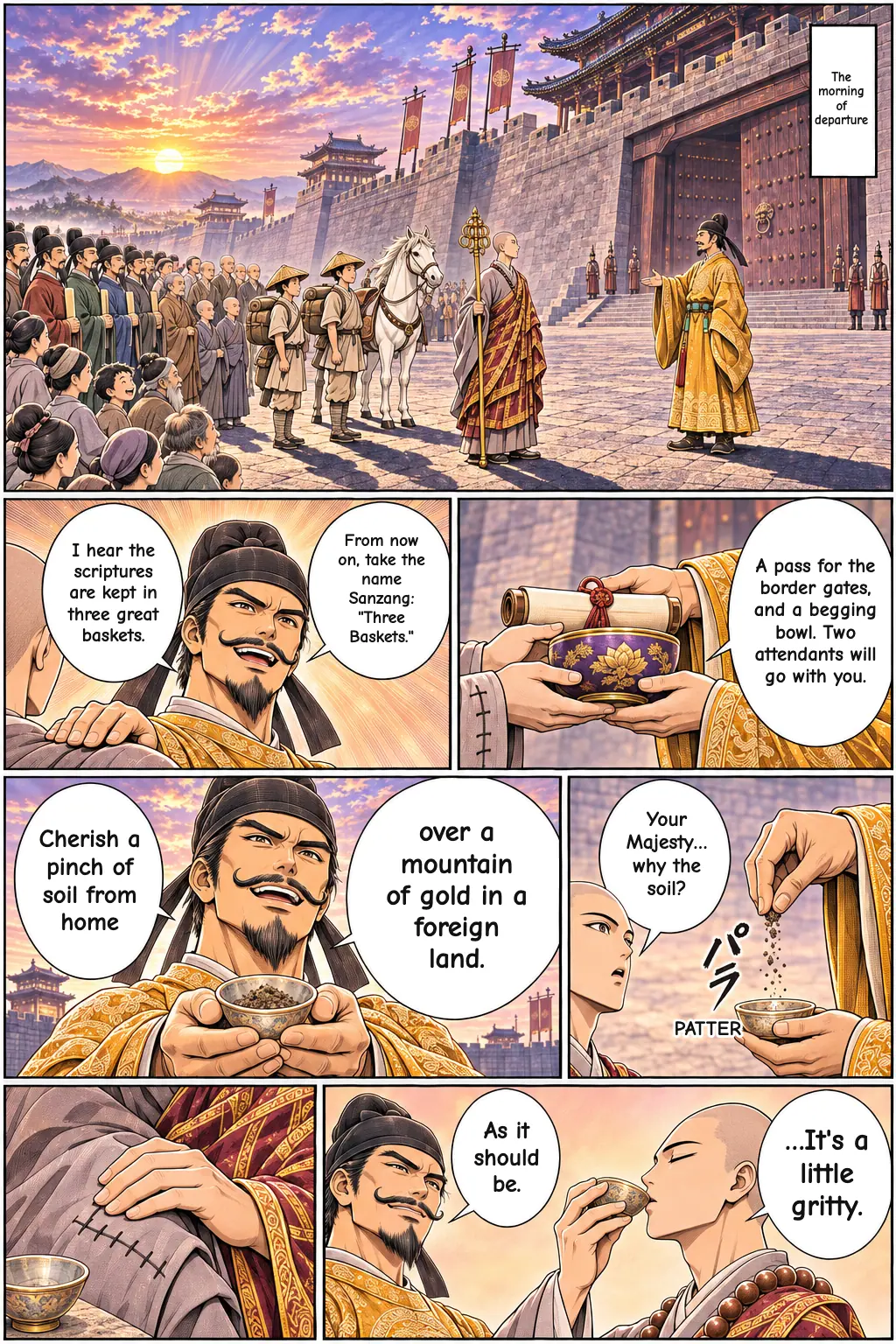
When Taizong asks who will go, Xuanzang steps forward. The emperor makes him his sworn brother and gives him the name Sanzang. Xuanzang vows never to return without the scriptures. At the farewell, Taizong drops a pinch of earth into his wine, a reminder of home. In chapter 13, demons eat his two attendants almost at once. An old man, who turns out to be the god Taibai Jinxing, rescues him, and the hunter Liu Boqin saves him from a tiger and guides him to Double Boundary Mountain.
What this part of the story is saying
Journey to the West was published in 1592 during the Ming dynasty and is often attributed to Wu Cheng'en, although scholars still debate the authorship. It is loosely based on the real monk Xuanzang, who traveled from China to India in the 7th century to collect Buddhist texts. The novel turns that trip into a cosmic plan.
This section sets up the book's central idea: truth has to be earned through hardship, and wrongdoers can make up for their crimes by serving others. Every future disciple is a fallen or punished being, and the journey will be their penance. Xuanzang himself is the opposite of a superhero. He has sincerity and resolve, but no magic at all.
What the manga changes
Episode 8 follows the original order of events: the River of Flowing Sand, Fuling Mountain, the dragon, and then Wukong. The manga's own additions are mostly in how the story is shown. Chapters 9–11 are condensed into one page of narration, and the four visits are told as a montage with the characters' faces hidden in shadow. Xuanzang's inner thoughts and his hesitation before volunteering were written for the manga, because the novel says almost nothing about what he feels. The streets of Chang'an and the costumes are drawn to fit the Tang period. The novel does not clearly describe Guanyin's appearance, so that design is the artist's choice. To keep the episode suitable for all ages, the chapter 13 demon attack is softened so that the attendants simply vanish.
Where to read it
If you want to see Wukong counting his five hundred years and a nervous young monk choosing to walk into the unknown, Episode 8 of Journey to the West: The Great Sage Equal to Heaven is on Manga Portal. Every episode is free to read, and you don't need an account.
Characters in this episode
Sun Wukong (the Monkey King)
A stone-born monkey pinned under a mountain for 500 years who agrees to protect the pilgrim in exchange for his freedom.
Guanyin Bodhisattva
The bodhisattva of compassion who volunteers to find the pilgrim and gives each punished soul a way to earn forgiveness.
Tang Sanzang (Xuanzang)
A sincere young monk with no special powers who volunteers to fetch the scriptures from the west.
Emperor Taizong of Tang
The emperor who comes back from the underworld, holds a great mass for the dead and adopts Xuanzang as his sworn brother.
Sha Wujing and Zhu Wuneng
Two heavenly officers exiled to earth as monsters, who promise Guanyin they will wait for the pilgrim.
The Dragon Prince
The son of the Dragon King of the Western Sea, saved from execution so he can become the pilgrim's horse.
FAQ
How does Journey to the West begin?
After Sun Wukong's rebellion, the Buddha decides his scriptures must be fetched by a pilgrim from China who suffers on the way. Guanyin travels east to find that person and recruits future disciples as she goes, and in Chang'an the monk Xuanzang volunteers.
Why was Sun Wukong trapped under a mountain for 500 years?
He rebelled against Heaven and caused chaos in the heavenly palace, so the Buddha pinned him under the Mountain of Five Elements. Guanyin later promises he will be freed if he protects the pilgrim on the journey west.
Why didn't the Buddha just send the scriptures to China?
In the novel, the Buddha says scriptures given away freely would be taken lightly. Someone has to come and earn them through hardship, so that the teachings are valued.
Who is Tang Sanzang?
He is the monk Xuanzang. In the novel, he is a reincarnated disciple of the Buddha who leads Emperor Taizong's mass and volunteers to go west, and the emperor gives him the name Sanzang. He is based on a real 7th-century monk who traveled to India.
Why did Guanyin give Tang Sanzang a cassock and a staff?
The Buddha made both treasures for the pilgrim. Guanyin, disguised as a ragged monk, used them to test the court in Chang'an and then gave them to Xuanzang for free.