The next episode should be out around November 26Bookmark the series page so you can jump back in when the next episode is out: Journey to the WestRSS for this series
Get new episodes in your feed. Follow us on:ThreadsBluesky
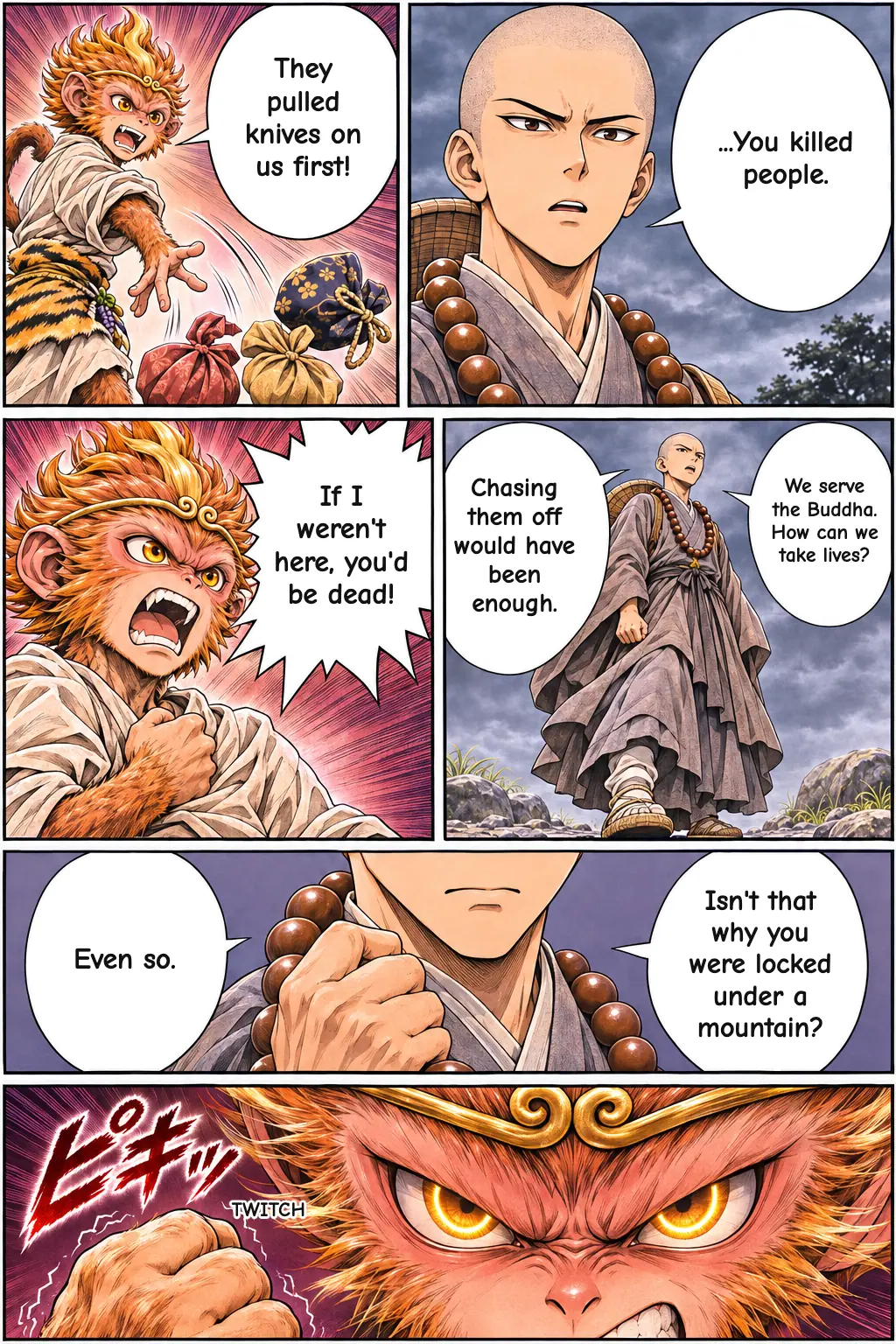
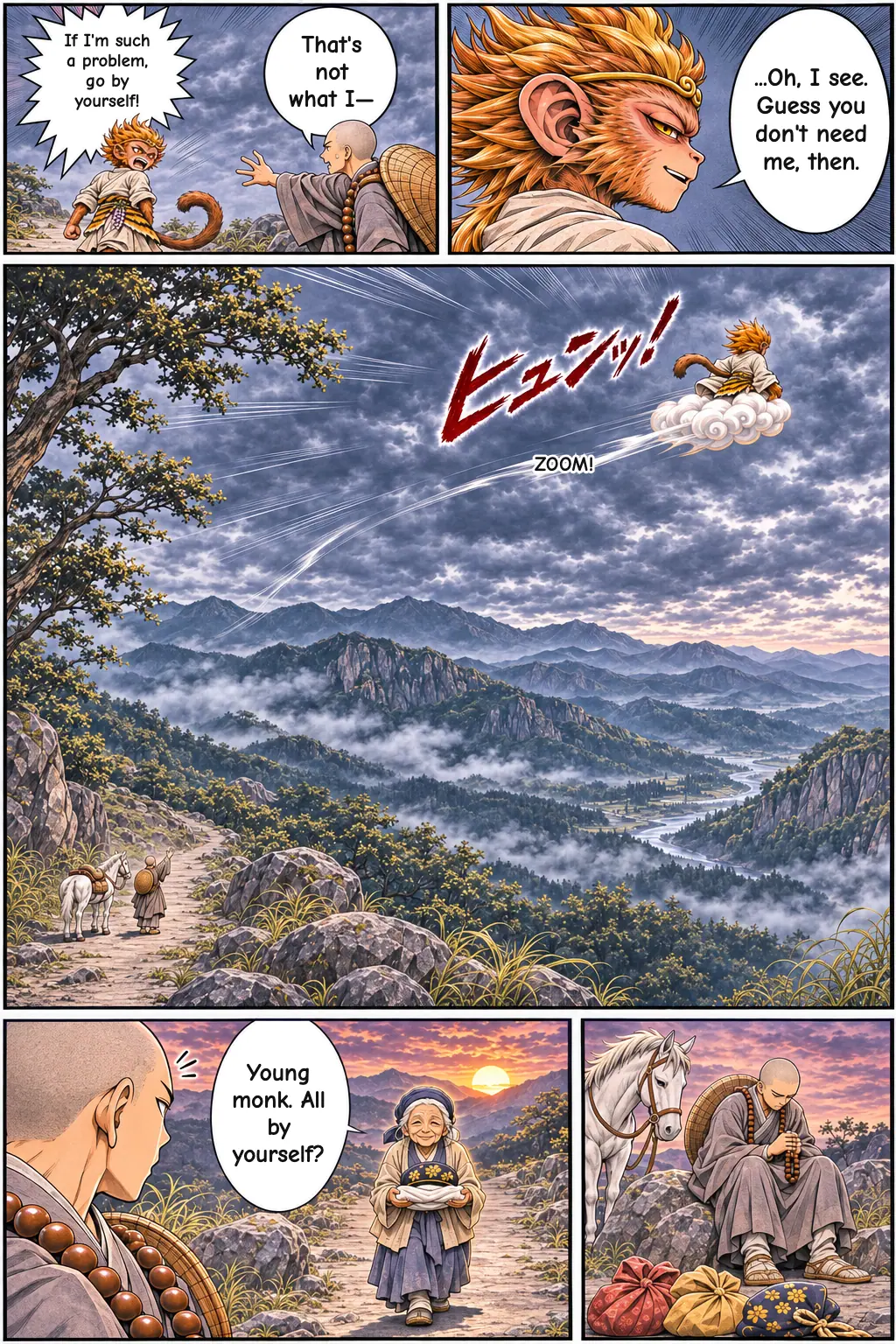
After five hundred years trapped beneath a mountain, Sun Wukong finally meets the young monk Tang Sanzang, who peels away the seal and sets him free to soar into the open sky. But when Wukong takes down a gang of bandits and expects praise, his new master scolds him hard. The monkey storms off—and when he chooses to come back on his own, a little golden band is waiting for him… one that will never come off.
Story summary
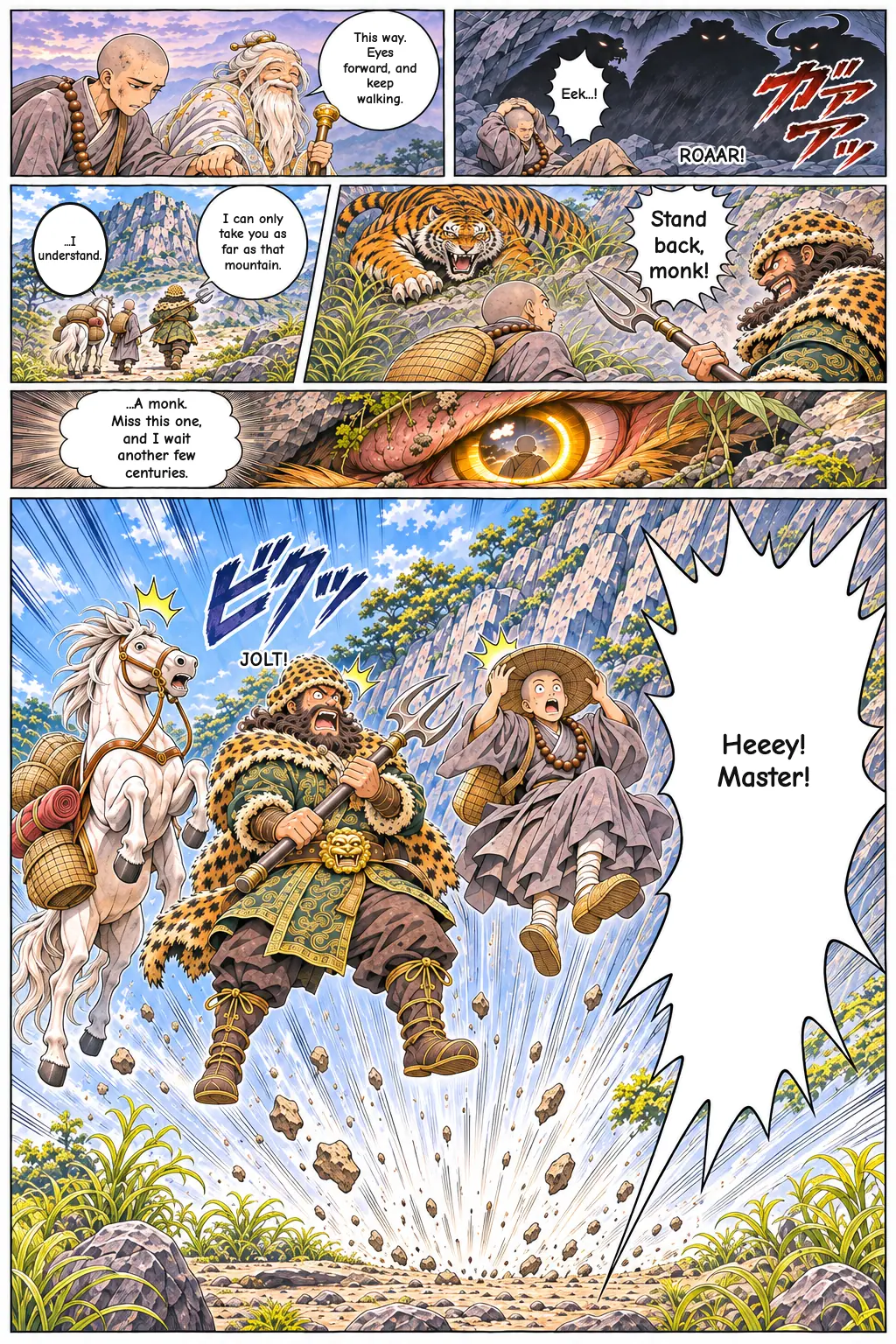
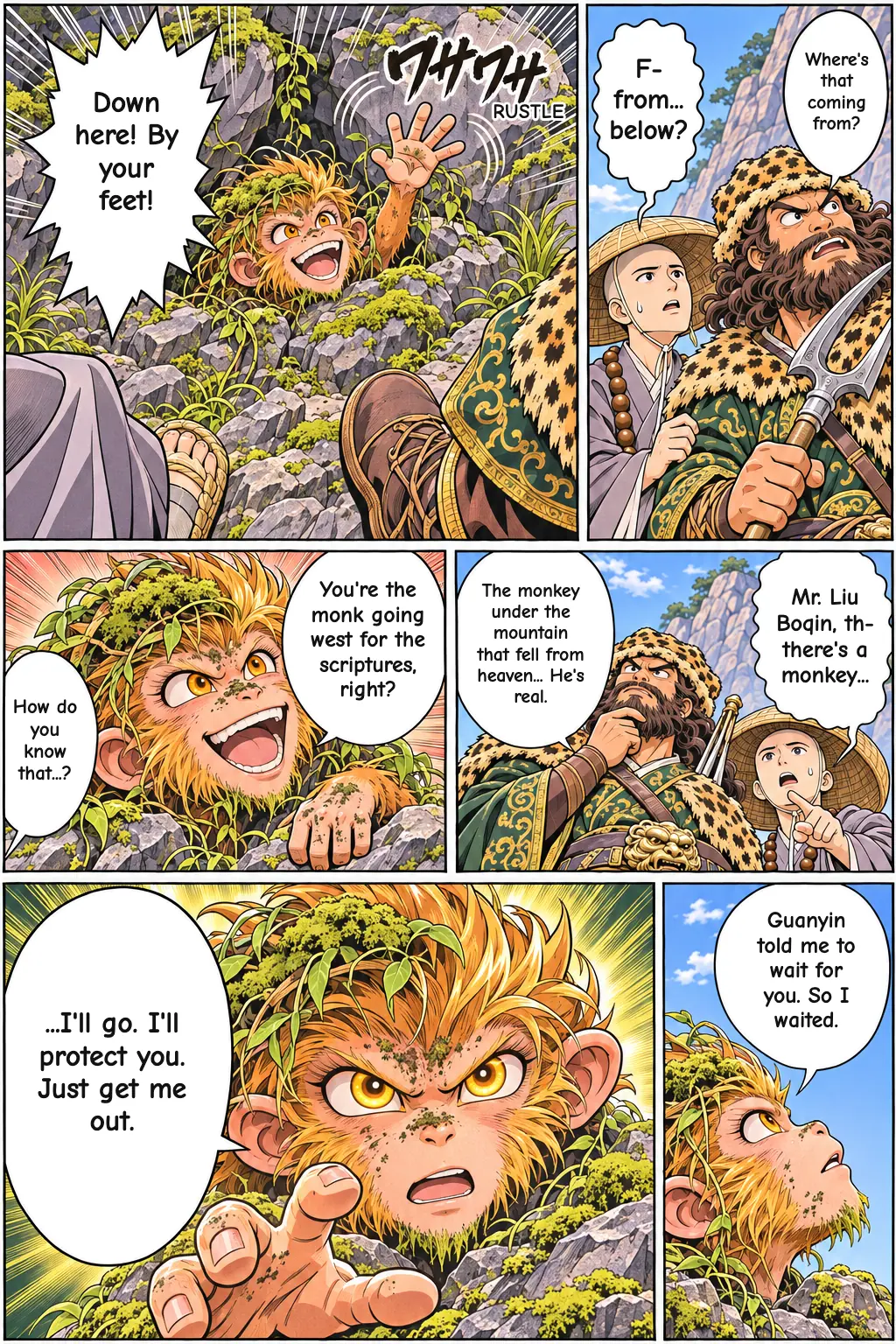
Tang Sanzang (also called Tripitaka) is a Buddhist monk sent west by the Tang emperor to bring holy scriptures back from India. The hunter Liu Boqin has been escorting him, and the two reach Two Frontier Mountain, the border mountain once called Five Elements Mountain. A voice under the rock shouts, "My master has come!" It is a monkey stuck in a stone hollow with only his head and hands free. Liu Boqin tells Sanzang the local legend: in the days of Wang Mang, an ancient Chinese ruler, a mountain fell from the sky and pinned down a divine monkey.
Sun Wukong Freed and the Golden Headband: Journey to the West Ch. 14
In short: In Chapter 14 of Journey to the West (the 1592 Ming edition), the monk Tang Sanzang peels a golden seal off Five Elements Mountain and frees Sun Wukong, the Monkey King, who has been trapped beneath it for five hundred years. Wukong becomes his first disciple, but he kills six robbers and storms off when his master scolds him. After the Dragon King of the Eastern Sea talks him into going back, Wukong puts on a cap from Guanyin, the bodhisattva of mercy. A golden band inside it tightens whenever Sanzang chants a spell, and it will never come off.
The Original Story: From Prisoner to Disciple
Tang Sanzang (also called Tripitaka) is a Buddhist monk sent west by the Tang emperor to bring holy scriptures back from India. The hunter Liu Boqin has been escorting him, and the two reach Two Frontier Mountain, the border mountain once called Five Elements Mountain. A voice under the rock shouts, "My master has come!" It is a monkey stuck in a stone hollow with only his head and hands free. Liu Boqin tells Sanzang the local legend: in the days of Wang Mang, an ancient Chinese ruler, a mountain fell from the sky and pinned down a divine monkey.
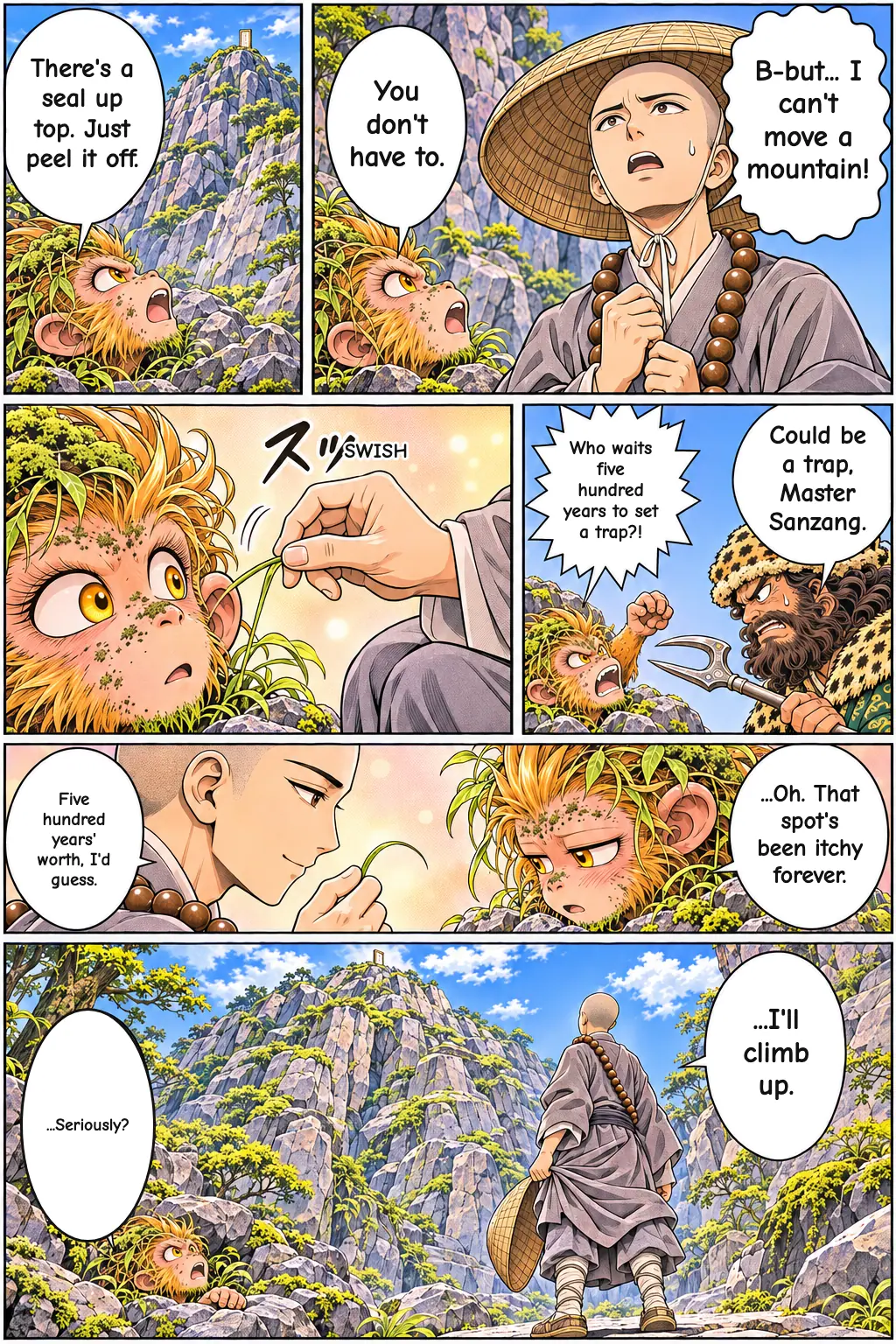
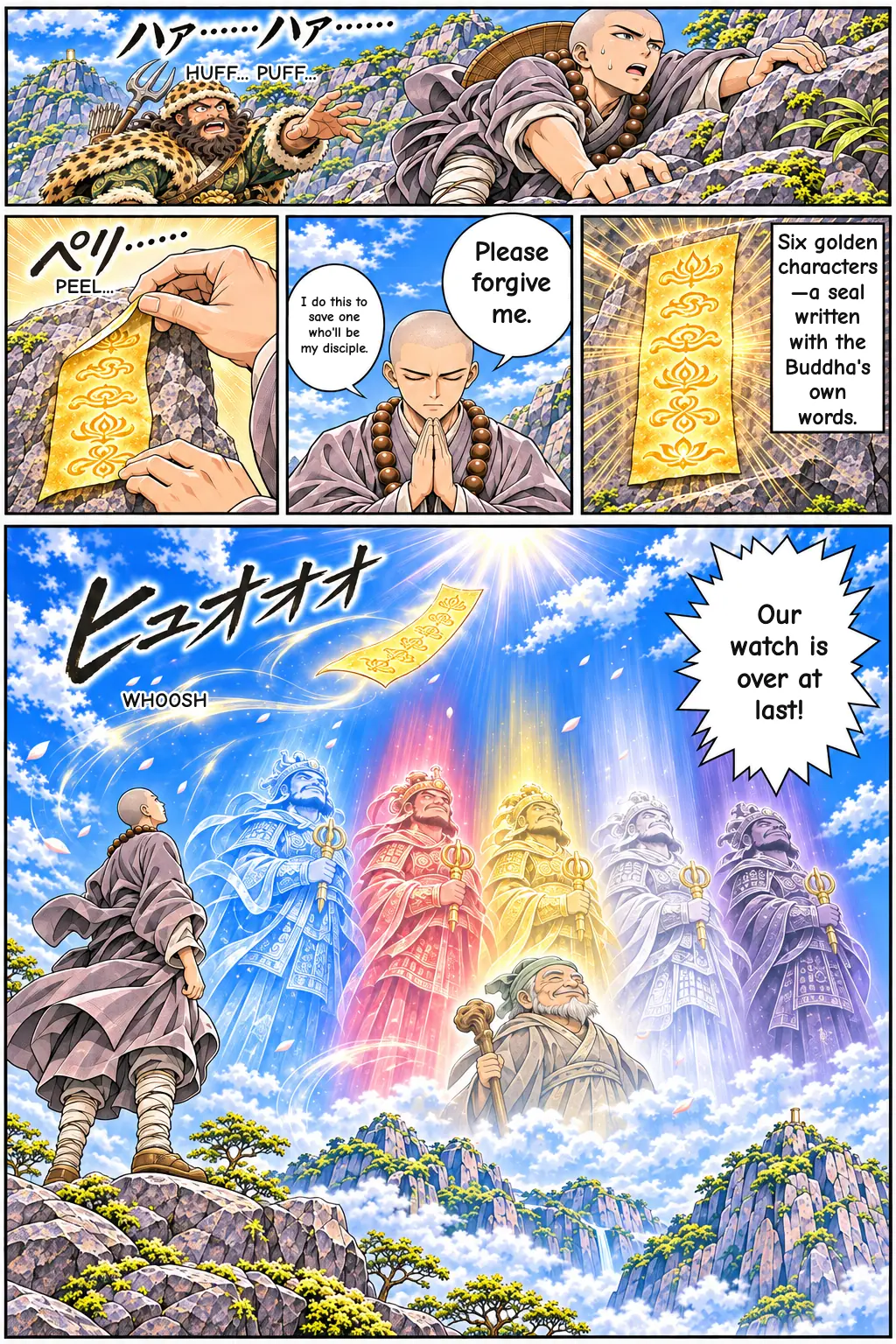
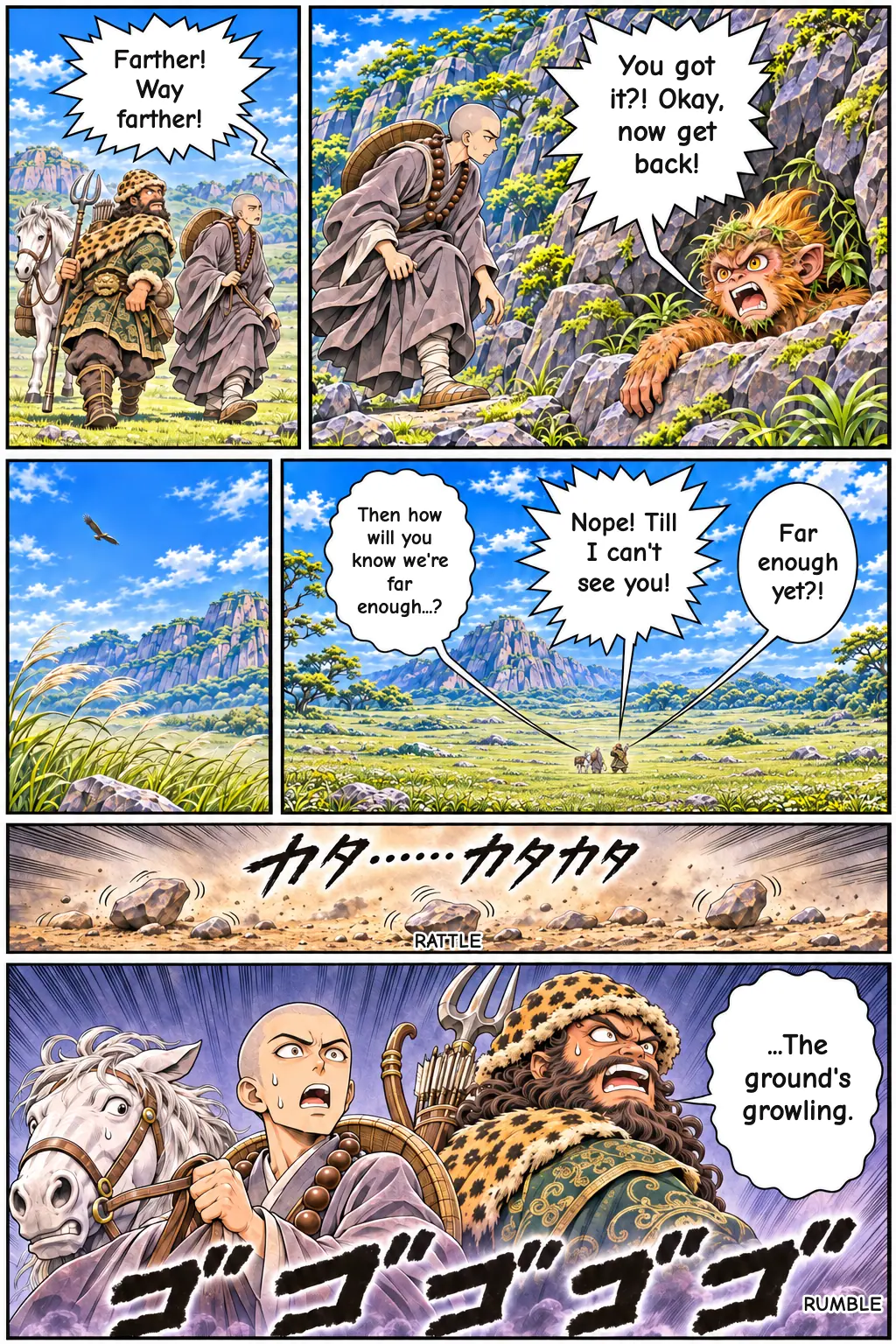
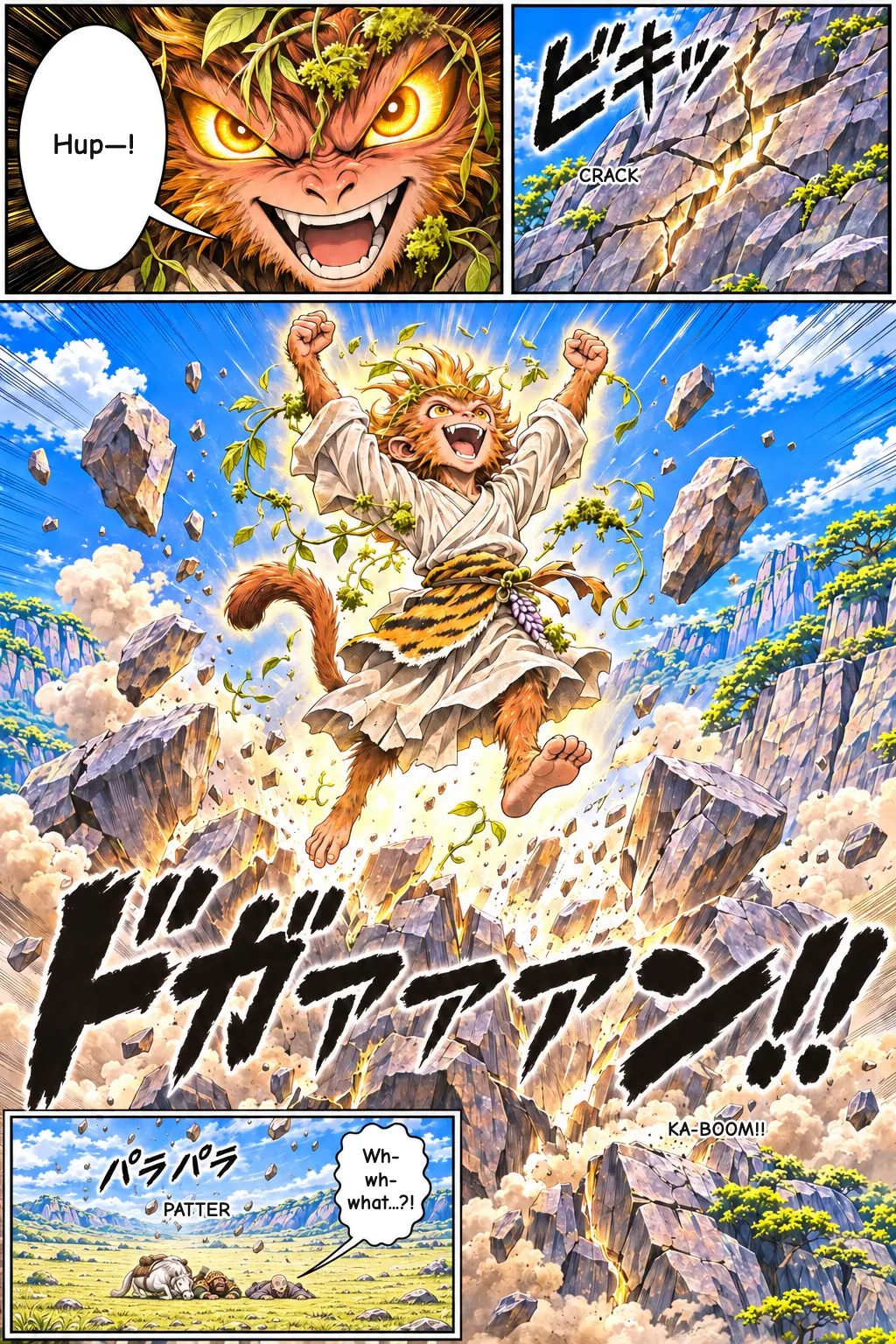
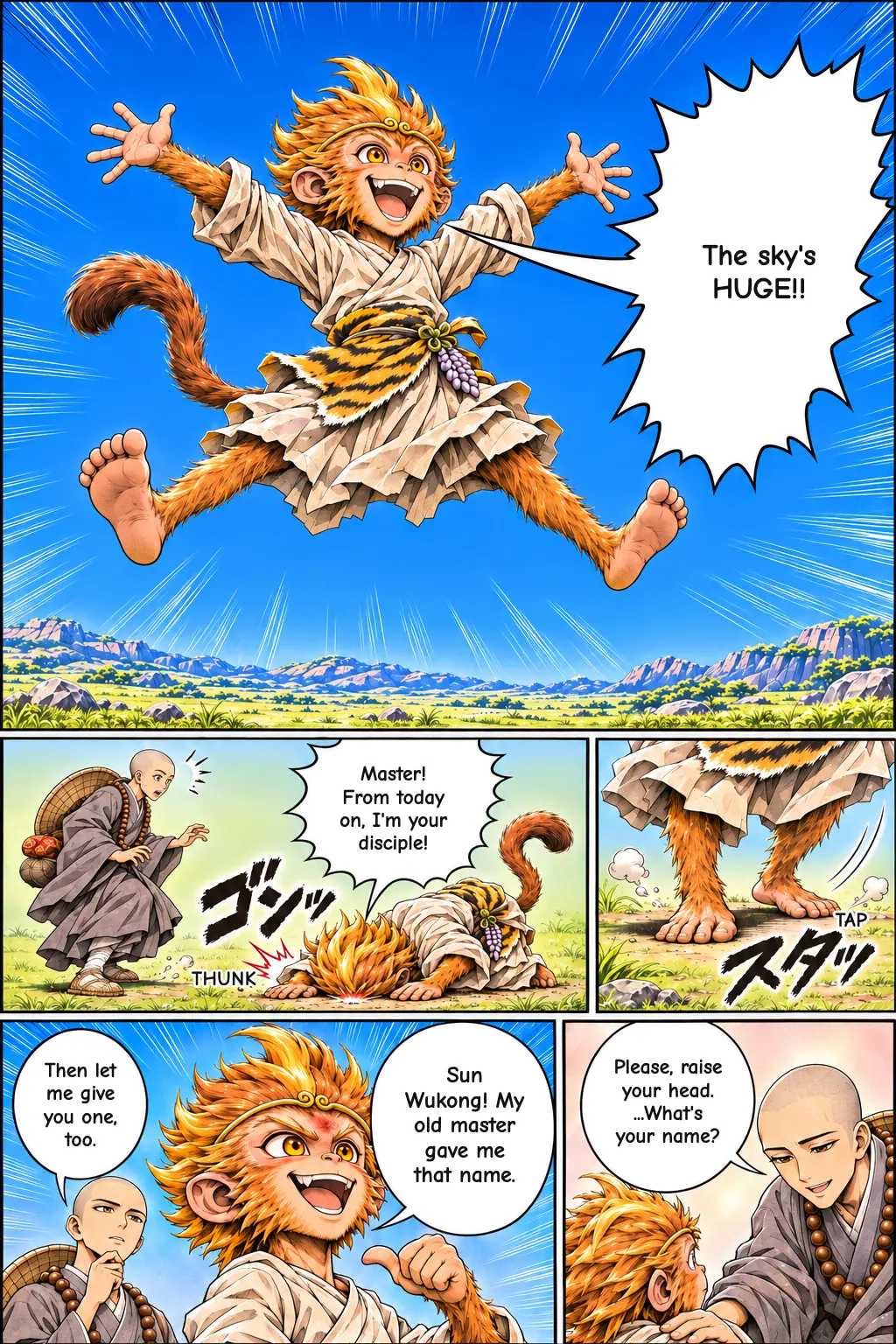
The monkey is Sun Wukong, who once called himself the Great Sage Equal to Heaven. He explains that Guanyin promised him freedom if he would protect a pilgrim going west for scriptures. Sanzang climbs to the summit and finds a paper seal printed with six golden syllables, the Buddhist mantra Om mani padme hum. After a prayer, he lifts it off. The seal blows away into the sky, and a voice announces that the Great Sage's guards are finished with their duty. Wukong asks the travelers to stand far back. Then the mountain splits with a roar, and the monkey leaps out and bows to his new master.
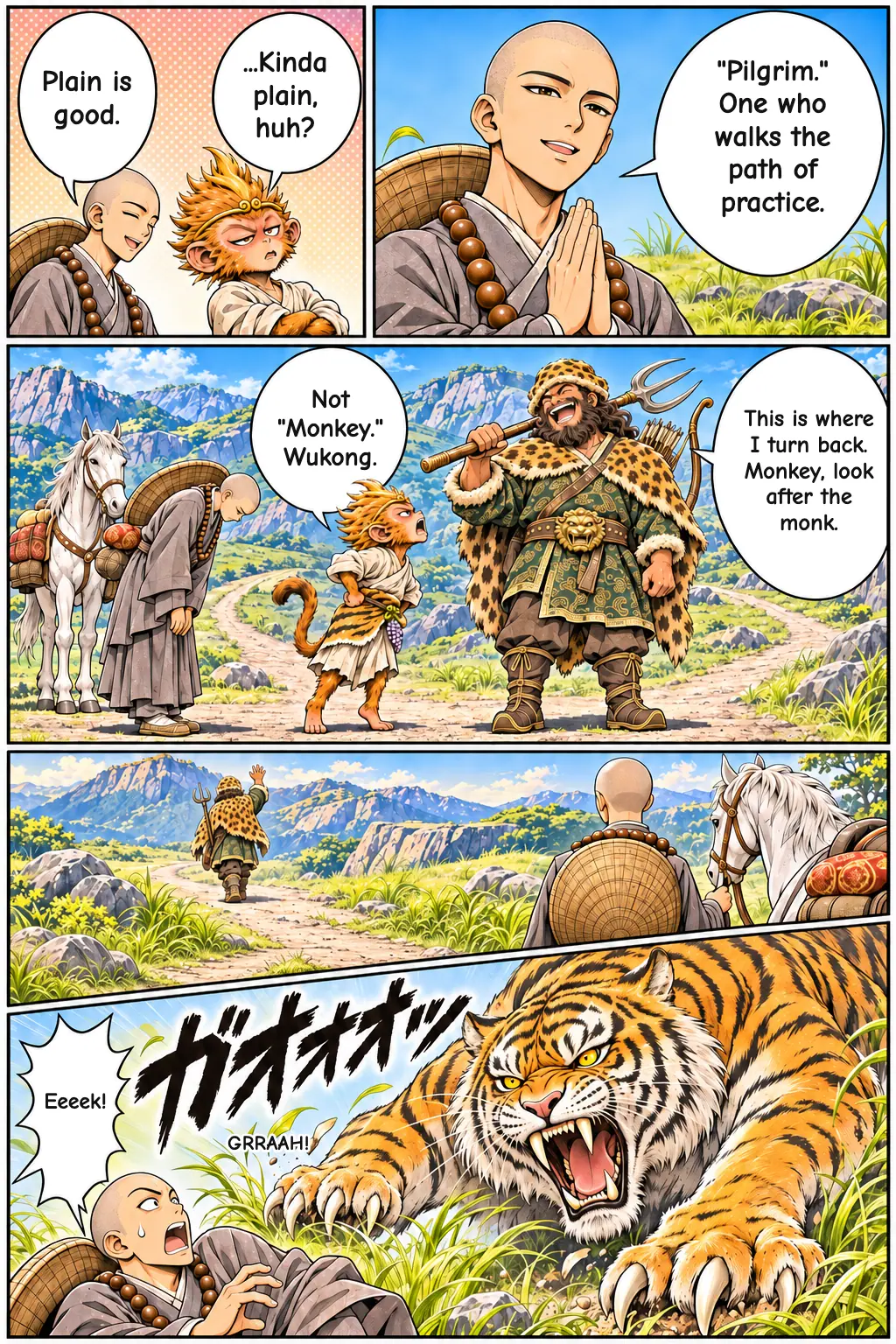
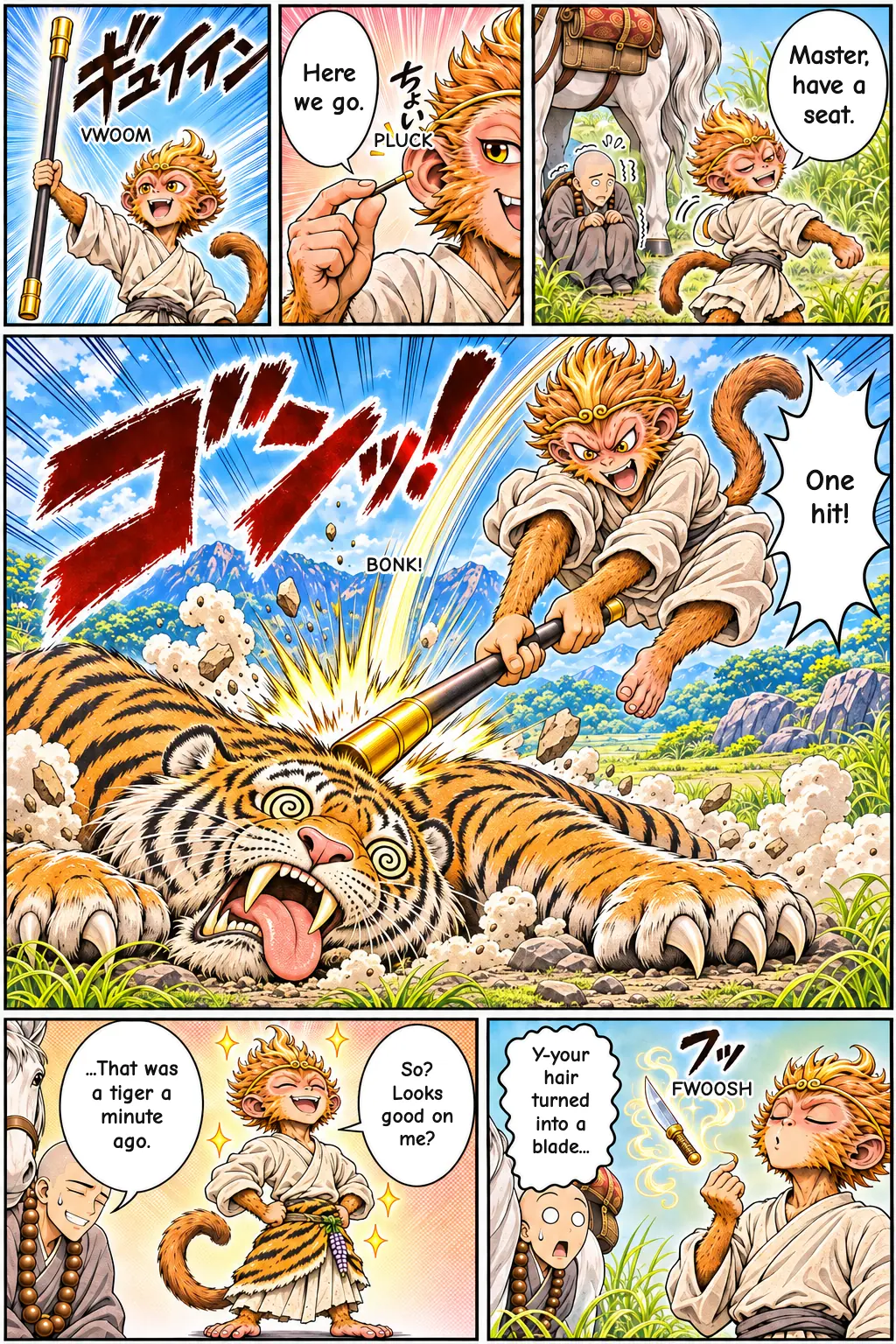
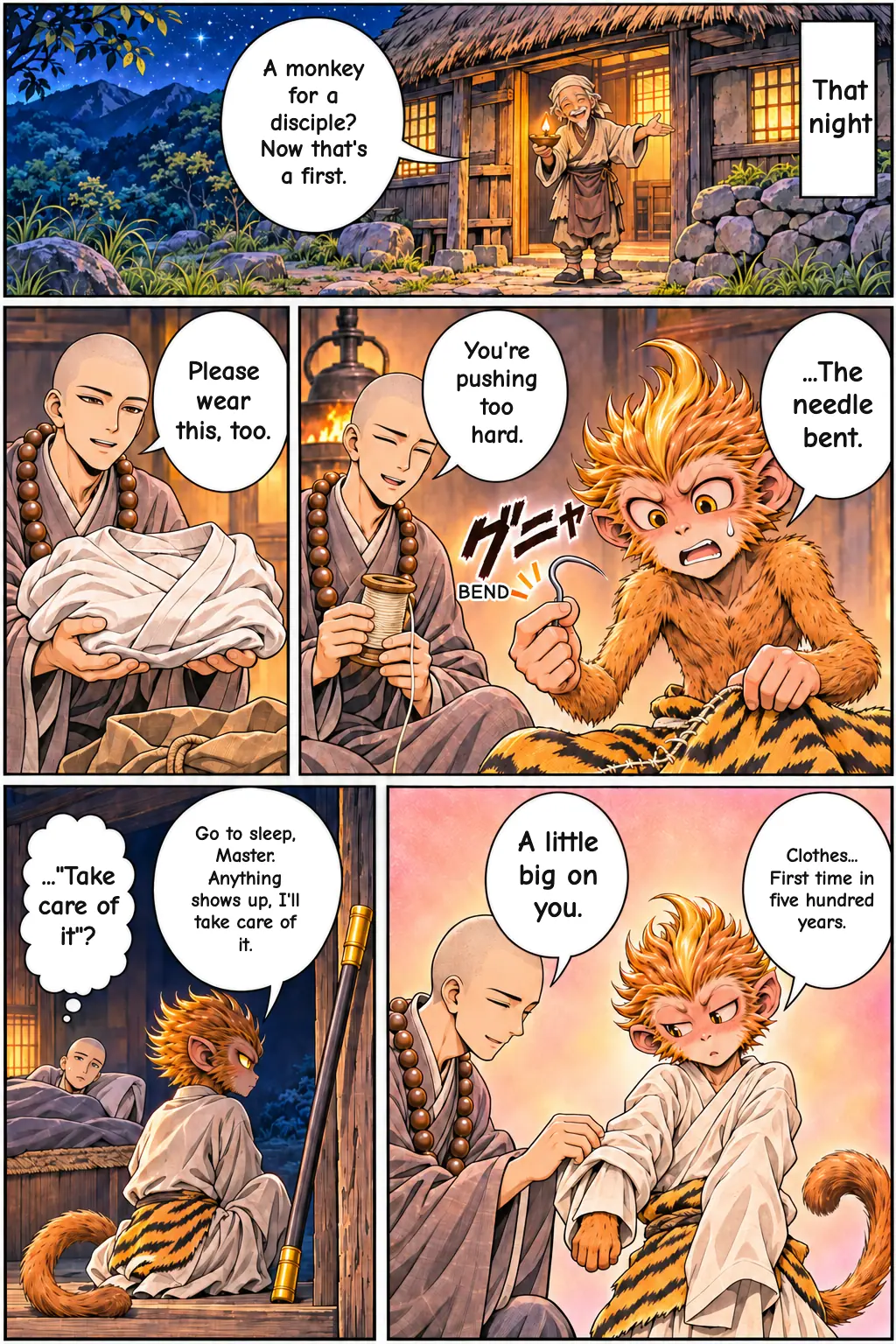
Sanzang gives him the nickname Xingzhe, "the pilgrim" or "the ascetic." Liu Boqin turns for home. Soon a tiger appears, and Wukong pulls a needle from his ear, turns it into his iron staff, and kills the tiger with one blow. He wraps its skin around his waist, and that night he borrows needle and thread from his master to sew it into a proper kilt.
Six Robbers, a Quarrel, and the Golden Headband
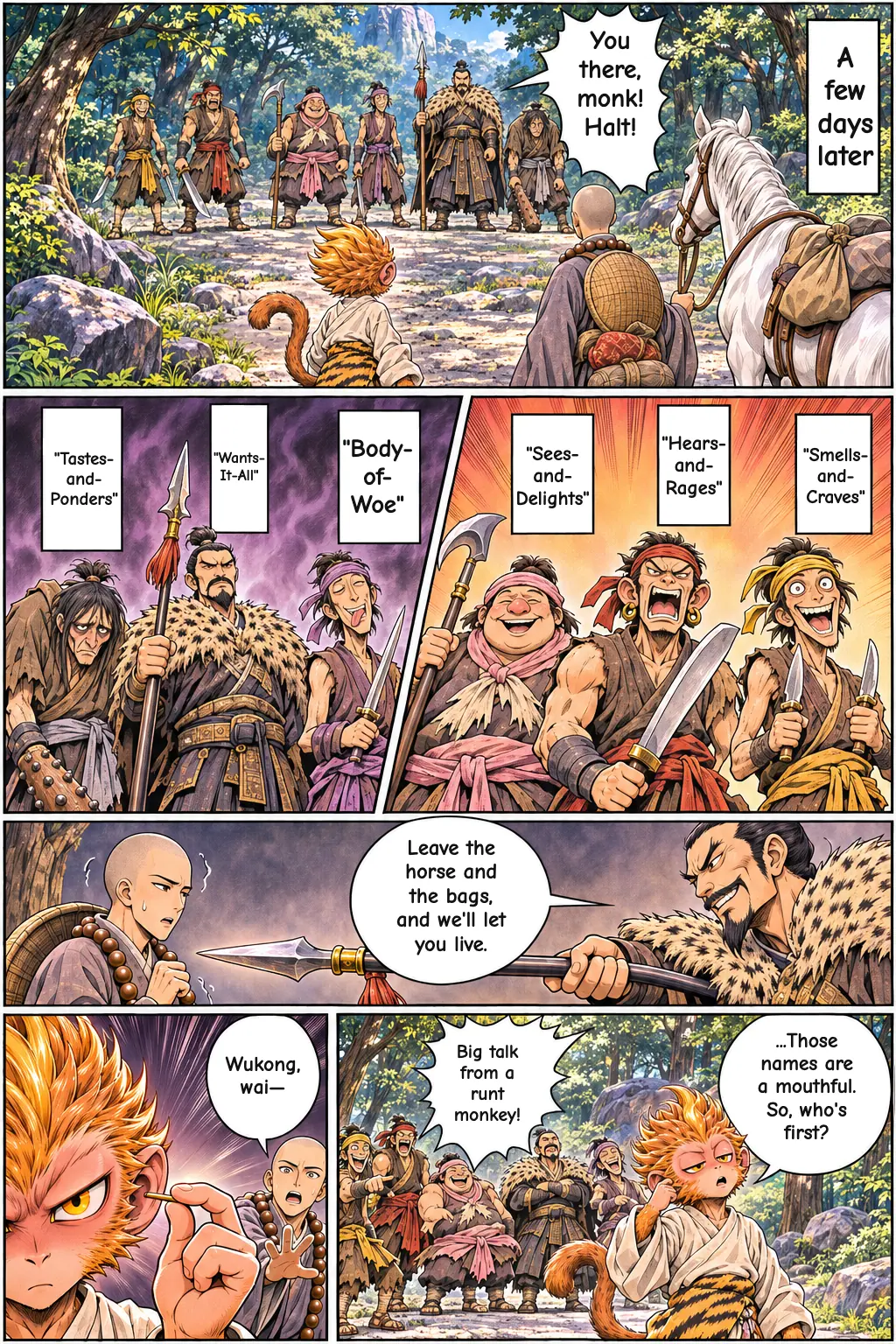
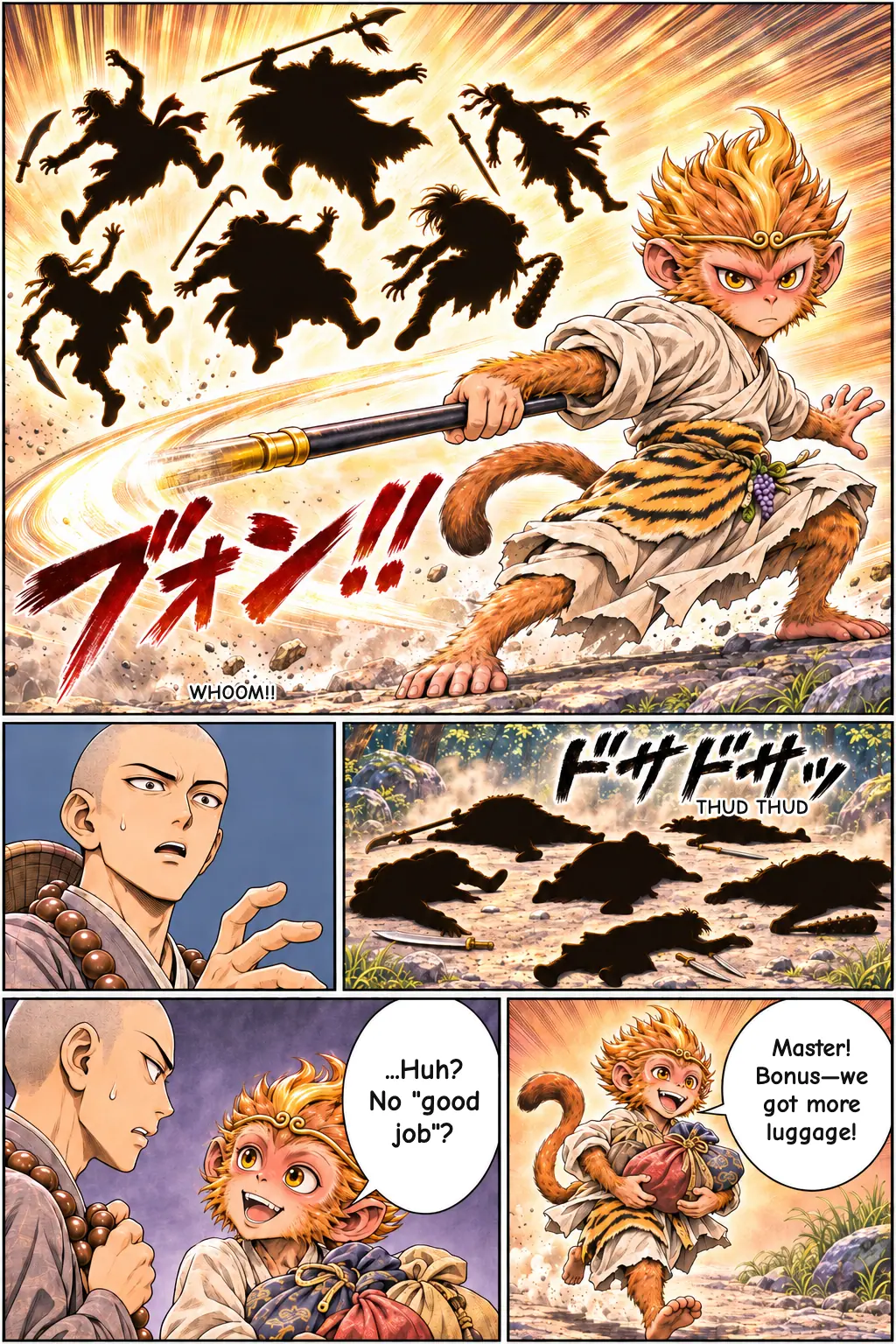
On the road, six bandits block the way and demand the travelers' bags. Wukong kills all six and comes back laughing with their loot. Sanzang is horrified. A monk, he says, must never take a life, and this is far too much. Furious at the scolding, Wukong vanishes east in a single leap.
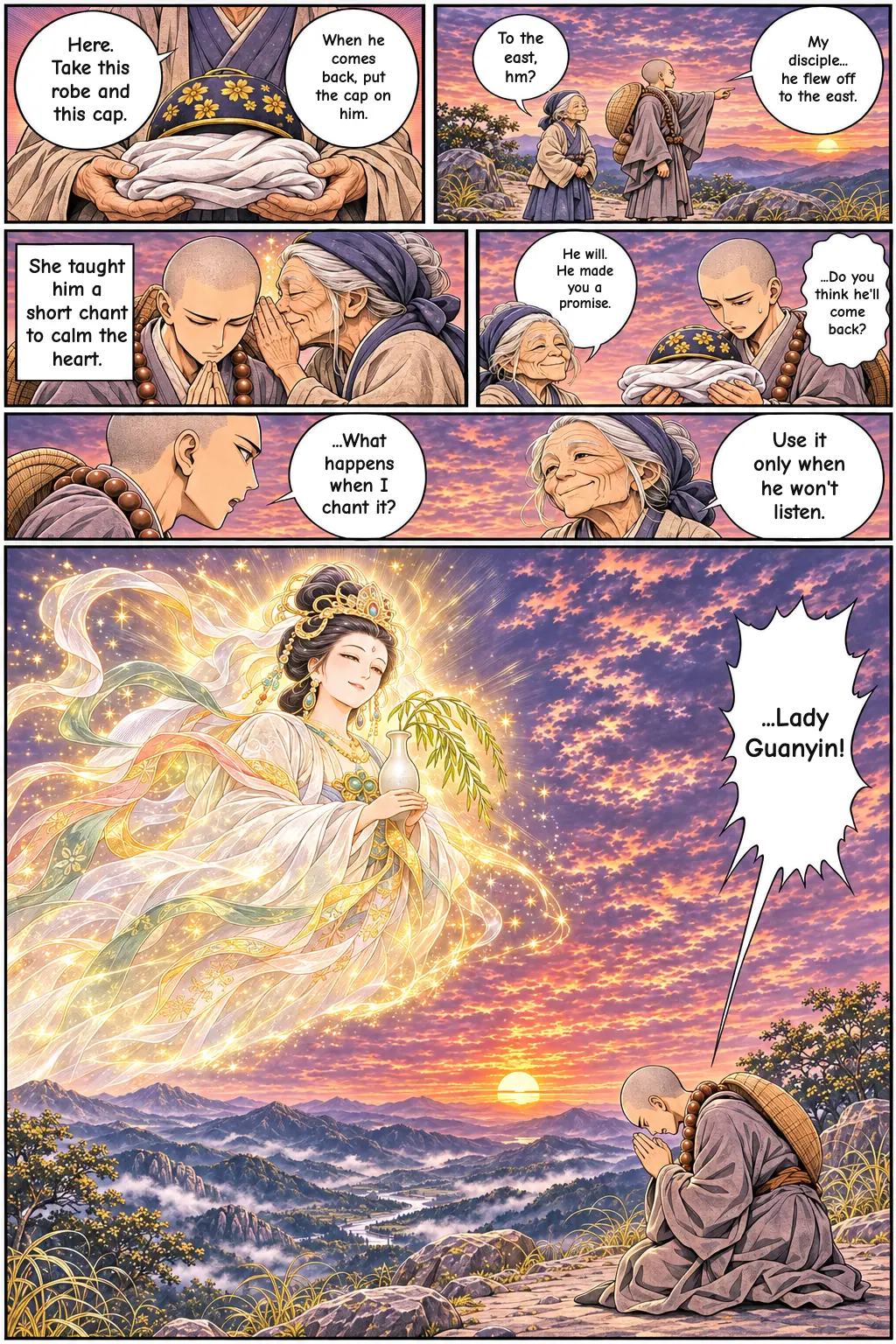
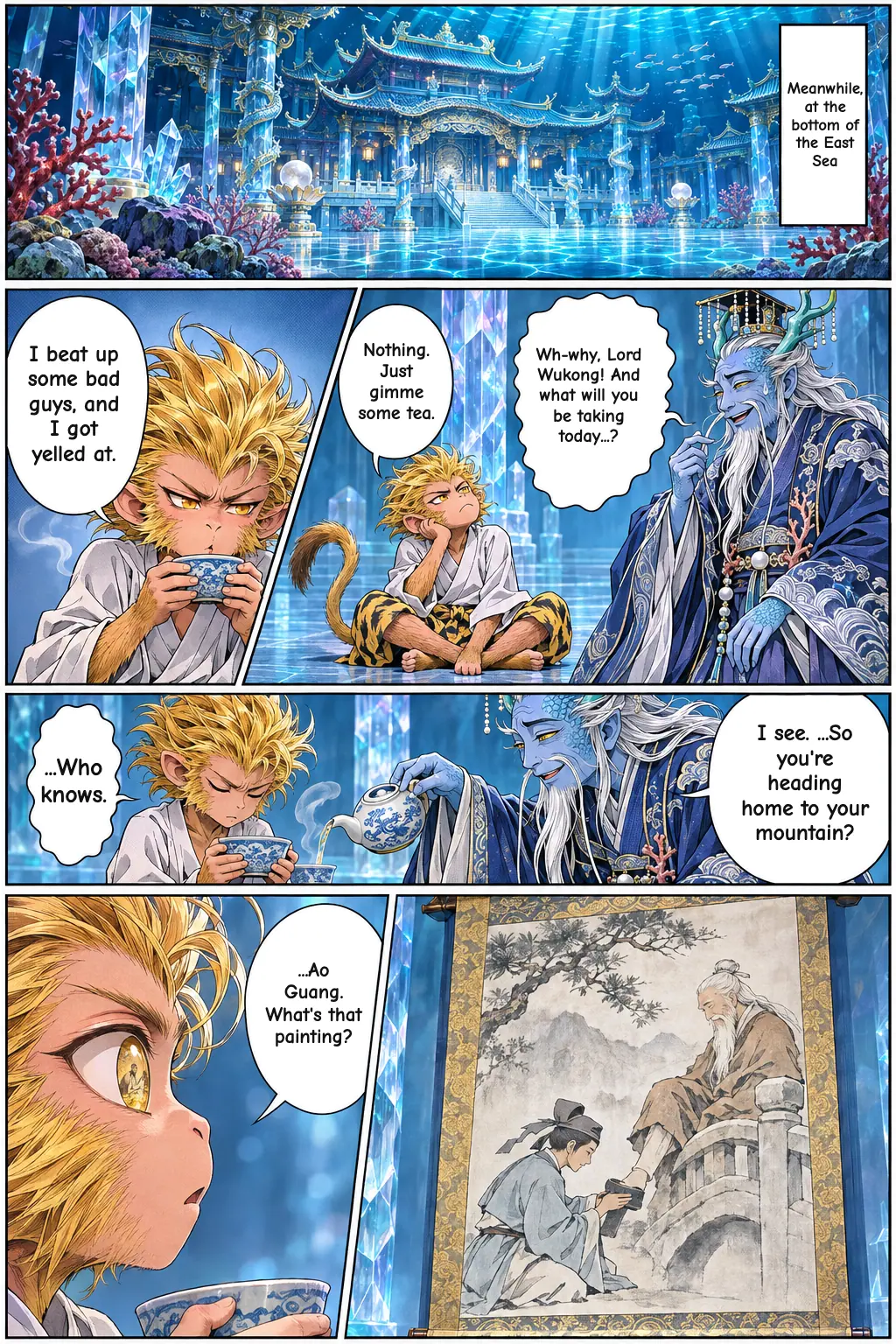
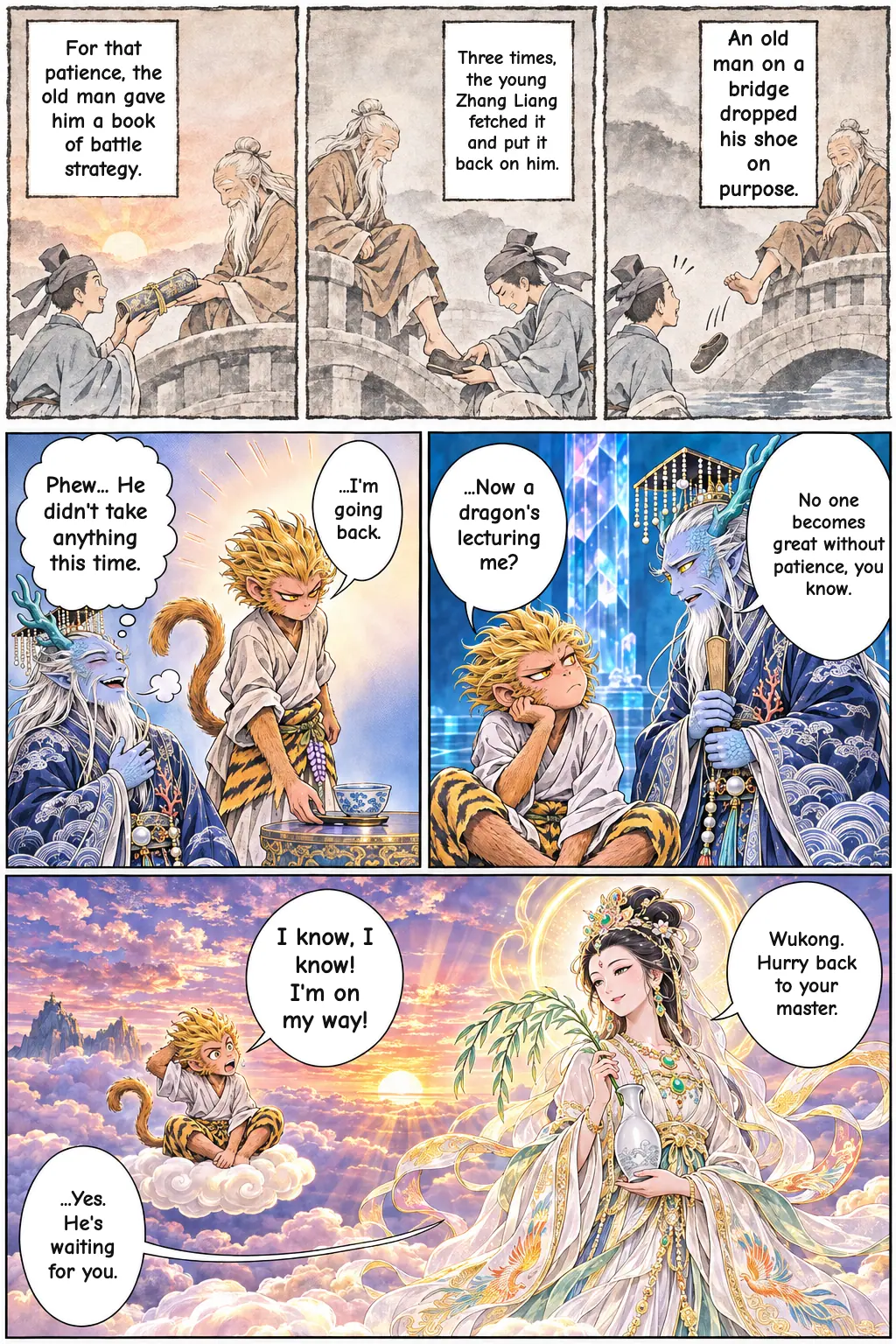
Left alone, Sanzang meets an old woman carrying a robe and a flowered cap. She tells him to put the cap on his disciple and teaches him a secret chant, the spell for calming the mind, often called the Tight-Band Spell. She is Guanyin in disguise. Meanwhile Wukong visits the Dragon King of the Eastern Sea, an old acquaintance. Over tea, the Dragon King points to a painting on his wall: young Zhang Liang fetching an old man's shoe from under a bridge, a humble act that later earned him great wisdom. The Dragon King's point is to serve your master patiently. Wukong decides to go back.
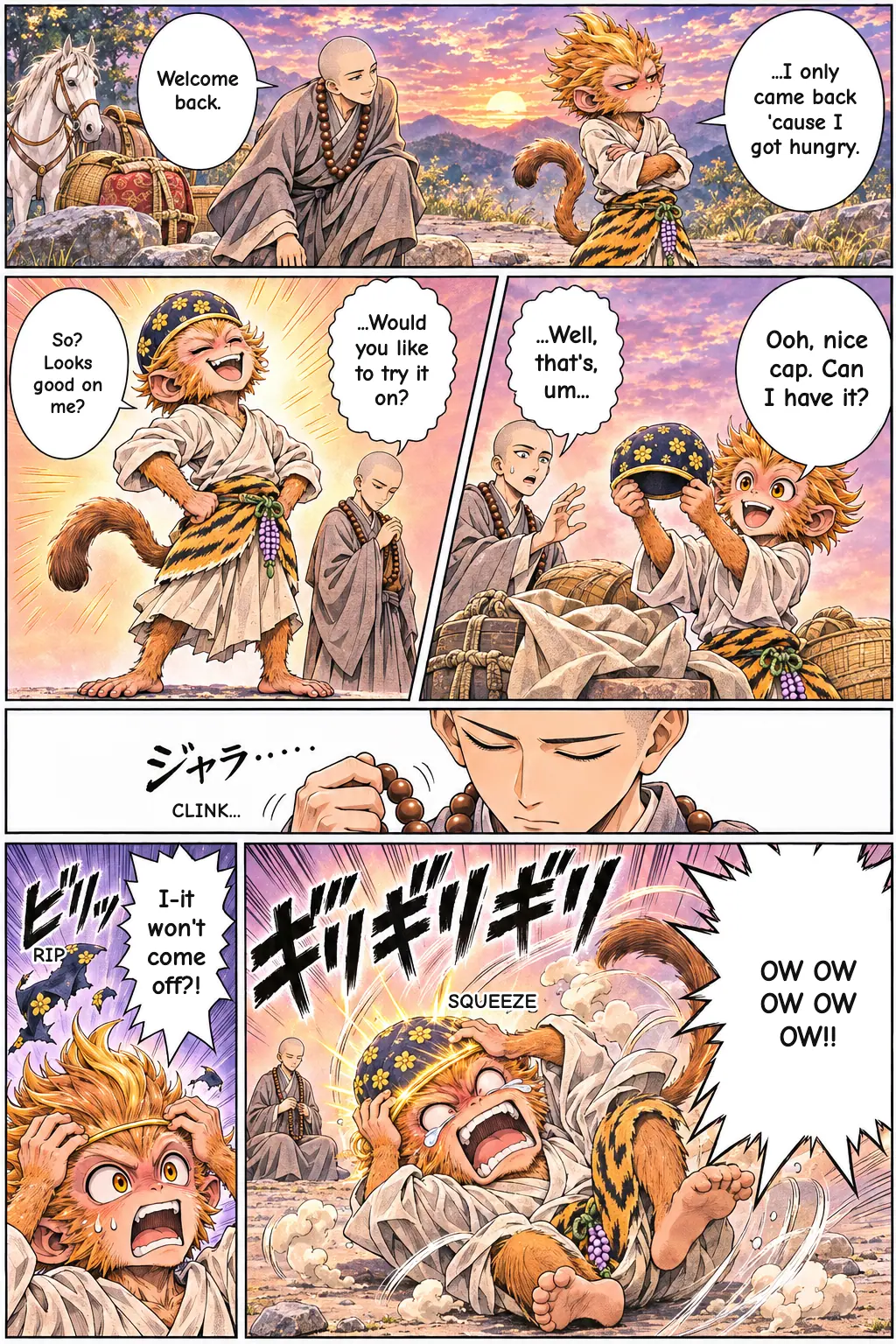
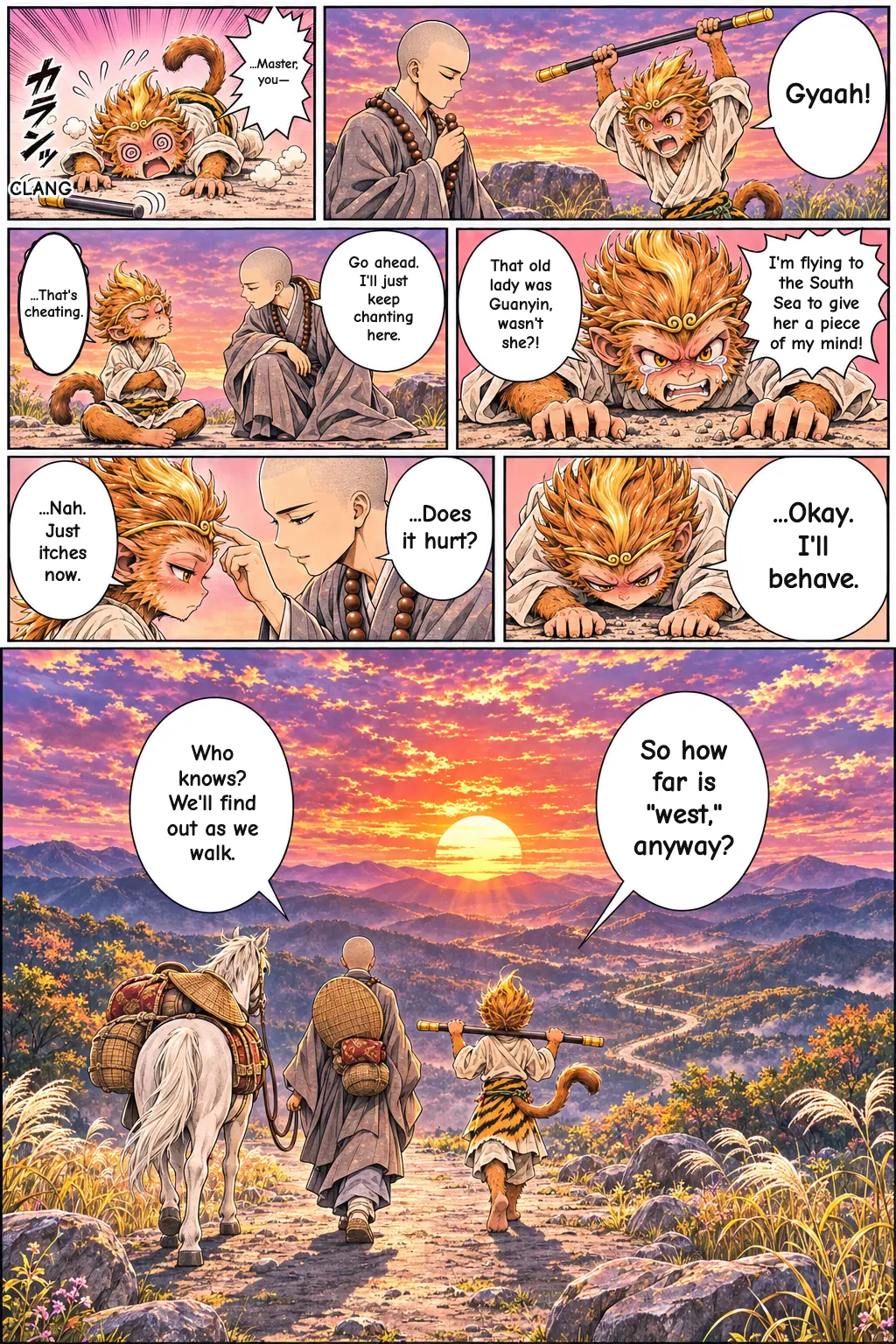
Wukong returns, finds the cap in the bundle, and puts it on. Sanzang recites the spell, and a golden band hidden in the cap squeezes his skull. Wukong rolls on the ground in agony and cannot pull it off. When he raises his staff at his master, one more recitation drops him again. At last he vows never to disobey, and the two set off west together.
What the Story Means: The Mind Monkey Tamed
The chapter's title roughly means "the mind-monkey returns to the right path; the six robbers vanish without a trace." In Chinese Buddhist thought, the "mind monkey" is the restless, jumping mind. The six robbers have allegorical names that match the six senses of Buddhist teaching (eye, ear, nose, tongue, mind, and body), such as "Eye That Sees and Delights" and "Ear That Hears and Rages." So killing them can be read as cutting off the senses' pull on the mind. Readers often treat the headband the same way: wild talent needs discipline before it is any use on a spiritual journey.
The novel was printed in 1592 during the Ming dynasty. It is traditionally credited to Wu Cheng'en, though scholars still debate that, because the early edition gives no author. Tang Sanzang is based on the real monk Xuanzang, who traveled to India in the 7th century. Two Chinese cultural values also run through this chapter: the duty a disciple owes a teacher, which the Zhang Liang painting shows, and the Buddhist ban on killing.
What the Manga Changes or Adds
Episode 9 follows every major event of Chapter 14, including Wukong killing all six robbers. The source text says little about Wukong's five centuries under the mountain beyond his diet of iron pellets and molten copper. The manga imagines his feelings during that wait, Sanzang's hesitation before he peels away the seal, and the look the two exchange when they first meet.
The fights with the tiger and the bandits get original choreography. The Dragon King's advice plays out as a story within the story, with the Zhang Liang tale drawn in its own art style. The manga also gives more space to Sanzang's loneliness after Wukong leaves and to his talk with the old woman. The headband's pain is exaggerated in comic style but stays within what the novel describes. The border landscape, the Dragon Palace, and the costumes are original designs inspired by the Tang era.
Where to Read It
If you want to see the moment the mountain splits open, and the look on Wukong's face when the band tightens, Episode 9 of Journey to the West: The Great Sage Equal to Heaven tells this chapter in full color here on Manga Portal. Every episode is free to read, and you don't need to sign up. You can start here or go back to Episode 1 to see how the Monkey King ended up under the mountain.
Characters in this episode
Sun Wukong (the Monkey King)
A powerful, quick-tempered monkey who spent 500 years trapped under Five Elements Mountain before becoming Sanzang's first disciple.
Tang Sanzang (Tripitaka)
A gentle Buddhist monk on a mission to India who frees Wukong and refuses to tolerate killing.
Guanyin
The bodhisattva of mercy, who appears as an old woman and gives Sanzang the cap and the spell that control Wukong.
Dragon King of the Eastern Sea
An old acquaintance of Wukong who uses the tale of Zhang Liang to persuade him to return to his master.
Liu Boqin
A local hunter who escorts Sanzang to the mountain, tells its legend, and turns back at the border.
The Six Robbers
Bandits named after the six senses of Buddhist teaching, all killed by Wukong.
FAQ
How did Sun Wukong get free from the mountain?
The monk Tang Sanzang climbed Five Elements Mountain and removed the golden seal that held it in place. Once the seal was gone, the mountain split open and Wukong leapt out. In return, he became Sanzang's disciple and protector.
Why does Sun Wukong wear a golden headband?
Guanyin gave Sanzang a cap with a golden band hidden inside, along with a spell that makes the band tighten. Wukong put the cap on after killing six robbers and quarreling with his master. The pain of the spell forced him to obey, and the band never came off.
Why was Tang Sanzang angry when Wukong killed the bandits?
As a Buddhist monk, Sanzang believed that taking any life was a grave wrong, even the life of a robber. He scolded Wukong for being cruel. Wukong could not stand the criticism and left.
Who are the six robbers in Journey to the West?
Their names match the six senses of Buddhist teaching: eye, ear, nose, tongue, mind, and body. Many readers take Wukong's killing of them as a symbol of overcoming sensory desires.
Which chapter of Journey to the West has the golden headband?
Chapter 14 of the 1592 novel tells how Wukong is freed, meets Sanzang, and receives the headband. On Manga Portal, it is adapted as Episode 9 of Journey to the West: The Great Sage Equal to Heaven.