Episode 4The Brother Who Wouldn't Sit on the ThroneBharata and Rama's Sandals (Paduka)
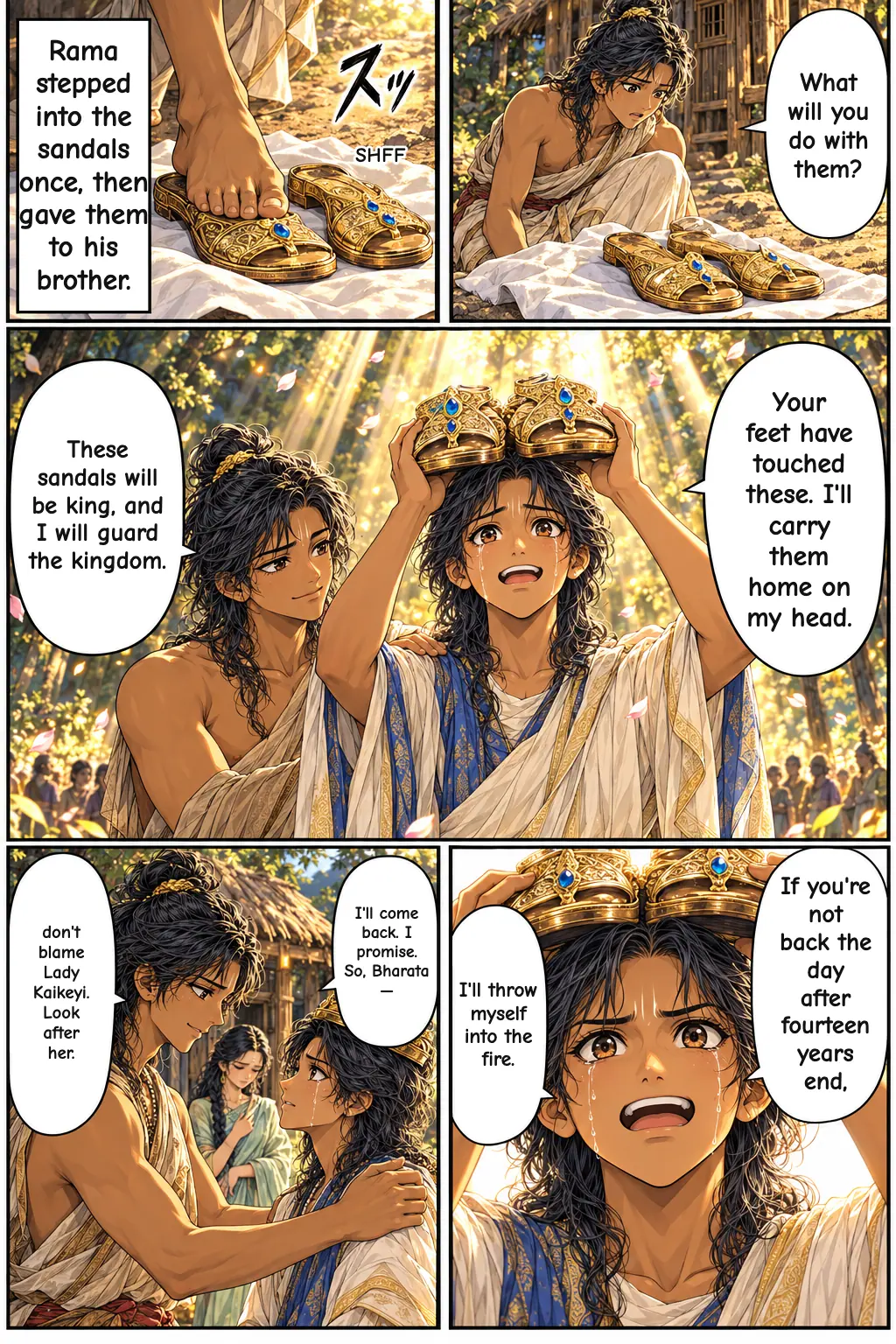
Grieving for Rama, now exiled to the forest, King Dasharatha dies, still haunted by an arrow he loosed in his youth. Bharata is offered the throne. Instead, he marches with the whole army to bring his brother home. Rama refuses to break their father's promise, so the two brothers find another answer: Rama's sandals will sit on a throne that no one else will use.
Bharata and Rama's Sandals (Paduka): Ramayana Ayodhya Kanda Summary
The Original Story, Part 1: Into the Forest, and a King's Death
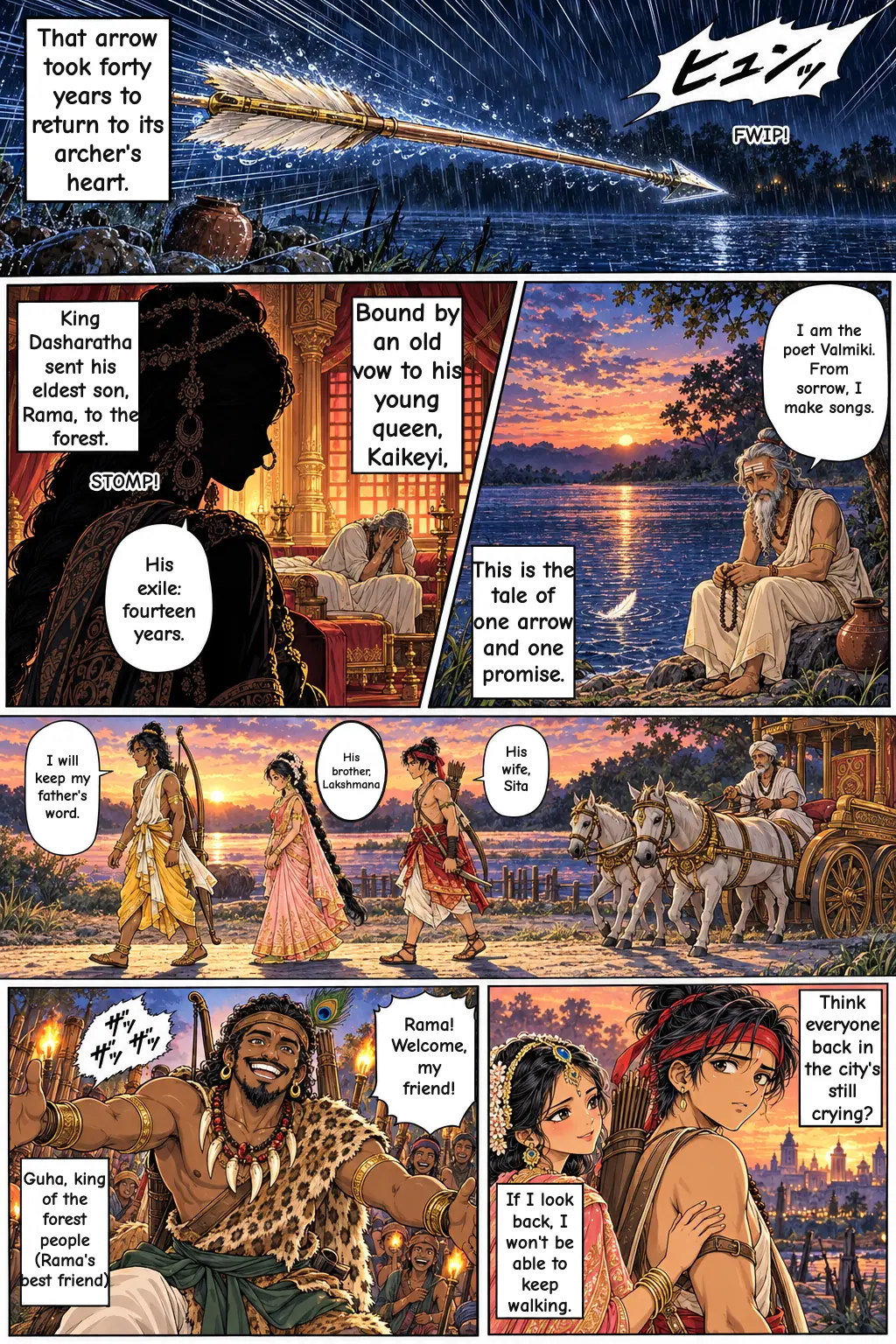
This episode covers a long stretch of Book 2 of Valmiki's Sanskrit Ramayana, the Ayodhya Kanda (roughly chapters 46–115 in the common southern 'vulgate' numbering; the Baroda critical edition divides the same material differently, at about chapters 40–107). It begins just after Prince Rama has been sent into fourteen years of forest exile, together with his wife Sita and his loyal younger brother Lakshmana.
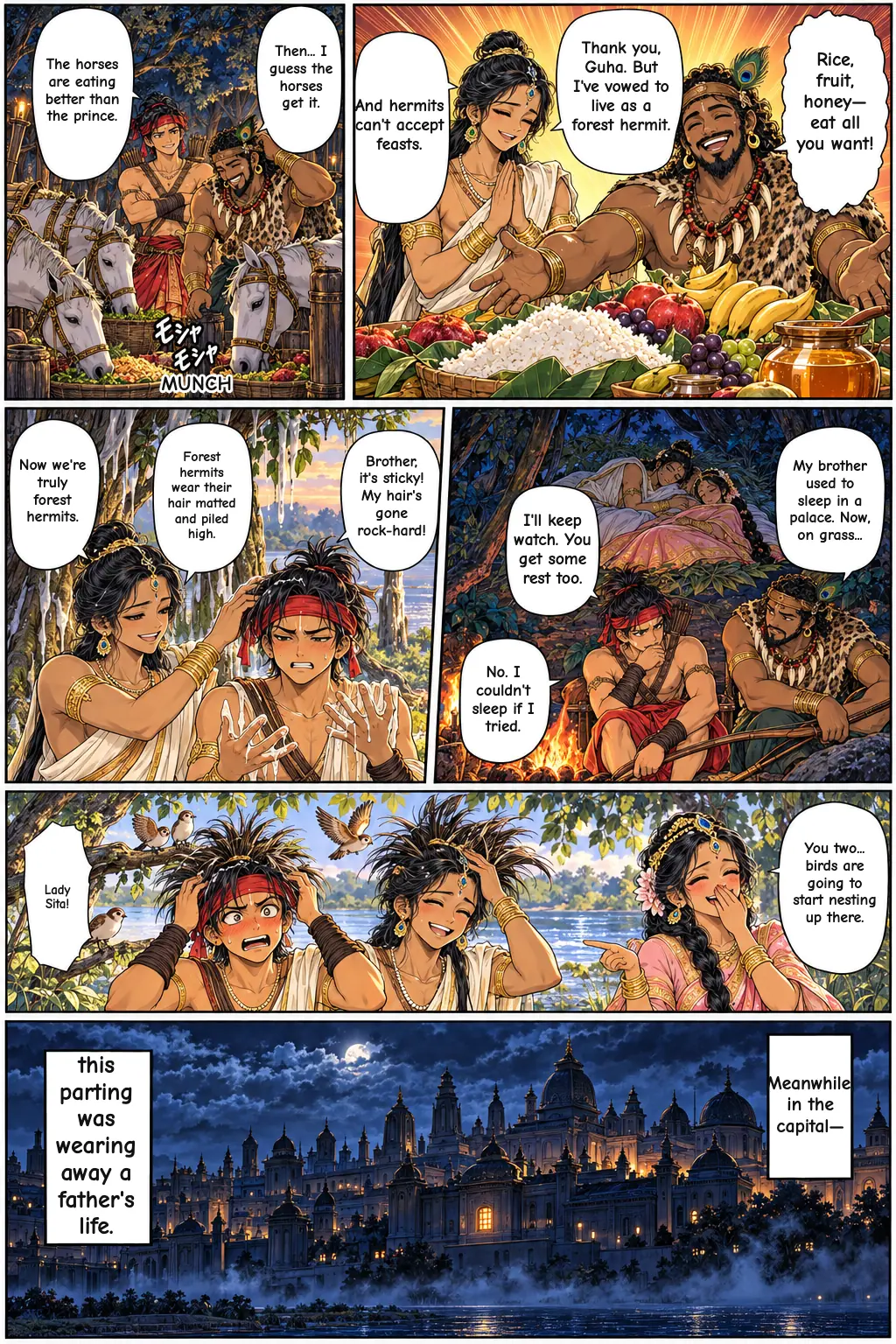
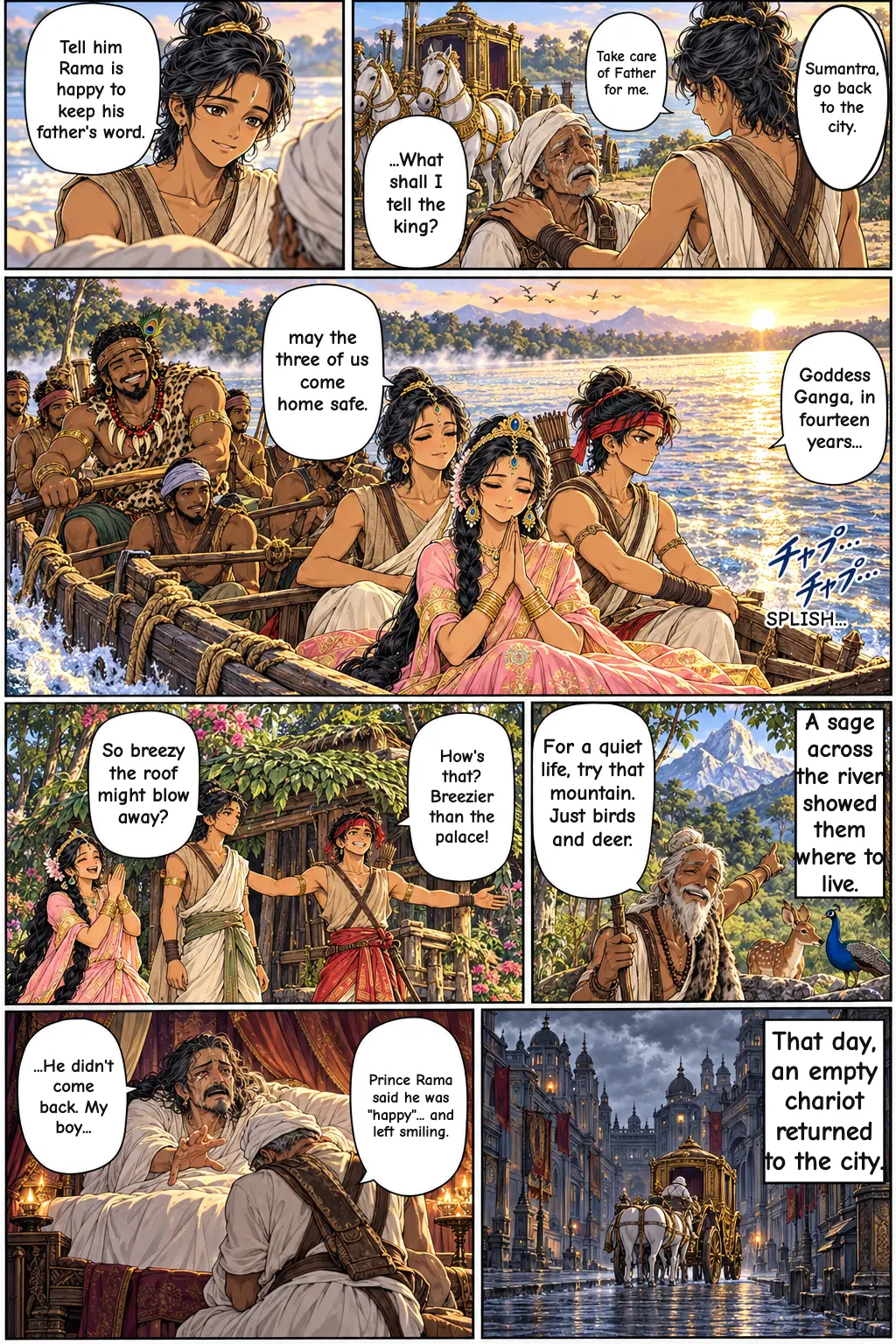
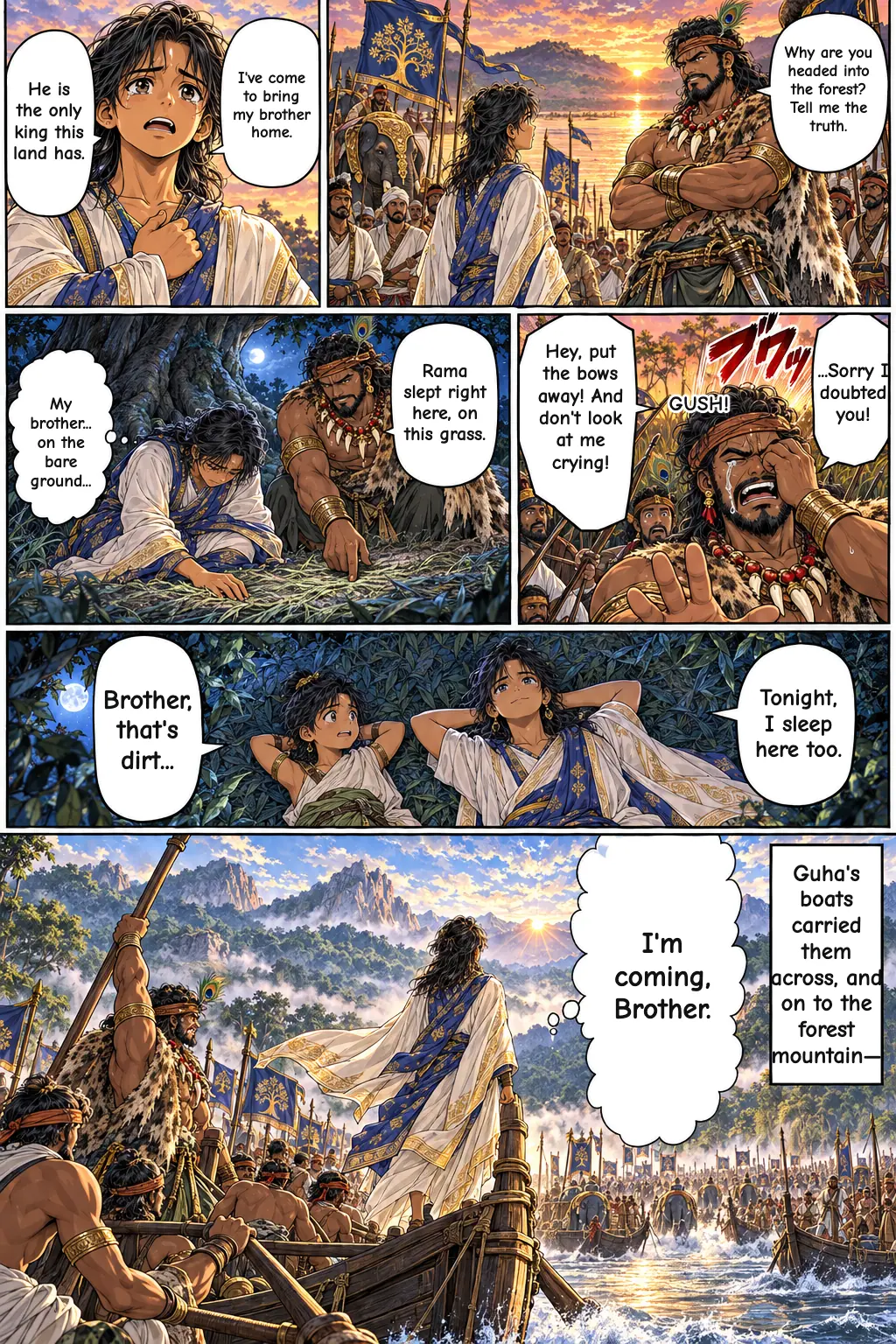
The three travel to Shringaverapura on the Ganges, where Guha, king of the Nishadas (a forest-dwelling people) and a close friend of Rama, welcomes them with food. Rama, now bound by an ascetic's vow, politely declines everything except fodder for the horses. That night Lakshmana stays awake with Guha, grieving to see his brother and Sita sleeping on bare ground. The next morning the brothers mat their hair with banyan sap into the knotted locks of forest hermits, send the royal charioteer Sumantra back to the capital, and cross the Ganges in Guha's boat while Sita prays to the river goddess for a safe return. The sage Bharadvaja advises them to settle on Chitrakuta hill, where Lakshmana builds a hut of wood and leaves.
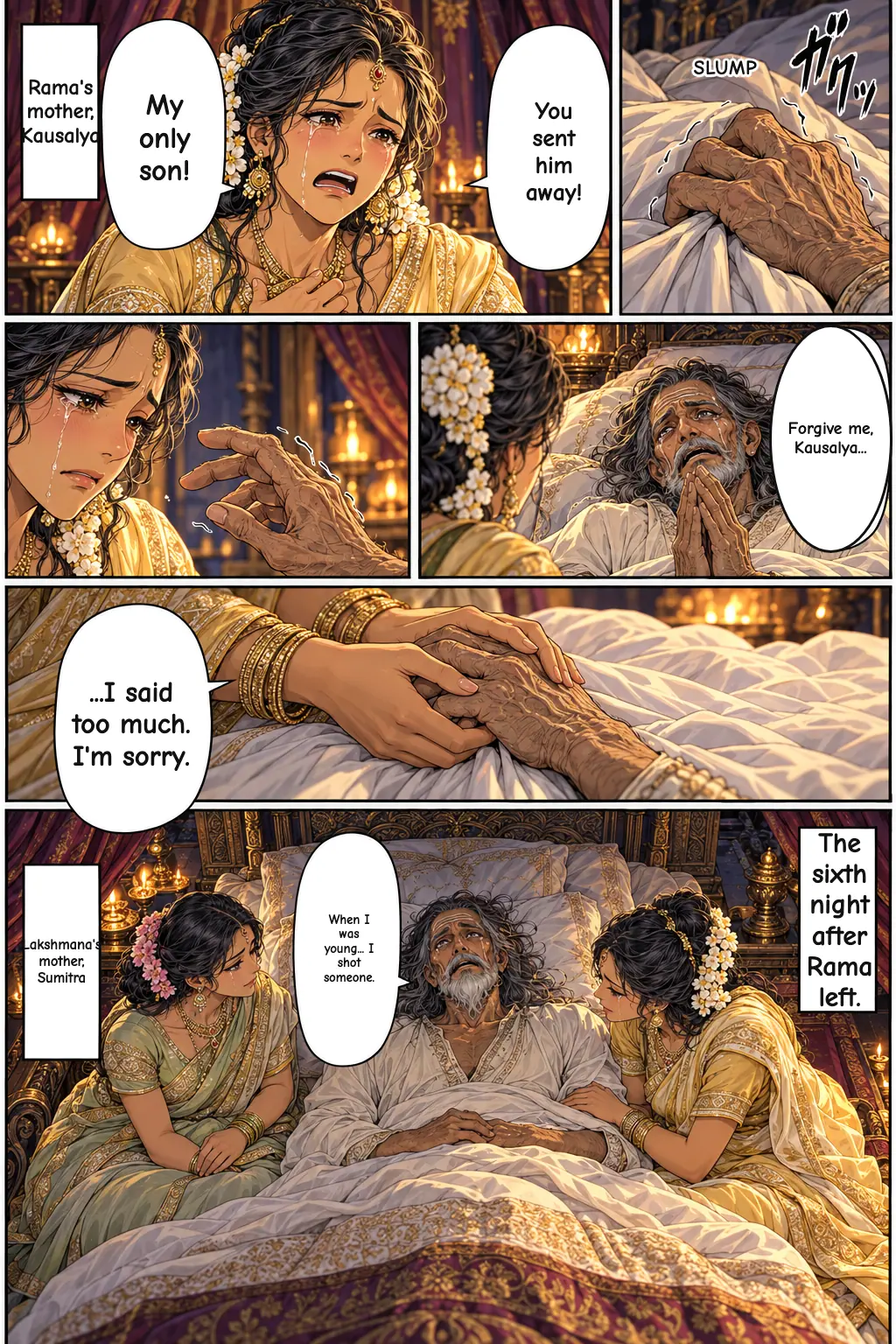
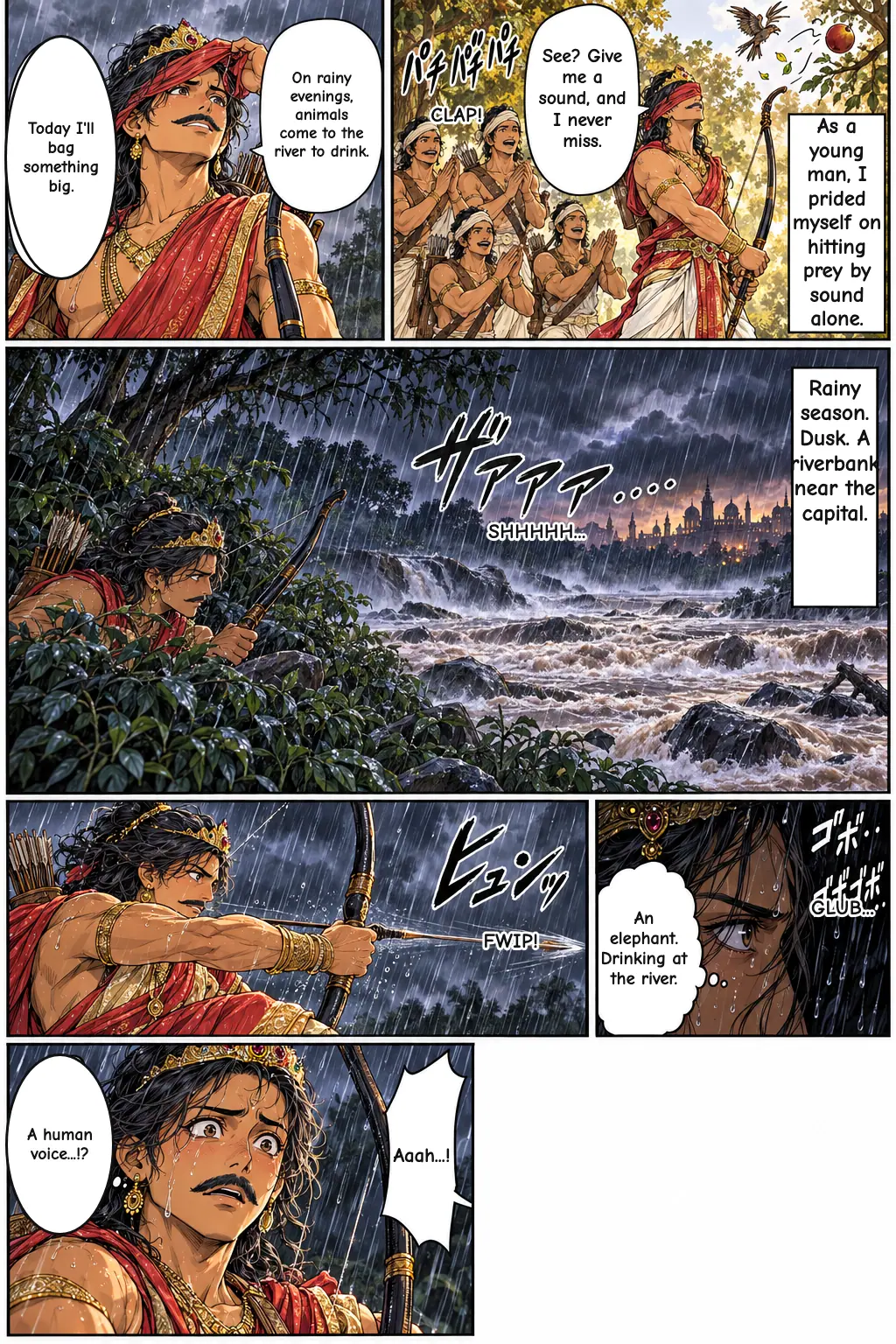
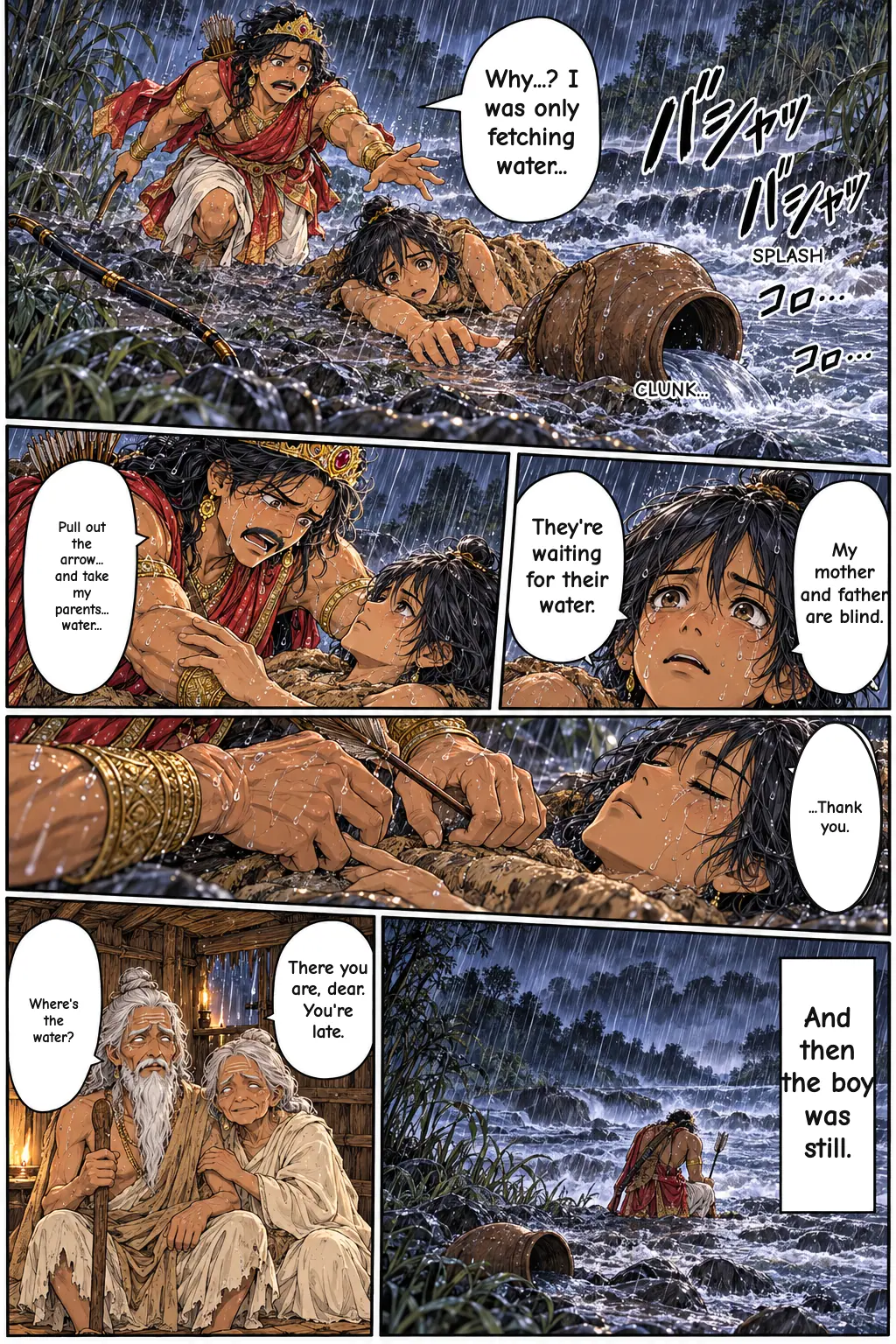
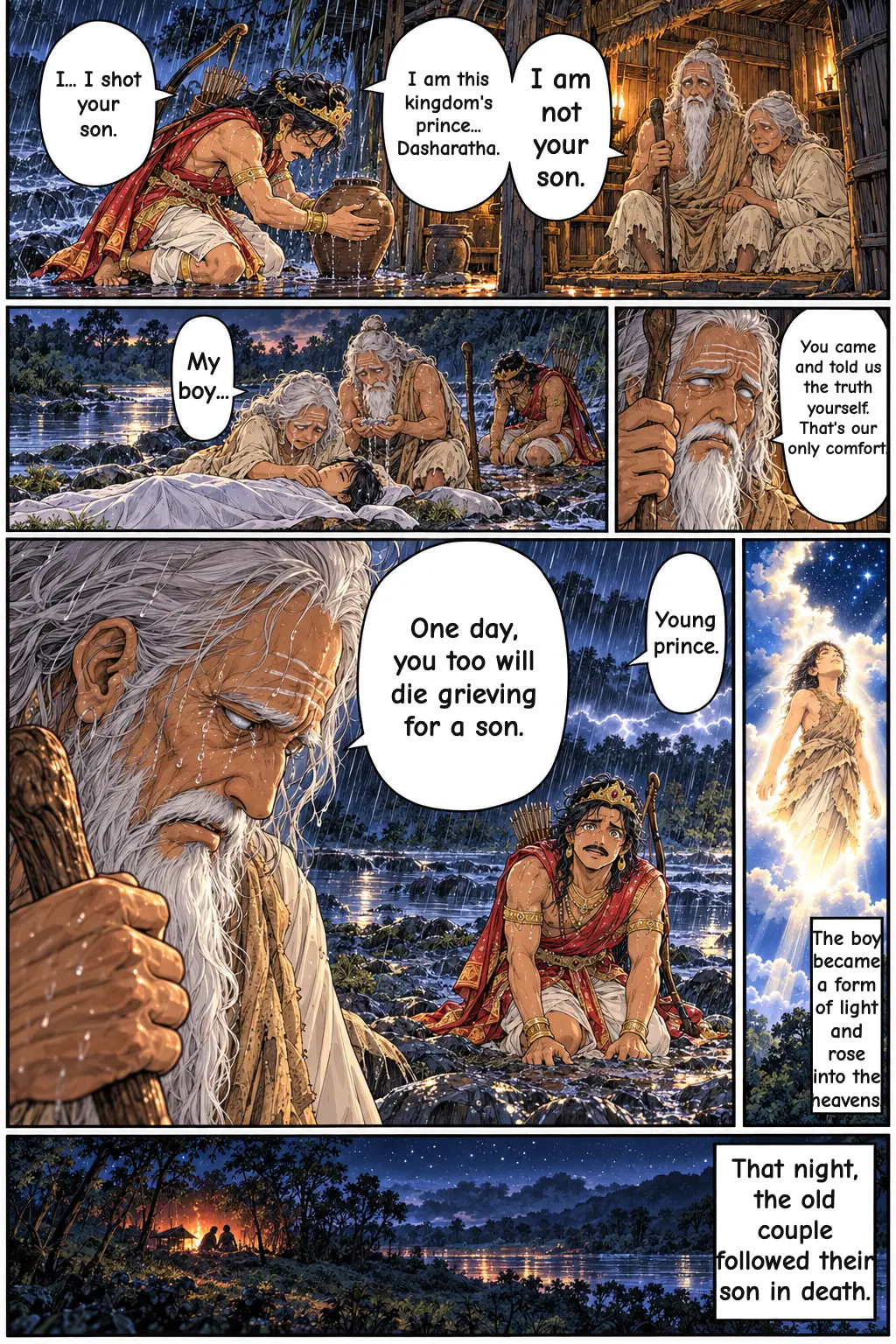
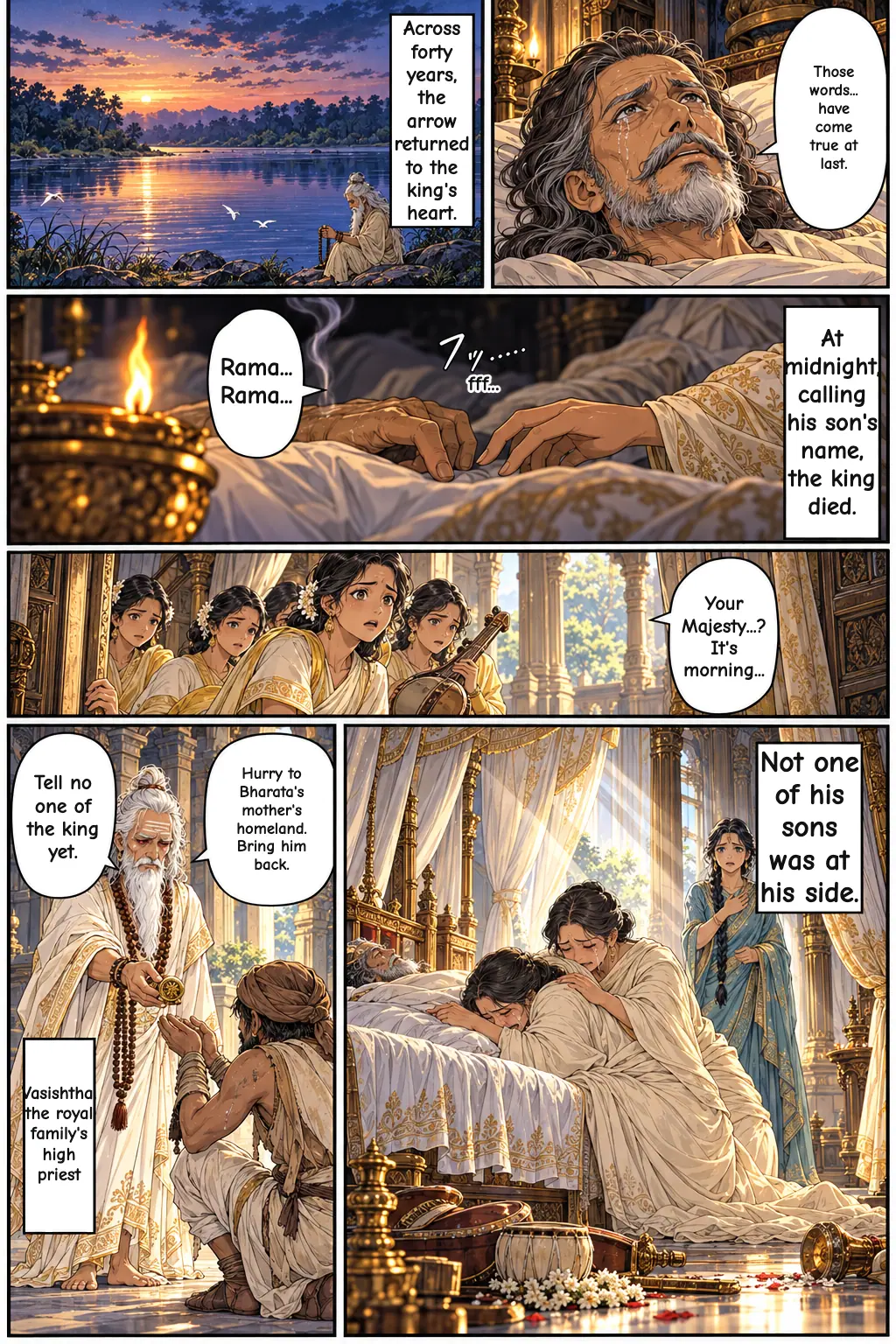
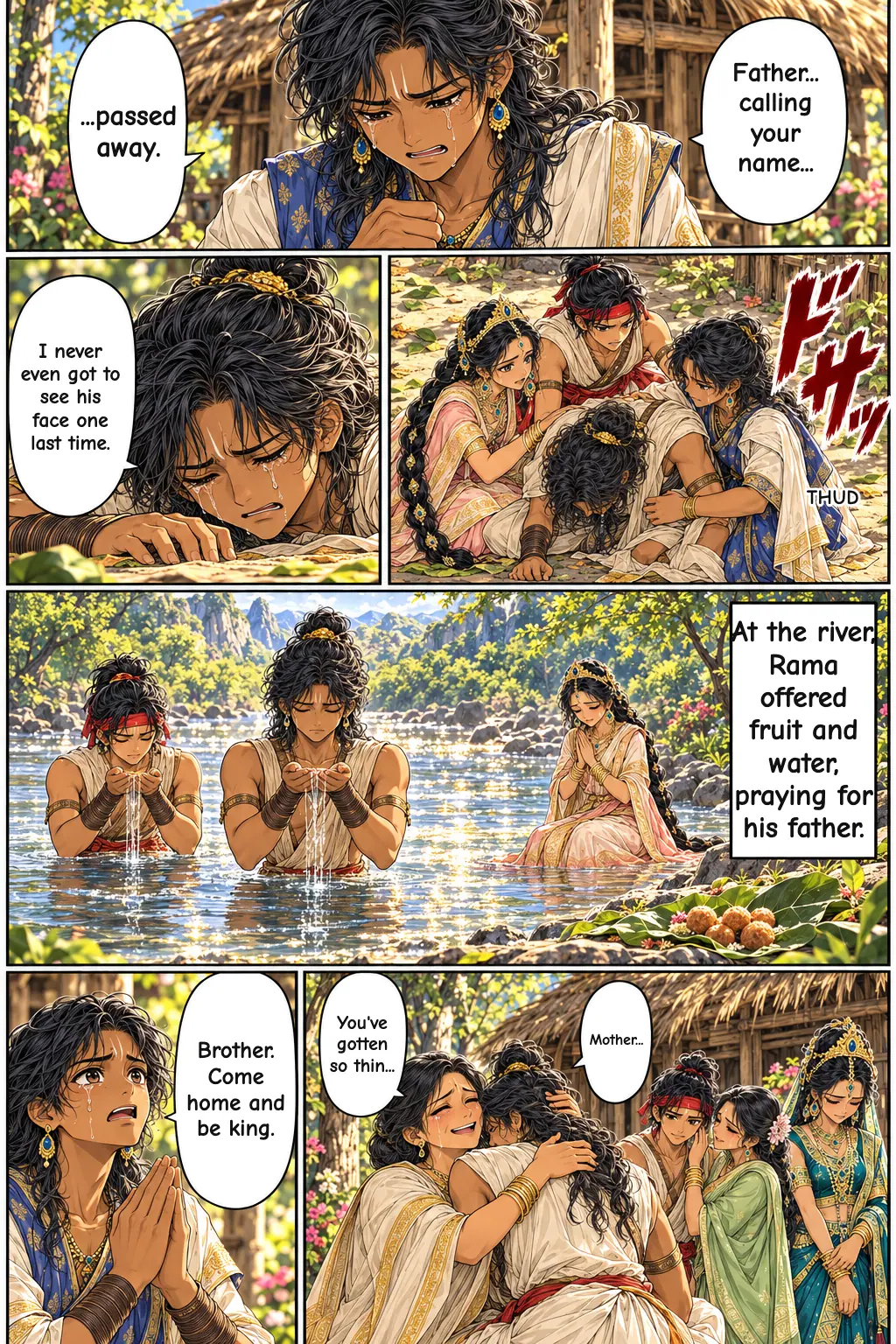
Back in Ayodhya, King Dasharatha collapses into grief when Sumantra returns alone. On the sixth night after Rama's departure he confesses an old sin to Queen Kausalya, Rama's mother. As a young prince, proud of his skill at shooting at targets by sound alone, he heard something at the Sarayu River at dusk in the rainy season and loosed an arrow, thinking it was an elephant drinking. It was a young man filling a water pot for his blind, elderly parents. Dying, the youth asked the prince to pull out the arrow and told him he was not a Brahmin, so the king need not fear that particular sin. Dasharatha carried the water to the parents and confessed. The grieving father cursed him: he too would one day die of sorrow for a son. The couple then mounted their son's funeral pyre. Having told the story, Dasharatha realizes the curse has come true, and he dies at midnight calling Rama's name.
The Original Story, Part 2: Bharata Refuses the Crown
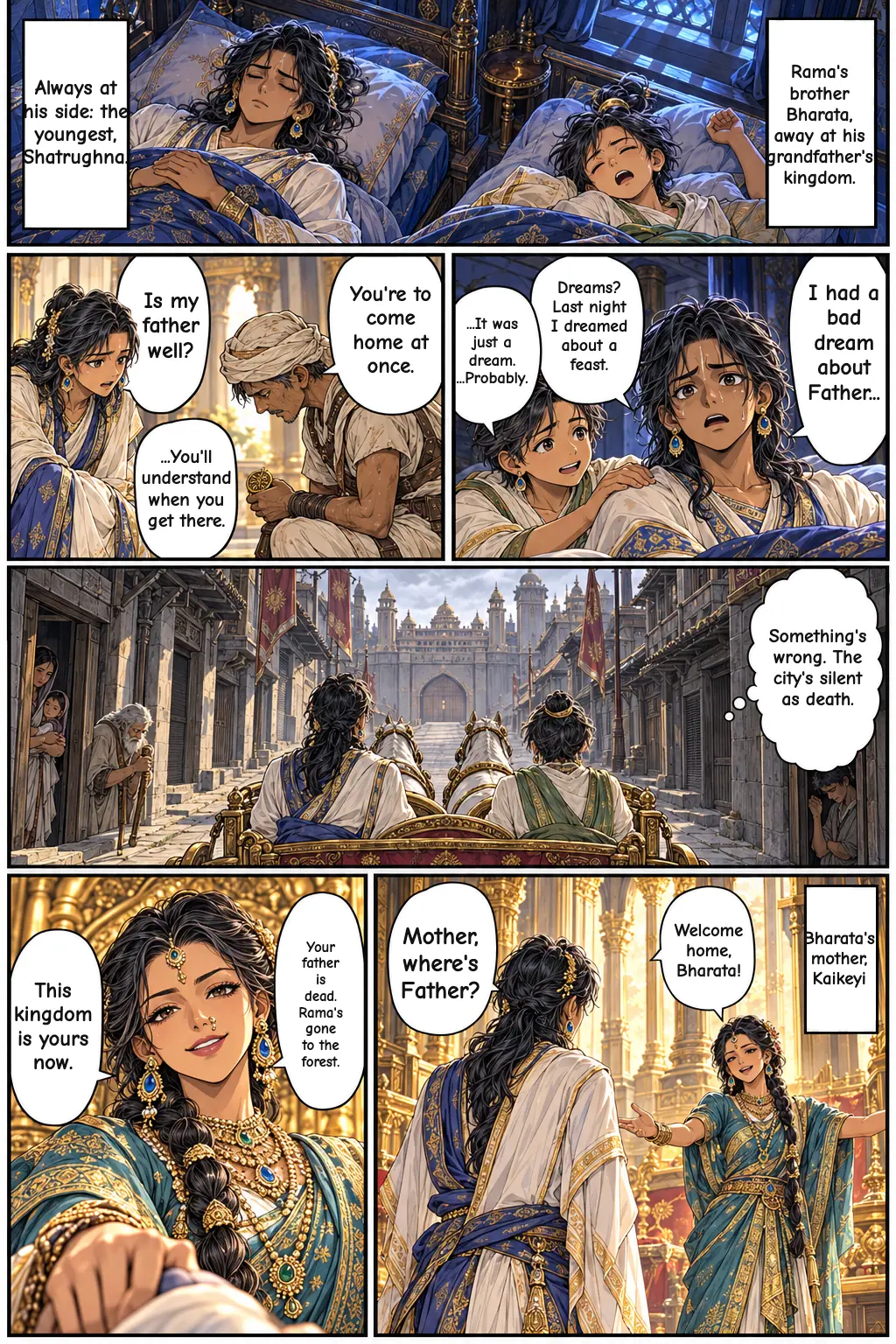
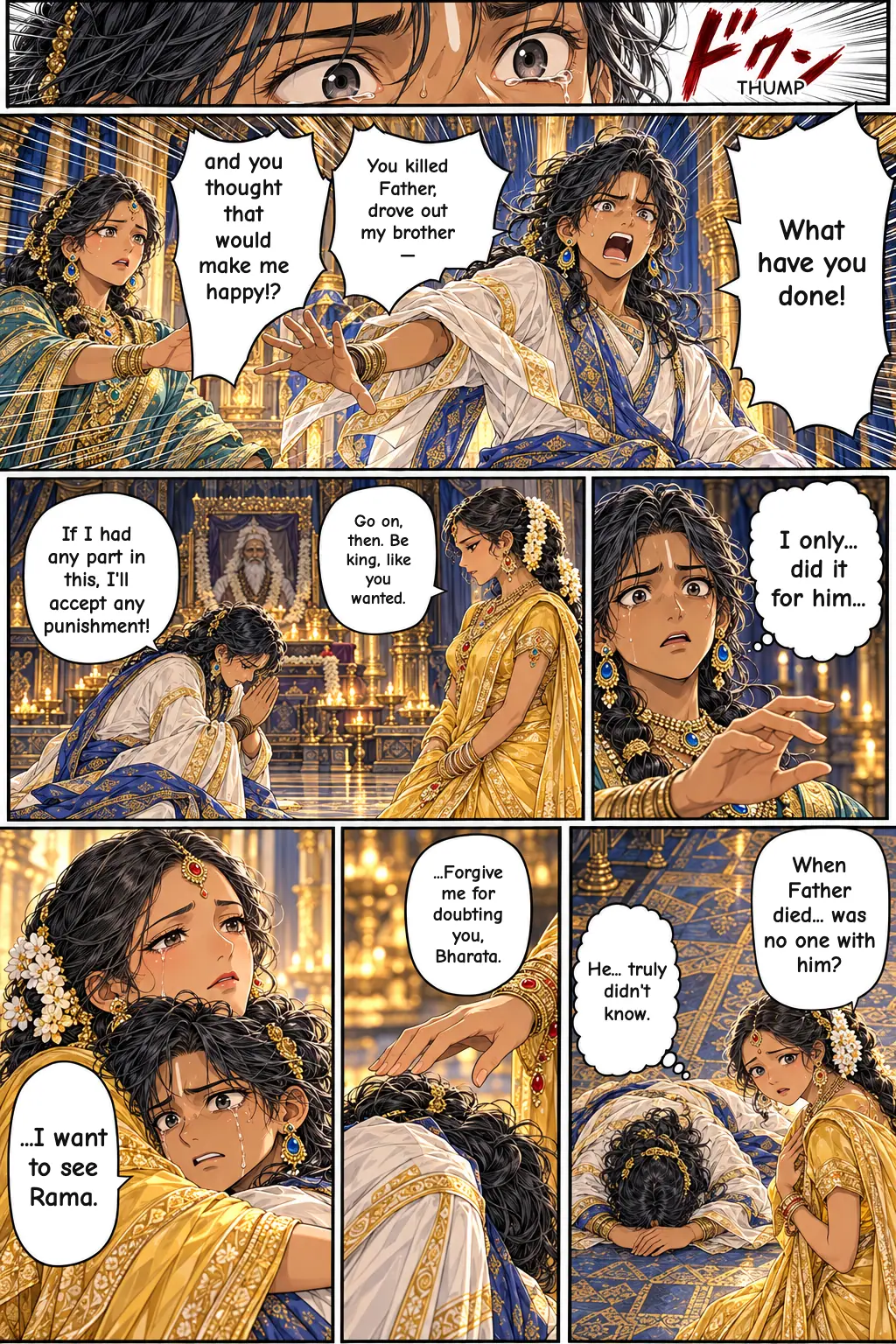
None of the king's sons are present, so his body is preserved in a vessel of oil while the royal priest Vasishtha sends messengers to the kingdom of Kekaya, where Prince Bharata is staying with his maternal grandfather. Bharata, troubled by an ominous dream, hurries home. His mother Kaikeyi proudly tells him everything: the king is dead, Rama is exiled, and the throne is his, because she used two boons the king once promised her. Bharata is horrified. He denounces her furiously, swears a long series of oaths to Kausalya that he had no part in the plot, performs his father's funeral rites, and stops his brother Shatrughna from beating Manthara, the maid who encouraged Kaikeyi's scheme.
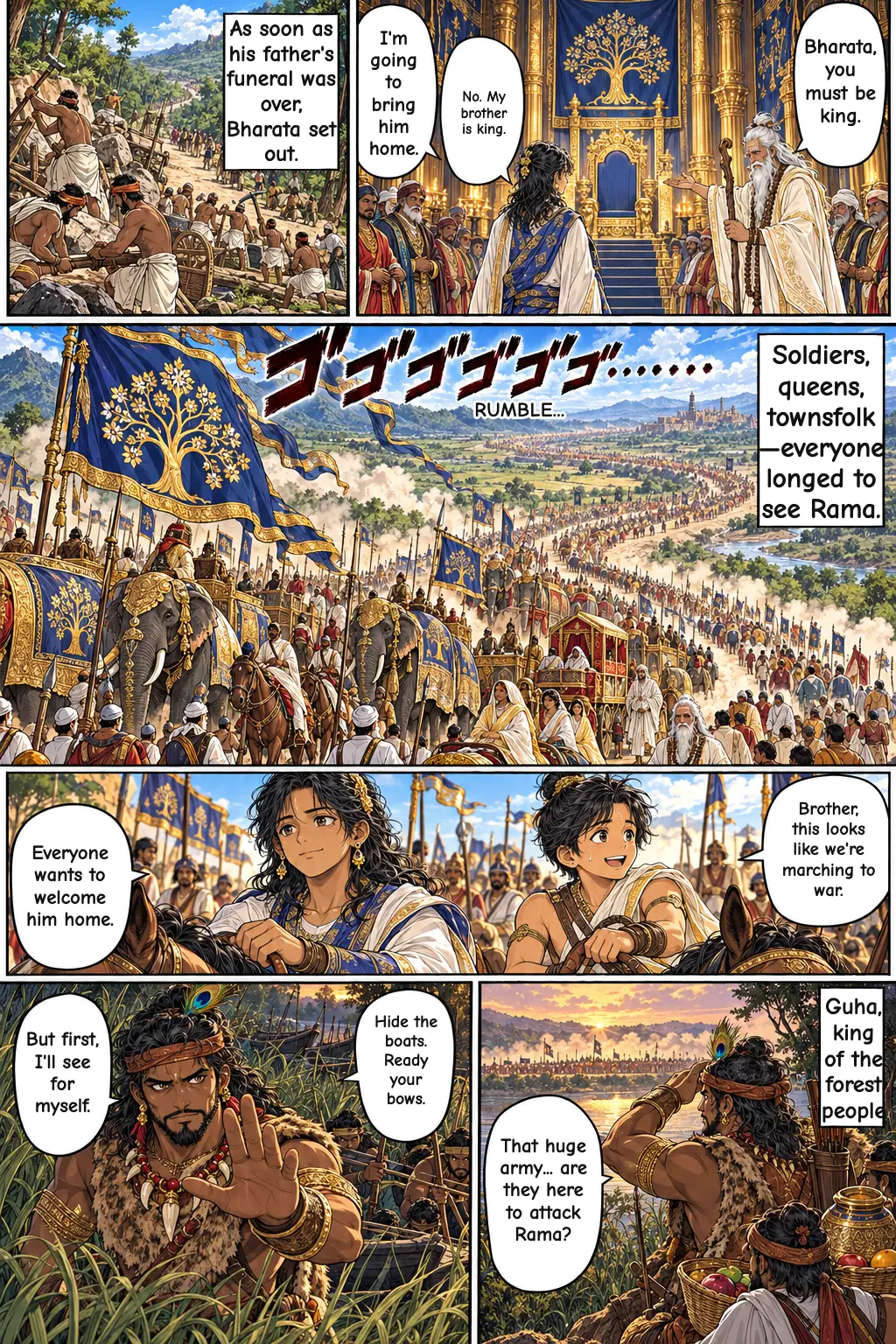
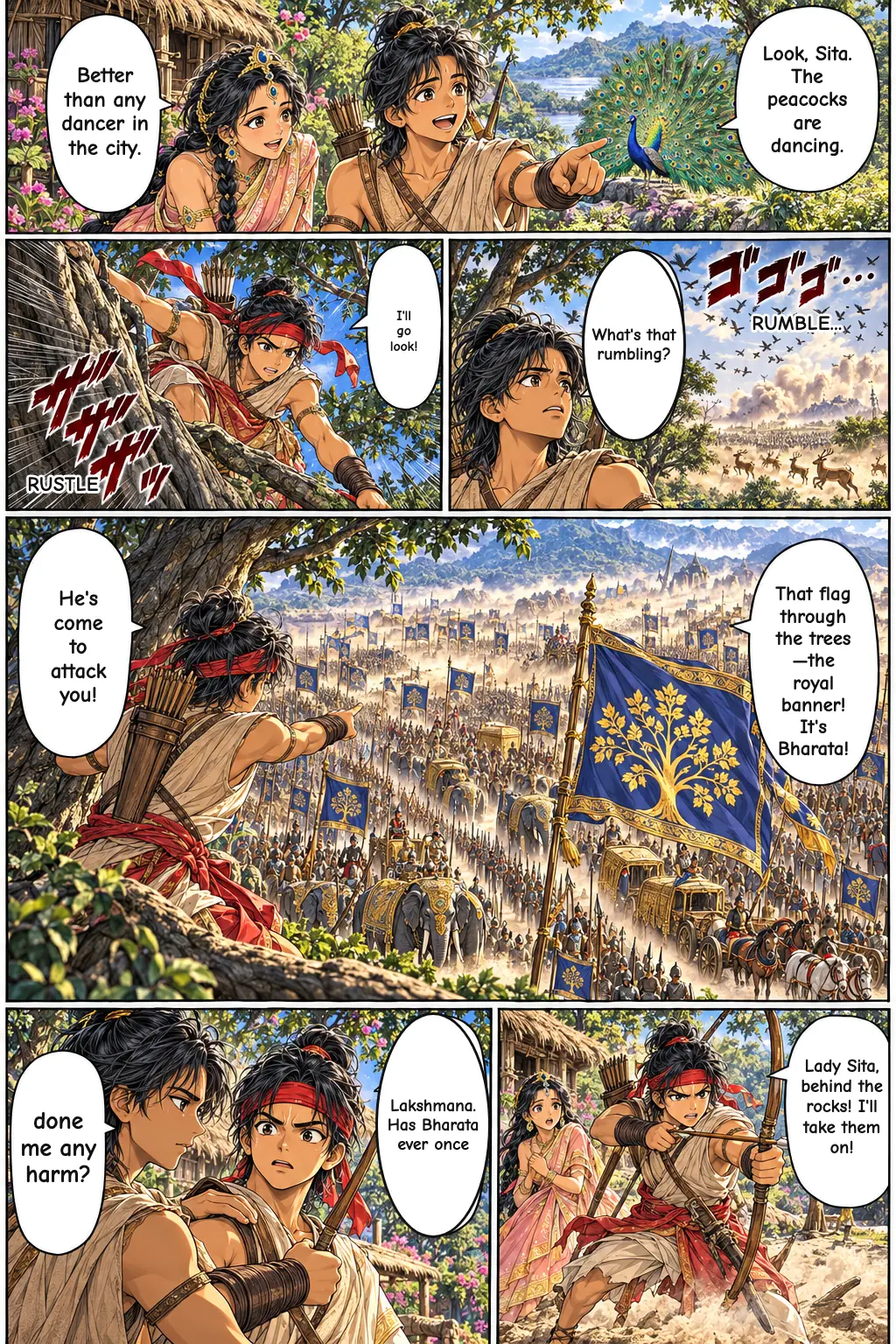
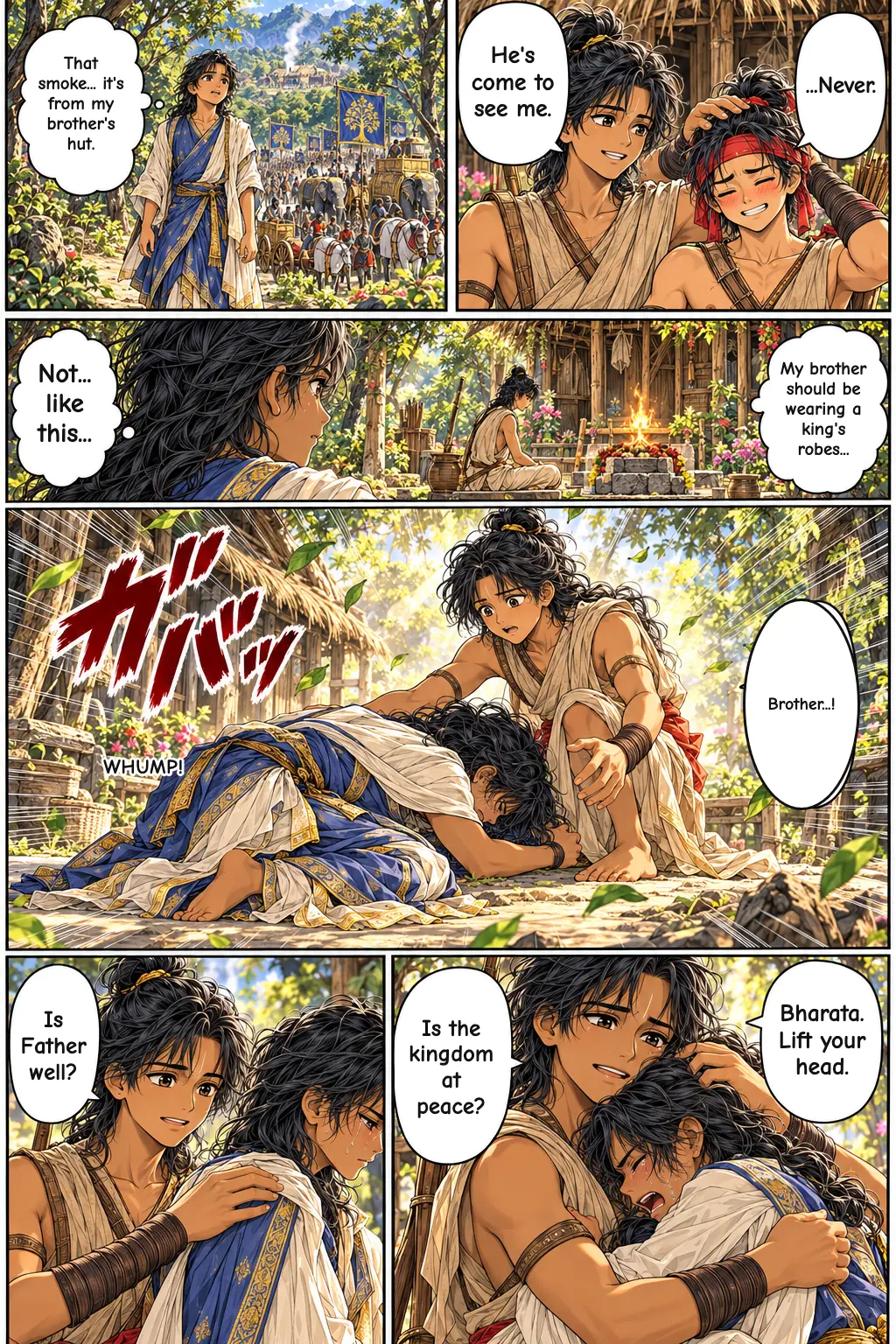
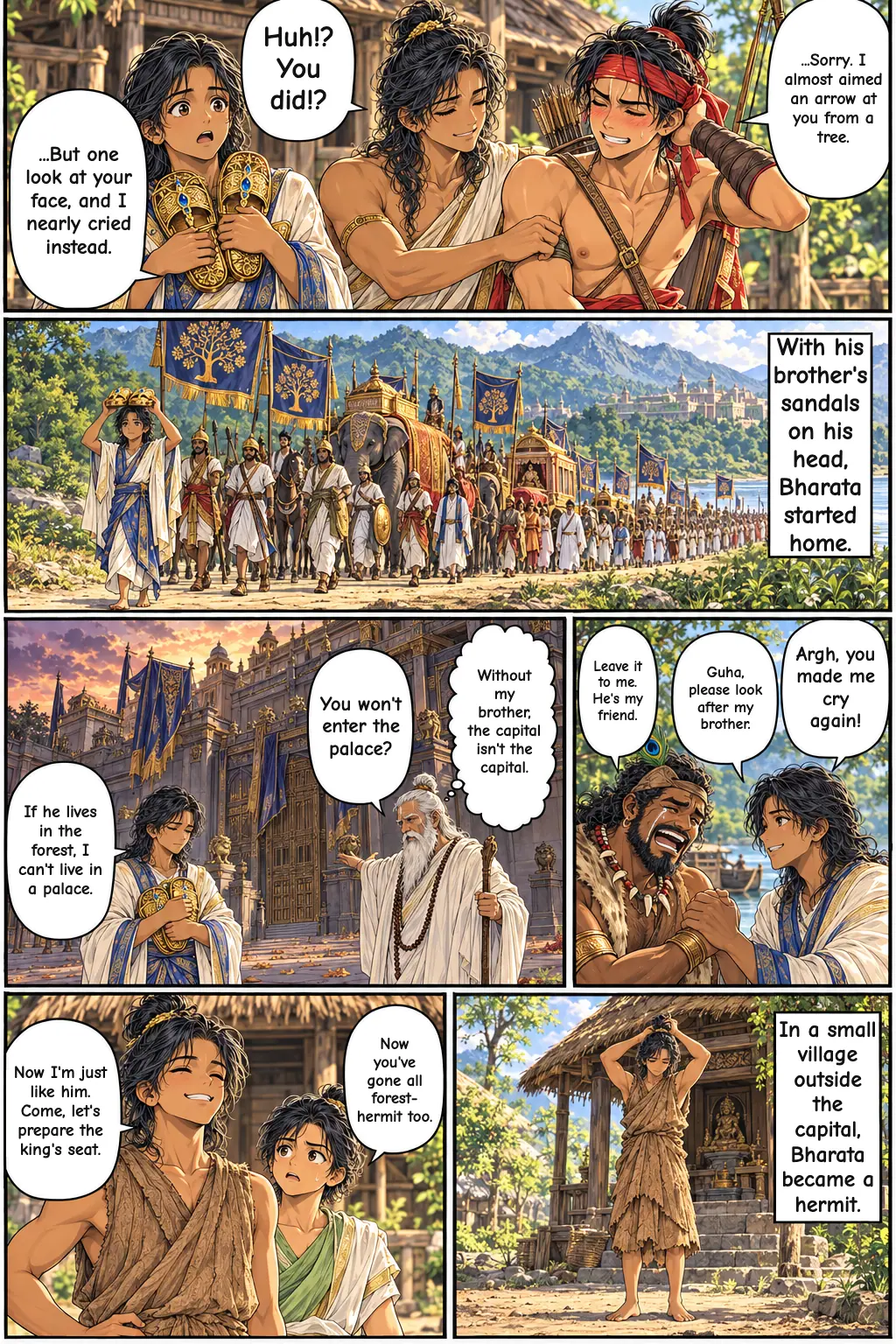
When the ministers urge him to take the throne, Bharata refuses. Instead he sets out with the army, the queens, Vasishtha and the townspeople to bring Rama back. On the way Guha, and later Bharadvaja, first suspect him of hostile intent. At Chitrakuta, Lakshmana sees the banners and assumes Bharata has come to attack; Rama calms him and says he trusts Bharata. Bharata throws himself at Rama's feet and begs him to return.
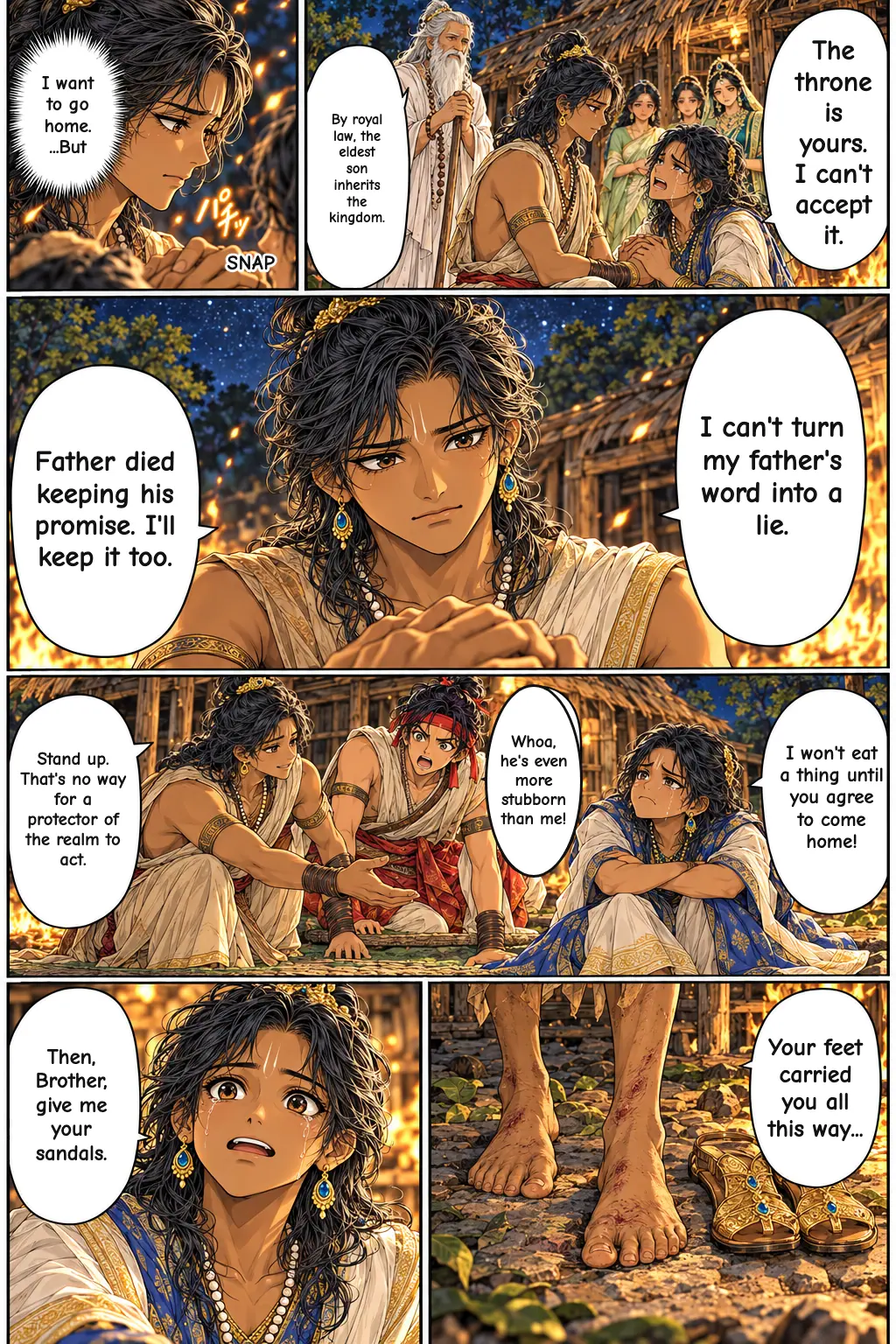
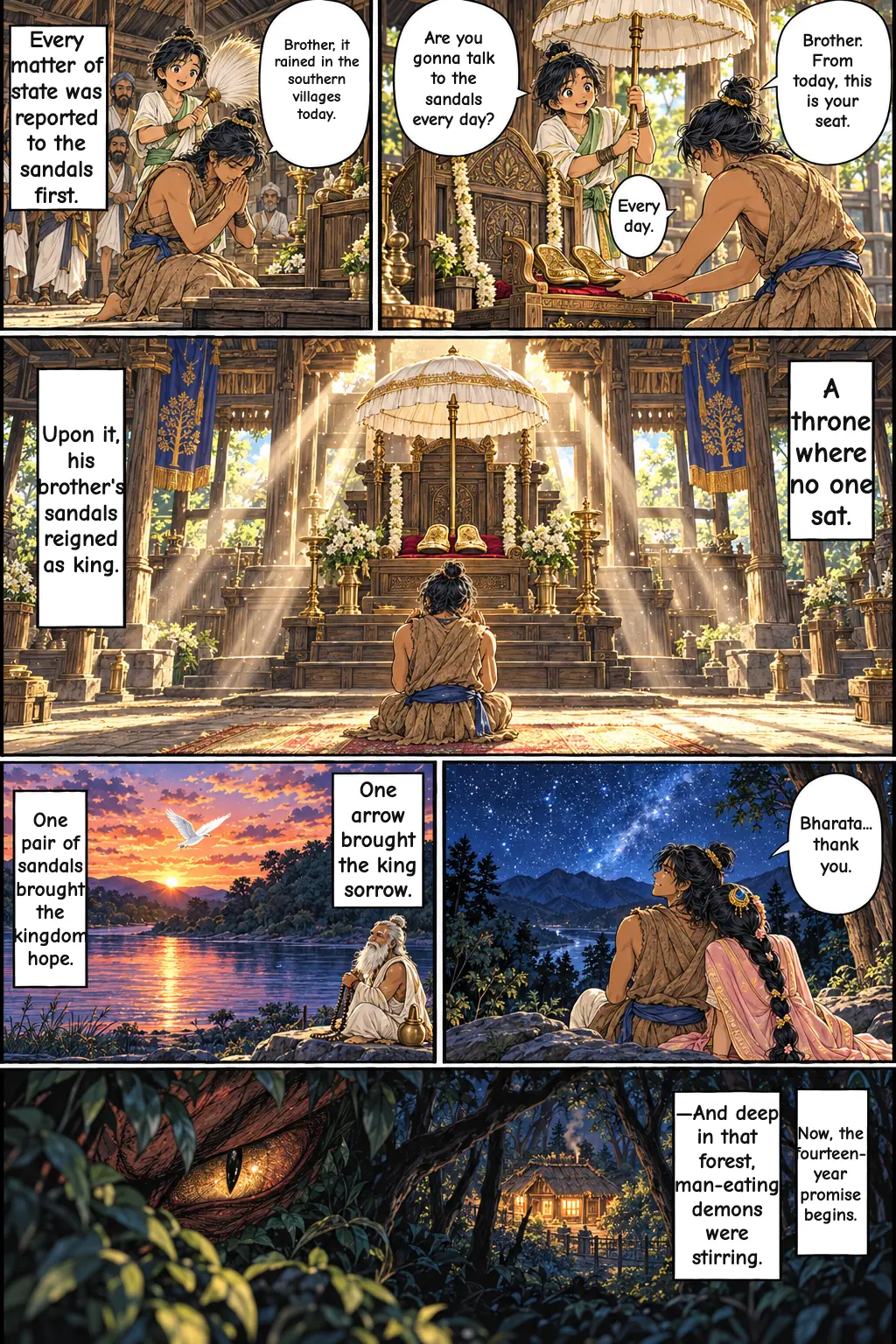
Rama mourns their father deeply but will not break Dasharatha's word. Neither Vasishtha's appeal to the rule of the eldest son nor the skeptical arguments of the Brahmin Jabali, who claims a dead father's promise means nothing, can move him. Finally Bharata accepts Rama's sandals (paduka), decorated with gold, and places them on his head. He vows to enter fire if Rama does not return when the fourteen years are over. He does not live in the capital. Instead he settles in the village of Nandigrama, dressed as an ascetic, and governs the kingdom in the name of the sandals.
What This Story Is About: Dharma, Promises and Stewardship
At its heart this section is about dharma, the duty and right conduct that shape every character's choices. Rama treats a father's promise as something that cannot be broken, even after the father has died and even when everyone around him offers good reasons to break it. His rejection of Jabali's argument shows the epic firmly siding with truthfulness and duty over convenience.
Bharata's choice is just as important. He could rule legally, but he understands kingship as a trust rather than a prize. By governing as a hermit on behalf of the sandals, he becomes a steward, not an owner. In Indian tradition Bharata is often held up as the model of a devoted brother, and honoring a revered person's sandals or feet is a familiar gesture of respect and devotion. Dasharatha's story adds a darker theme: a deed done carelessly in youth returns decades later, a pattern many readers link to the idea of karma.
What the Manga Changes (and What It Keeps)
The manga follows Valmiki's sequence of events, but some details are artistic choices. Valmiki gives only the bare conditions of Dasharatha's fatal shot: dusk turning to night in the rainy season, the Sarayu River, the sound of a water pot. The panel layout, lighting and staging of the roughly three-page flashback are the artist's work. So are the young man's face and apparent age and the look of his parents' hermitage. Valmiki never names the youth; later popular retellings in India call him Shravan Kumar, but that name does not appear in this text.
The faces, clothing and boats of Guha's people, the construction of the Chitrakuta hut, the landscapes, and the size of Bharata's army on the page are also visual inventions, since the original gives few details. The original says only that the sandals were decorated with gold, so their shape and style are a design choice. Long speeches, including the debates at Chitrakuta and Rama's detailed questions to Bharata about governing the kingdom, are condensed, and the characters' inner thoughts and silences are the manga's own dramatization.
Where to Read It
If you'd like to see Bharata's march to the forest and the moment the sandals change hands, Episode 4 of RAMAYANA: The Exiled Prince and the Son of the Wind is on this page. Every episode on Manga Portal is free to read with no sign-up, so you can start from Episode 1 or continue from here. For the original, look for a complete English translation of Valmiki's Ayodhya Kanda, and check which chapter numbering it uses.
Characters in this episode
Rama
Eldest son of King Dasharatha, who accepts fourteen years of forest exile and refuses to return early because he will not break his father's promise.
Bharata
Rama's younger half-brother, who refuses the throne his mother won for him and rules as Rama's stand-in, in the name of Rama's sandals.
Dasharatha
King of Kosala, who dies of grief for Rama, fulfilling a curse from the blind father of a young man he shot by mistake in his youth.
Kaikeyi
Bharata's mother, who used two boons to have Rama exiled and Bharata made king, and is fiercely rejected by her own son.
Lakshmana
Rama's devoted, quick-tempered brother, who follows him into exile and at first mistakes Bharata's approach for an attack.
Guha
King of the Nishadas and Rama's friend, who ferries the exiles across the Ganges and later helps Bharata once he trusts him.
FAQ
Why did Bharata put Rama's sandals on the throne?
Bharata believed the kingdom rightfully belonged to Rama, but Rama would not return before his fourteen-year exile ended. Taking Rama's sandals (paduka) let Bharata govern as a caretaker in his brother's name rather than as king. He lived as an ascetic in Nandigrama until Rama came back.
How did King Dasharatha die in the Ramayana?
He died of grief soon after Rama left for exile. That night he told Queen Kausalya how, as a young man, he had shot a blind couple's son by mistake, and the father had cursed him to die of sorrow for a son. He realized the curse had come true and died at midnight.
Why didn't Rama go back to Ayodhya when Bharata asked him?
Rama's exile came from a promise his father had made to Kaikeyi, and Rama considered keeping that promise his duty (dharma), even after his father's death. He rejected every argument for returning, including Jabali's claim that such promises do not matter.
Who was the boy Dasharatha killed?
In Valmiki's Ramayana he is the unnamed son of a blind ascetic couple, shot while filling a water pot at the Sarayu River. Later popular retellings in India call him Shravan Kumar, but that name is not in Valmiki's text.
What is a paduka?
Paduka is the Sanskrit word for sandals or footwear. In this story, Rama's paduka become the symbol of his royal authority while he is in exile.