Episode 4He Paid a Fortune for a Fireproof FurThe Fire-Rat Robe and the Dragon's Jewel
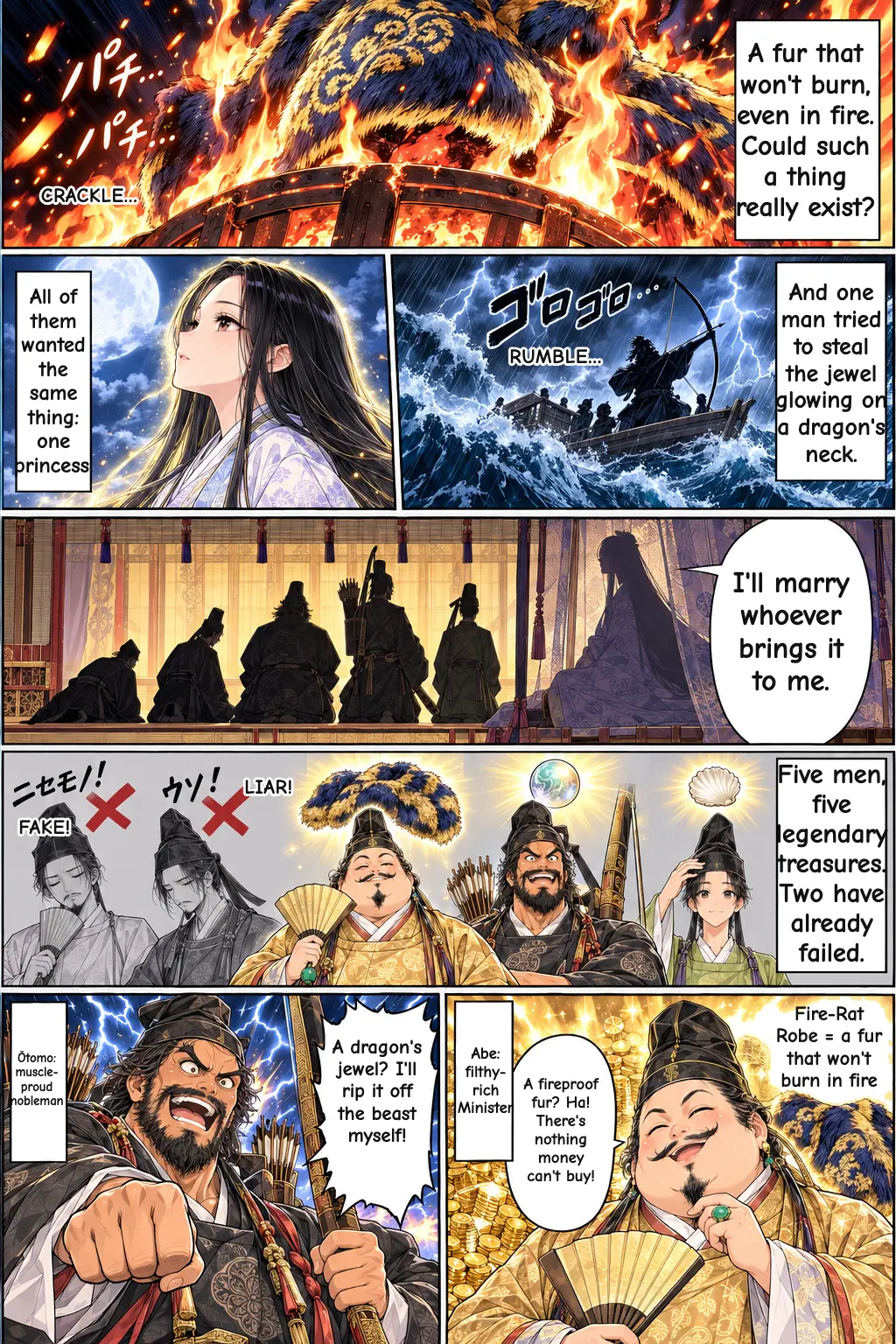
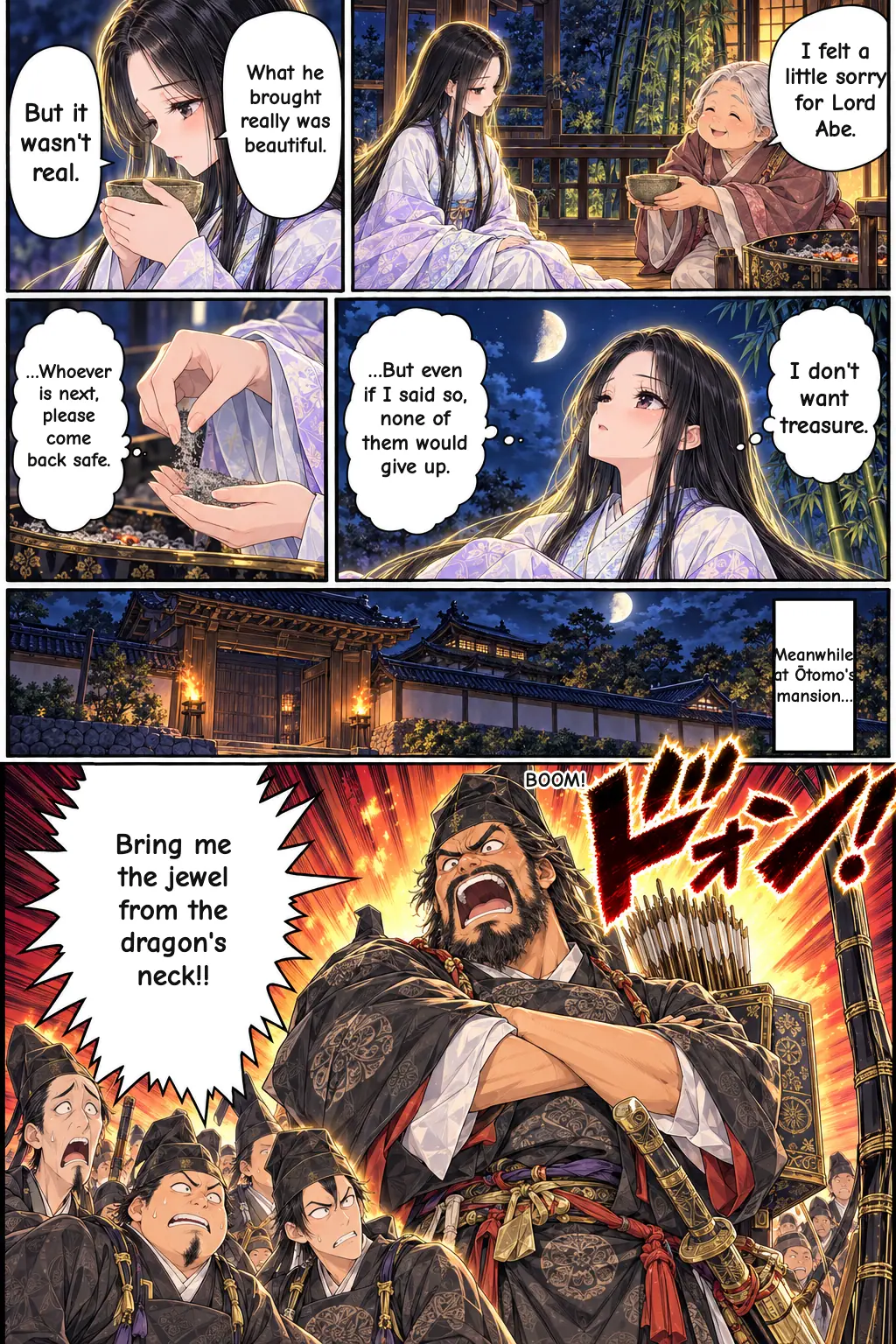
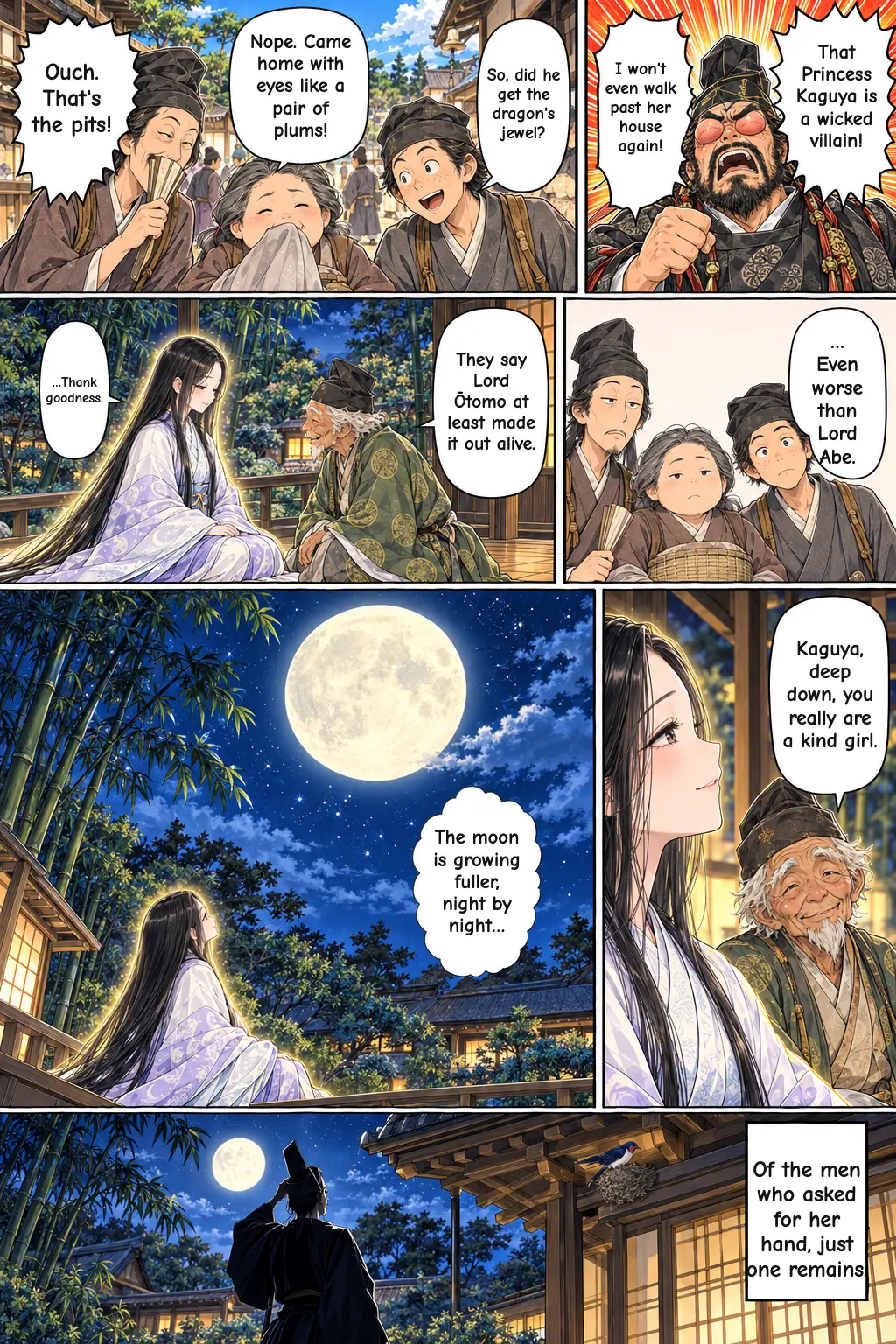
The Tale of the Bamboo Cutter, Episode 4. Minister of the Right Abe no Miushi spends a fortune on a "fireproof" fur robe, and Grand Counselor Ōtomo no Miyuki tries to take a dragon's jewel by brute force. Princess Kaguya sees both of these vain quests through with her own eyes, and quietly hopes both men come home safe. Only one suitor is left...
Tale of the Bamboo Cutter: Fire-Rat Robe & Dragon's Jewel Summary
Where This Episode Fits in the Tale of the Bamboo Cutter
The Tale of the Bamboo Cutter (Taketori Monogatari) is a Japanese story from the early Heian period, written roughly in the 9th or 10th century by an unknown author. It is often called the oldest surviving Japanese prose tale. An old bamboo cutter finds a tiny girl glowing inside a bamboo stalk. She grows into Princess Kaguya, a young woman so beautiful that five high-ranking nobles come to ask for her hand.
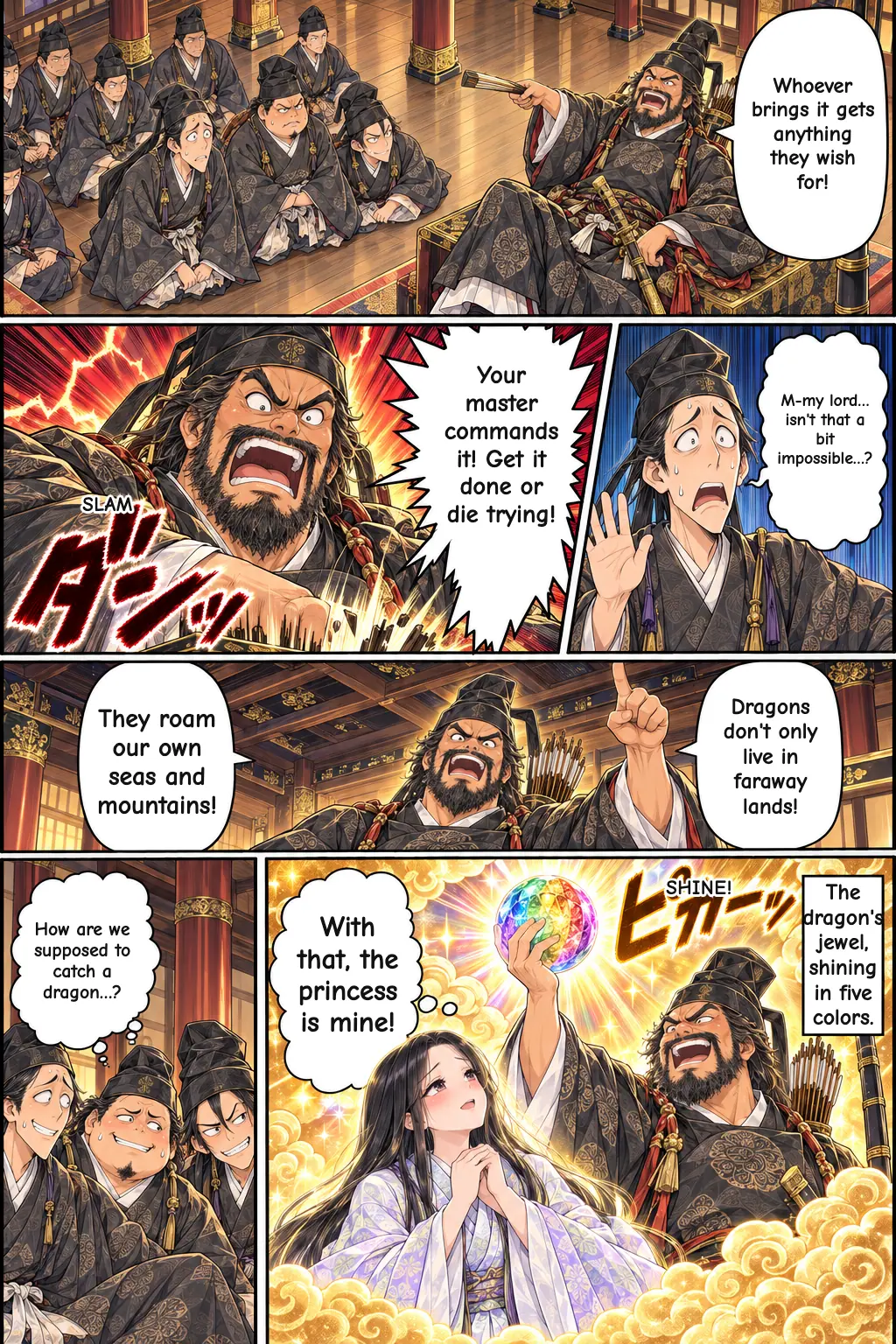
Kaguya does not want to marry. Instead of refusing outright, she gives each suitor a task: bring back a legendary treasure that probably does not exist. This episode covers two of those quests. Abe no Miushi, Minister of the Right, must find the robe made from the fur of the fire-rat, said to be in China. Ōtomo no Miyuki, a Grand Counselor, must bring back the five-colored glowing jewel that hangs from a dragon's neck.
The Fire-Rat Robe: A Treasure Bought with Gold
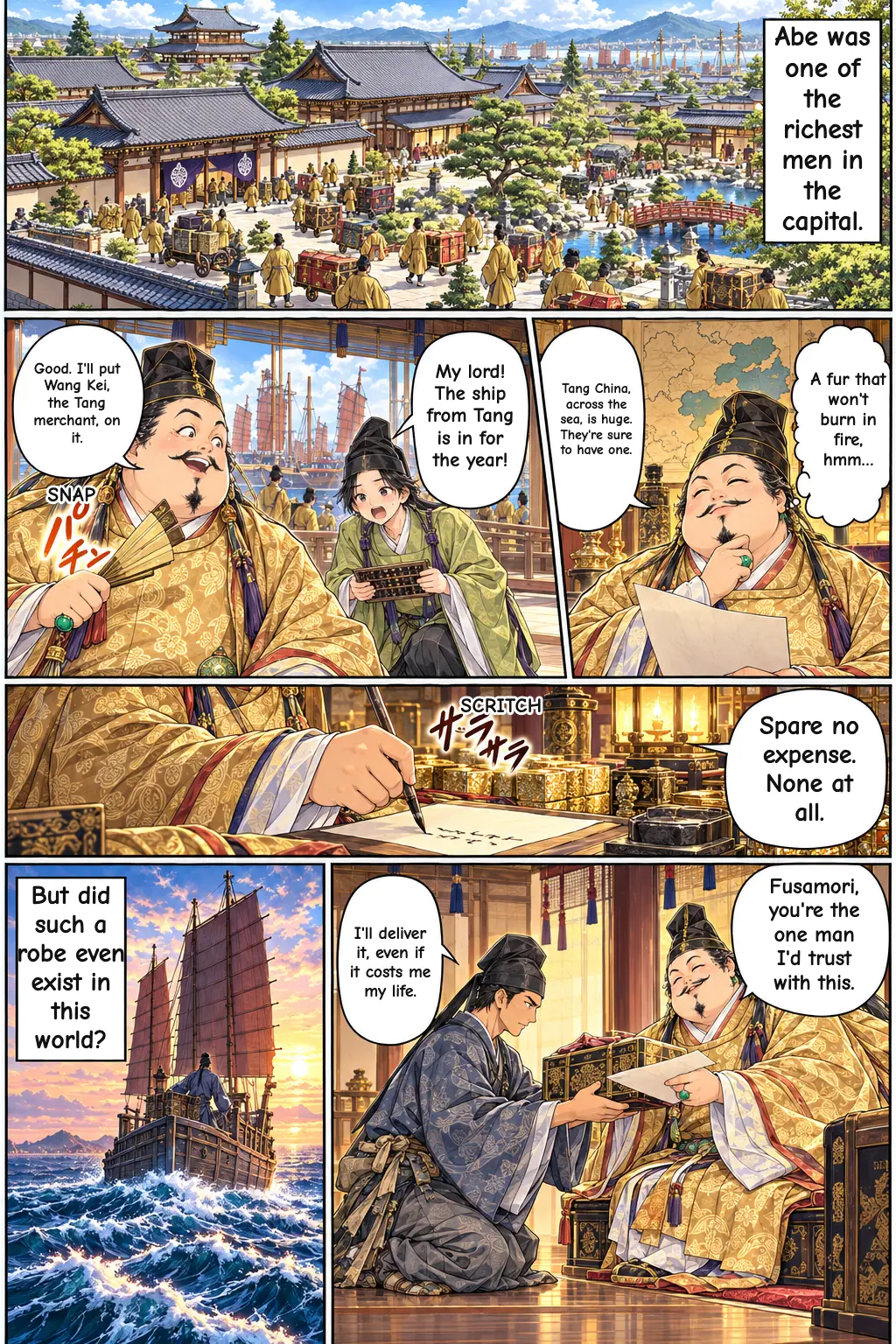
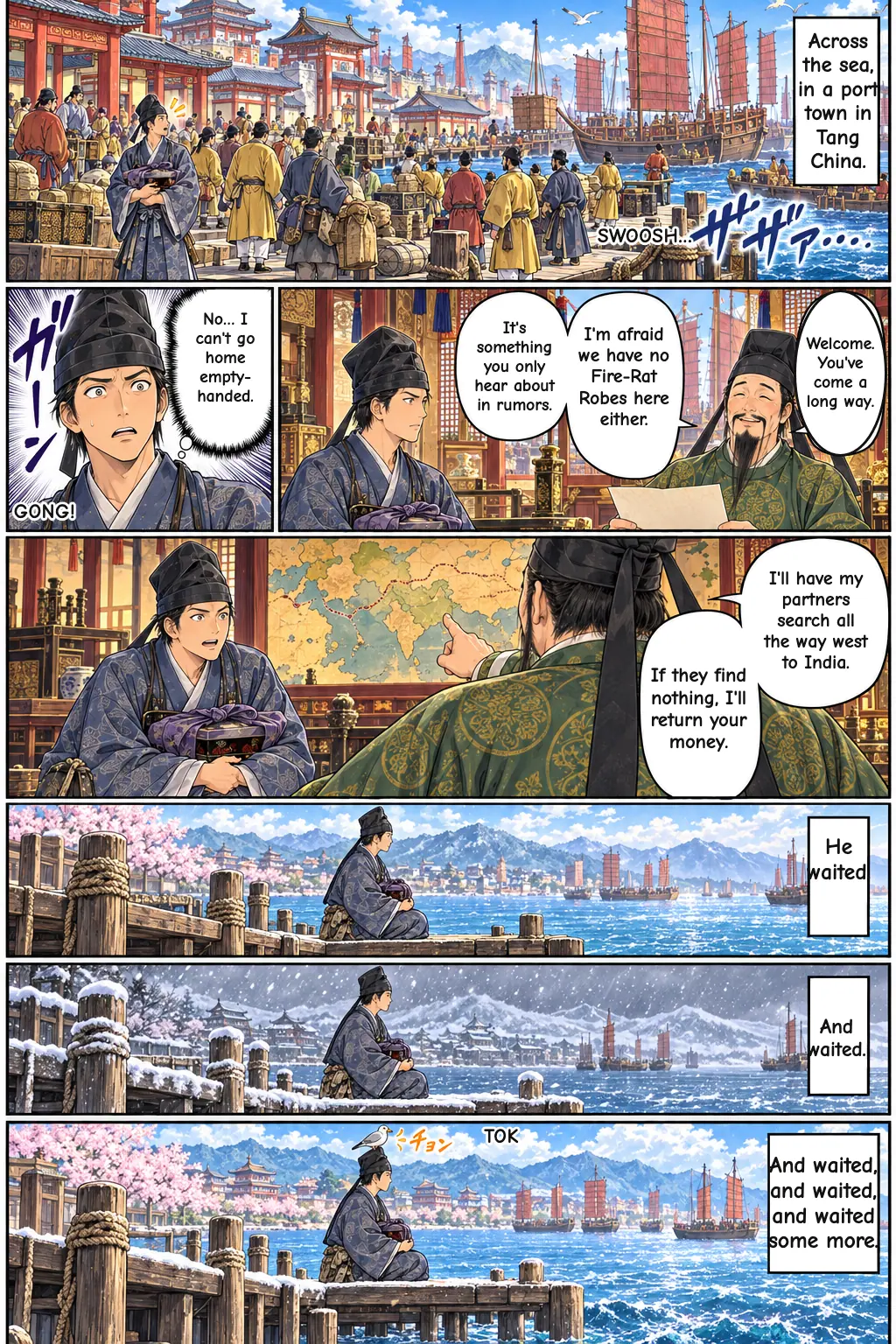
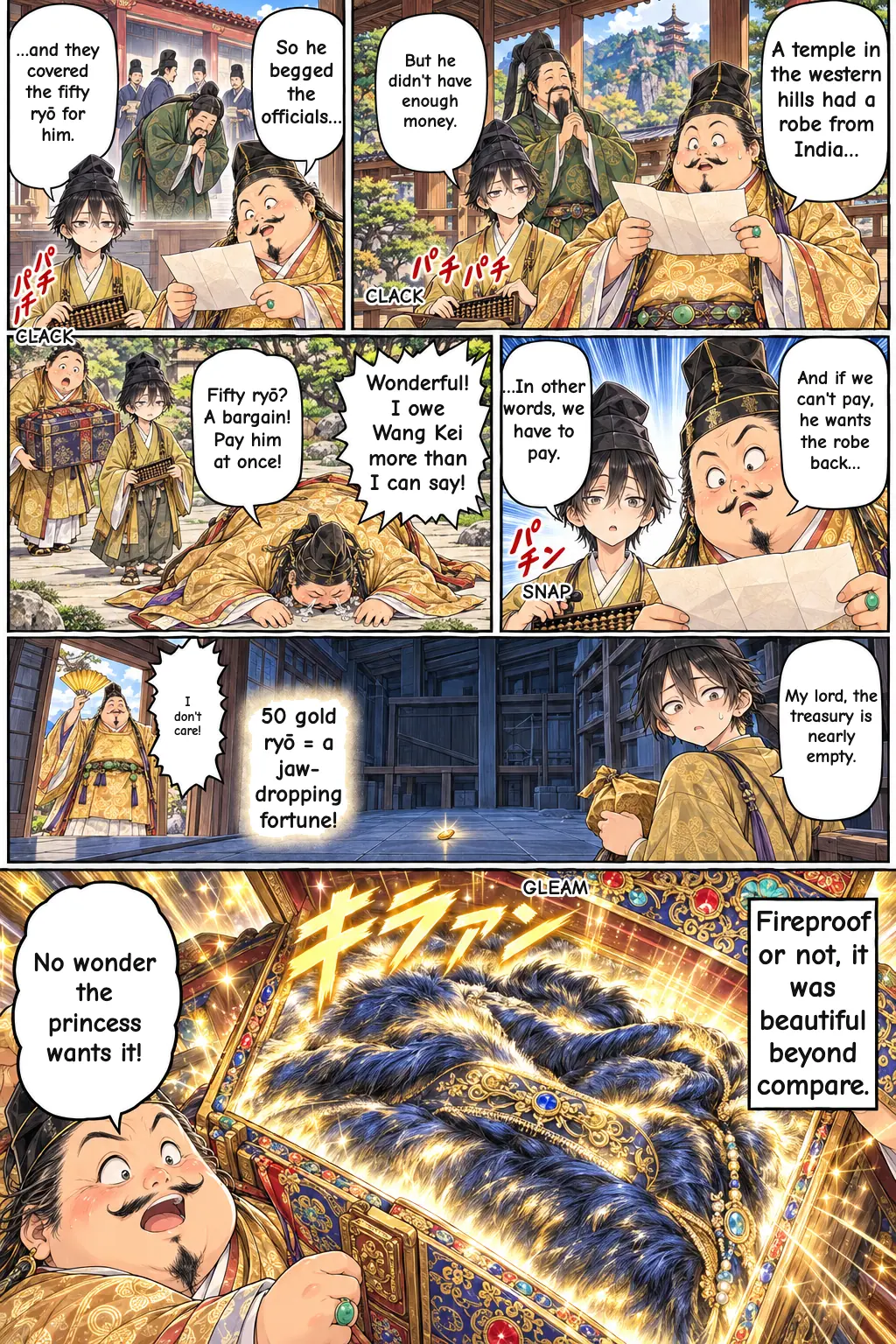
Abe is very rich, so he does not travel himself. He writes to Wang Qing (Ō Kei in Japanese), a Chinese merchant who has arrived on a trading ship, and sends a trusted retainer, Ono no Fusamori, with gold. At first the merchant answers honestly: the robe is only a rumor even in China, but he will search, and return the money if he fails.
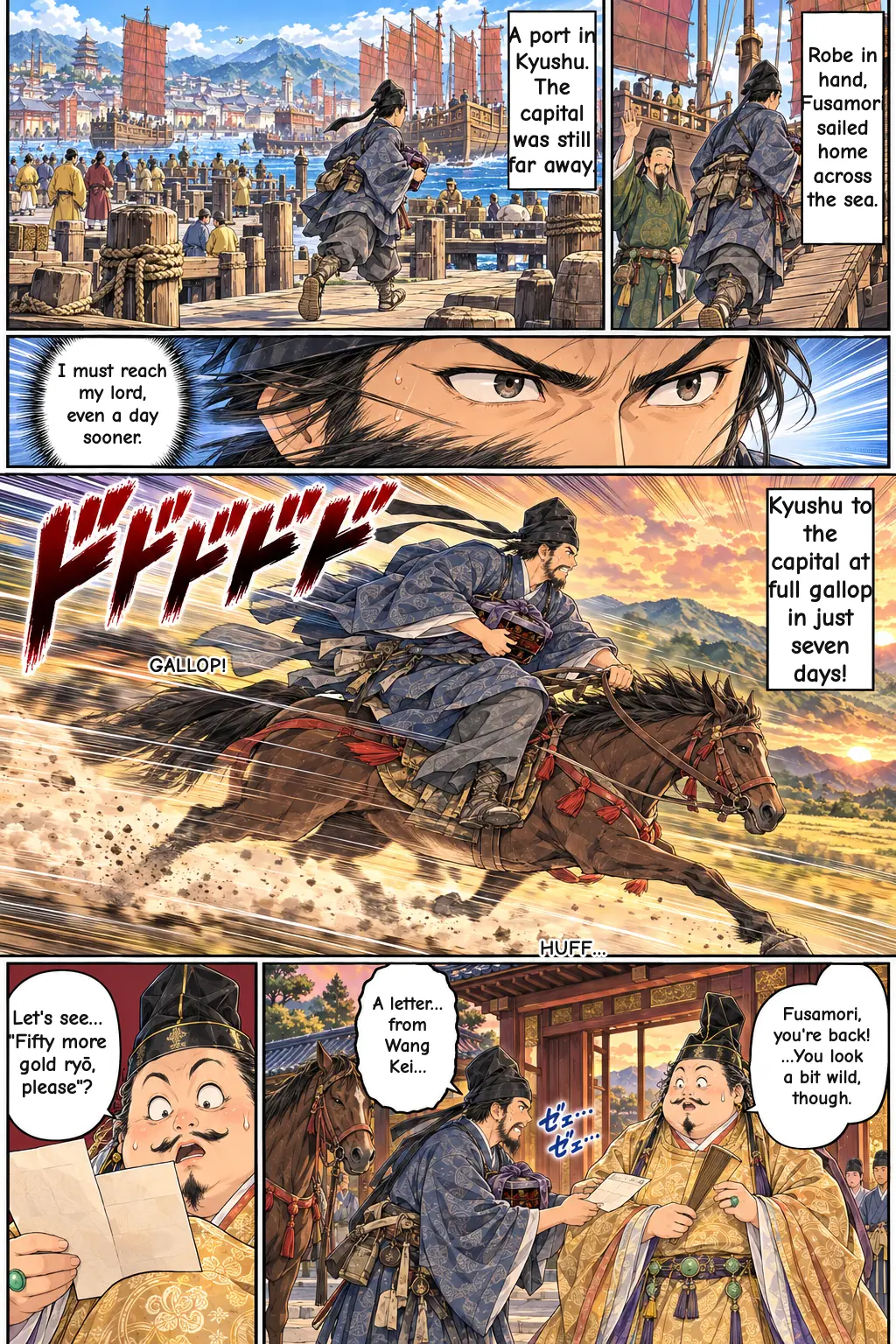
When the ship returns, Fusamori rushes the package from Kyushu to the capital in just seven days. The merchant's letter tells a long story: a holy man from India once brought the robe to a mountain temple in the west, and it was obtained only after a petition to the authorities. The price was higher than expected, so Abe owes fifty more taels of gold. Abe pays happily and even bows in the direction of China.
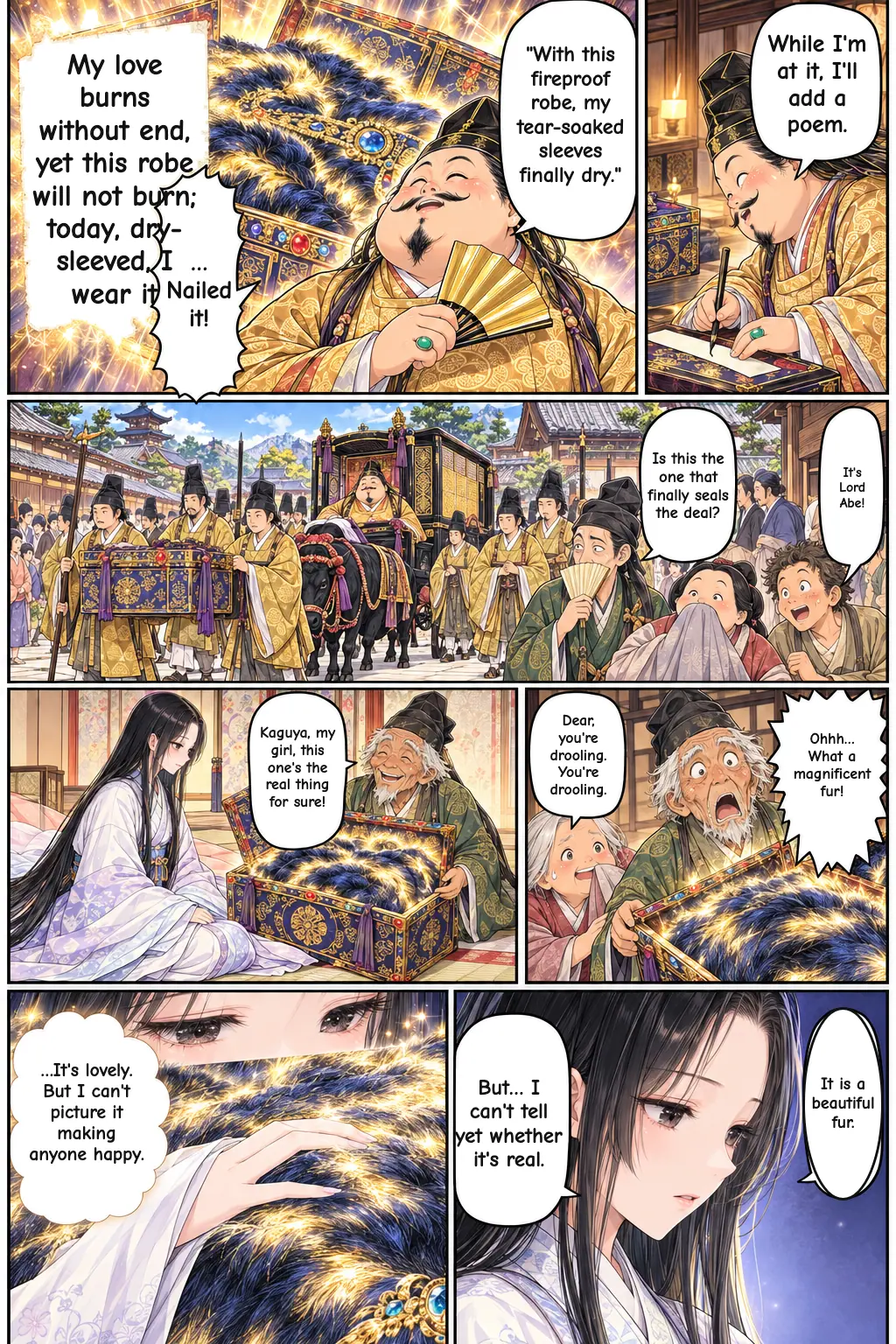
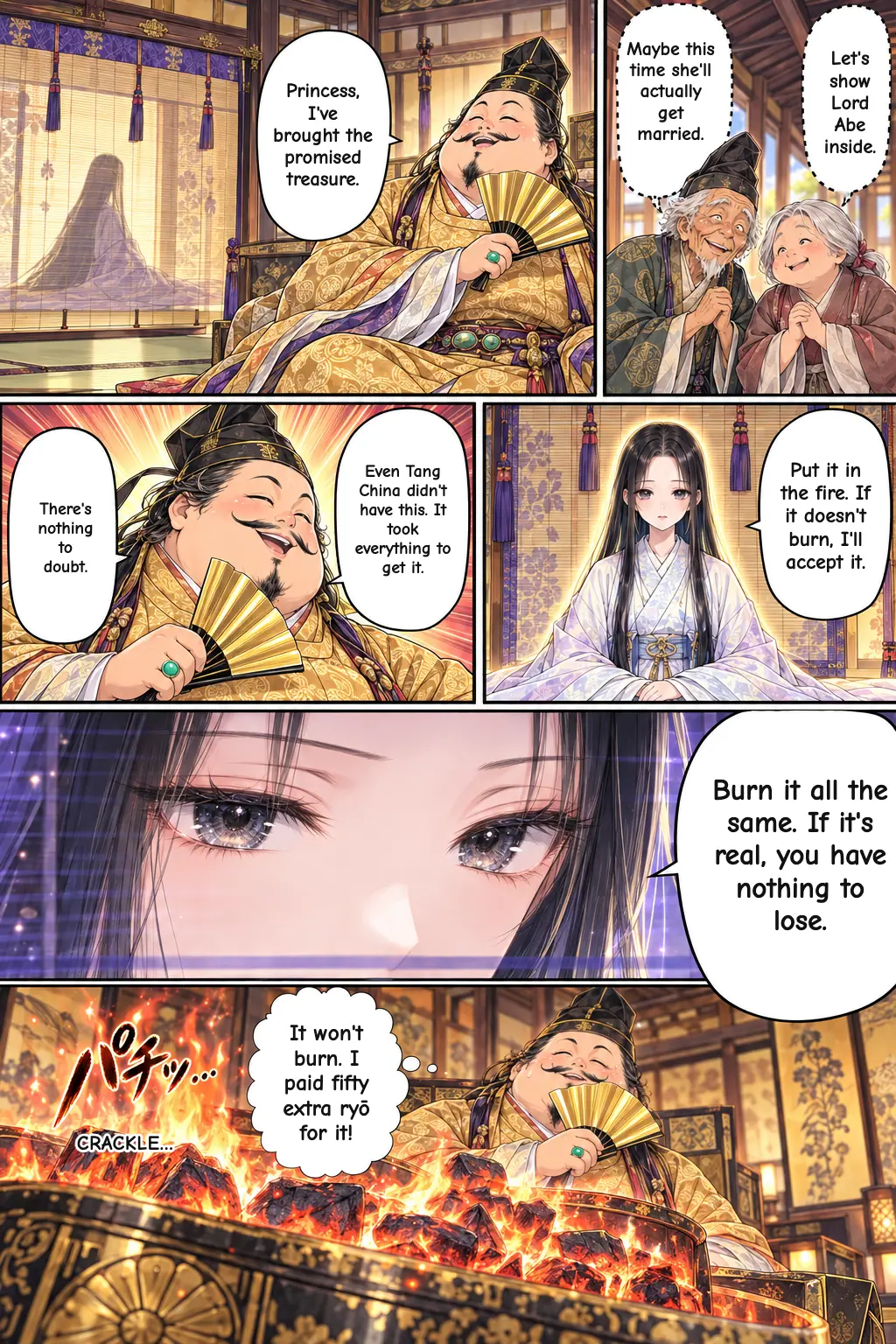
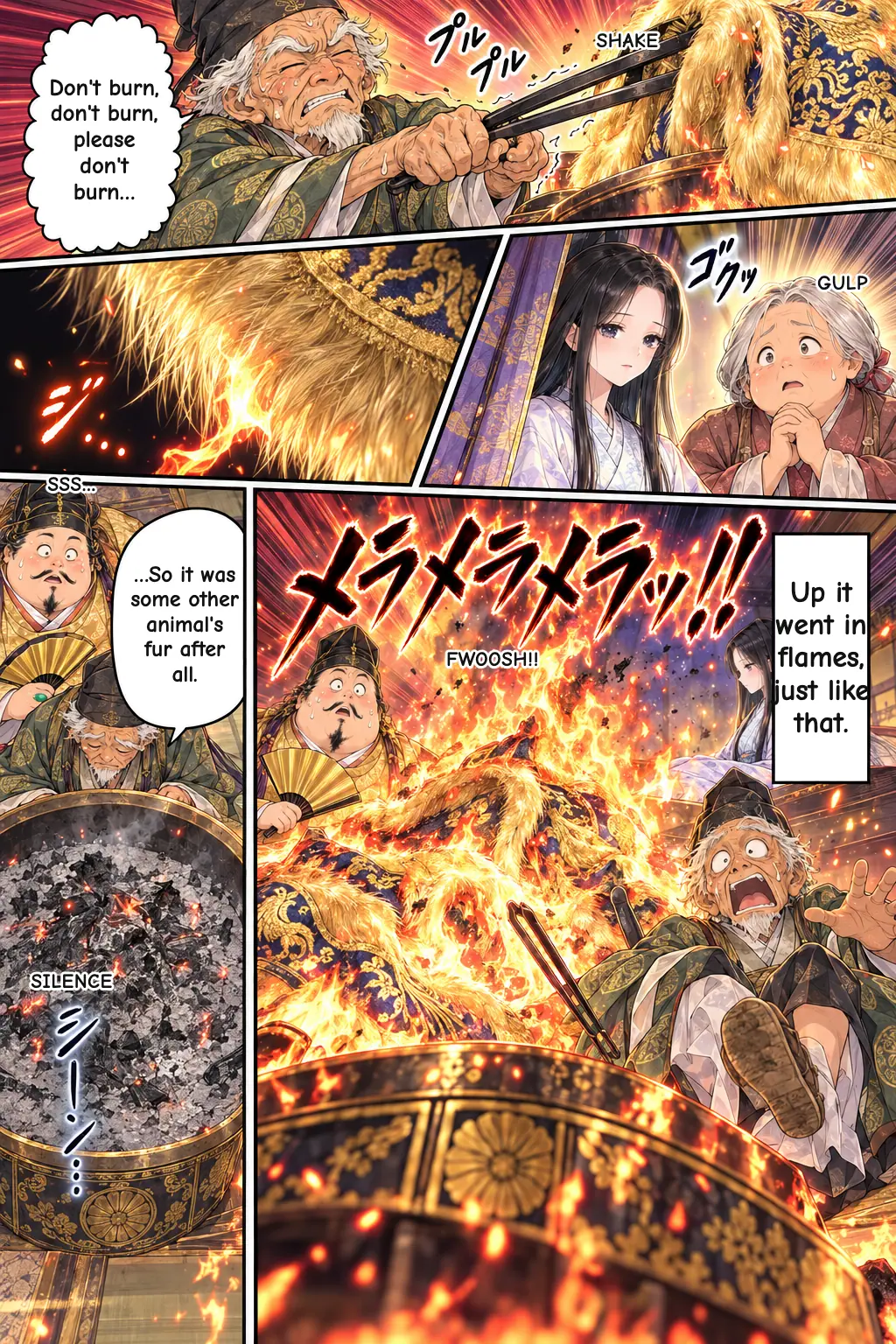
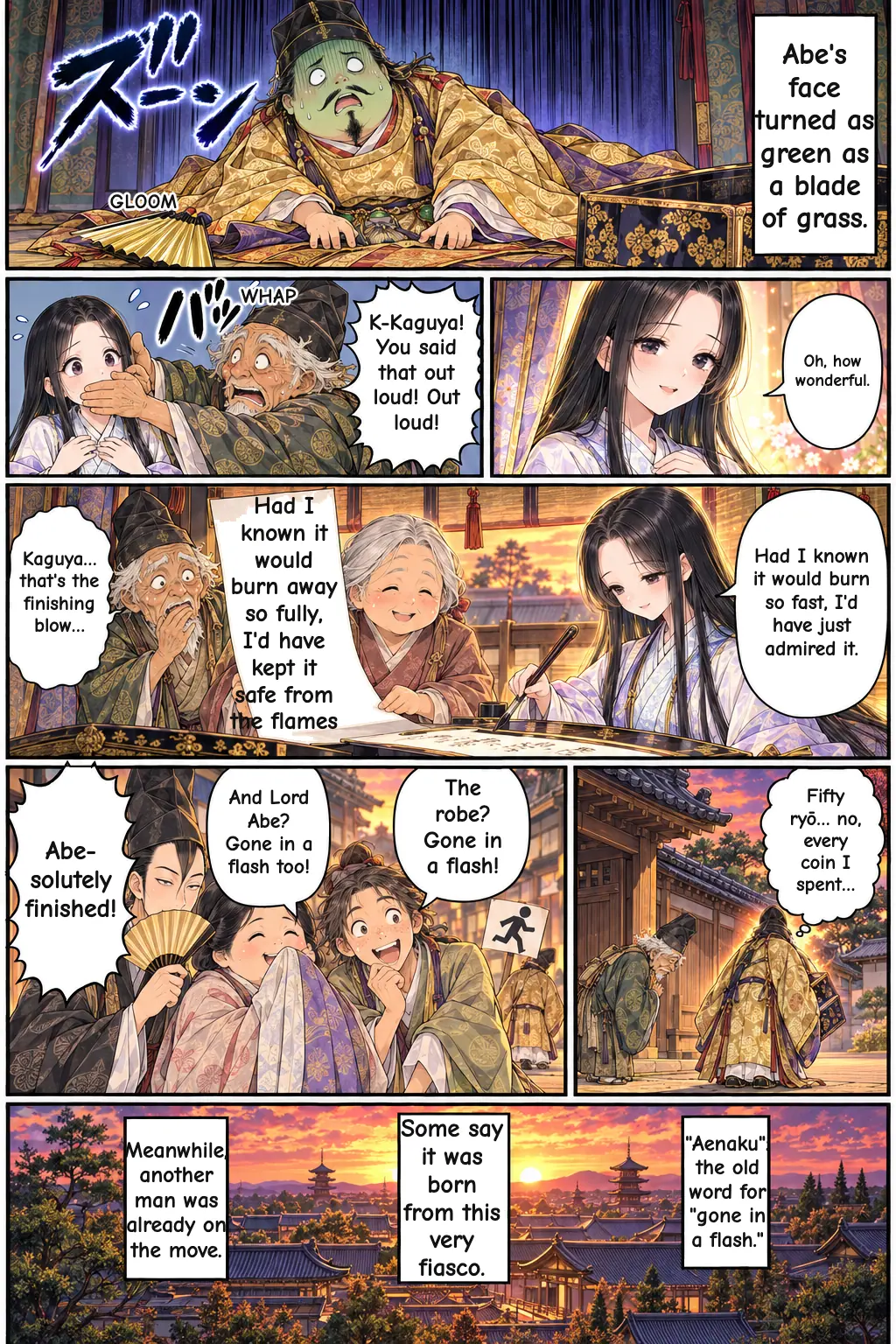
The robe arrives in a box decorated with precious stones. It is deep blue, and the tips of its fur shine like gold. Sure of himself, Abe brings it to Kaguya's house with a love poem. The old bamboo cutter is convinced she will finally marry. Kaguya, however, calmly says it looks lovely but she cannot tell if it is genuine. If it does not burn, she will believe it. Abe protests, but at her order the robe is put into the fire, and it burns up completely. Abe's face turns the color of grass, and he leaves without a word. Kaguya is openly relieved. The tale adds that people began calling any futile effort 'ahe nashi', a pun on Abe's name. The original never says whether the merchant knew the robe was fake.
The Dragon's Jewel: A Lord Lost at Sea
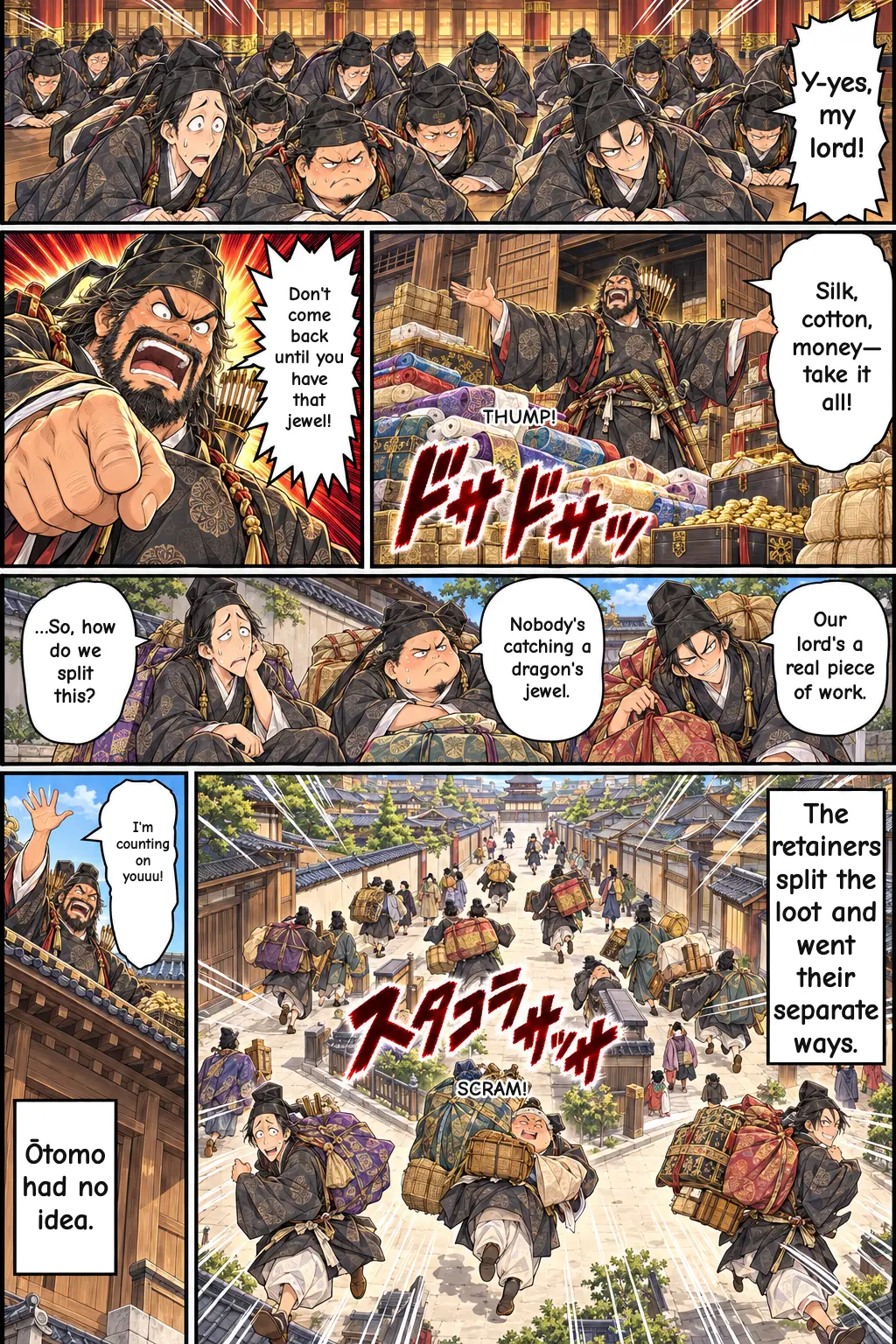
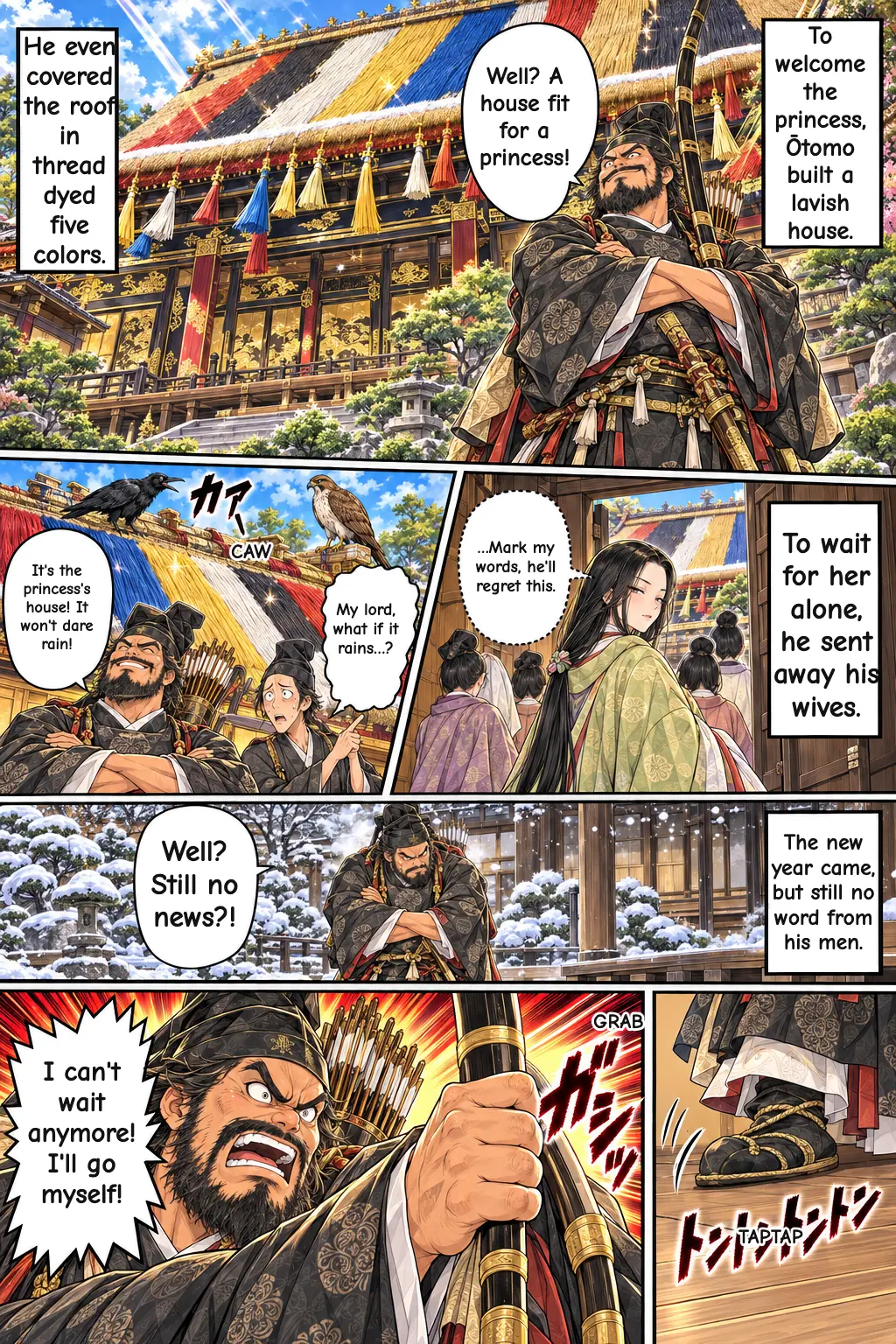
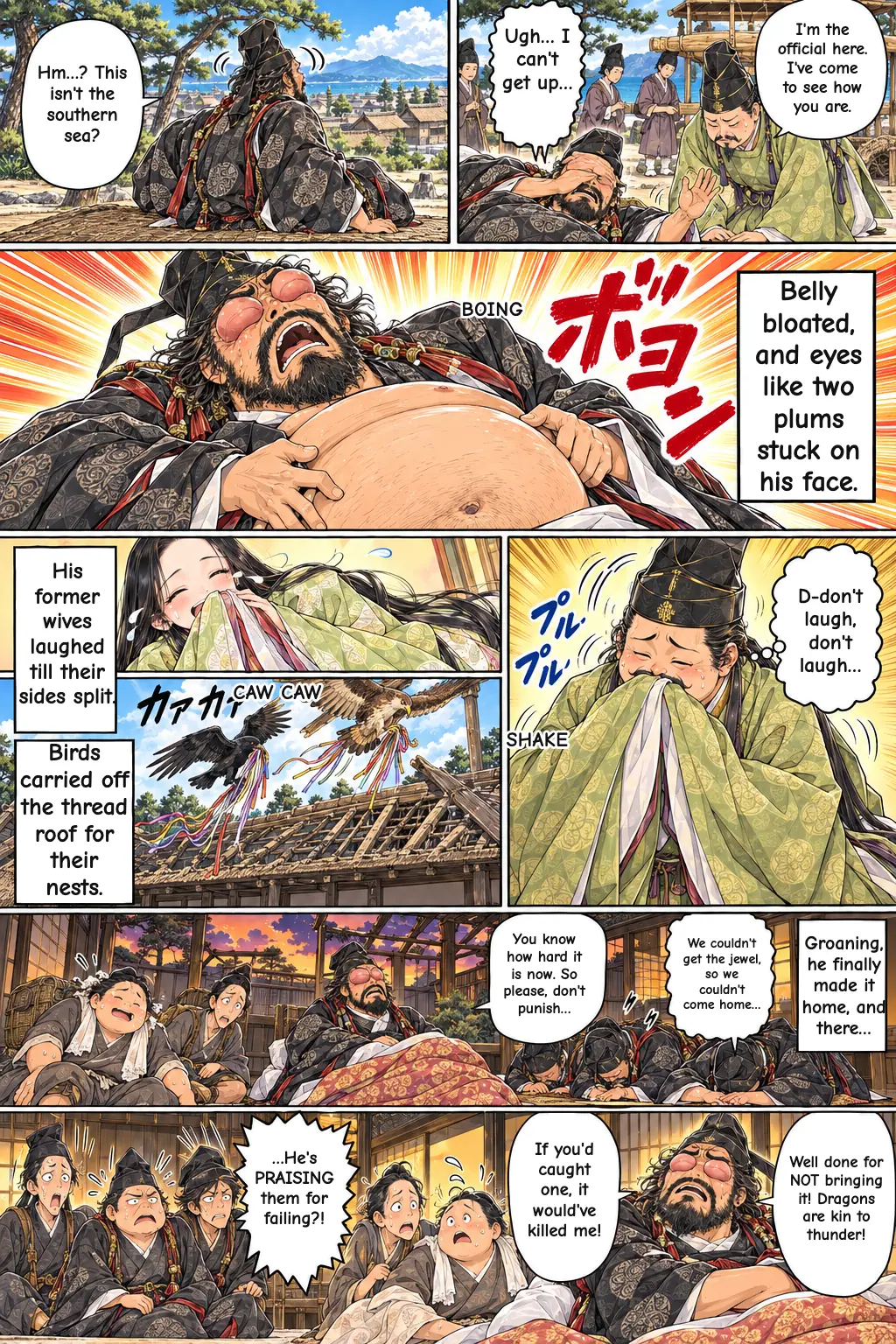
Ōtomo takes a different approach: he gives orders. He gathers his household, promises a reward to anyone who brings the jewel, and scolds them when they hesitate, saying that loyal servants should risk their lives for their lord. He hands over all the silk, cotton and money in his house for the journey and tells them not to come back without the jewel. The men complain about his foolish whim, split the treasure among themselves and scatter. Meanwhile, Ōtomo leaves his wives and builds a luxurious new house for Kaguya, though kites and crows soon carry off the colored threads of its roof for their nests.
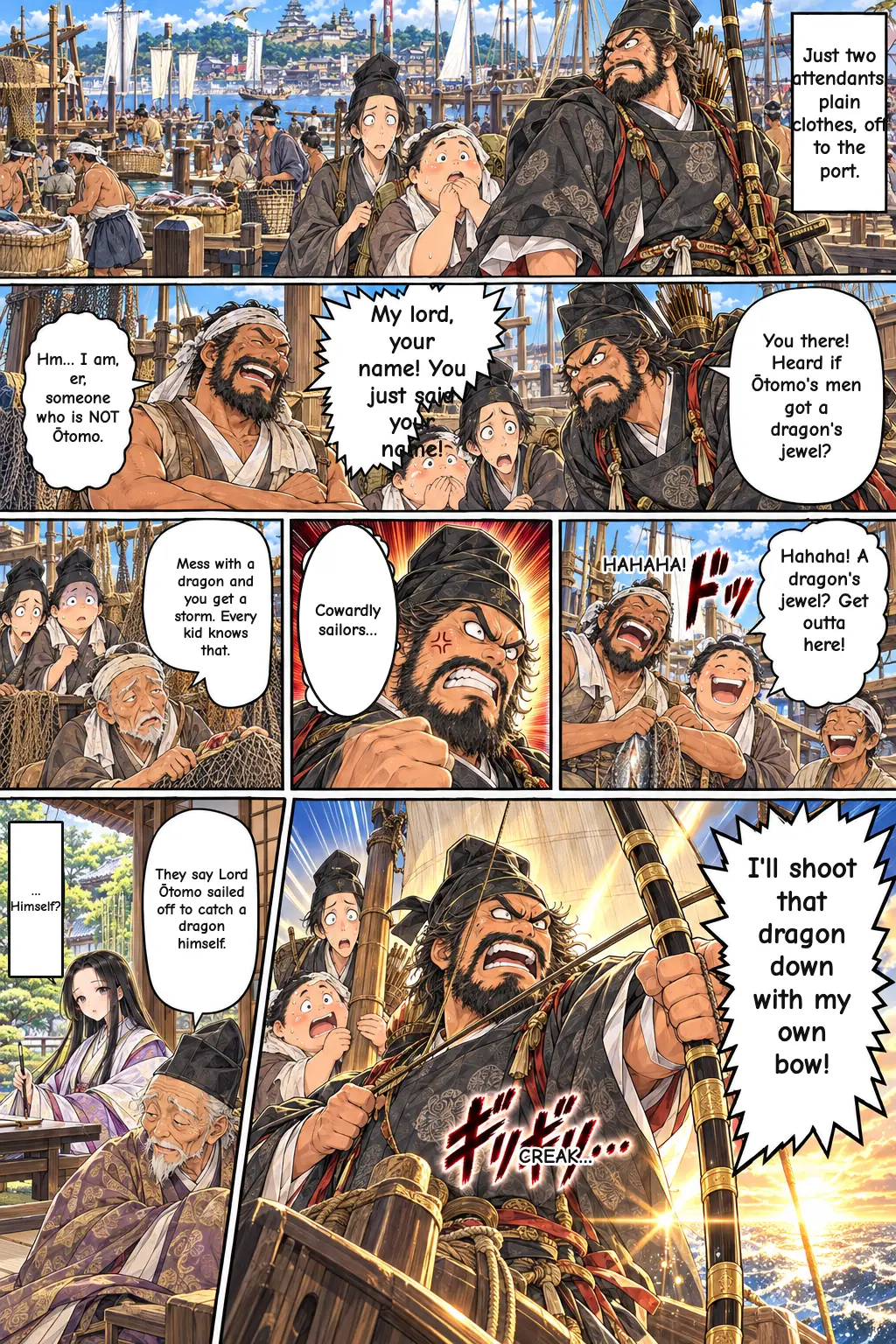
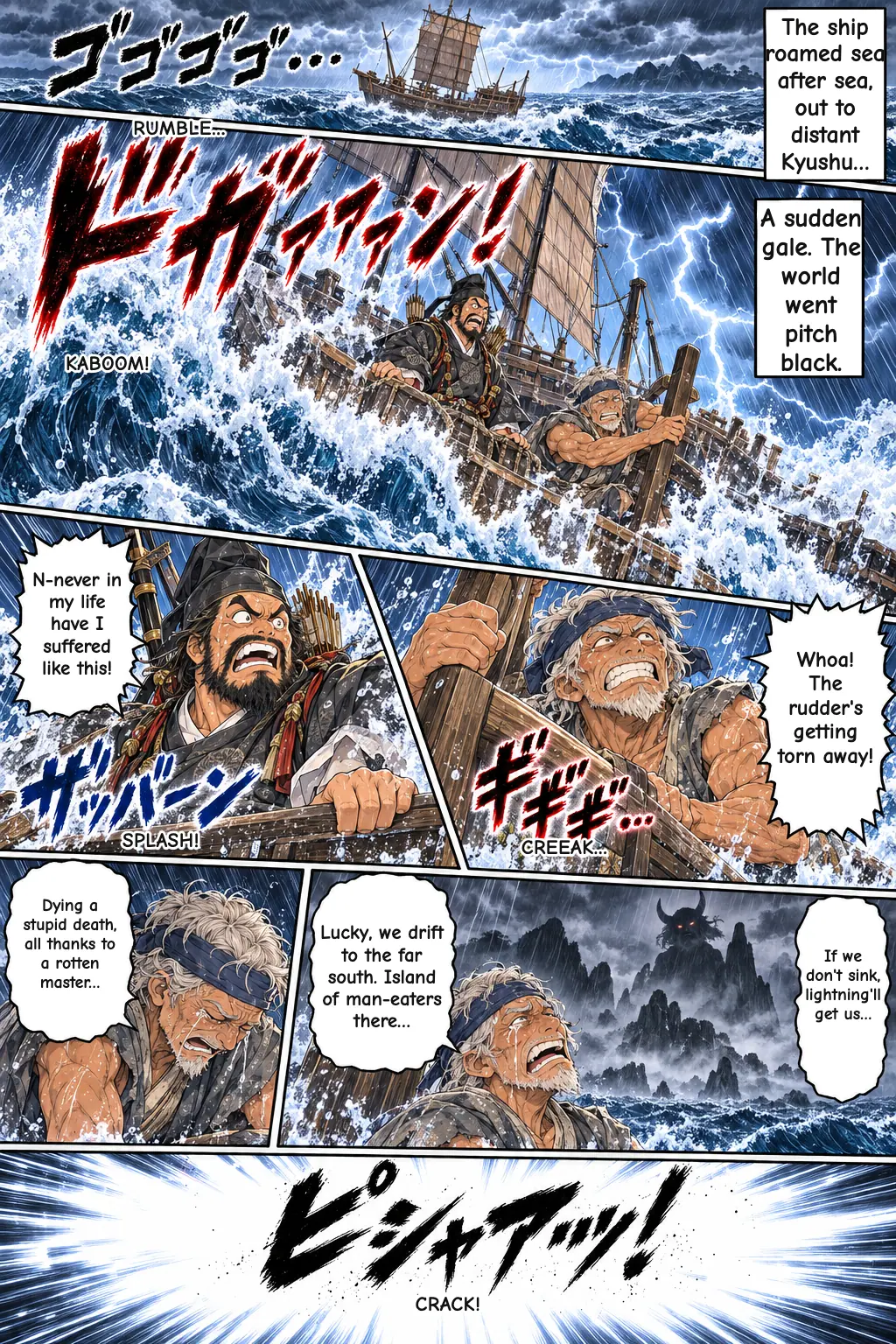
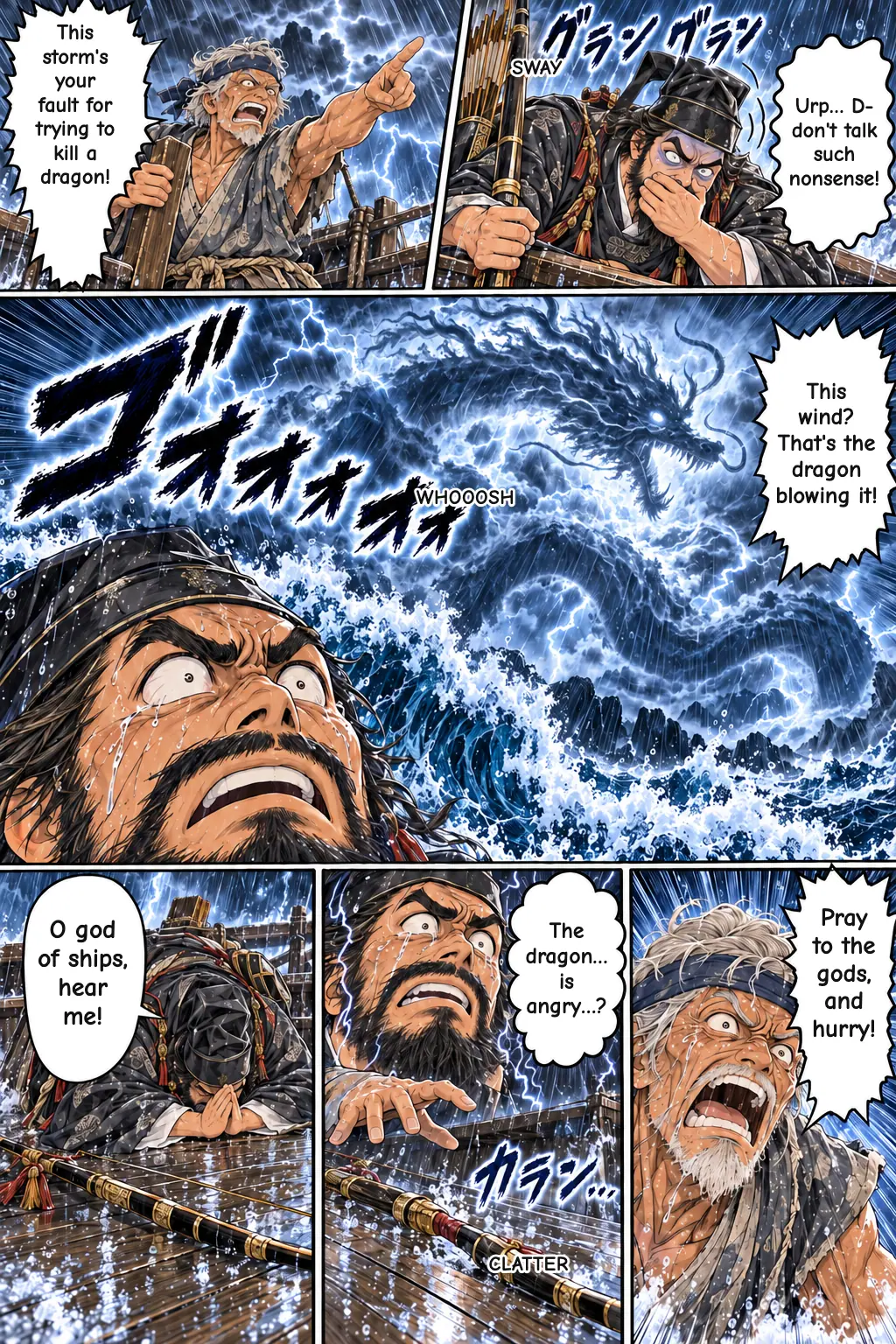
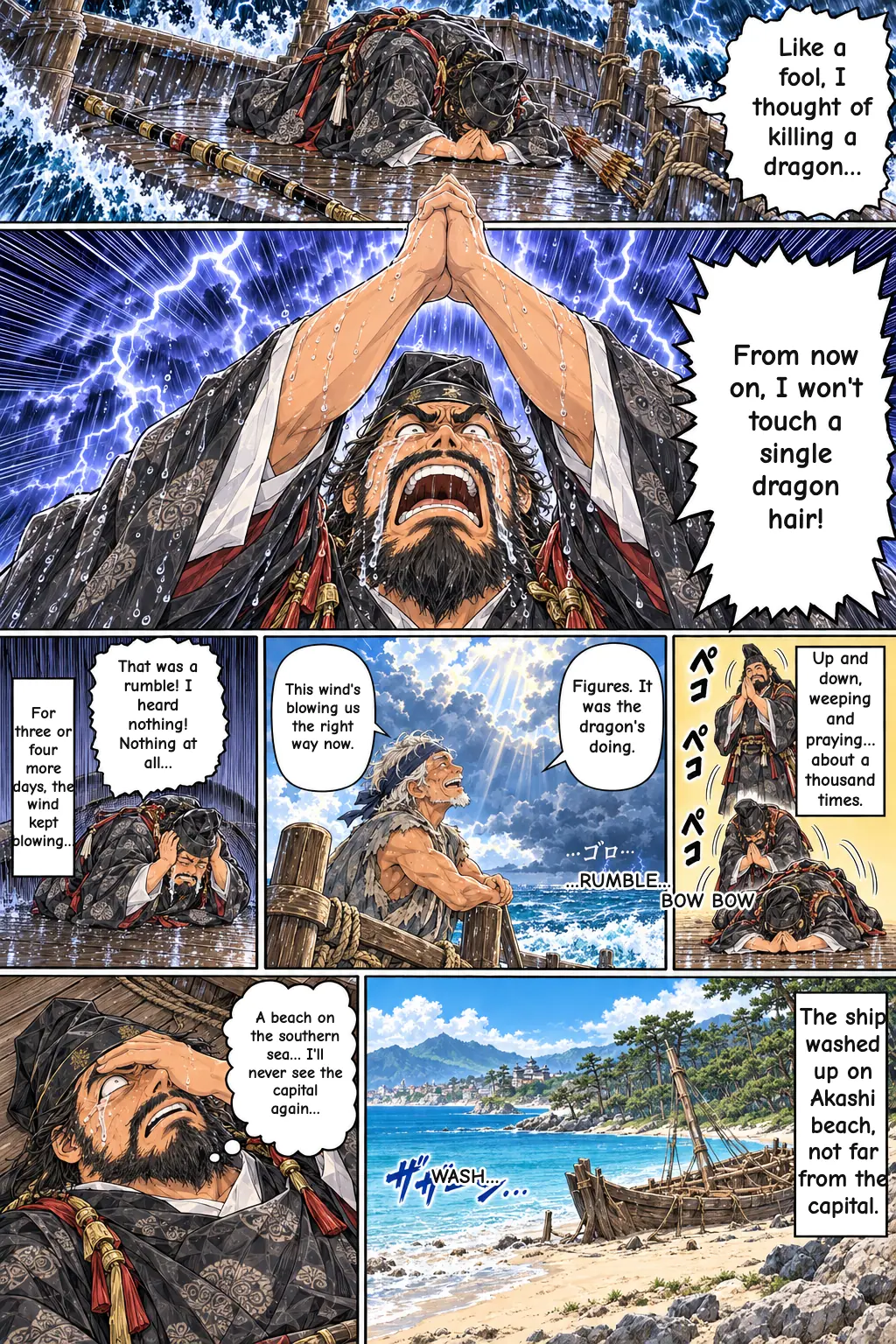
A year passes with no news. Impatient, Ōtomo goes to the port of Naniwa (modern Osaka) himself. Boatmen laugh at the idea of hunting dragons, but he boasts that his bow could kill one, and he sets out to sea. Off the coast of Kyushu a terrible storm hits, with darkness, huge waves and lightning. Ōtomo panics and is violently seasick. The helmsman tells him the storm is the dragon's anger at his plan, and Ōtomo prays to the gods about a thousand times for forgiveness.
After several days, the ship washes up at Akashi in Harima province. Ōtomo's belly is swollen, and his eyes are puffed up like two plums. The local governor cannot help smiling. Back home, Ōtomo calls Kaguya a great thief who tried to kill him and gives up his suit. His former wife laughs until her sides ache, and this ending also closes with a punning saying.
What This Story Tells Us
These episodes are comedy as much as fairy tale. Each suitor fails in a way that shows his character. Abe trusts money and middlemen, and he never looks closely at what he bought. Ōtomo trusts his rank and his bow, and he treats his servants as tools. Neither one ever actually tries to understand Kaguya, and both end up humiliated in public.
The tale also reflects its time. Heian Japan valued luxury goods from China, and India was a distant, almost legendary land, so a treasure 'from India by way of China' sounded convincing. The fire-rat itself comes from Chinese legend. Some scholars have suggested that stories of fireproof cloth were inspired by asbestos, but this is only one theory. The jokes about 'ahe nashi' show that the author liked wordplay and expected readers to enjoy a bit of satire about powerful nobles.
What the Manga Changes
In the original these are two separate sections. The manga combines them into one episode so that the two quests seem to unfold at the same time. This fits well, since Kaguya assigns all the tasks in the same scene. The contrast between 'the man of money' and 'the man of force' is the manga's own interpretation, though it follows what the two men actually do.
Many visual and emotional details are also new. The original says nothing about the characters' faces, ages or clothing, except for Ōtomo's swollen eyes and belly. The manga invents Abe's inner thoughts as the robe burns, the mood of Ōtomo's servants as they leave, the details of the new house and the storm scenes. It also decides how the robe was put into the fire, whether the merchant was a cheat or a victim, how the dragon is shown (in the original it never appears), what the god Ōtomo prays to looks like, and whether Kaguya learns how Ōtomo's quest ended. The original is silent on all of these. Kaguya quietly hoping both men return safely is the manga's portrayal, not a scene from the source text.
Where to Read It
If you would like to see these two quests play out, from the shining fur going up in flames to Ōtomo's terrifying night at sea, Episode 4 of THE TALE OF THE BAMBOO CUTTER: Princess Kaguya from the Moon is on Manga Portal. Every episode is free to read, and you do not need to sign up. With only one suitor left, the next chapter brings Kaguya one step closer to the secret of where she really comes from.
Characters in this episode
Princess Kaguya
The girl found inside a glowing bamboo stalk, who sets impossible tasks so she will not have to marry.
The Bamboo Cutter (Taketori no Okina)
Kaguya's adoptive father, who receives the suitors and hopes each time that she will finally accept one.
Abe no Miushi
The wealthy Minister of the Right, who pays a merchant a fortune for a 'fireproof' fire-rat robe.
Wang Qing (Ō Kei)
A Chinese merchant who obtains the robe for Abe and asks for extra gold; the original never says whether he knew it was fake.
Ōtomo no Miyuki
A Grand Counselor who orders his servants to take a dragon's jewel and then sails out himself, only to be caught in a deadly storm.
The Helmsman
The steersman of Ōtomo's boat, who blames the storm on the dragon's anger and tells Ōtomo to pray.
FAQ
What is the fire-rat robe in the Tale of the Bamboo Cutter?
It is a legendary robe made from the fur of the fire-rat, a creature from Chinese legend, and it was supposed to be impossible to burn. Princess Kaguya asks Abe no Miushi to bring her one. The robe he buys looks beautiful but burns up as soon as it is put into the fire.
What happened to the suitor who went after the dragon's jewel?
Ōtomo no Miyuki's servants ran off with his money, so he sailed out himself and was caught in a violent storm. He prayed for his life, washed ashore at Akashi with a swollen belly and plum-like eyes, and gave up on Kaguya, calling her a great thief.
Who are Princess Kaguya's five suitors?
They are Prince Ishitsukuri, Prince Kuramochi, Minister of the Right Abe no Miushi, Grand Counselor Ōtomo no Miyuki and Middle Counselor Isonokami no Marotari. Each is given a different impossible treasure to find, and all of them fail.
What does 'ahe nashi' mean in the story?
After Abe's robe burns, the tale says people began calling a futile or disappointing effort 'ahe nashi'. The phrase is a pun on Abe's name, a playful origin story the author attaches to the episode.
Does Princess Kaguya marry any of the suitors?
No. Every suitor fails his task, and Kaguya never marries. Later in the tale even the emperor seeks her, but she finally returns to the Moon, where she came from.