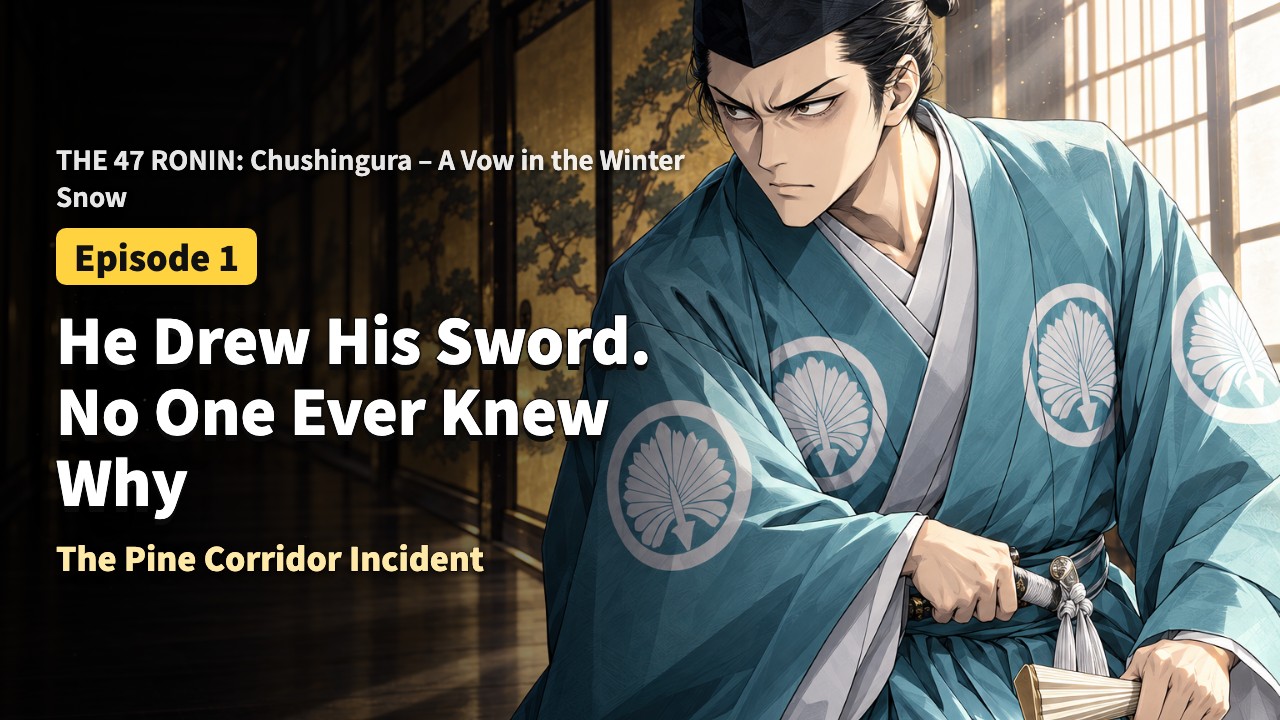
Episode 3The Perfect Lie Came With an Unpaid BillThe Jeweled Branch of Mount Hōrai
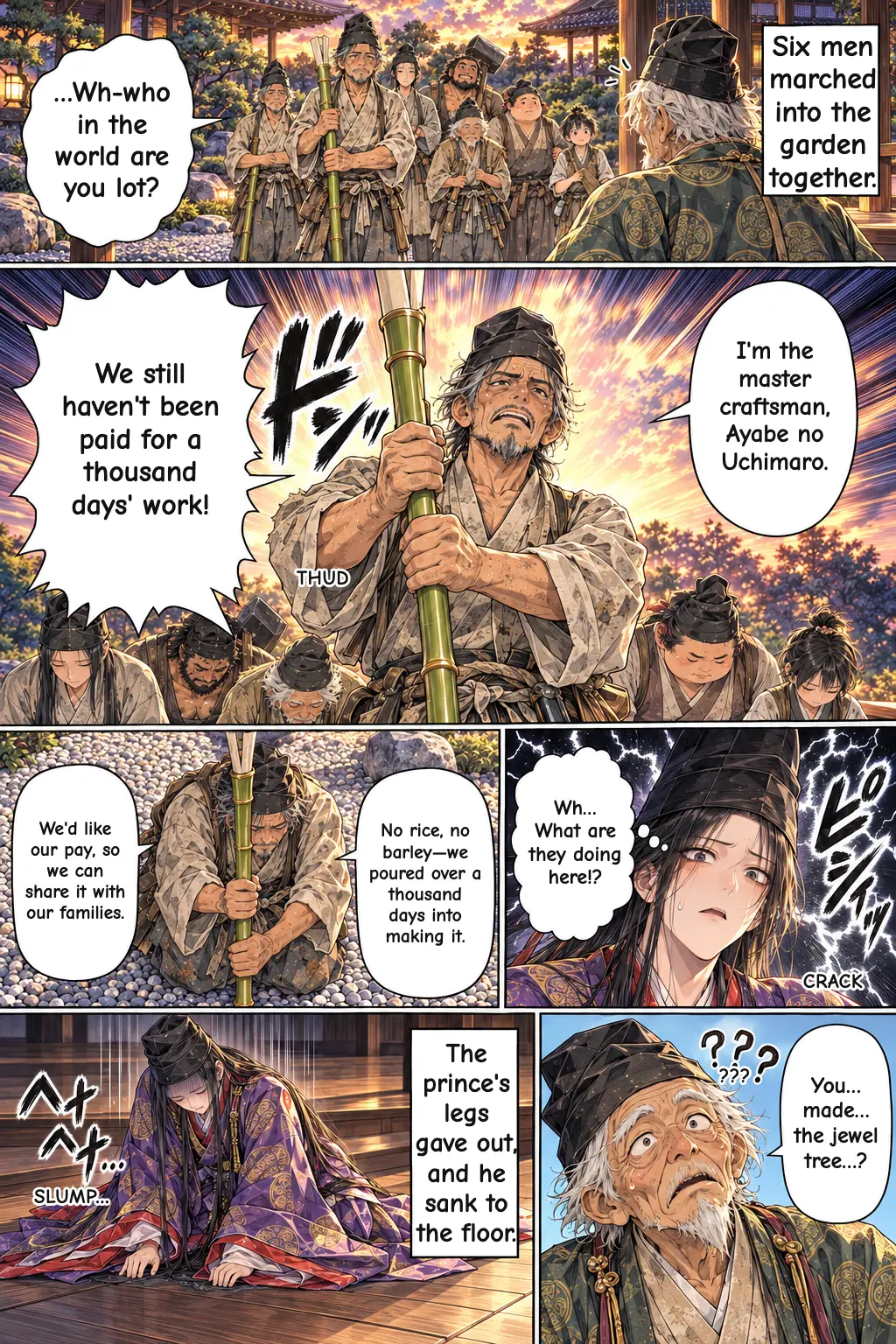
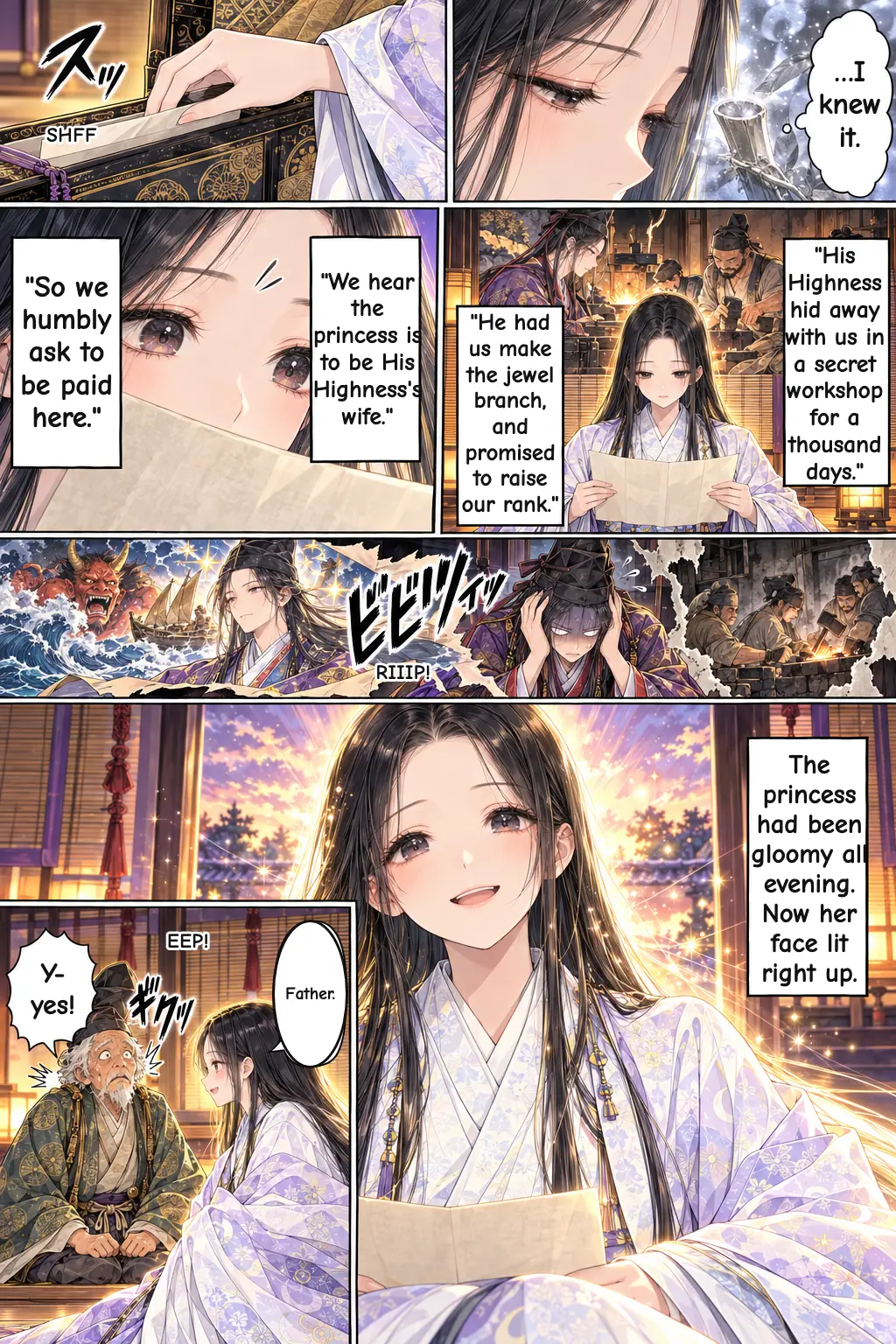
Prince Kuramochi pretends to set sail, then hides in a secret workshop and has craftsmen forge the jewel branch. With a made-up tale of high adventure, he backs Princess Kaguya into a corner. But the princess has already noticed something odd about the branch's cut end. Then six soot-covered craftsmen walk in, asking to be paid for a thousand days of work.
Prince Kuramochi's Fake Jeweled Branch: Bamboo Cutter Tale Summary
The Original Story: A Voyage That Never Happened
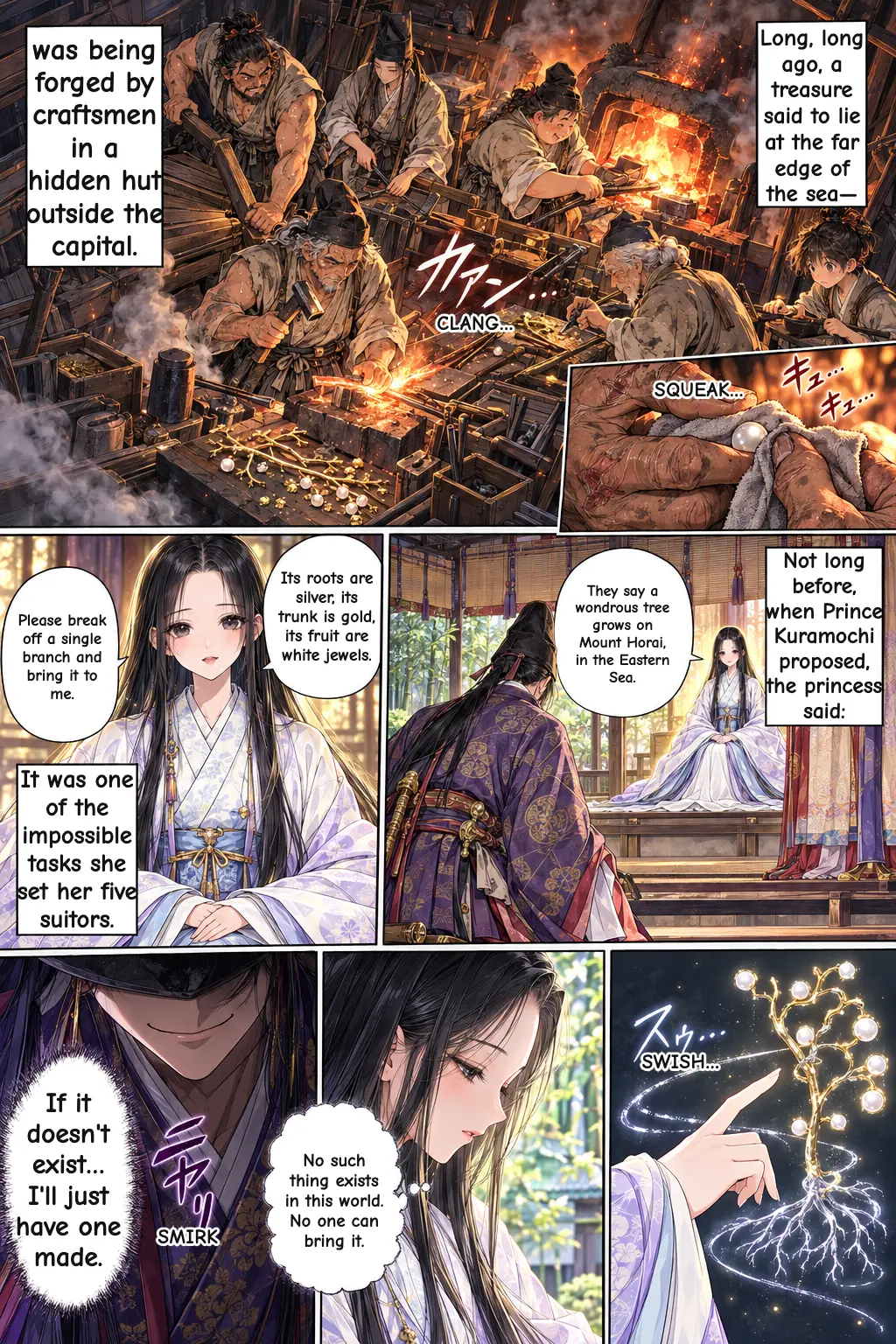
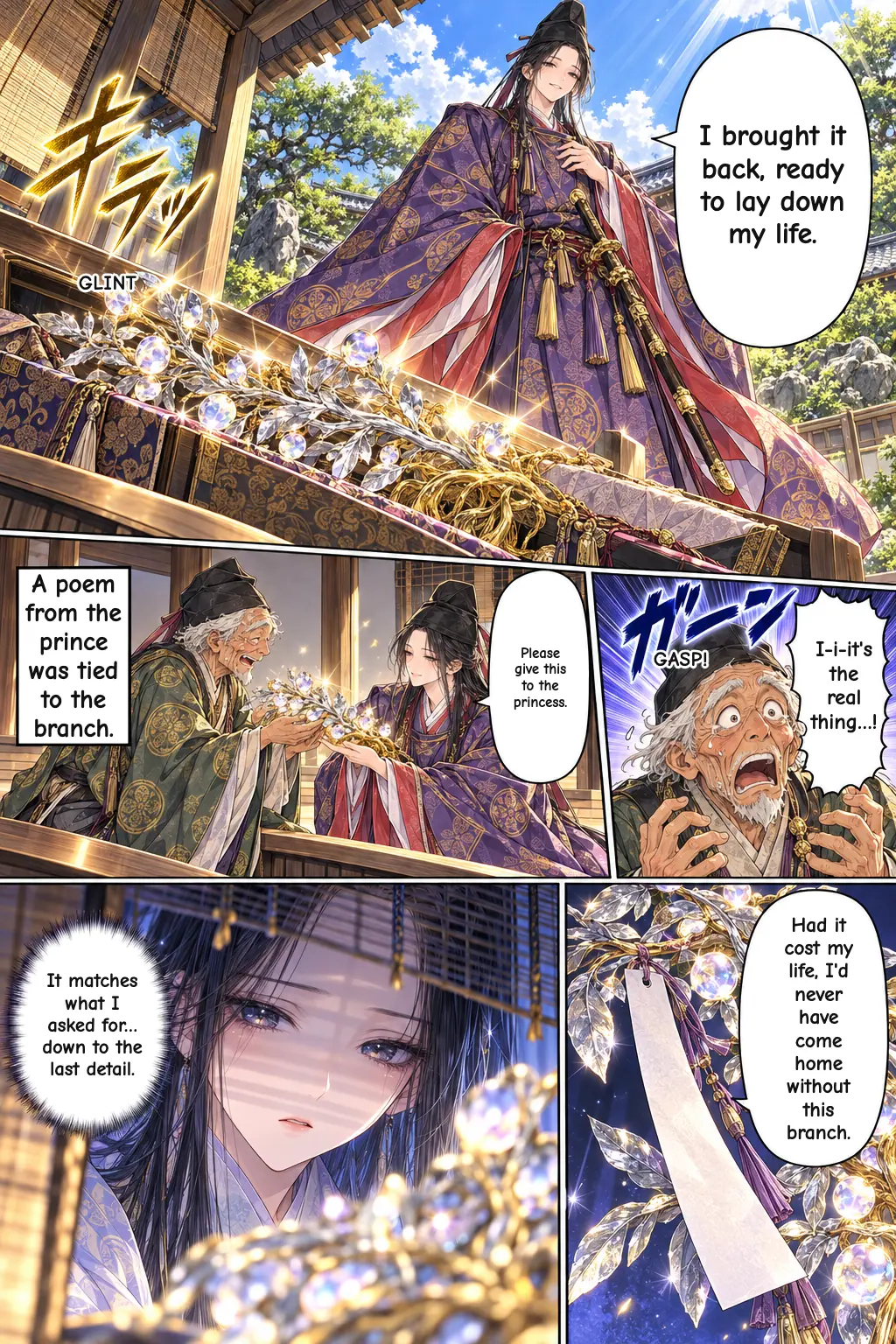
The Tale of the Bamboo Cutter (Taketori Monogatari) is a Japanese story by an unknown author, generally dated to the early Heian period, around the 9th to 10th century. An old bamboo cutter finds a tiny girl inside a glowing stalk of bamboo, and she grows into Princess Kaguya, a woman of unearthly beauty. Five noble suitors ask to marry her, and she gives each one a task that should be impossible. Prince Kuramochi's task is to bring back a branch from a tree on Mount Hōrai, a legendary mountain in the eastern sea. The tree has roots of silver, a stem of gold, and white jewels for fruit.
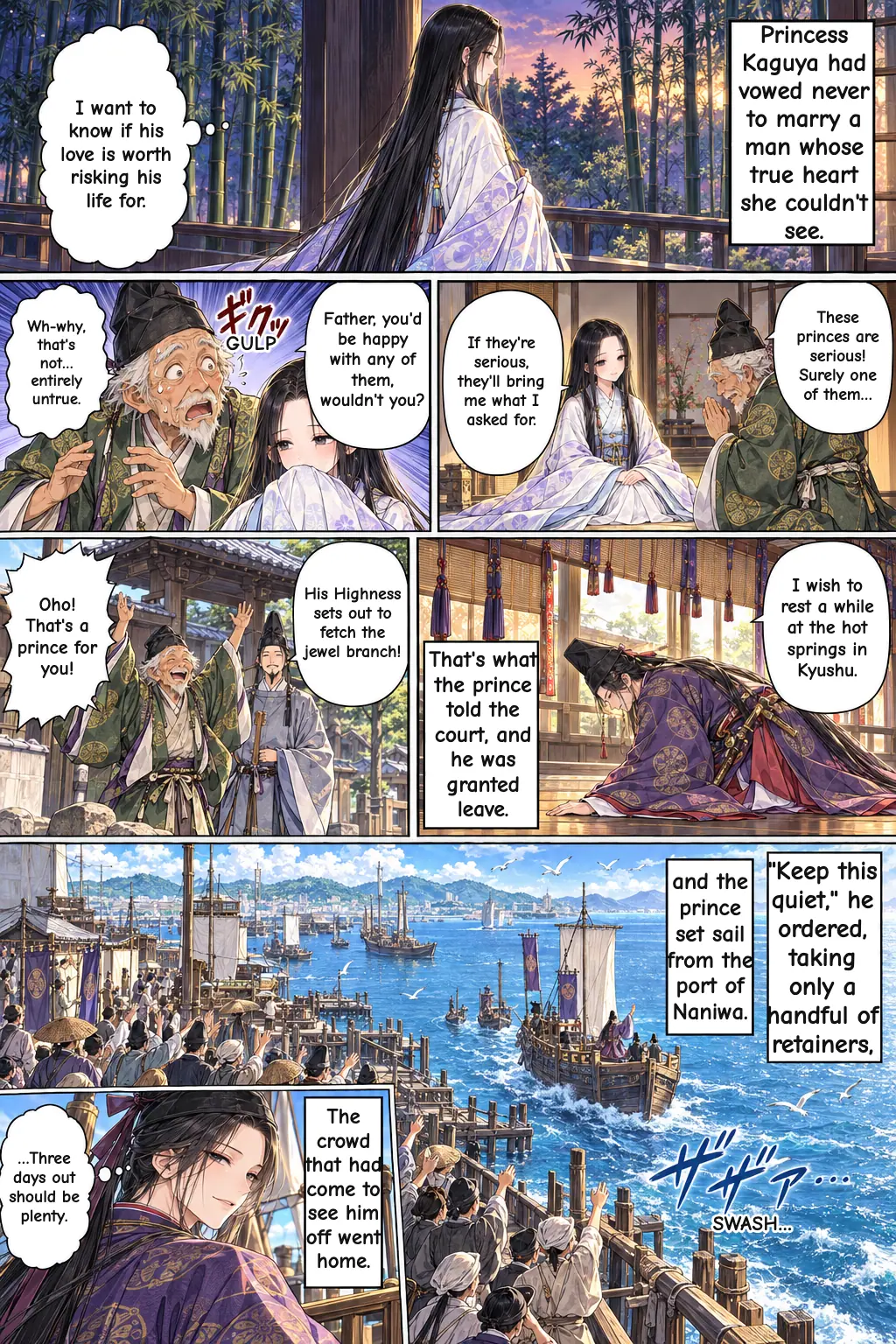
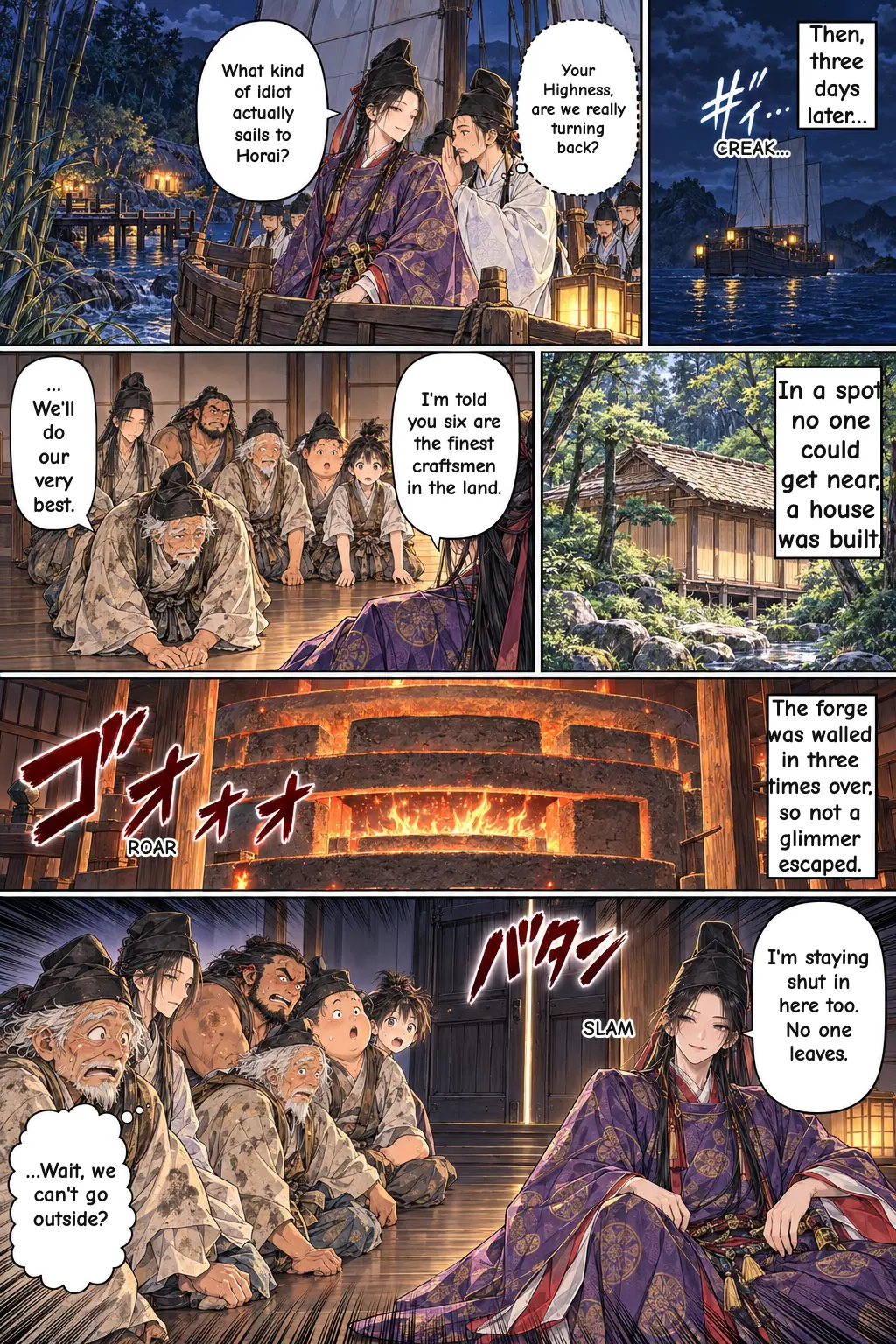
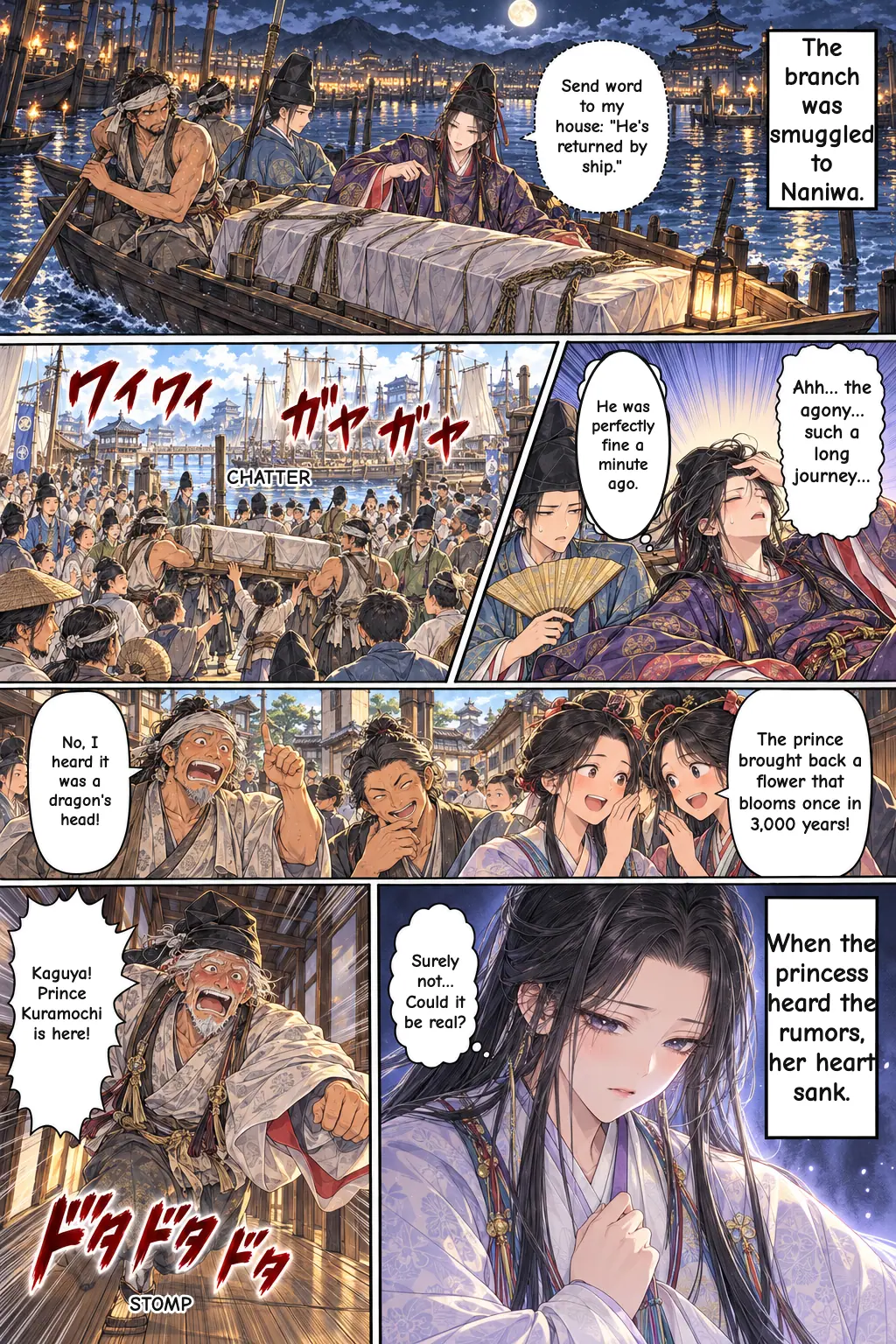
The original text openly calls the prince a man of cunning. He tells the imperial court he is going to Tsukushi (the old name for Kyushu) to bathe in hot springs, and he sends word to Kaguya's household that he is setting off to find the branch. He sails from Naniwa, the old port of present-day Osaka, with only a few close attendants. Once the people who saw him off have gone home, he quietly rows back, about three days later.
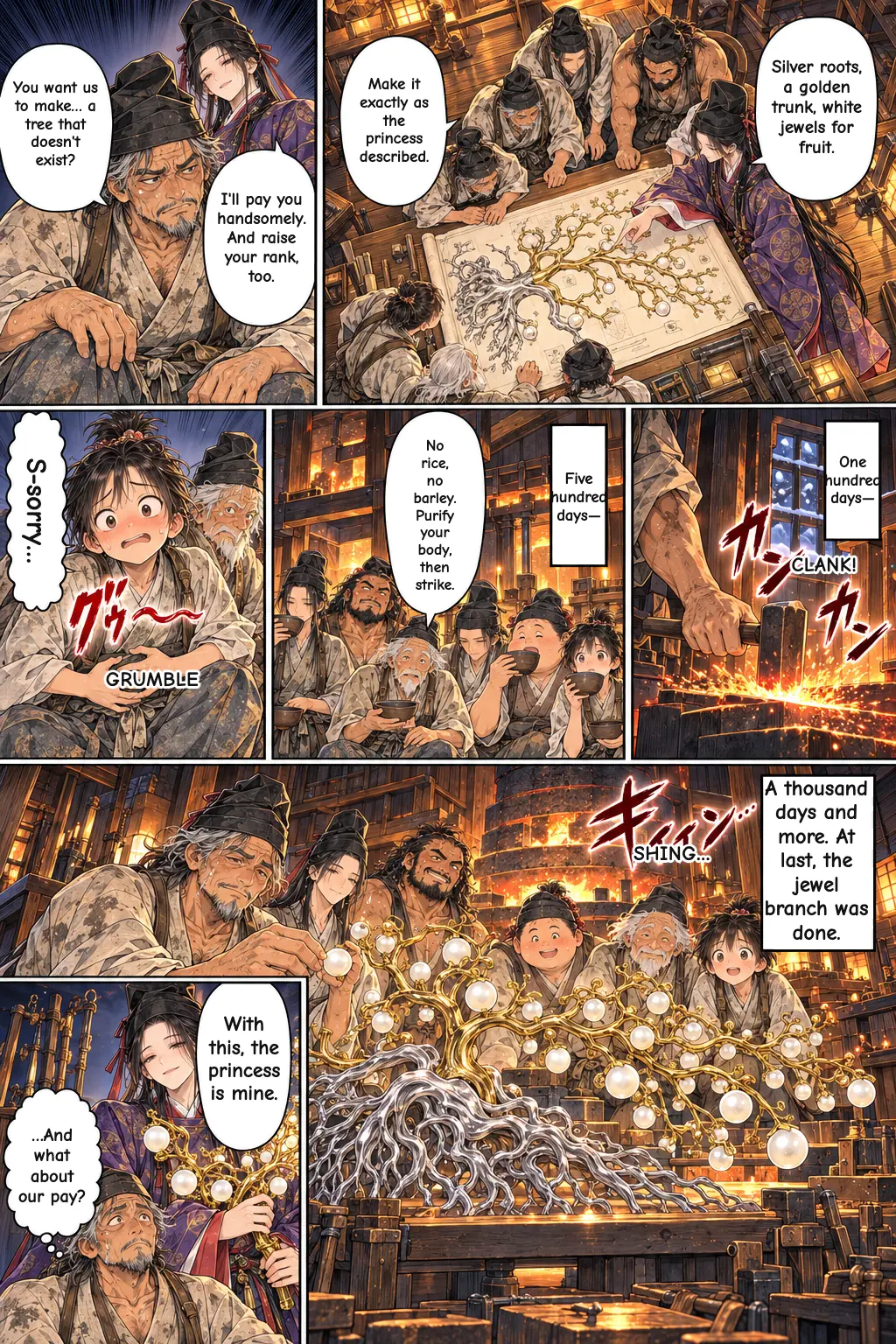
He had planned everything in advance. He gathers the six finest metalsmiths of the day, builds a house that outsiders cannot easily reach, surrounds the forge with three layers of walls, and shuts himself inside with the craftsmen. Pouring in the wealth of his estates, he has them make a branch exactly as Kaguya described. The work takes about a thousand days, a detail the reader only learns later.
The Prince's Grand Adventure Story
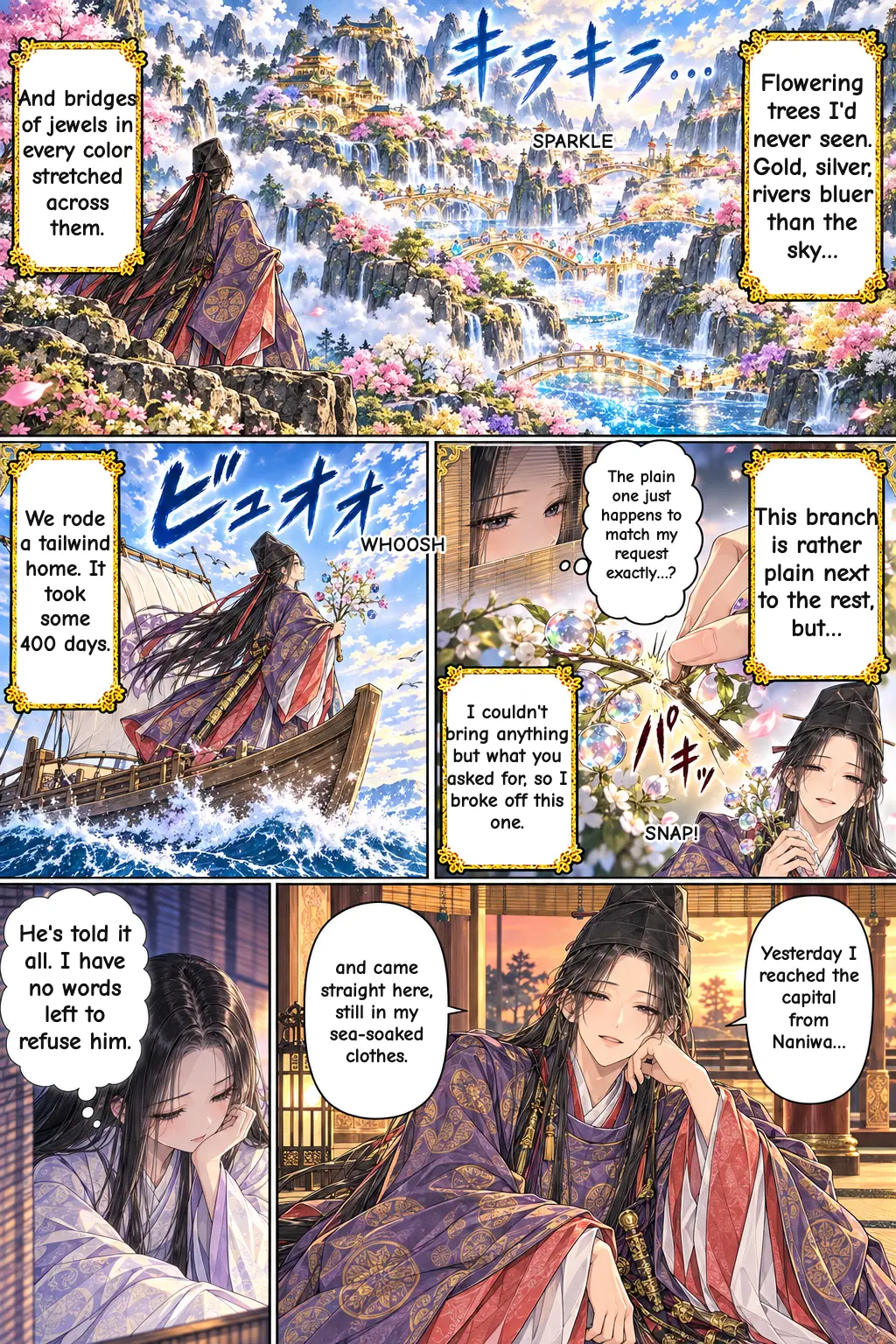
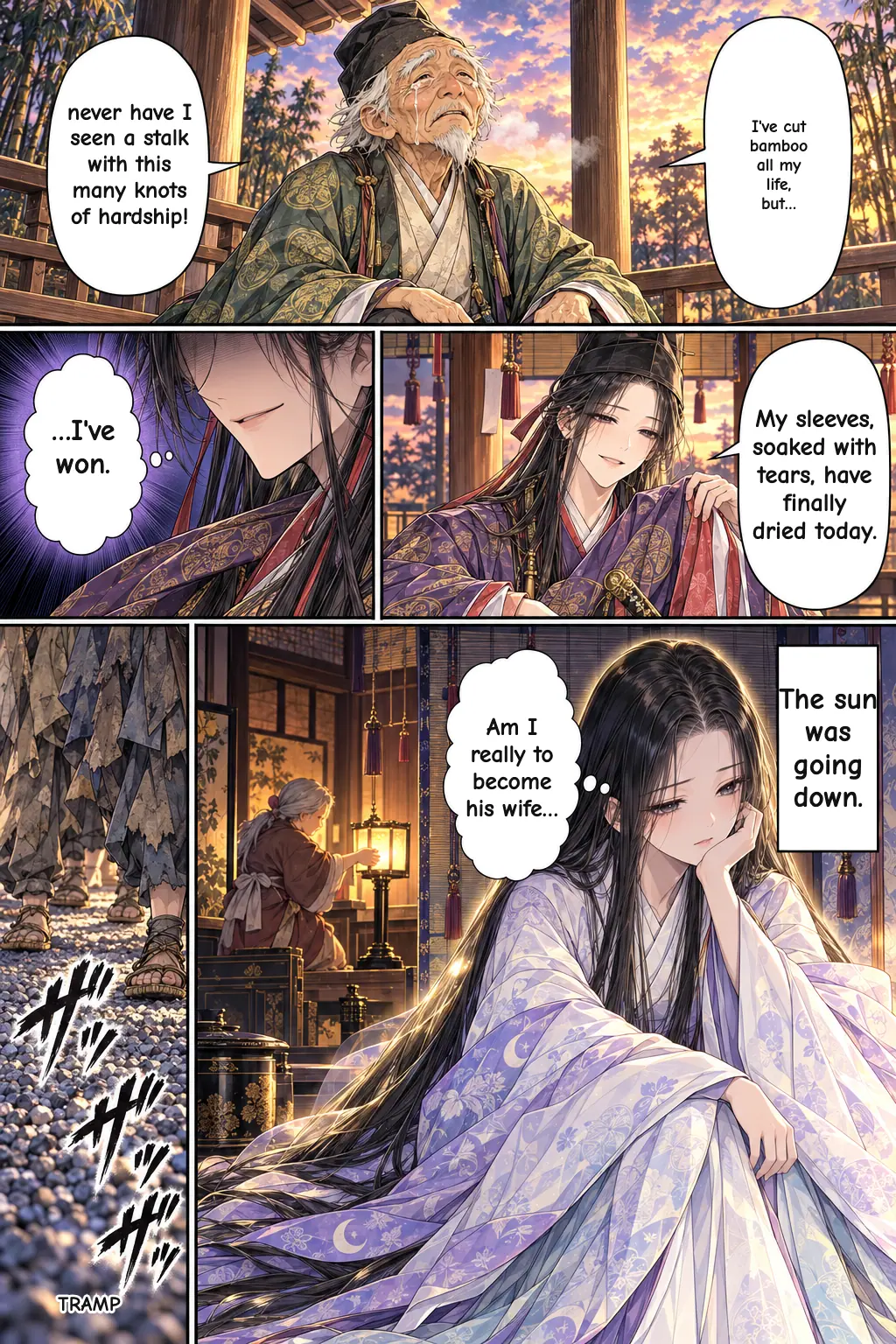
When the branch is finished, the prince secretly carries it to Naniwa, announces that he has returned by ship, and acts as if the voyage has worn him out. A rumor spreads that he has come back carrying an udonge, the udumbara flower of Buddhist legend, which is said to bloom very rarely. Kaguya hears this and feels crushed, sure she has lost. The prince arrives at her home still in his traveling clothes. The branch carries a poem in which he says he would never have come home without it.
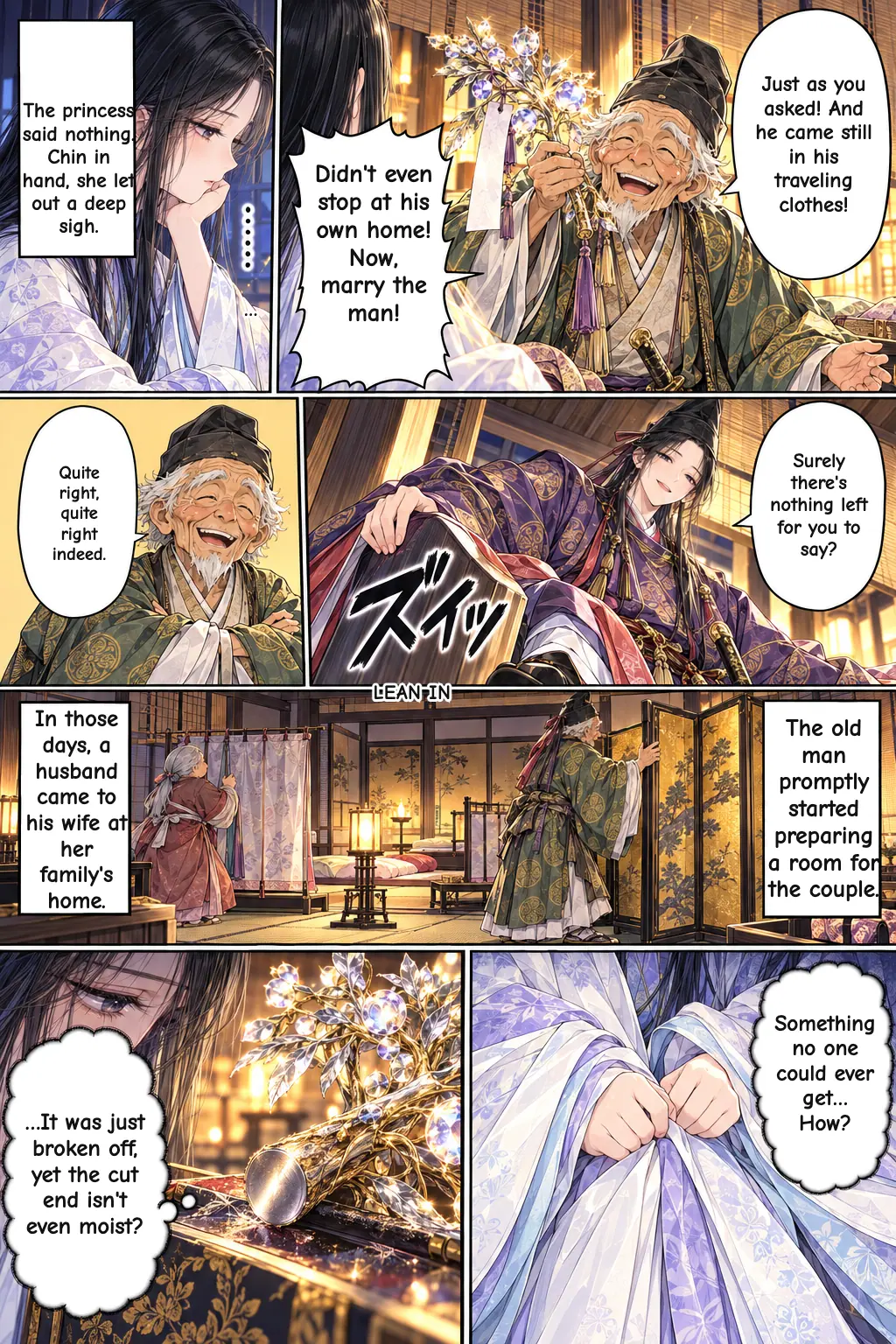
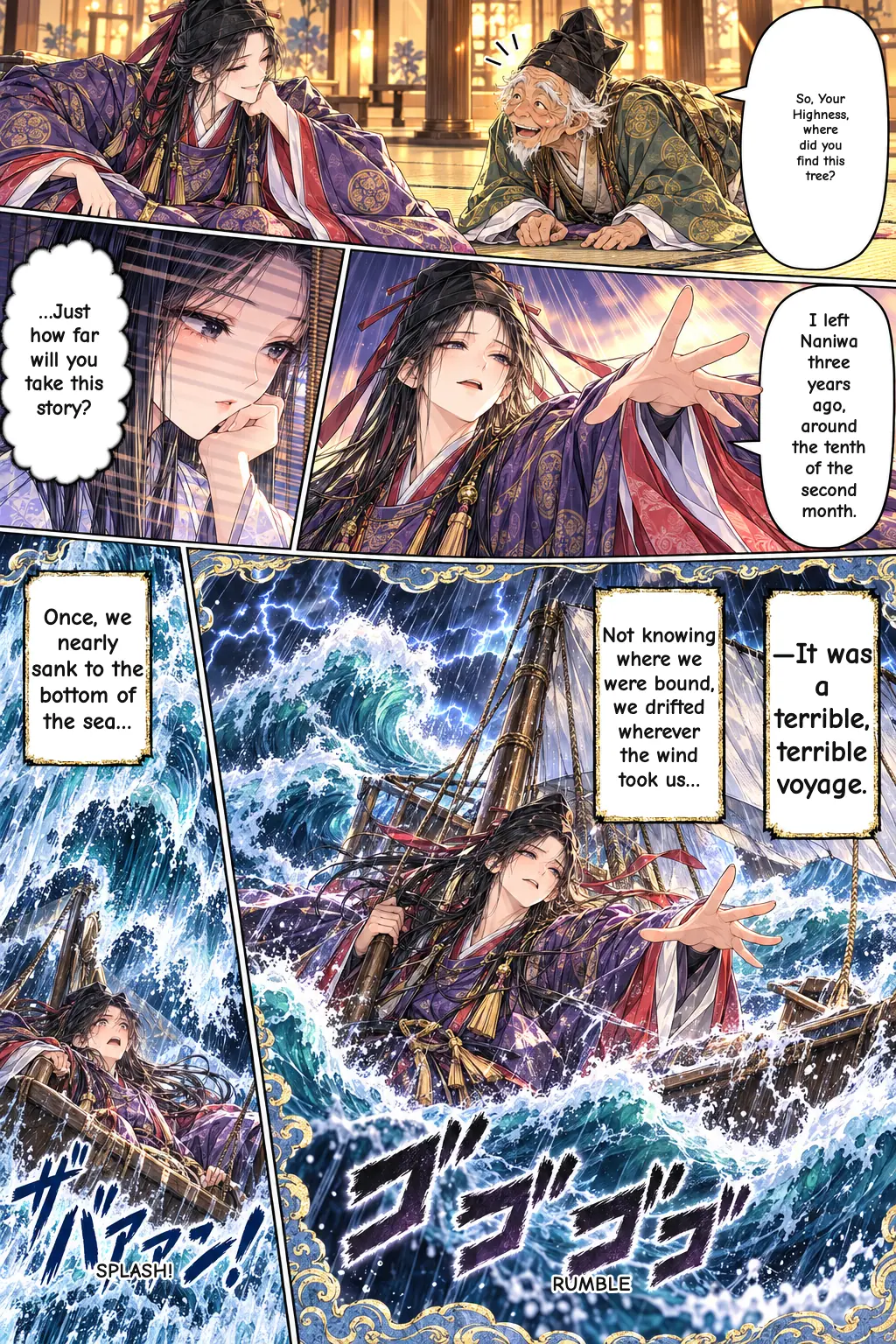
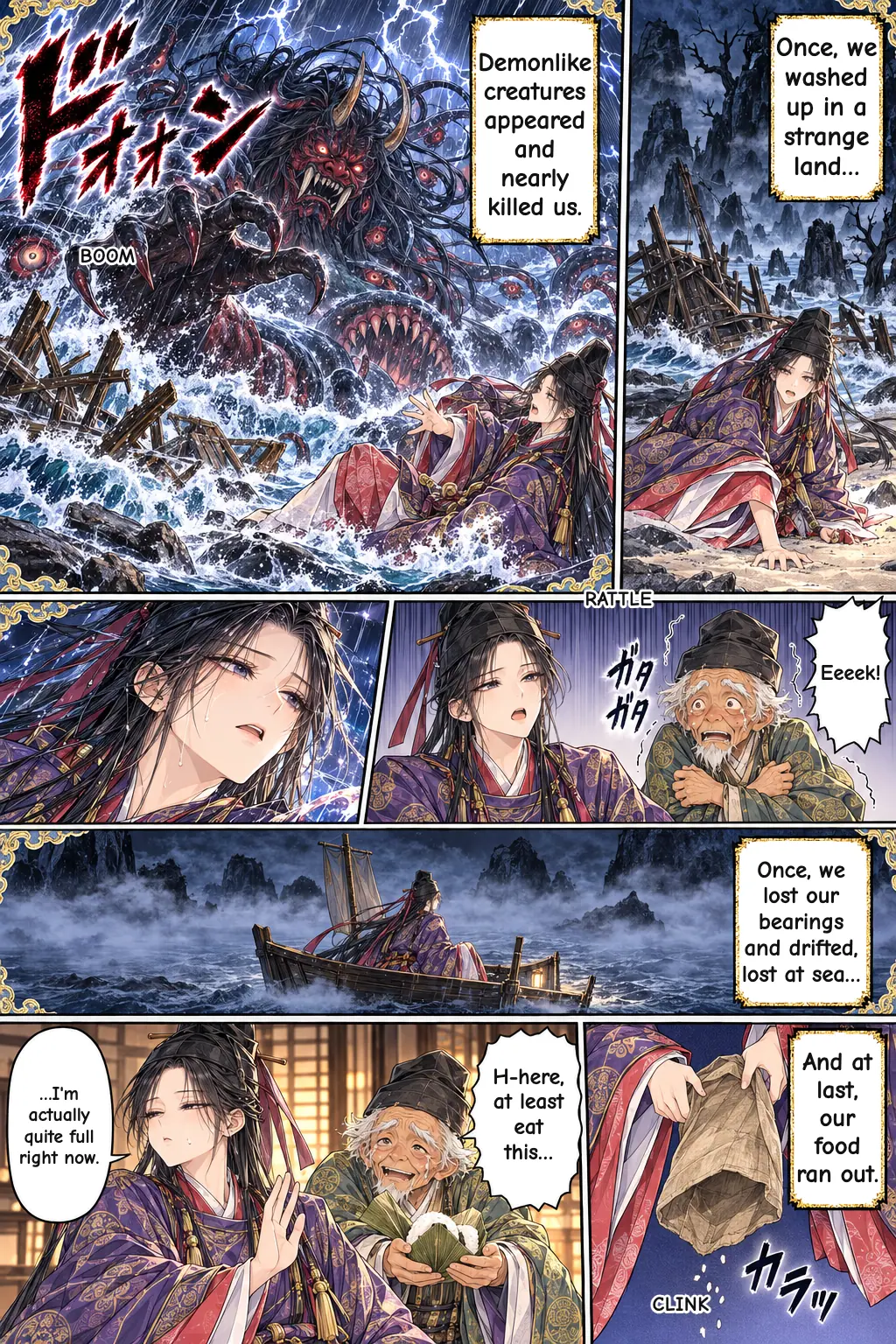
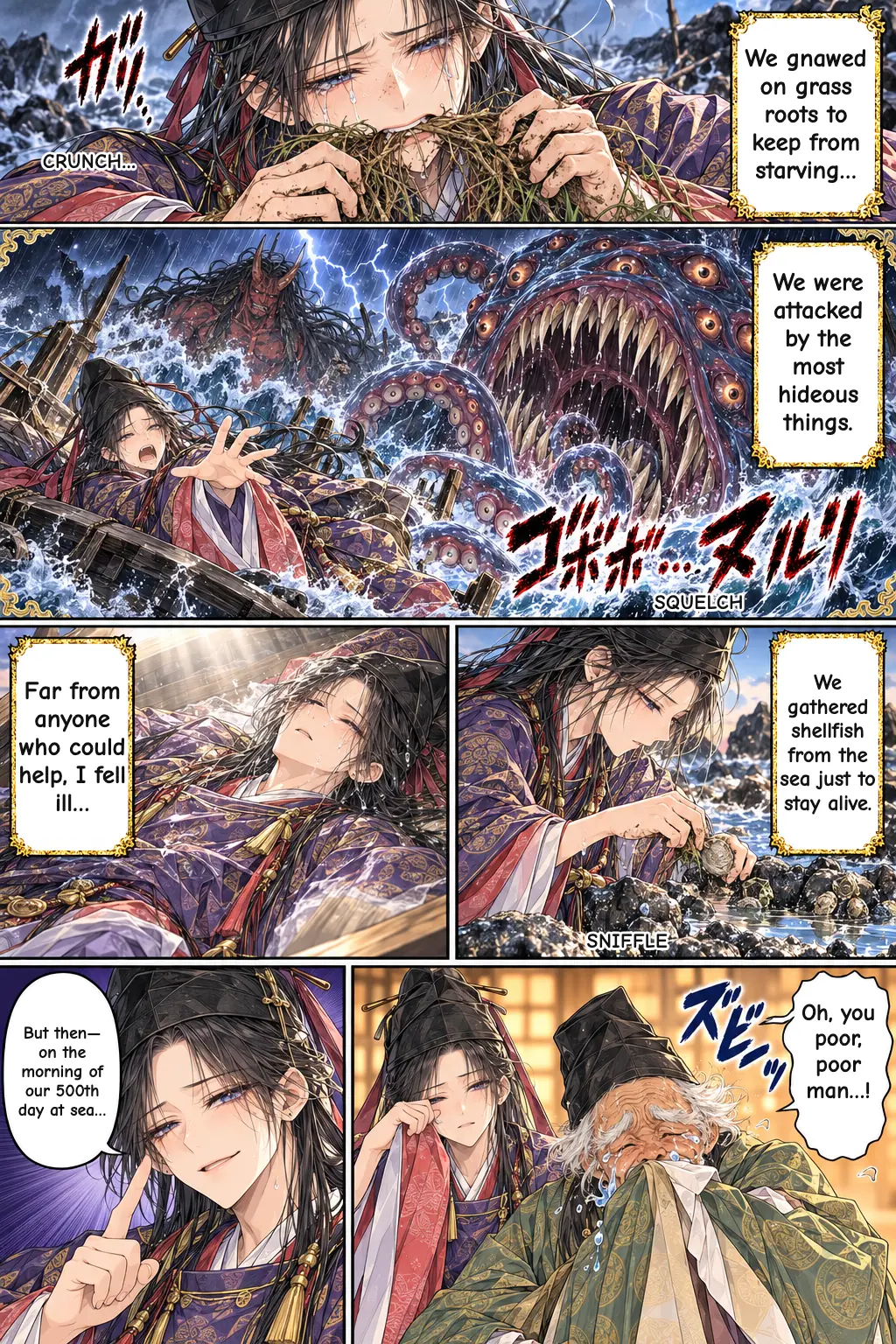
The old bamboo cutter is convinced. The branch matches the request perfectly, so he urges Kaguya to marry, and he even begins preparing a bedchamber. Kaguya says nothing. She rests her chin on her hand and grieves. Only after this does the old man ask where the tree grew, and the prince tells a long, polished story. He describes storms that nearly sank him, a strange land where something like a demon tried to kill him, days with no idea which way he was heading, eating grass roots and shellfish to survive, and illnesses far from any help.
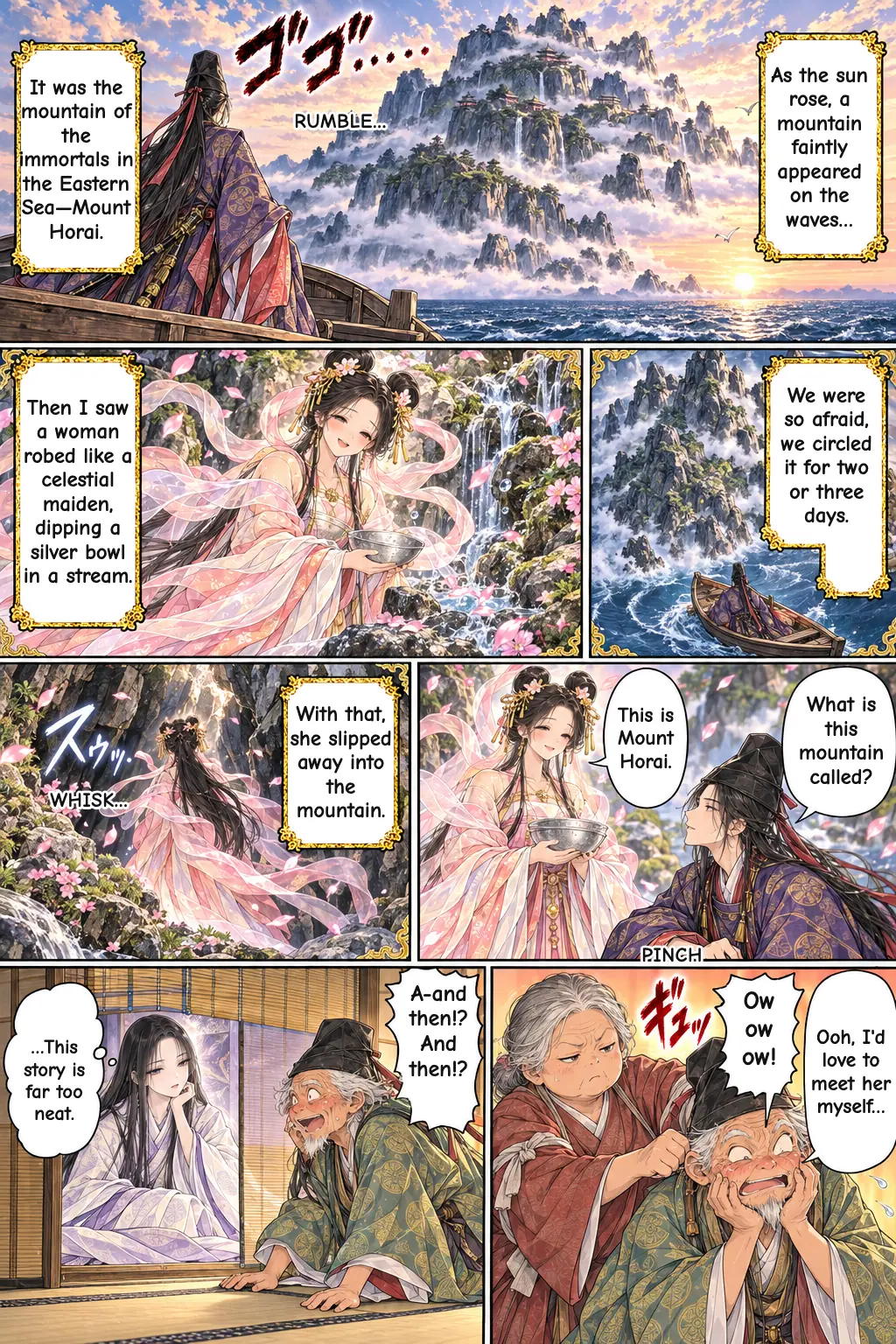
On the five-hundredth day, he says, a beautiful mountain appeared, drifting on the sea. A woman dressed like a celestial being came out to draw water with a silver bowl. She told him the mountain was Hōrai, gave her name as Ukanruri, and vanished. Around the mountain grew flowers not found in this world, beside streams of gold, silver, and lapis-blue water crossed by jeweled bridges. His branch, he claims, was a plain one by comparison, but he took it so it would match her request. Then he sailed home in a little over four hundred days.
The Unpaid Bill That Exposed Everything
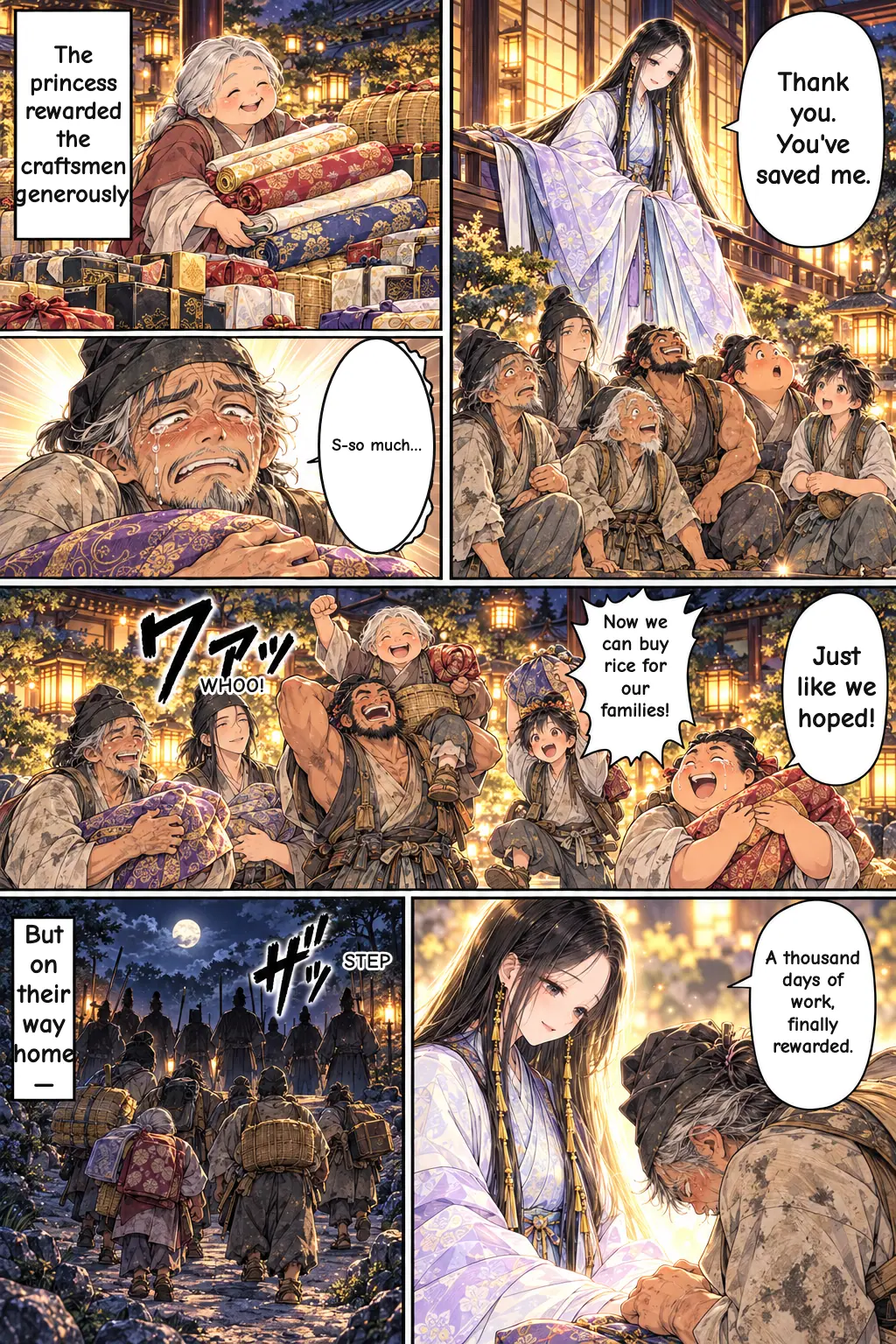
The old man is moved, and the two men trade poems. Then six men walk into the garden, and one of them holds out a petition. The craftsman Ayabe no Uchimaro (the reading of his name differs between editions) of the palace crafts bureau says that they kept away from grain and worked for more than a thousand days to make the jeweled tree, and that the prince had promised them official posts. They have still not been paid, and they want their reward for their families. The prince is so shocked he can barely move.
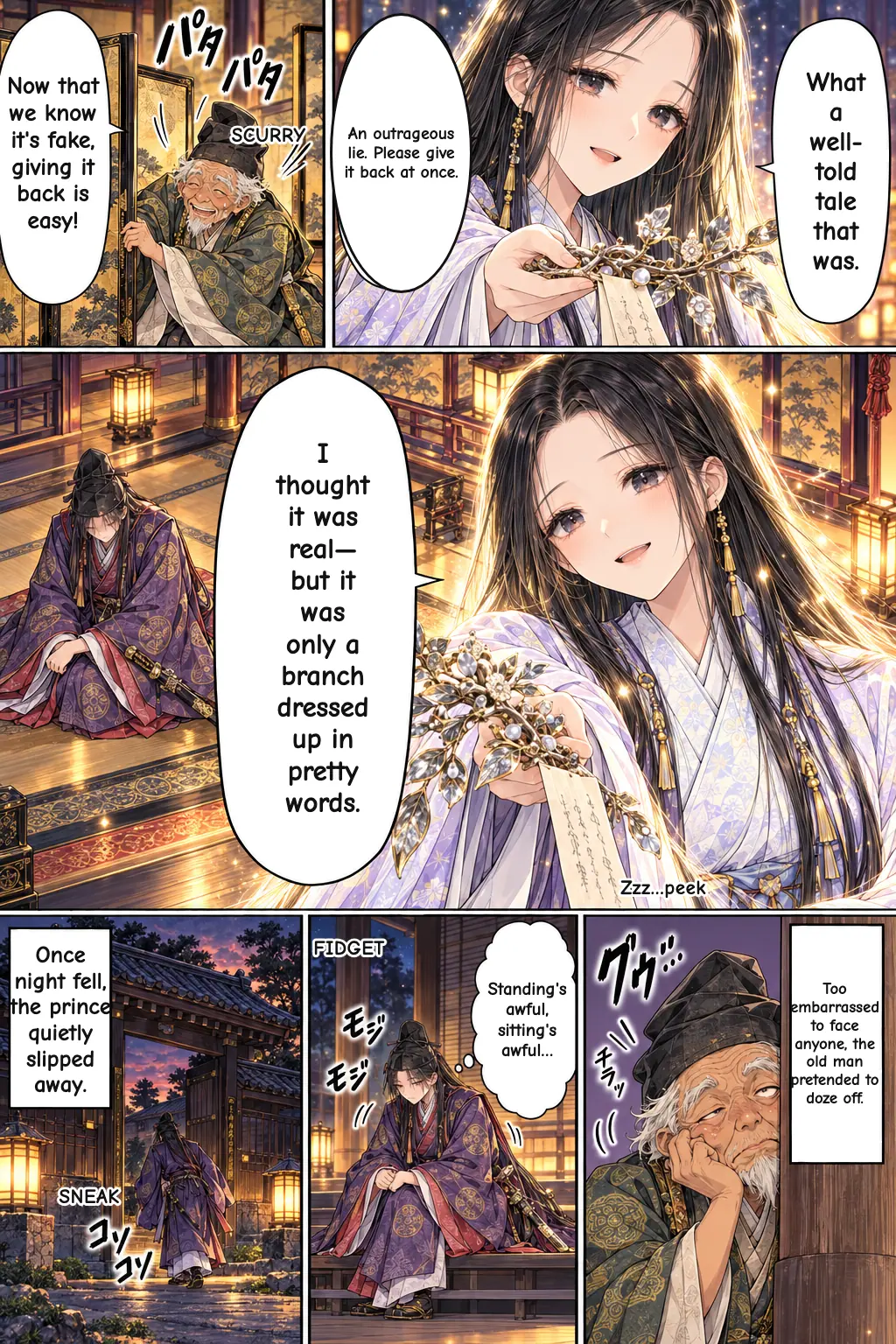
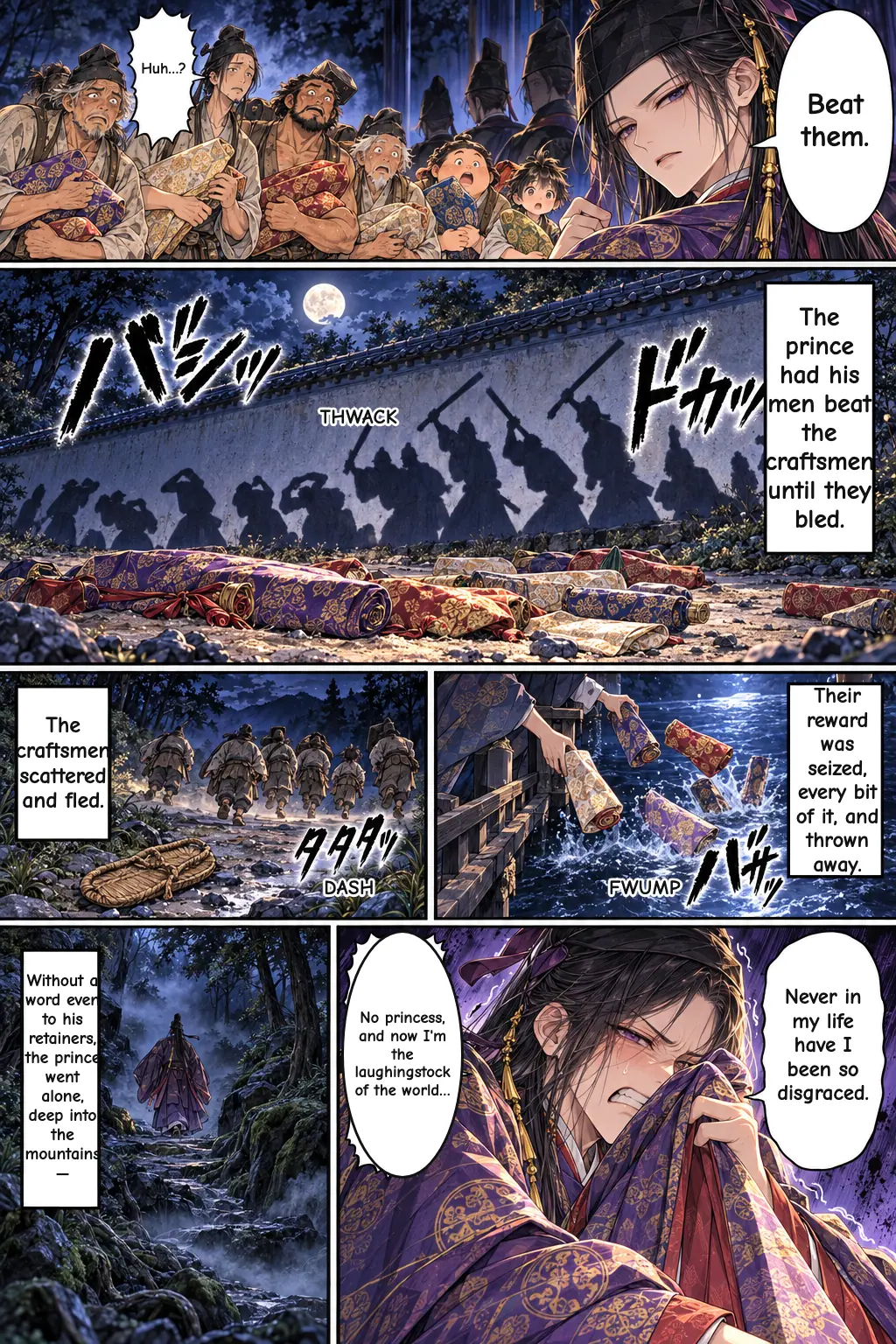
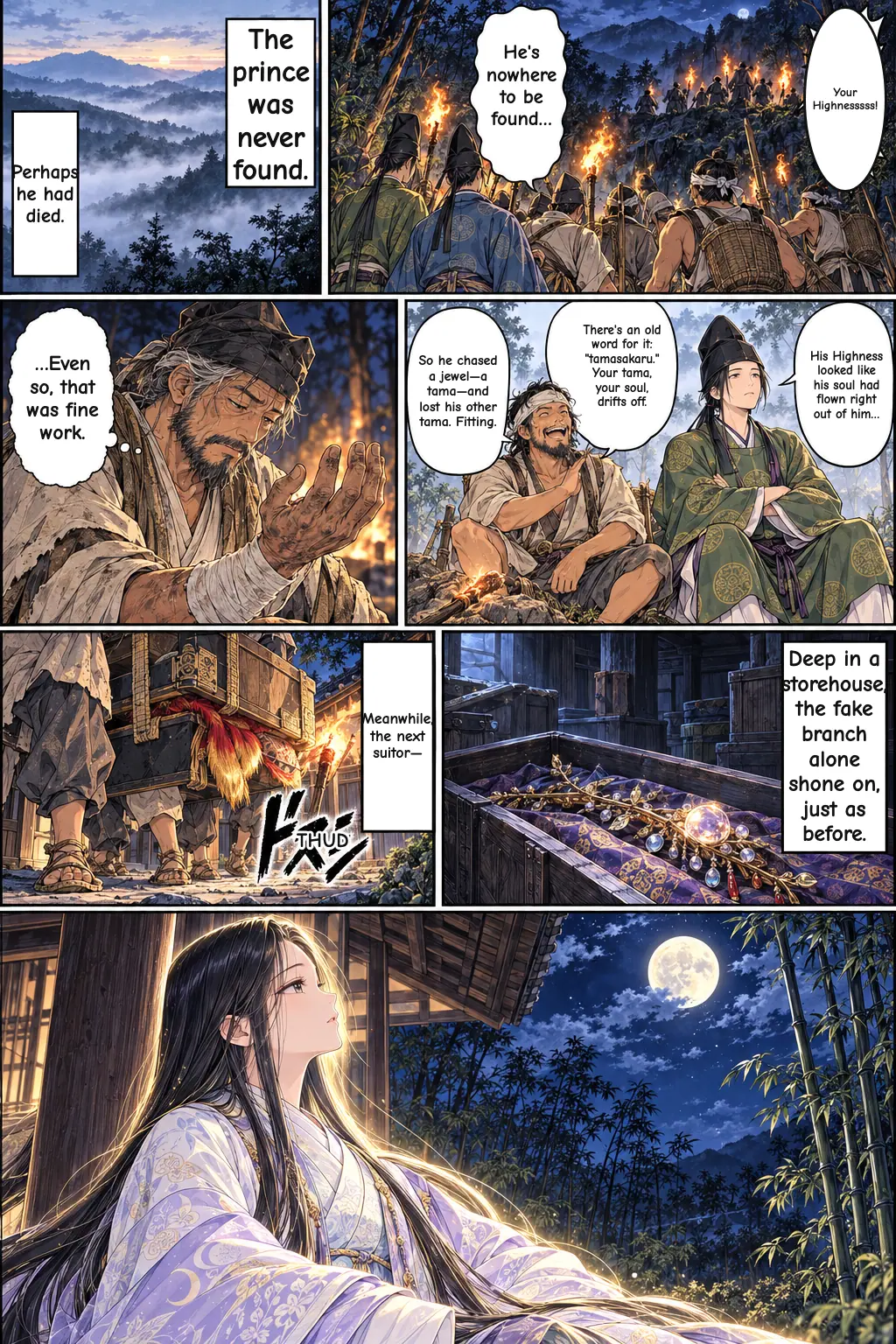
Kaguya reads the petition herself, and her mood lifts at once. She returns the branch with a teasing poem. The embarrassed old man pretends to doze. The prince sits there awkwardly until dusk, then slips away. Kaguya rewards the craftsmen generously. On the road home, however, the prince has them beaten until they bleed, and they throw away their rewards and flee. Calling this the greatest shame of his life, the prince goes alone into the deep mountains. His retainers search for him, but he is never found.
What This Episode Says About Its World
Mount Hōrai comes from Penglai, the island of immortals in Chinese tradition, so Kaguya was asking for something from the edge of legend. Of the five suitors, Kuramochi comes closest to winning because he uses money, skilled labor, and acting. What brings him down is not a magic test but his failure to pay the workers. Many readers see the episode as satire of the aristocracy, and the contrast between the prince's cruelty and Kaguya's generosity makes the point sharper. Some scholars have suggested that the prince was modeled on a real court figure, Fujiwara no Fuhito, but this is only one theory and has not been settled.
The episode also shows Kaguya's limited position. She cannot simply refuse the people who raised her, so the impossible tasks are her only defense. That is why a convincing fake frightens her so much.
What the Manga Changes
In the original, nothing suggests that Kaguya inspects the branch, and she spots no flaw in it. Her noticing something odd about the cut end is the manga's own addition. The original order of events is also kept in mind: the old man starts preparing the bedchamber before the prince even tells his tale.
The prince's adventure is drawn in an exaggerated fantasy style, because he knows it is made up, but the events follow his words in their original order. The original gives no physical description of the demon-like creature, the eerie monster, Ukanruri, or Mount Hōrai, so their designs are invented. The same goes for the branch's exact design (within the silver, gold, and white-jewel rules), the inside of the hidden workshop, how the thousand days pass, the faces and personalities of the six craftsmen, and the characters' appearances, since this episode describes none of them.
Where to Read It
If you want to see the prince's lie fall apart panel by panel, Episode 3 of THE TALE OF THE BAMBOO CUTTER: Princess Kaguya from the Moon is right above this article. Like every episode on Manga Portal, it is free to read and needs no sign-up, so you can carry on with the story of the remaining suitors whenever you like.
Characters in this episode
Prince Kuramochi
A cunning, wealthy suitor who fakes a sea voyage and has a jeweled branch secretly made to win Princess Kaguya.
Princess Kaguya
The bamboo cutter's adopted daughter, who sets the impossible task and is saved when the craftsmen expose the fake.
The Bamboo Cutter (the Old Man)
Kaguya's kind but trusting foster father, who believes the prince and starts preparing for the wedding.
Ayabe no Uchimaro
A craftsman from the palace crafts bureau whose petition for unpaid wages reveals the prince's lie.
The Six Craftsmen
The master metalsmiths who spent about a thousand days making the branch and were beaten instead of paid.
Ukanruri
A heavenly-looking woman who exists only in the prince's invented story, where she names the mountain as Hōrai.
FAQ
What did Princess Kaguya ask Prince Kuramochi to bring?
She asked for a branch from a tree on Mount Hōrai in the eastern sea, with roots of silver, a stem of gold, and white jewels for fruit. It was meant to be impossible to get.
How was Prince Kuramochi's lie exposed?
Just after he finished telling his adventure story, the craftsmen who had made the branch arrived with a petition asking for wages for more than a thousand days of work. Their complaint proved the branch was handmade, not taken from Hōrai.
What is Mount Hōrai?
Hōrai is the Japanese name for Penglai, a legendary mountain island of immortals in Chinese tradition. In the tale it is pictured as a place of wonders far across the eastern sea.
What happened to Prince Kuramochi in the end?
After his lie was exposed, he had the craftsmen beaten, then went alone into the deep mountains out of shame. His retainers searched for him, but he was never found.
Who wrote The Tale of the Bamboo Cutter?
The author is unknown. The tale is generally dated to the early Heian period, around the 9th to 10th century, and is often called one of the oldest surviving Japanese prose tales.