Who Is Izumi Shikibu?
Brilliant Heian poet who lived for love
Izumi Shikibu was a woman poet of the mid-Heian period, known for her passionate love poems. She served Empress Shōshi (Akiko) and lived at the same time as Murasaki Shikibu, author of The Tale of Genji. She wrote the Hyakunin Isshu poem "Arazaran kono yo no hoka no omoide ni" ("As a memory to take beyond this world...").
In Episode 3, "The Izumi Shikibu Diary," she is still mourning her late lover, Prince Tametaka, when his younger brother, Prince Atsumichi, sends her a sprig of tachibana (mandarin orange) blossoms. Their exchange of poems turns into a new romance. Despite her doubts the love deepens, and in the end she is taken into the prince's household. In Episode 11, "Fireflies of Kibune," her lover has stopped visiting, so she goes to the shrine at Kibune. Watching the fireflies by the river, she writes: "Lost in longing, I see even the fireflies of the marsh as my own soul wandering out of my body." Legend says a god sent a poem back in reply.
The Izumi Shikibu Diary is written like a tale, with its author calling herself "the woman." Most scholars believe Izumi Shikibu wrote it herself.
Episodes featuring this character2
 NEW
Episode 3
I Fell for My Dead Lover's BrotherThe Izumi Shikibu Diary
A year after losing the man she loved, Izumi Shikibu has shut herself away—until his younger brother, Prince Atsumichi, sends her a sprig of white orange blossoms. A reply in verse sparks a love that survives rumors and lonely nights, and leads to a carriage waiting for her on a snowy night. But in the shadows, someone else quietly leaves the house.
19 pages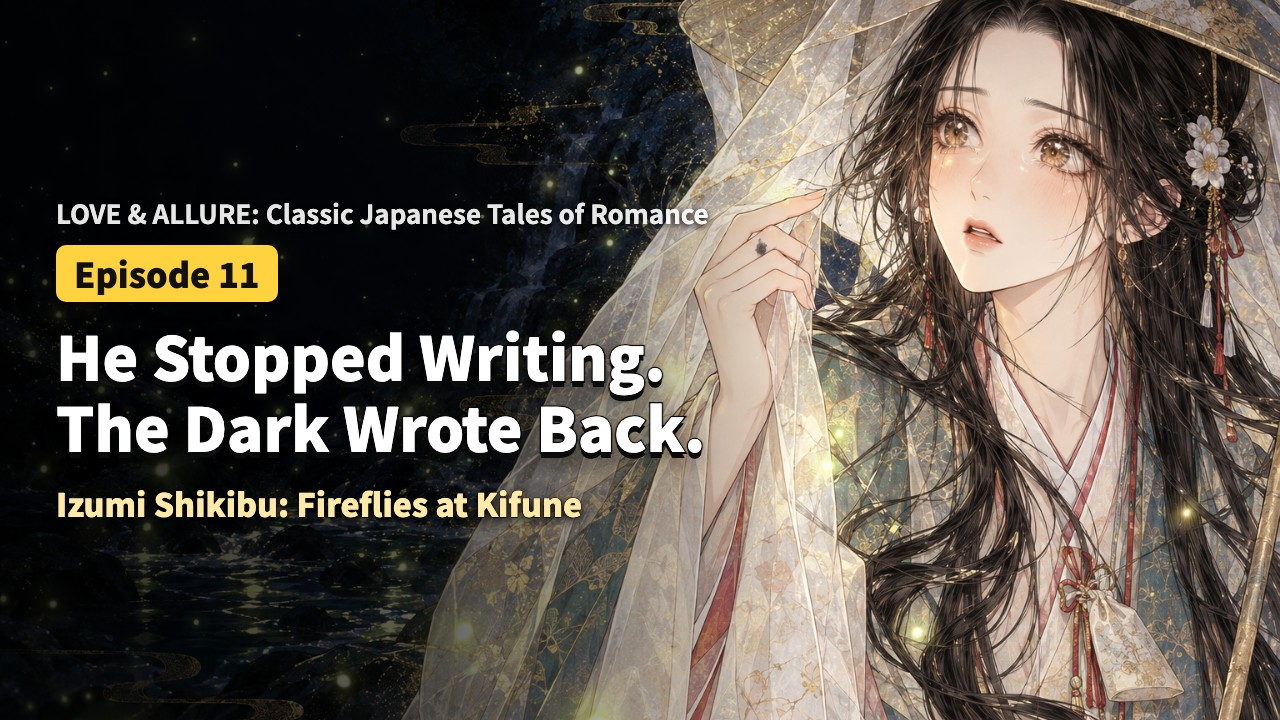 NEW
Episode 11
He Stopped Writing. The Dark Wrote Back.Izumi Shikibu: Fireflies at Kifune
Izumi Shikibu, a poet still waiting for a lover who has stopped coming, leaves her waiting room one summer night and heads for a mountain stream in the hills north of the capital. Seeing her own soul in the fireflies that fill the dark, she composes a poem, and from deep in the darkness a voice answers. This is the story of a thousand-year-old love poem and a reply whose sender no one knows.
19 pages