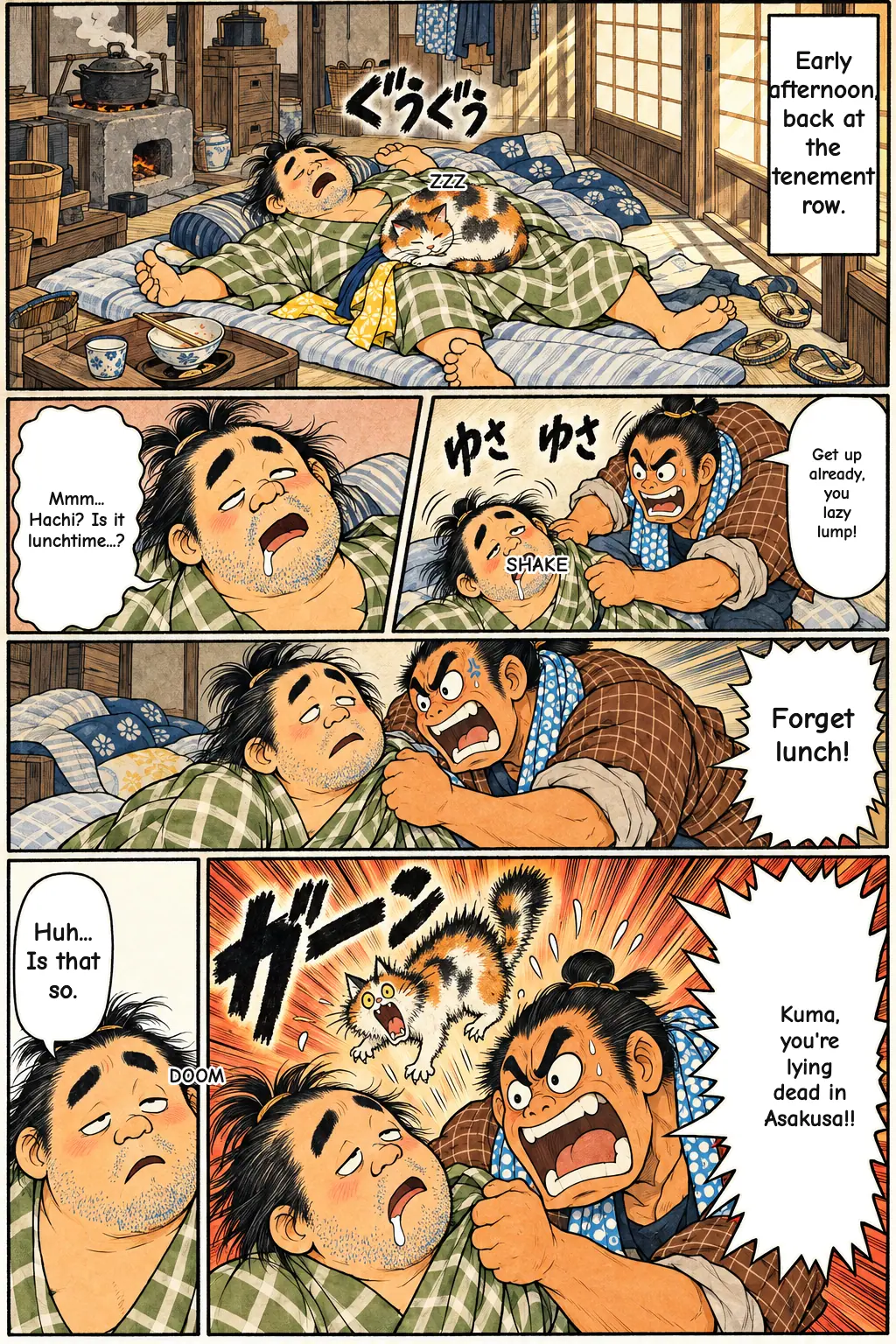
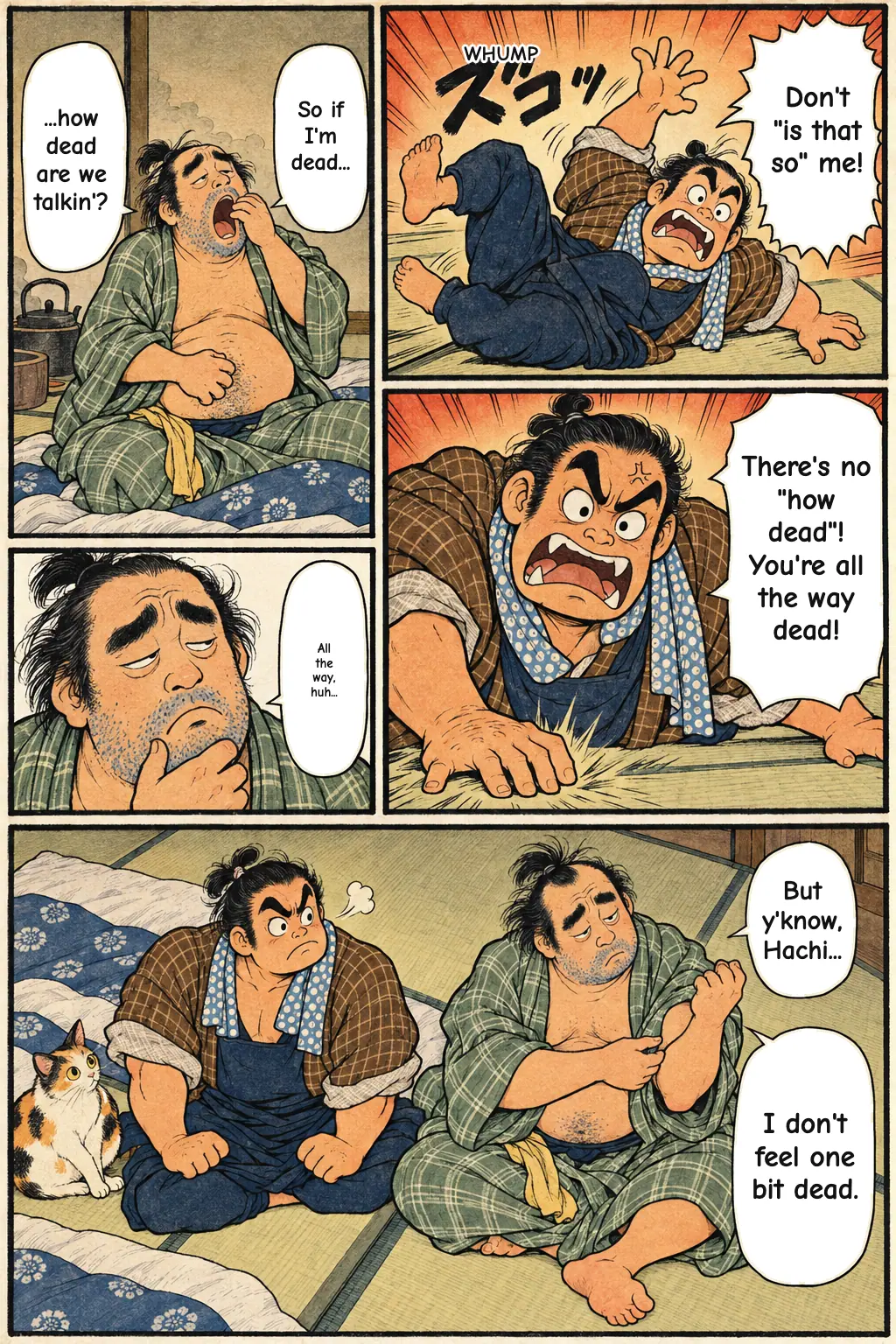
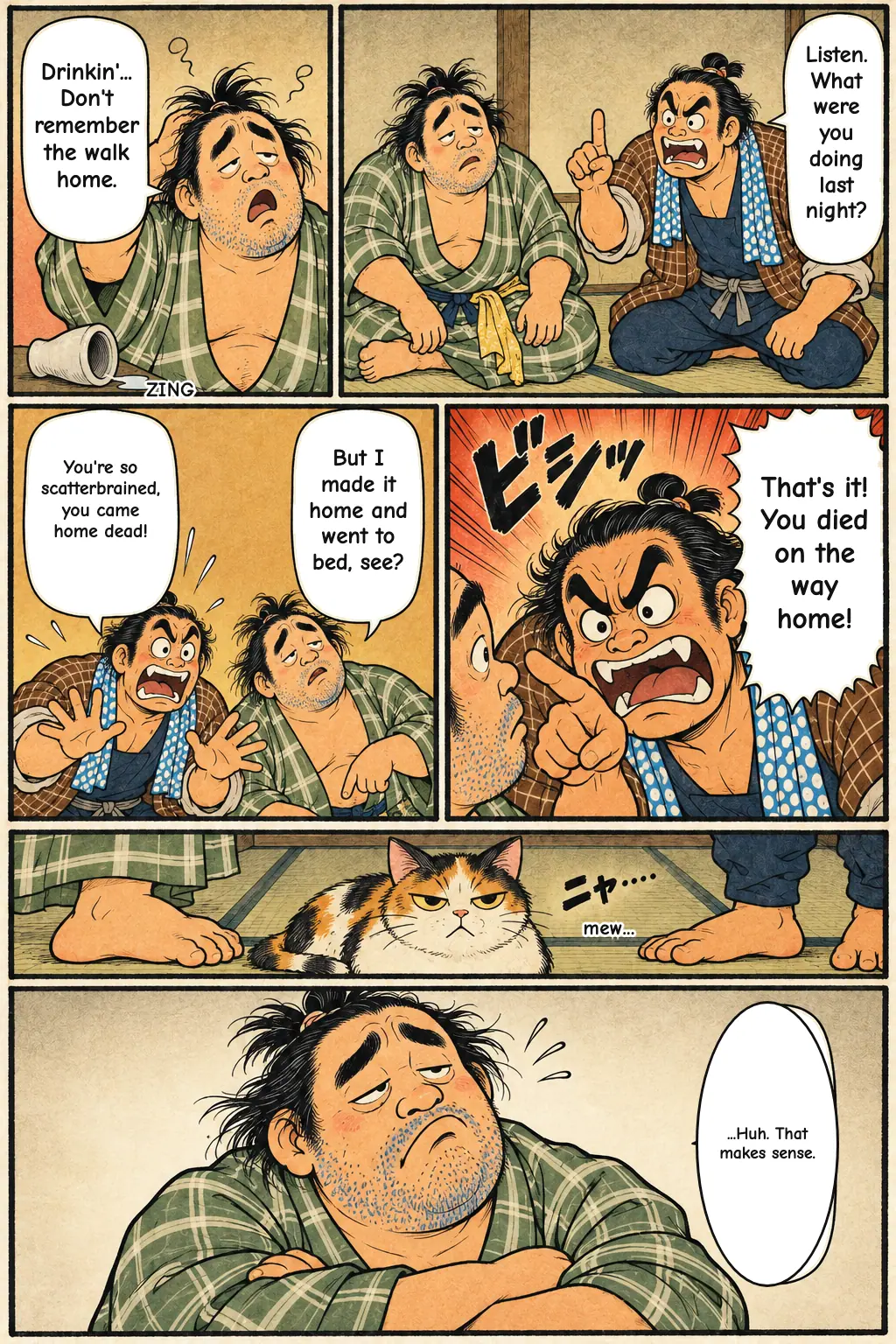
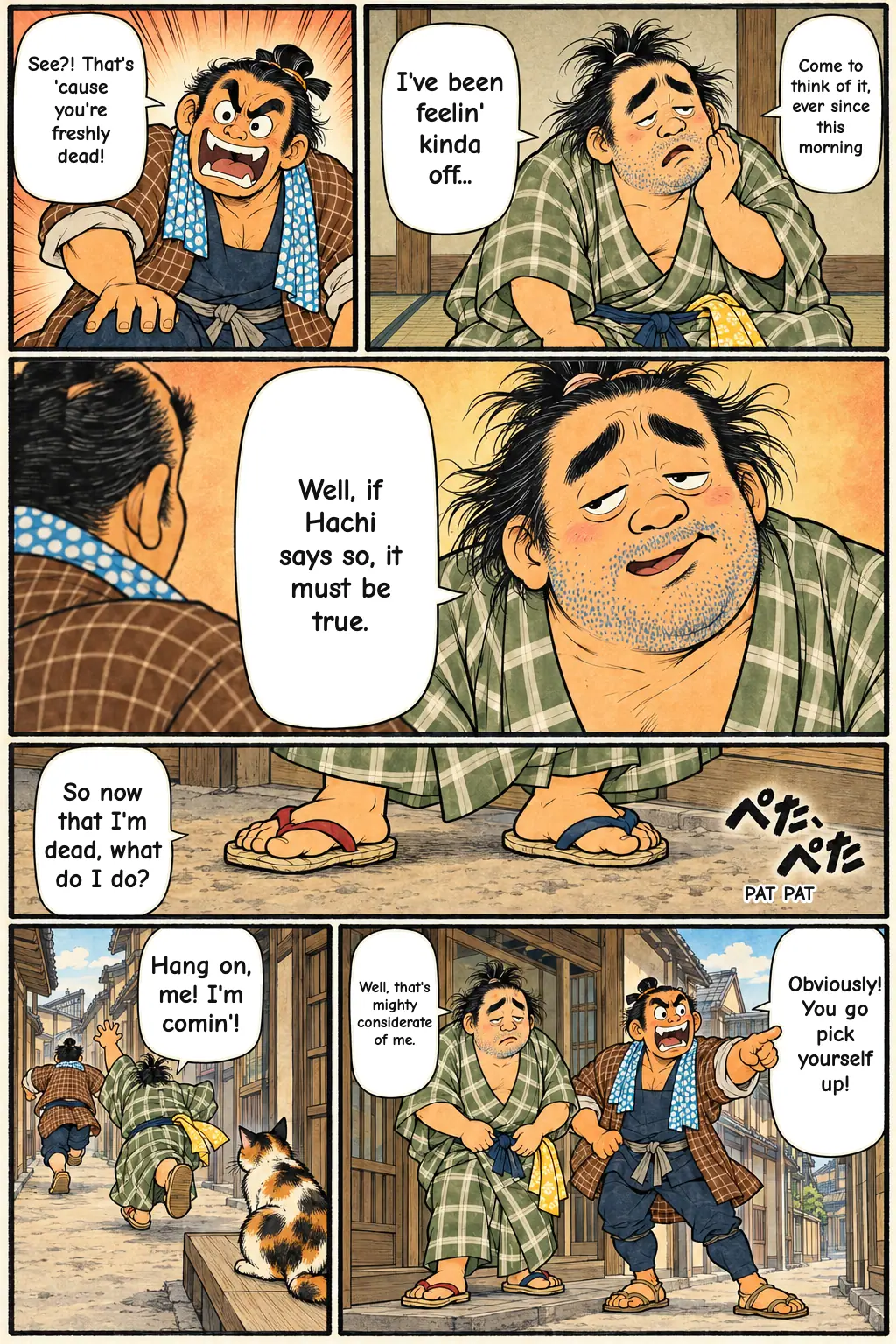
Episode 2The Man Who Claimed His Own CorpseSokotsu Nagaya (The Scatterbrains' Row)
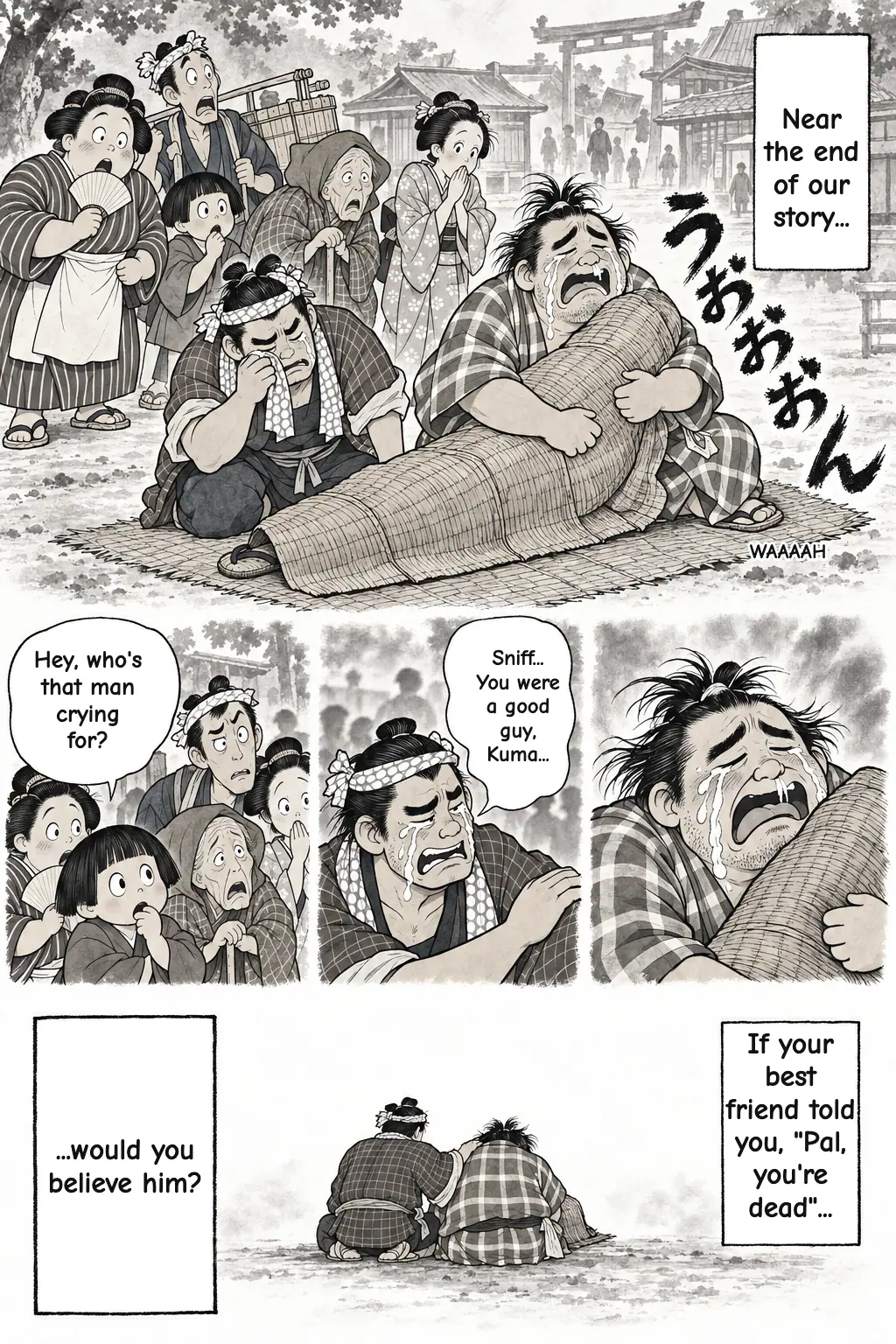
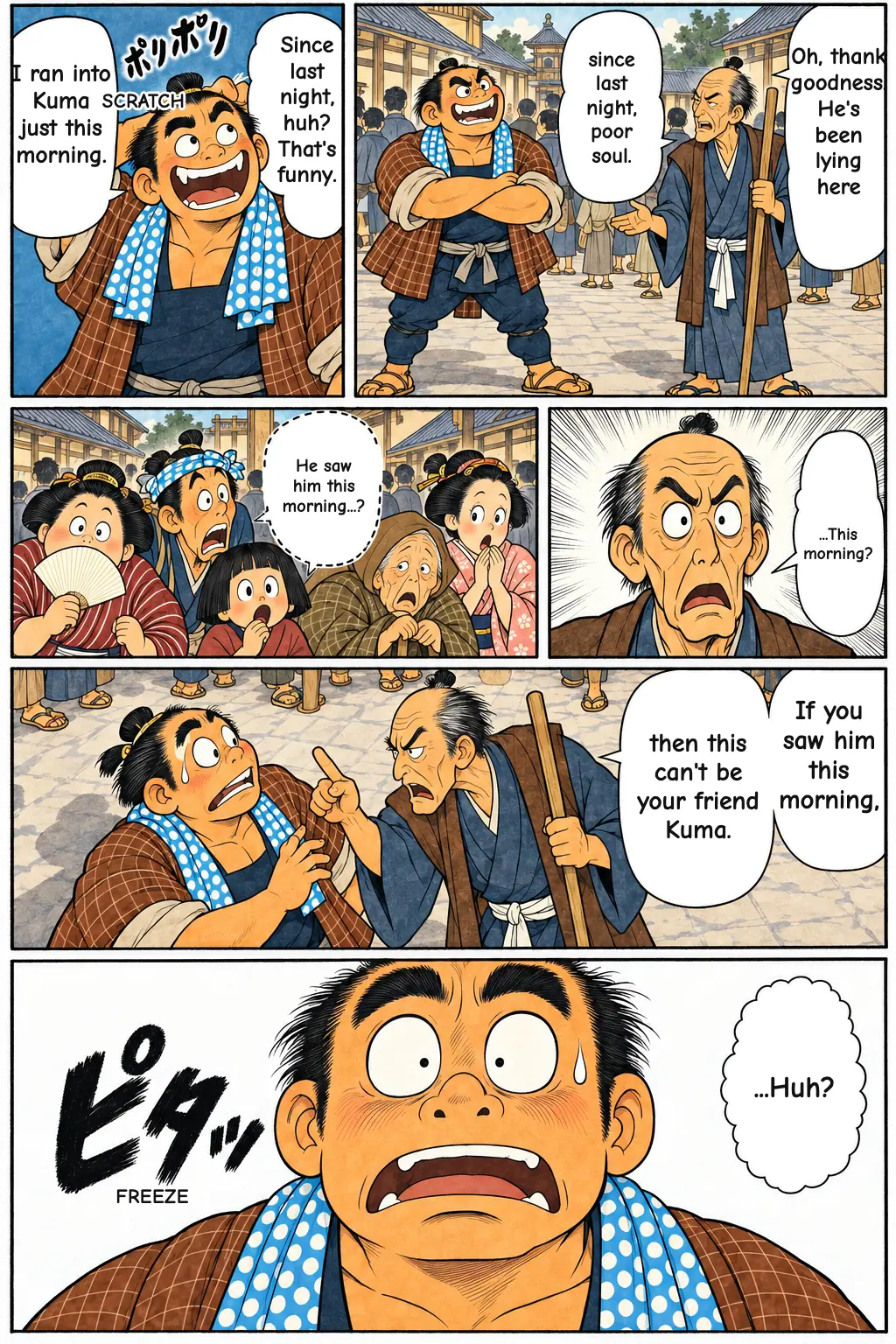
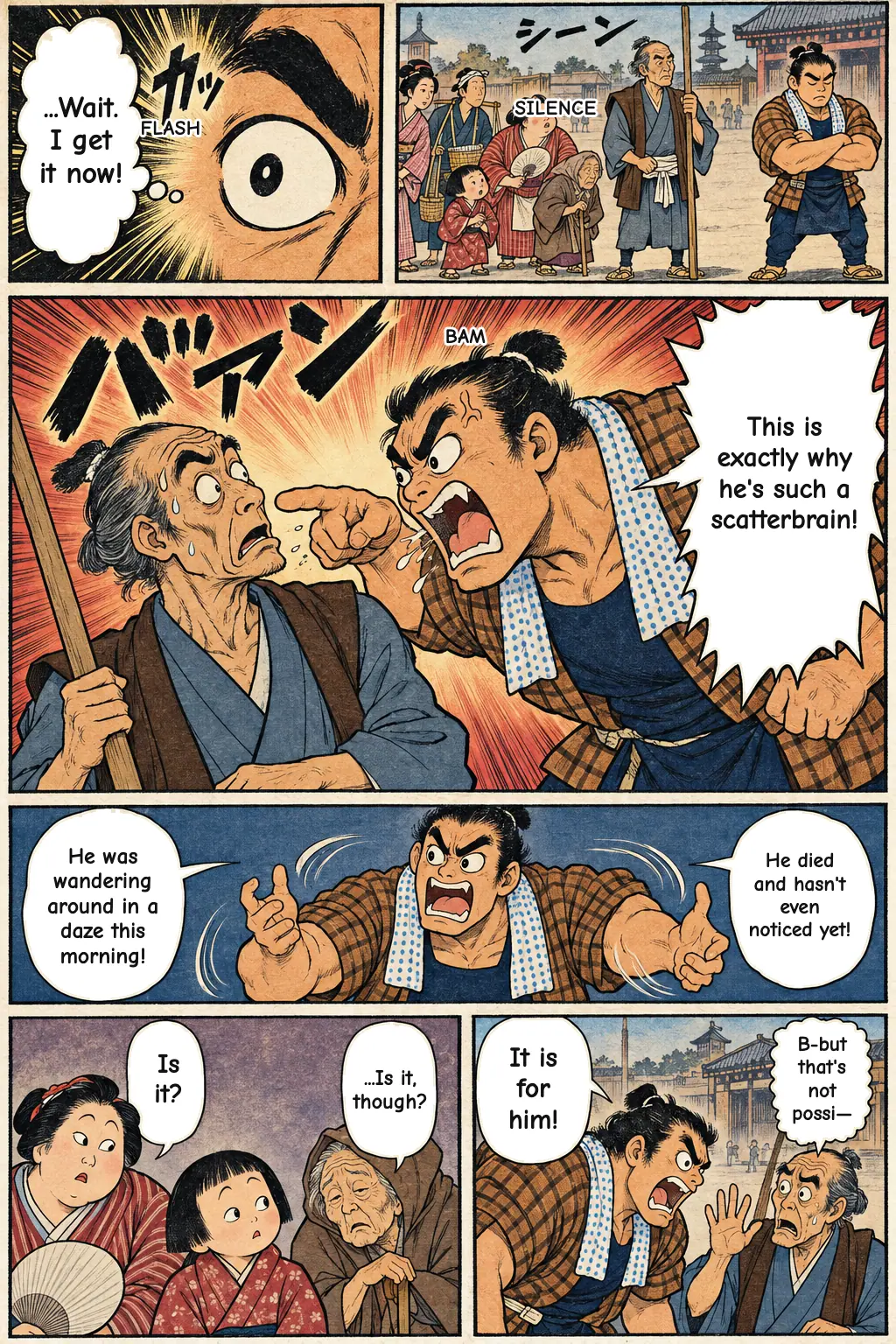
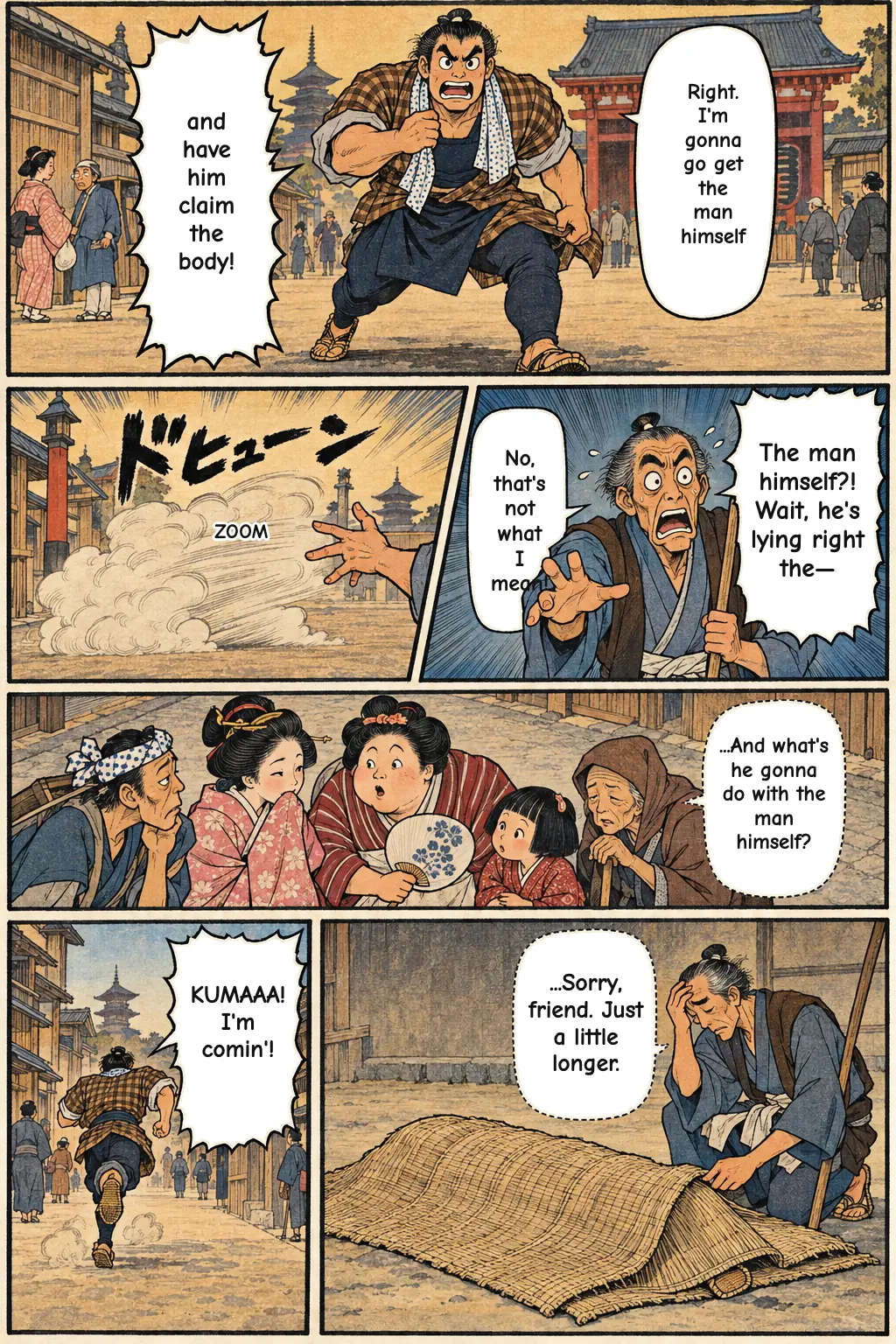
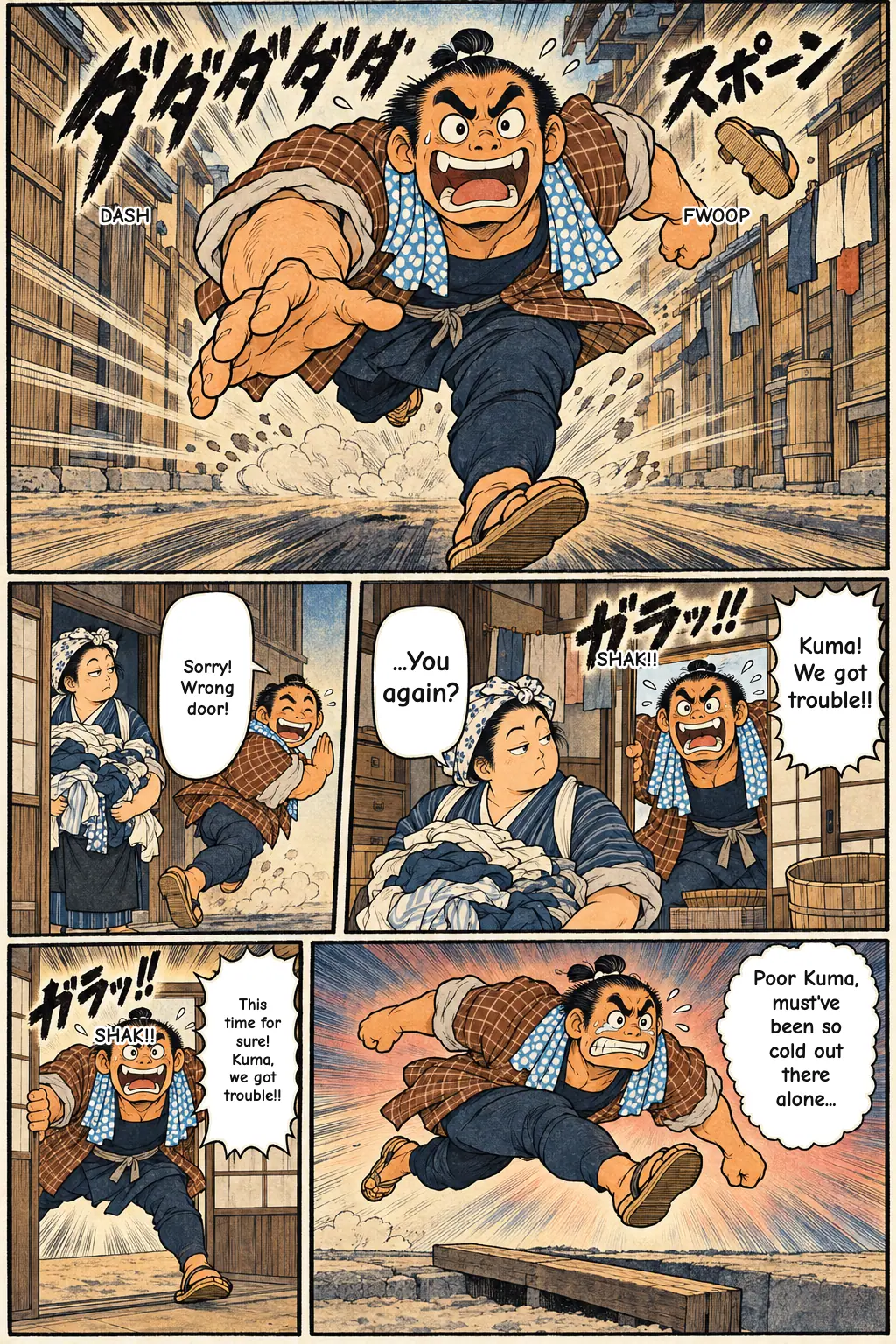
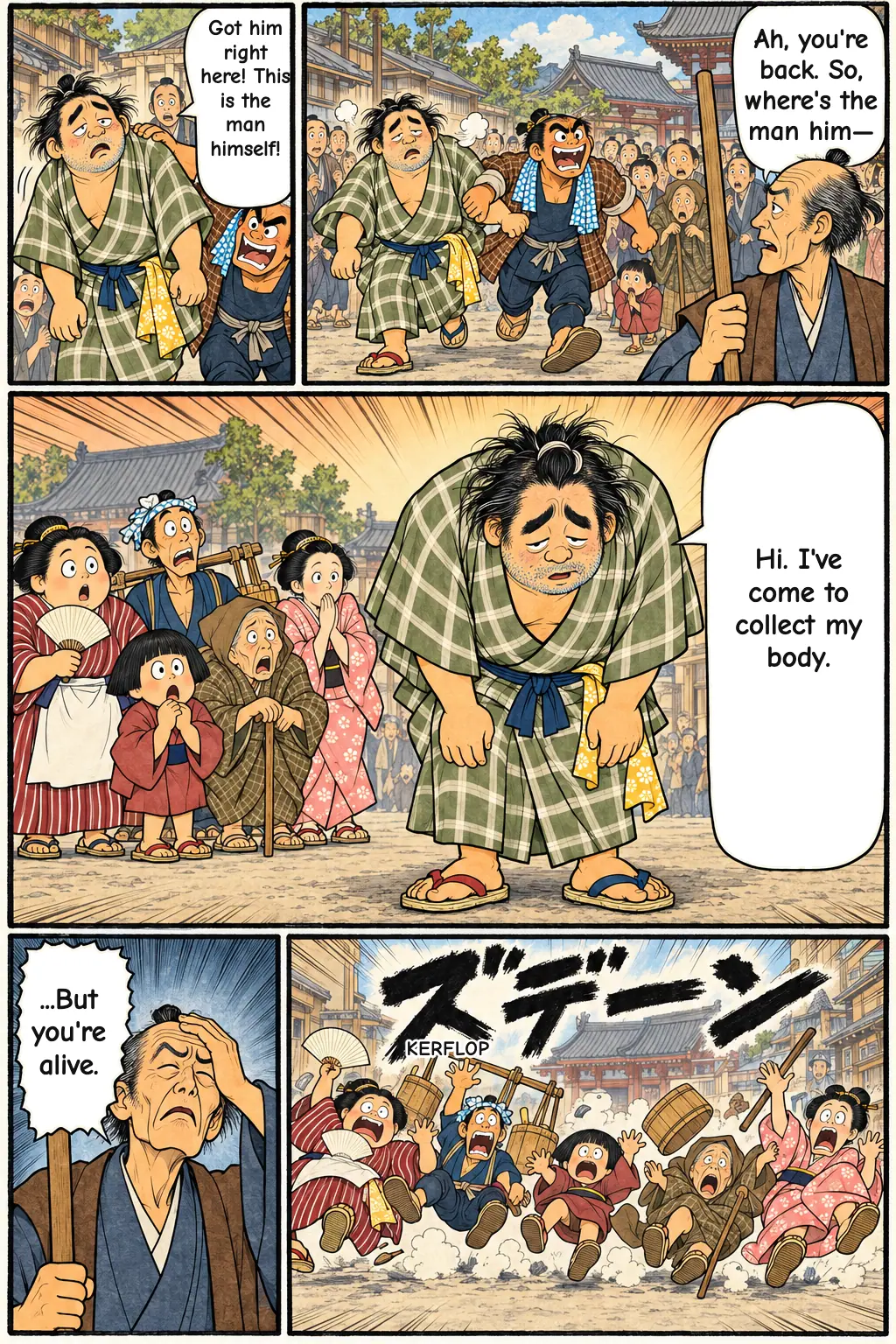
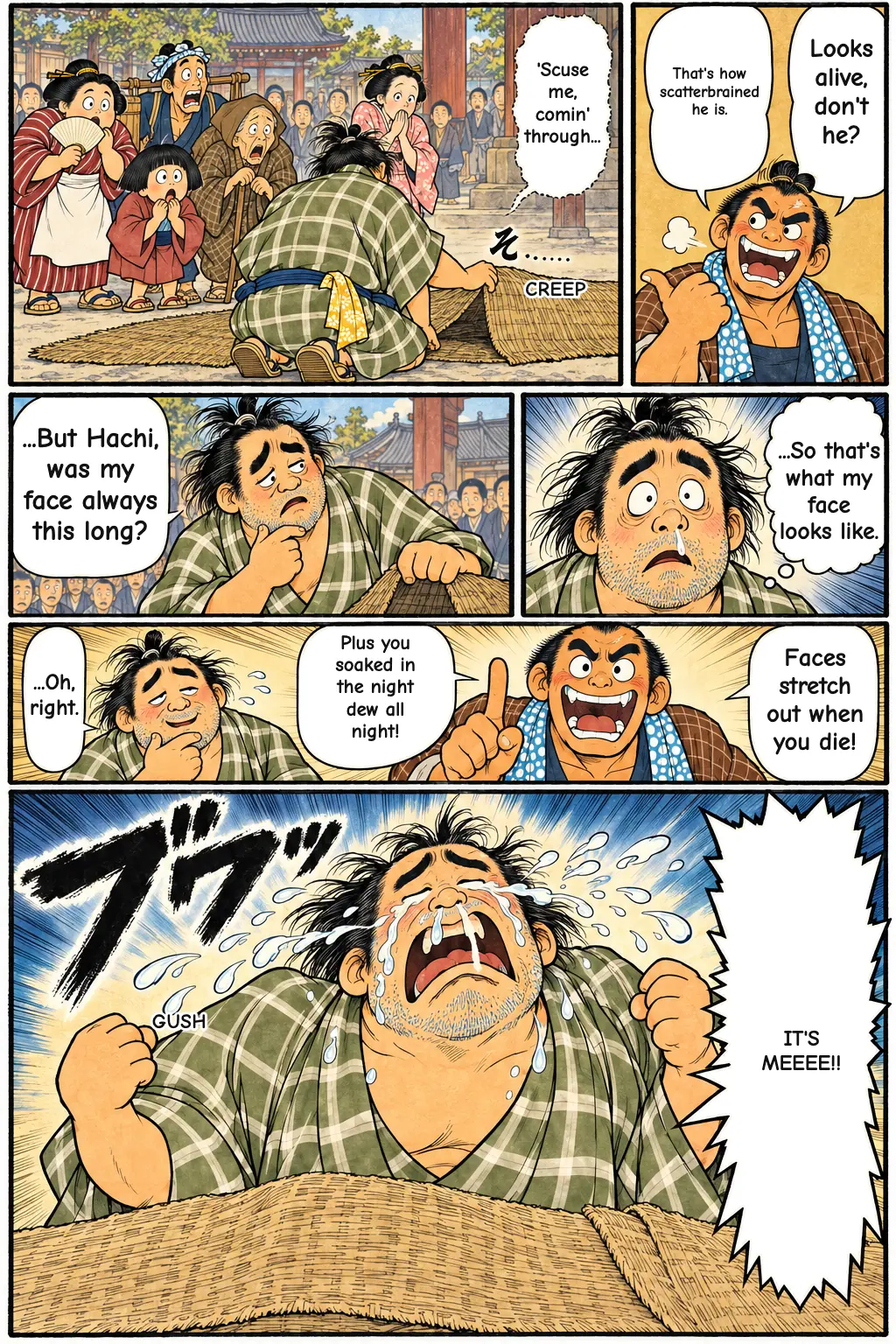
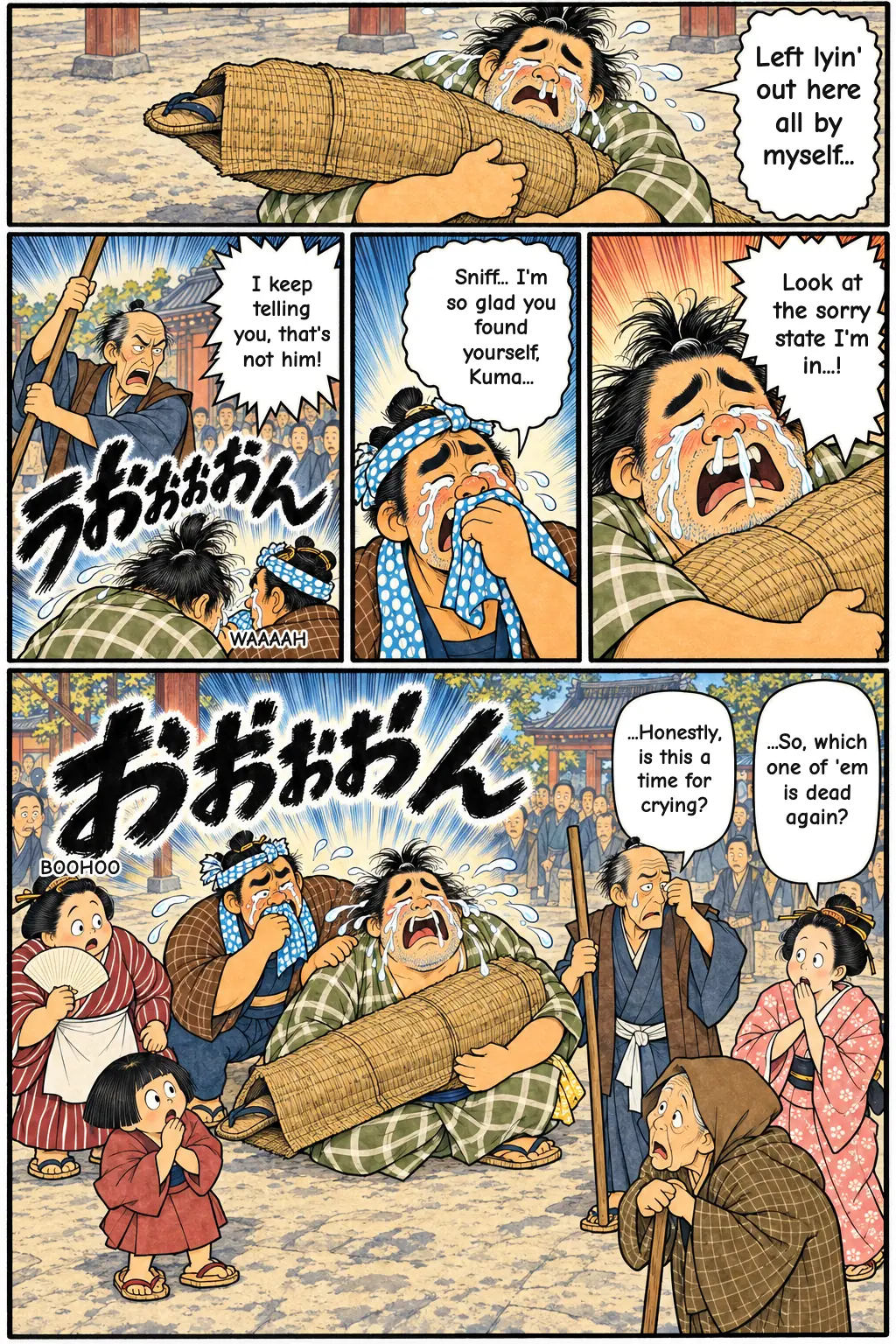
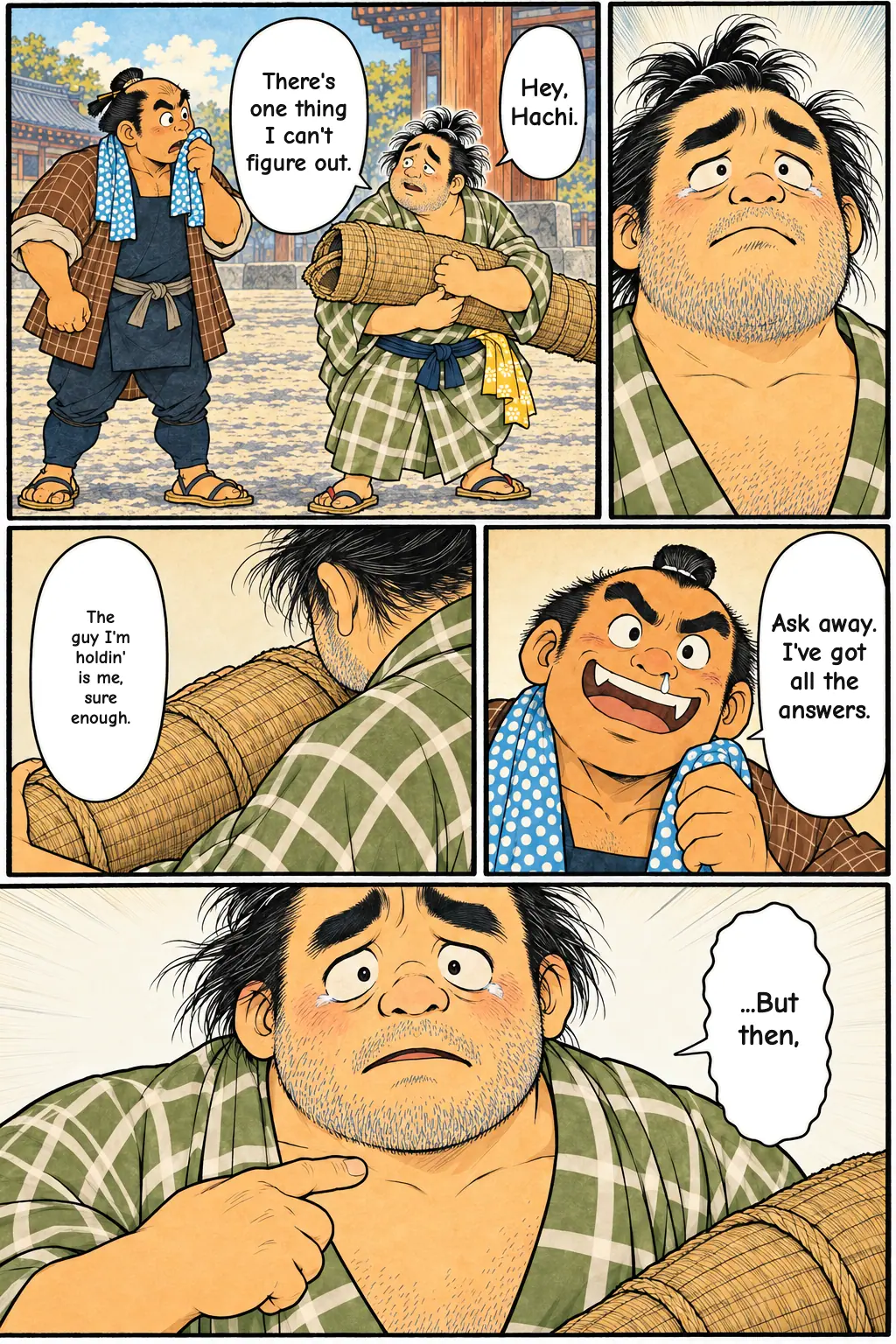
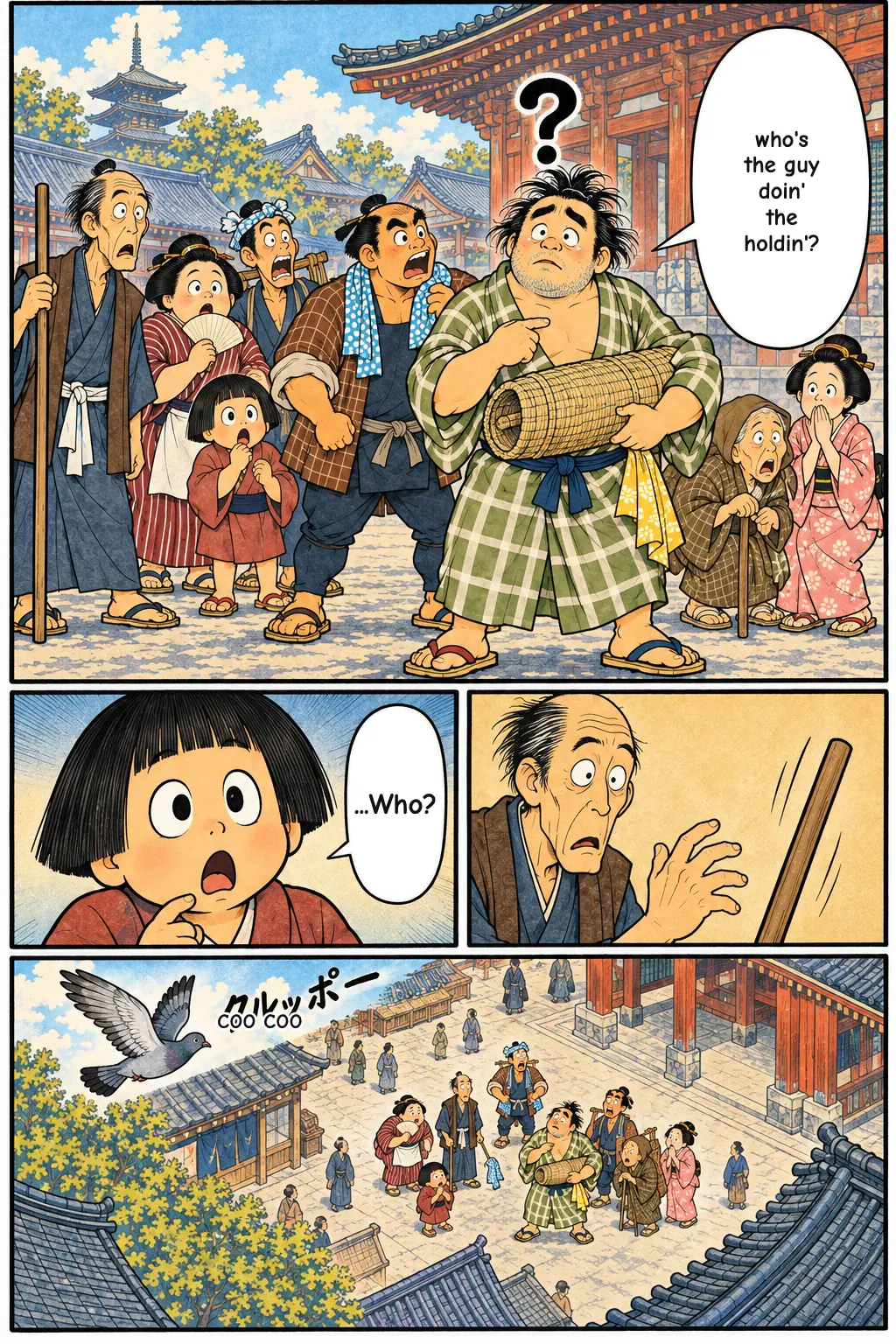
Episode 2 of RAKUGO: Japan's Comic Tales. Hasty Hachi finds a man who died in the street at Asakusa and decides it's his best friend and next-door neighbor, Kuma. When someone points out the obvious ("But you saw him this morning!"), Hachi just steamrolls right past it. He drags Kuma himself over to collect "his own body." Then Kuma, sobbing as he hugs the corpse, hits a question nobody can answer.
Sokotsu Nagaya Summary & Punchline Explained | Rakugo Comic Tale
Sokotsu Nagaya Summary: The Original Story
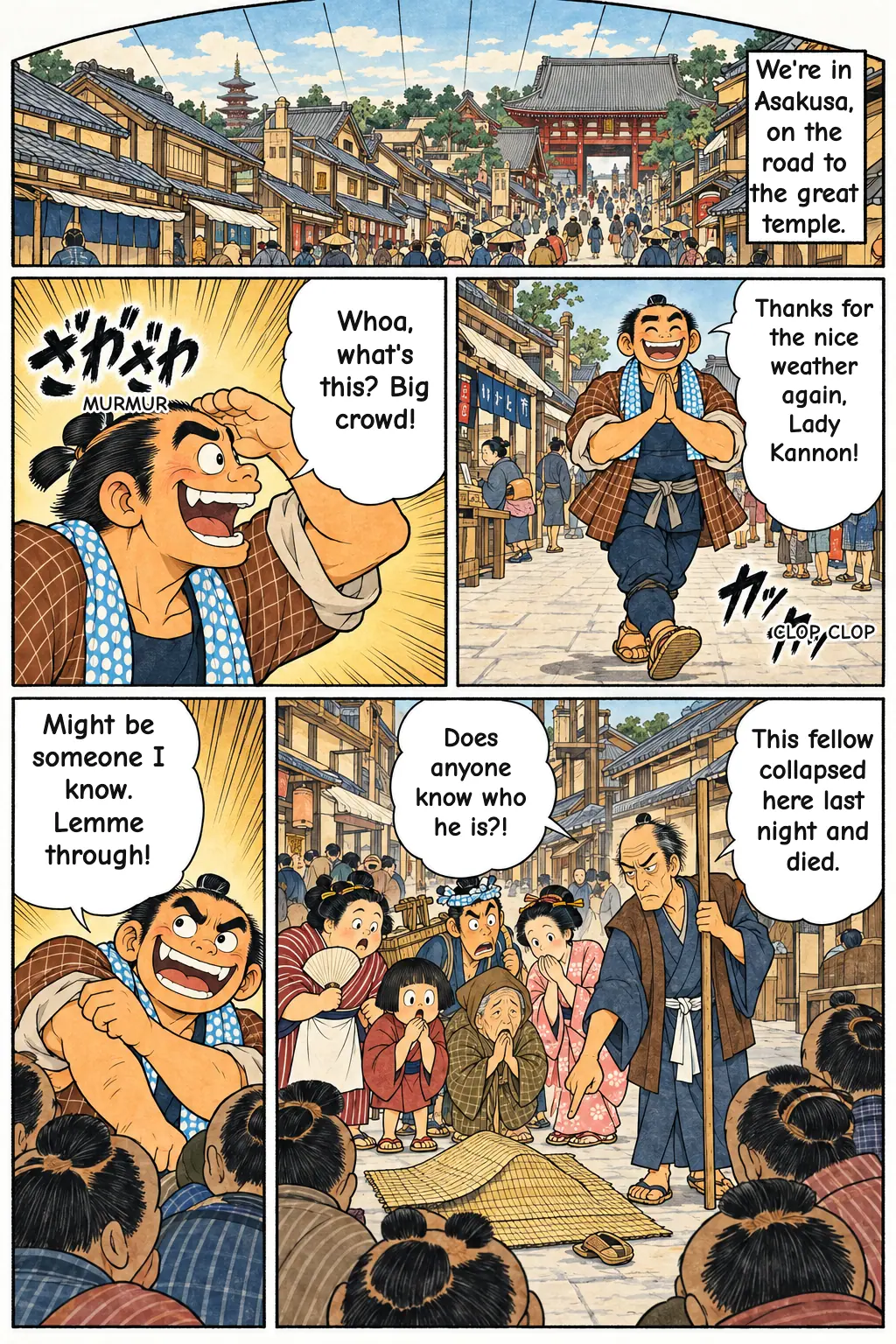
Sokotsu Nagaya ("The Scatterbrains' Row") is a classic comic tale from Edo rakugo, the Japanese art of storytelling, and storytellers have handed it down for generations. No single author is credited. For our manga we checked the plot against a sokki-bon, a word-for-word shorthand transcript of a live performance, from the Meiji–Taishō era (1868–1926). This one records Yanagiya Kosan III, who died in 1930. The story opens when a hasty man goes to pray at the Kannon temple in Asakusa, a busy district of old Edo (today's Tokyo), and finds a crowd. In the middle lies a stranger who collapsed and died in the street during the night. The man looking after the body is asking the onlookers whether anyone knows who he is.
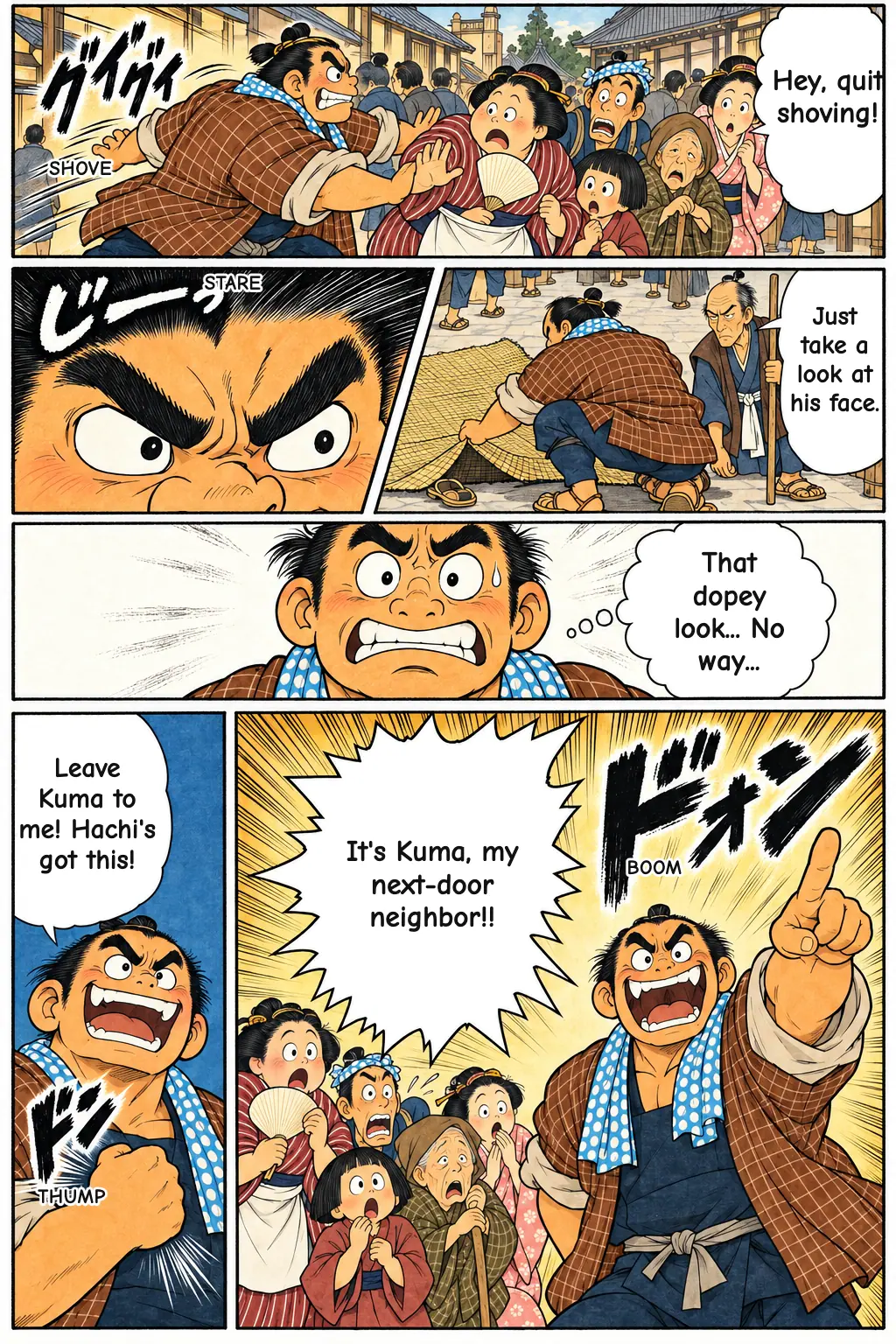
Our hero takes one look at the face and announces that it's Kuma, who lives in his own tenement row. The caretaker points out that this man has been lying here since last night. The hero even admits he saw Kuma this very morning. Anyone else would stop there. Not him. Kuma is so scatterbrained, he insists, that he hasn't noticed he's dead yet. So he'll go and fetch Kuma to collect the body himself.
Back home, he tells Kuma: "You're lying dead in Asakusa." Kuma doesn't feel dead and is puzzled at first, but he lets his friend talk him into it. Exactly how he gets convinced varies from teller to teller. The two of them hurry back, and Kuma steps forward to claim "his own corpse" while the crowd stares in disbelief. Kuma looks at the face, decides it really is him, and lifts the body in his arms, mourning the sorry state he's ended up in. Then one last, very strange thought stops him (see the punchline section below).
Who's Who: The Main Characters
The hasty man (Hachi in our manga) is the engine of the story. He's quick to jump to conclusions, and once he decides something, no fact can move him. Kuma, his close friend and neighbor, may be even more remarkable, because he's alive and well and still ends up believing he's dead. Hachigorō and Kumagorō are classic everyman names in rakugo, but tellers differ in what they call this pair. The third key figure is the caretaker at Asakusa. He's the only sensible person in the scene, and every reasonable objection he makes gets brushed aside. A crowd of onlookers fills out the background. The dead stranger is never identified, and the story never says how he died.
What Is Rakugo? (And What "Sokotsu" and "Nagaya" Mean)
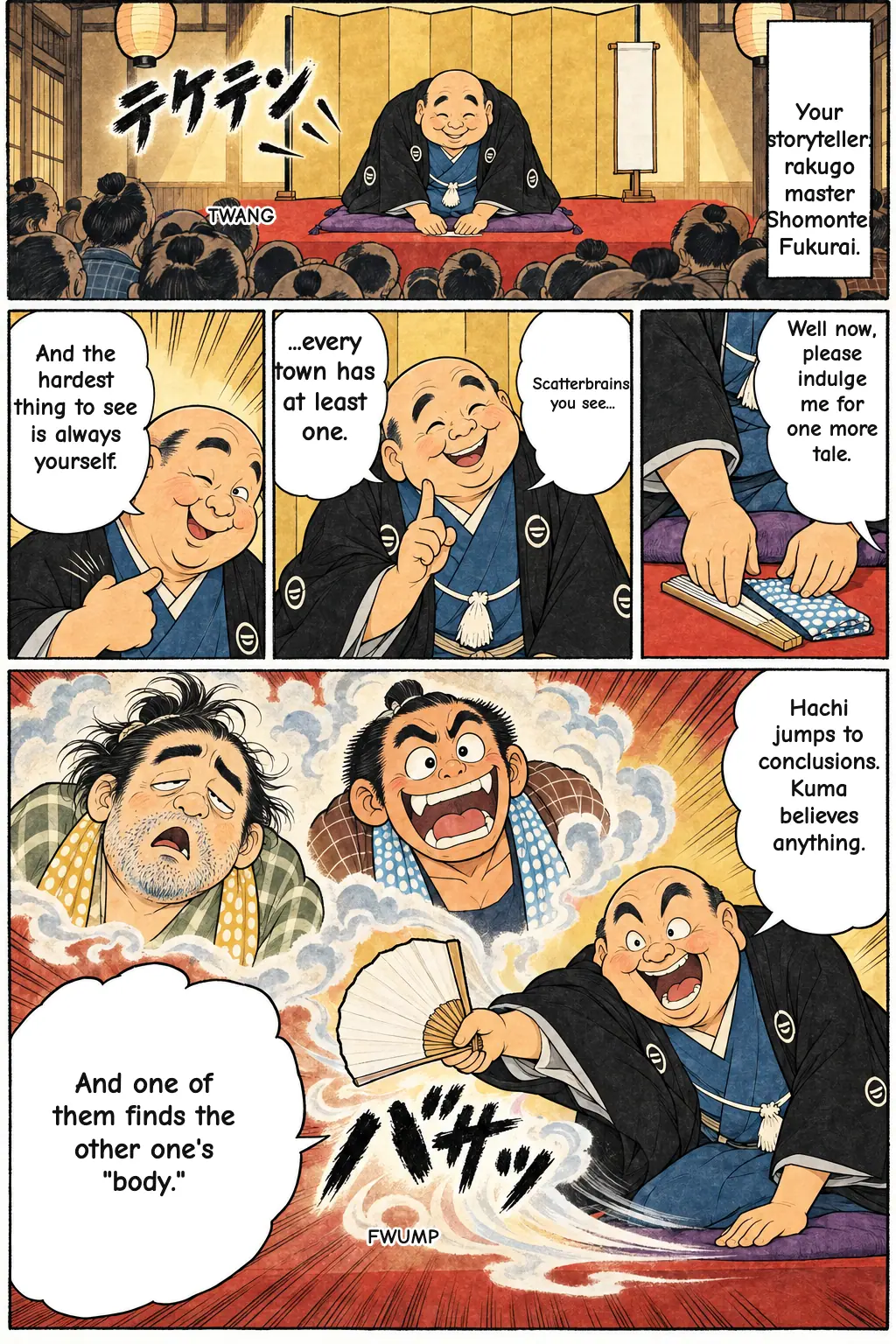
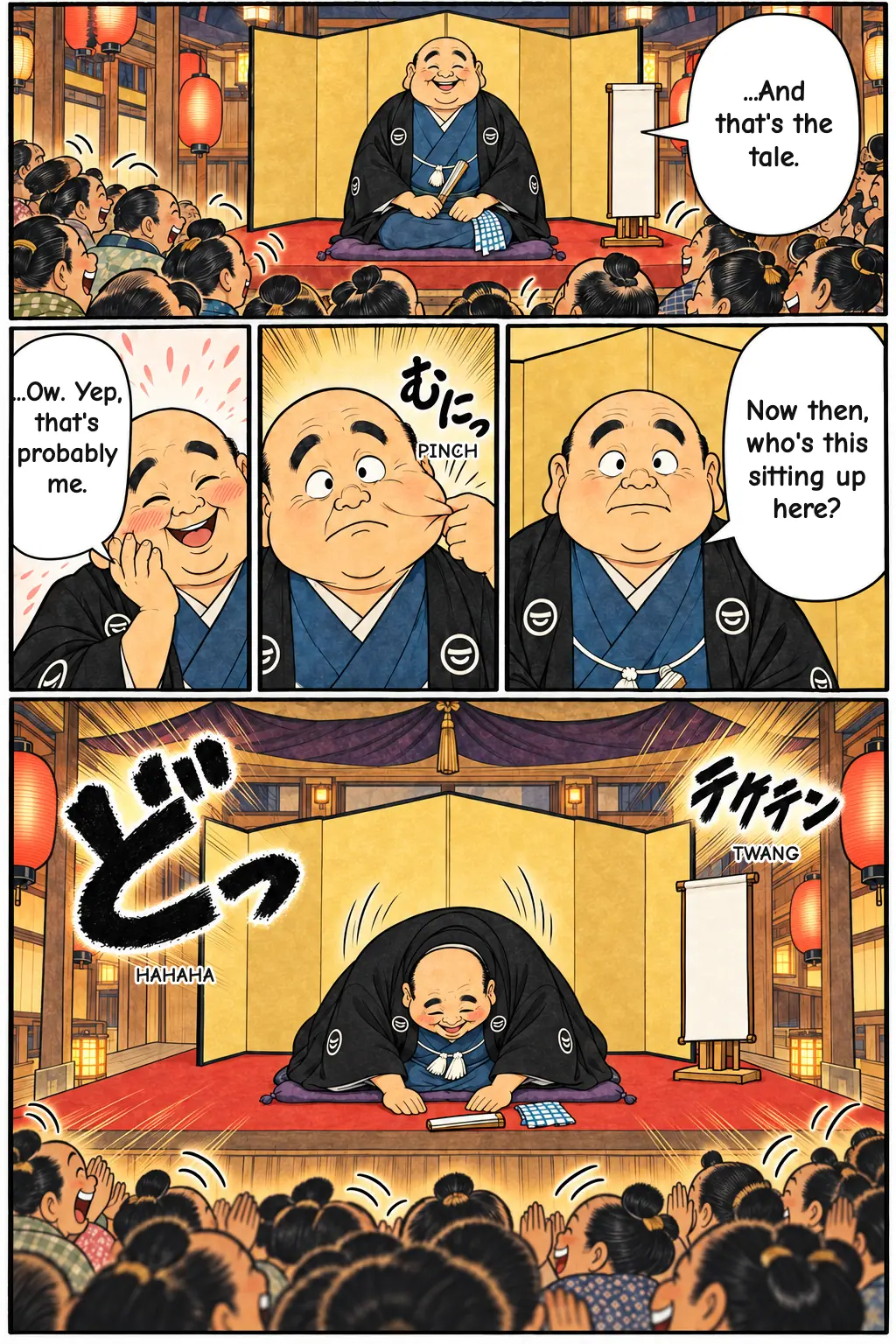
Rakugo is a Japanese storytelling art that has been performed in yose (variety theaters) for a few hundred years. A single storyteller sits on a cushion and plays every character, using only a folding fan and a hand towel as props. A slight turn of the head and a change of voice tell you who's speaking. The fan becomes chopsticks, a pipe or a sword, and the towel becomes a wallet or a letter. Most stories end on a final punchline called the ochi or sage. In our series, the opening and closing scenes are told by Shōmontei Fukurai, a fictional storyteller we created as the narrator. He isn't a real performer.
Two words in the title set up the joke. Sokotsu means careless, rash, always jumping to conclusions, and the sokotsu-mono (the scatterbrain) is a beloved stock character in rakugo. A nagaya was a long, shared wooden row house where ordinary working people of Edo lived wall to wall. Neighbors knew everything about each other, which is exactly why Hachi feels sure he'd recognize Kuma anywhere.
What the Manga Changed
The core events follow the traditional story: the crowd at Asakusa, the mix-up between "since last night" and "this morning," Hachi's run home, Kuma being talked into it, Kuma claiming and holding the body, and the final line. Everything else is our own adaptation. We wrote all the dialogue ourselves, keeping some of the flavor of Edo speech. We designed the characters' faces, builds and kimono, and drew the Asakusa temple grounds in a style that fits the Edo–Meiji period.
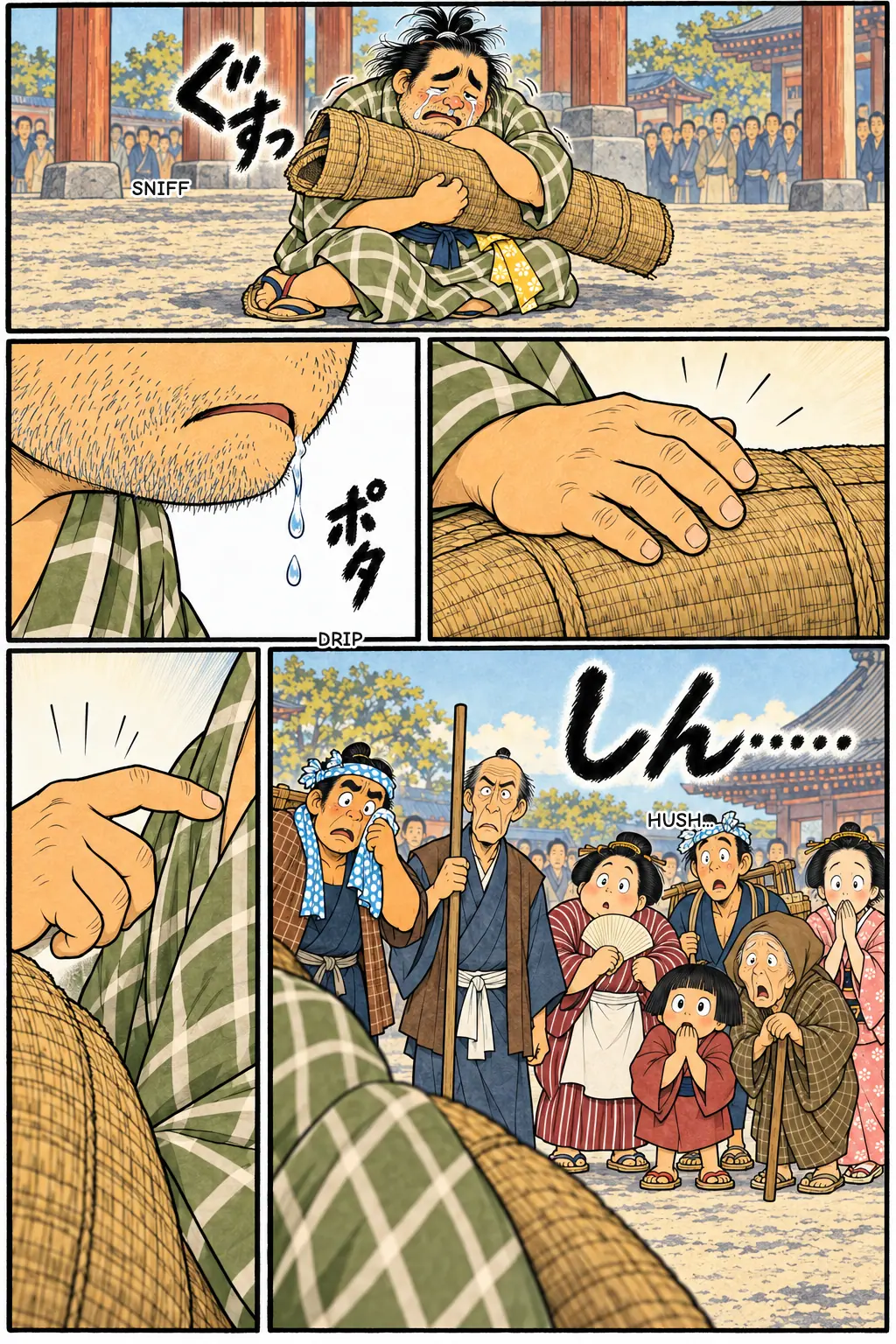
We added a sleepy Kuma, tenement props like a futon, a cooking pot and a cat, and slapstick running and tumbling as Hachi dashes back and forth. We also gave the crowd its comic reactions. We kept the exchange with the caretaker short. The body is never drawn realistically: you see only a shape under a straw mat, a hand, or the faces of the people around it. The storyteller's frame is also our invention, from Fukurai's opening line about how every corner of the world has its scatterbrains to his closing cheek pinch.
The Punchline (Ochi / Sage) Explained
The story ends with Kuma hugging the body and wondering out loud: "The one being held, that's me for sure… but then who's the me doing the holding?"
It's funny because Kuma finally starts to think logically at the worst possible moment. He never questions the big impossible claim that he's dead. He's swallowed that completely, because his hasty friend told him so. Only now, at the very end, does his reasoning kick in, and it lands on a perfectly sensible puzzle that no one in the crowd can answer. Taken to its limit, the scatterbrain's logic turns into a real question: who am I? That's why the story is often said to have a strangely philosophical aftertaste. In our version, Fukurai echoes it at the end by pinching his own cheek and asking who's sitting there.
Where to Read It
You can read Episode 2 of RAKUGO: Japan's Comic Tales, "The Man Who Claimed His Own Corpse," here on Manga Portal. Every episode is free, with no sign-up needed. If you've only read the summary, the manga lets you watch Hachi's unstoppable confidence and Kuma's tearful confusion play out panel by panel. The other episodes cover more classic rakugo stories about Edo's lovable fools.
Characters in this episode
Hachi (Hachigorō)
A hasty tenement dweller who decides a stranger who died in the street is his neighbor Kuma and won't let any fact change his mind.
Kuma (Kumagorō)
Hachi's friend and neighbor, alive and well, who is talked into believing he's dead and goes to claim his own body.
The Caretaker
The sensible man looking after the body at Asakusa, whose reasonable objections get steamrolled.
The Onlookers
The crowd at the Asakusa temple who watch the two friends' mix-up in disbelief.
Shōmontei Fukurai
The series' fictional rakugo storyteller, who opens and closes each episode in our manga.
FAQ
What is Sokotsu Nagaya about?
It's a classic rakugo comic story. A hasty man mistakes a stranger who died in the street for his neighbor Kuma, then convinces the very much alive Kuma to come and claim his own corpse. It ends with Kuma holding the body and wondering who he is.
What does "sokotsu" mean in Japanese?
Sokotsu means careless, rash, or prone to jumping to conclusions. The sokotsu-mono, or scatterbrain, is a favorite stock character in rakugo, and this story pairs two of them.
What is the punchline of Sokotsu Nagaya?
Holding the body, Kuma says, more or less: "The one being held is definitely me, but then who's the one holding me?" The joke is that he never doubts he's dead, yet he reasons very carefully about a puzzle that can't be solved.
What is rakugo?
Rakugo is a traditional Japanese storytelling art that has been performed in variety theaters for a few hundred years. One seated storyteller plays every character using only a fan and a hand towel, and the story usually ends with a punchline called the ochi or sage.
Who wrote Sokotsu Nagaya?
No single author is credited. It's a traditional Edo story passed down by storytellers. Manga Portal checked the plot against a transcript of a performance from the Meiji–Taishō era and wrote its own script.