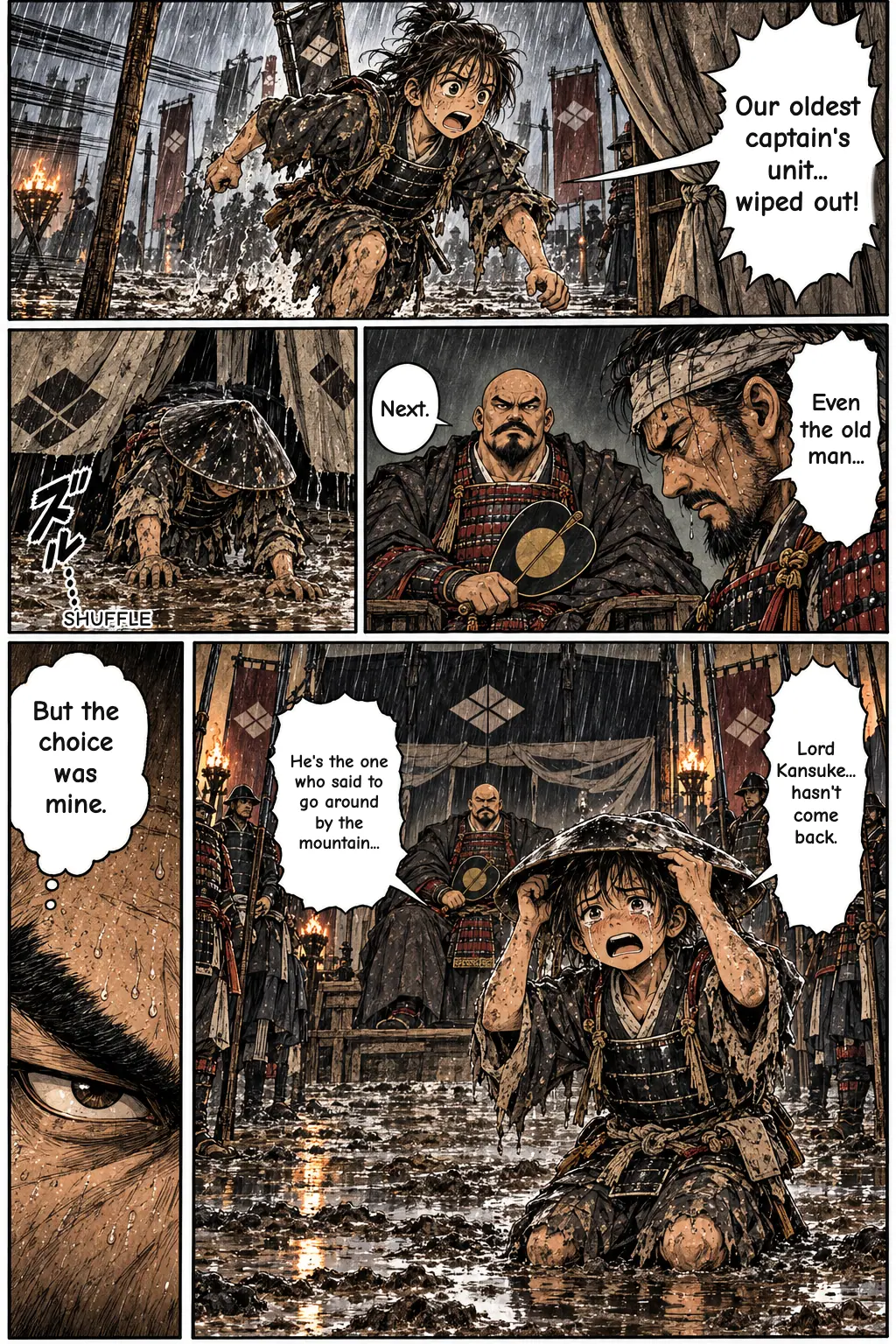
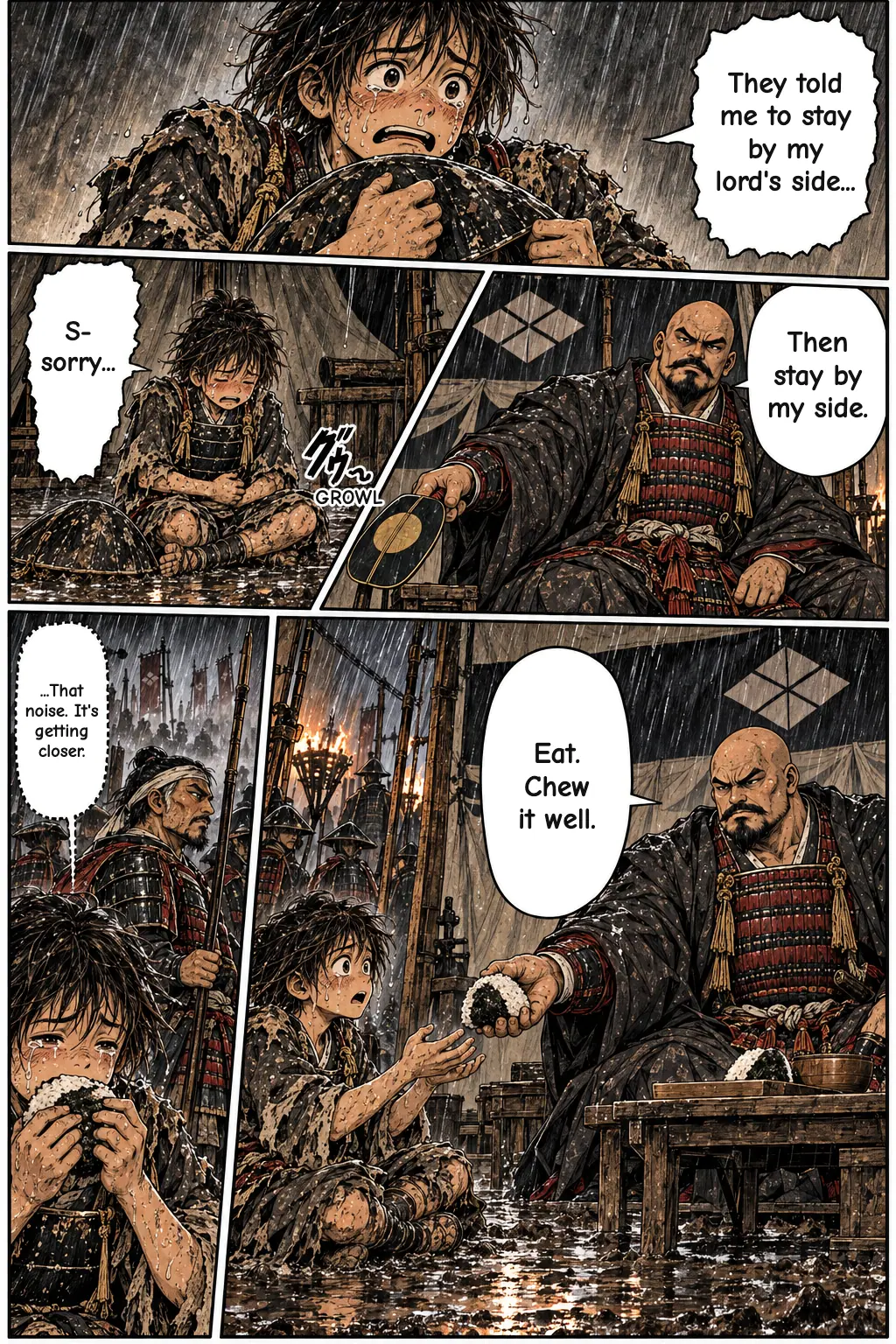
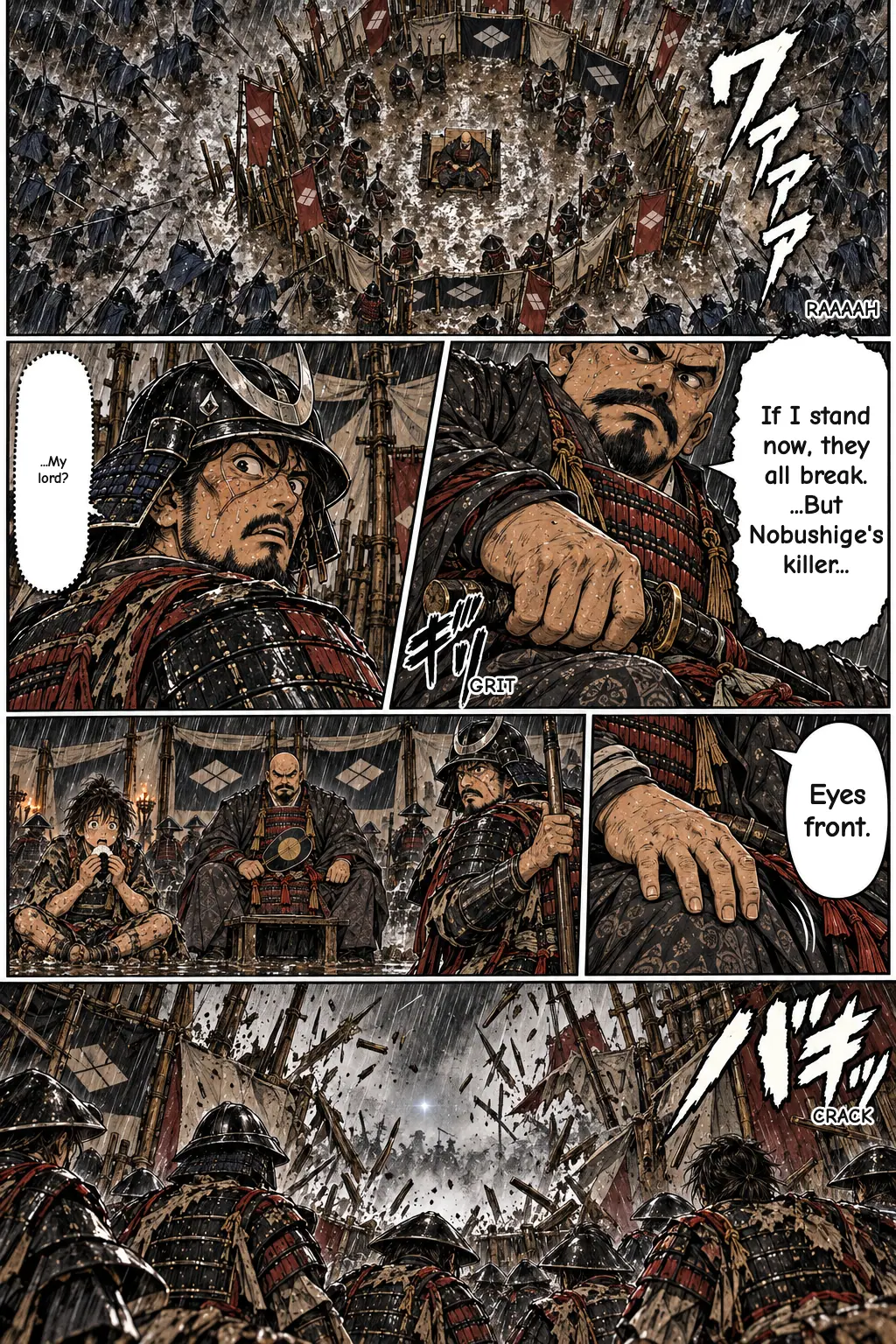
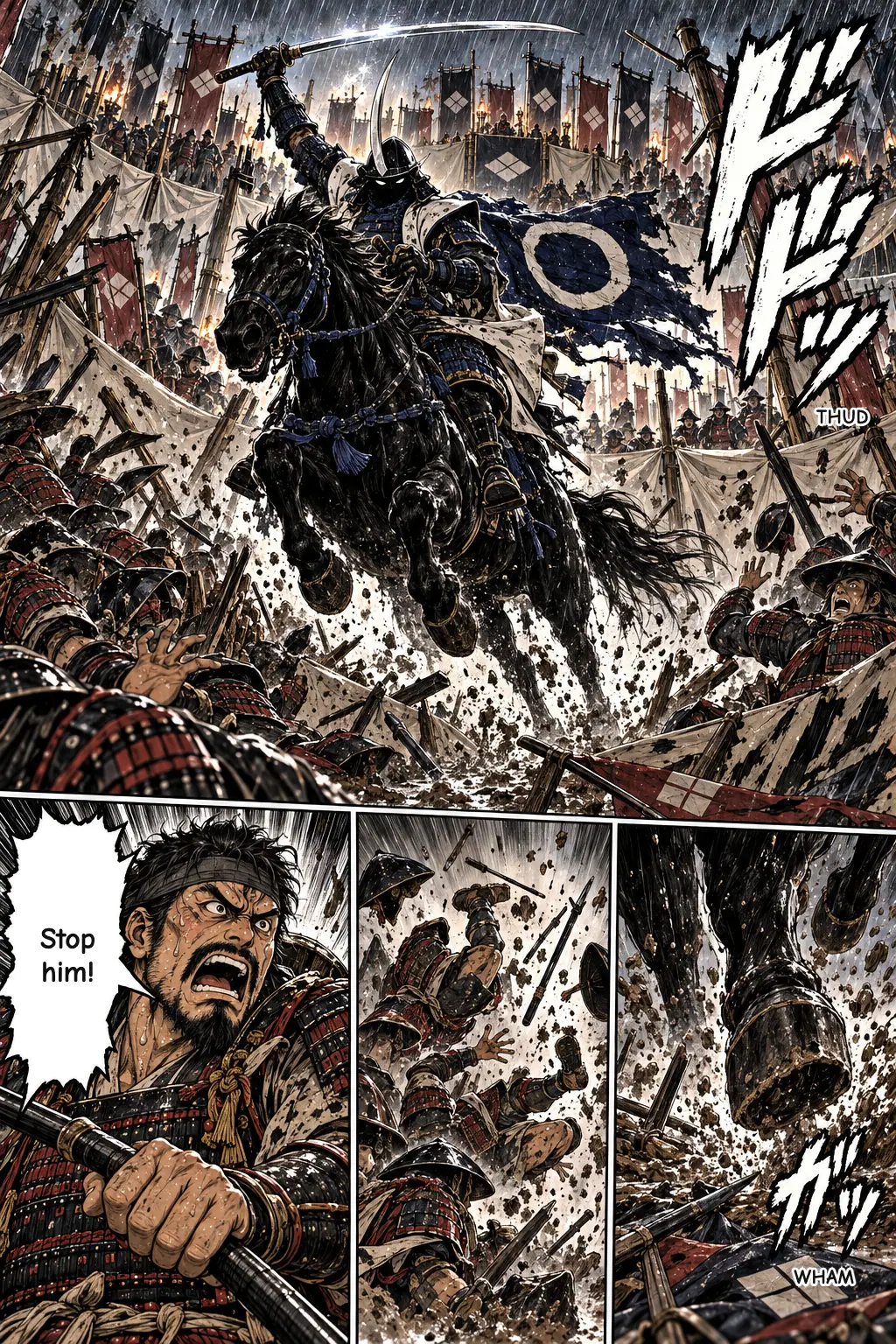
Episode 4Who Was the Rider Who Struck the Warlord?Battle of Kawanakajima (Shingen vs. Kenshin)
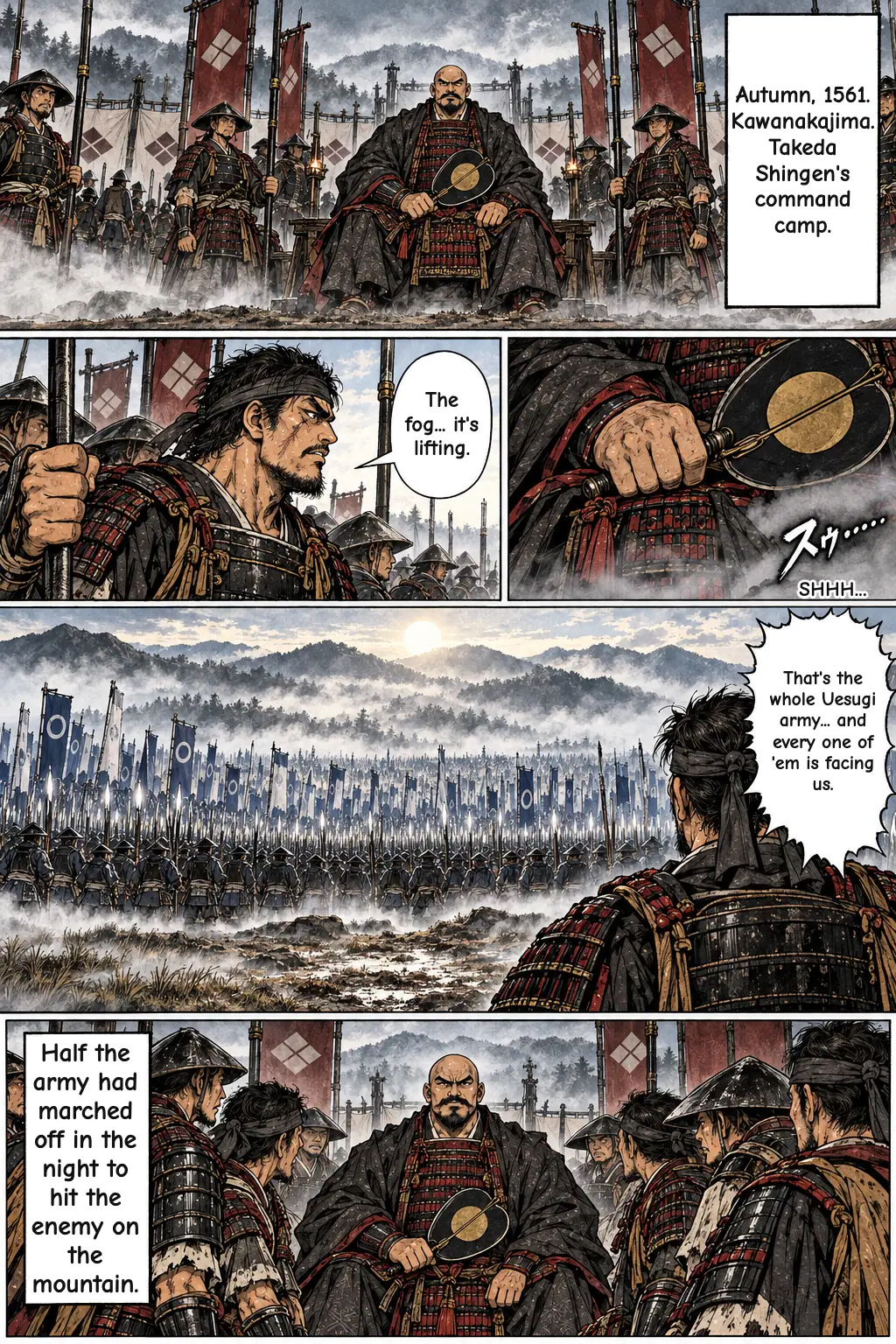
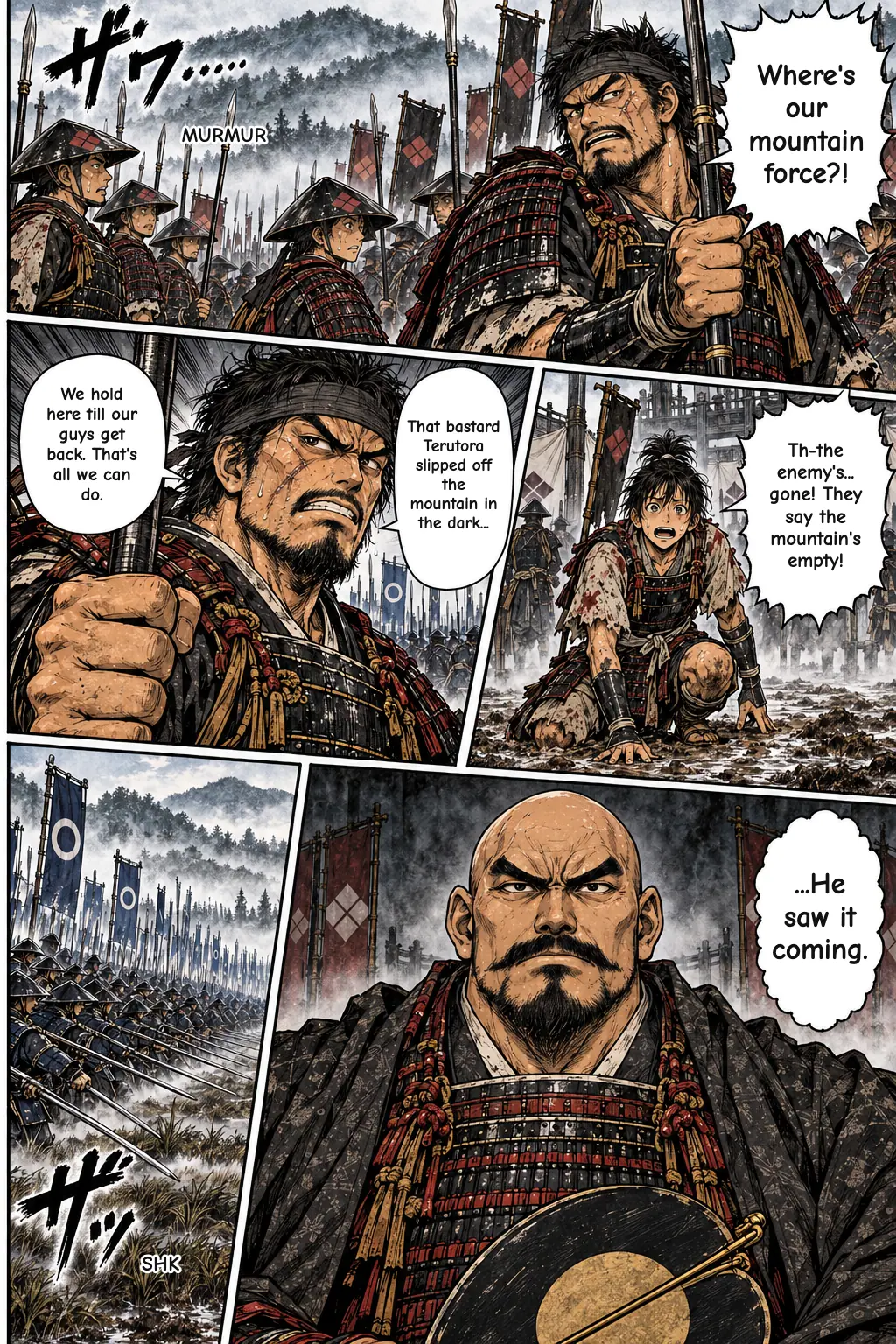
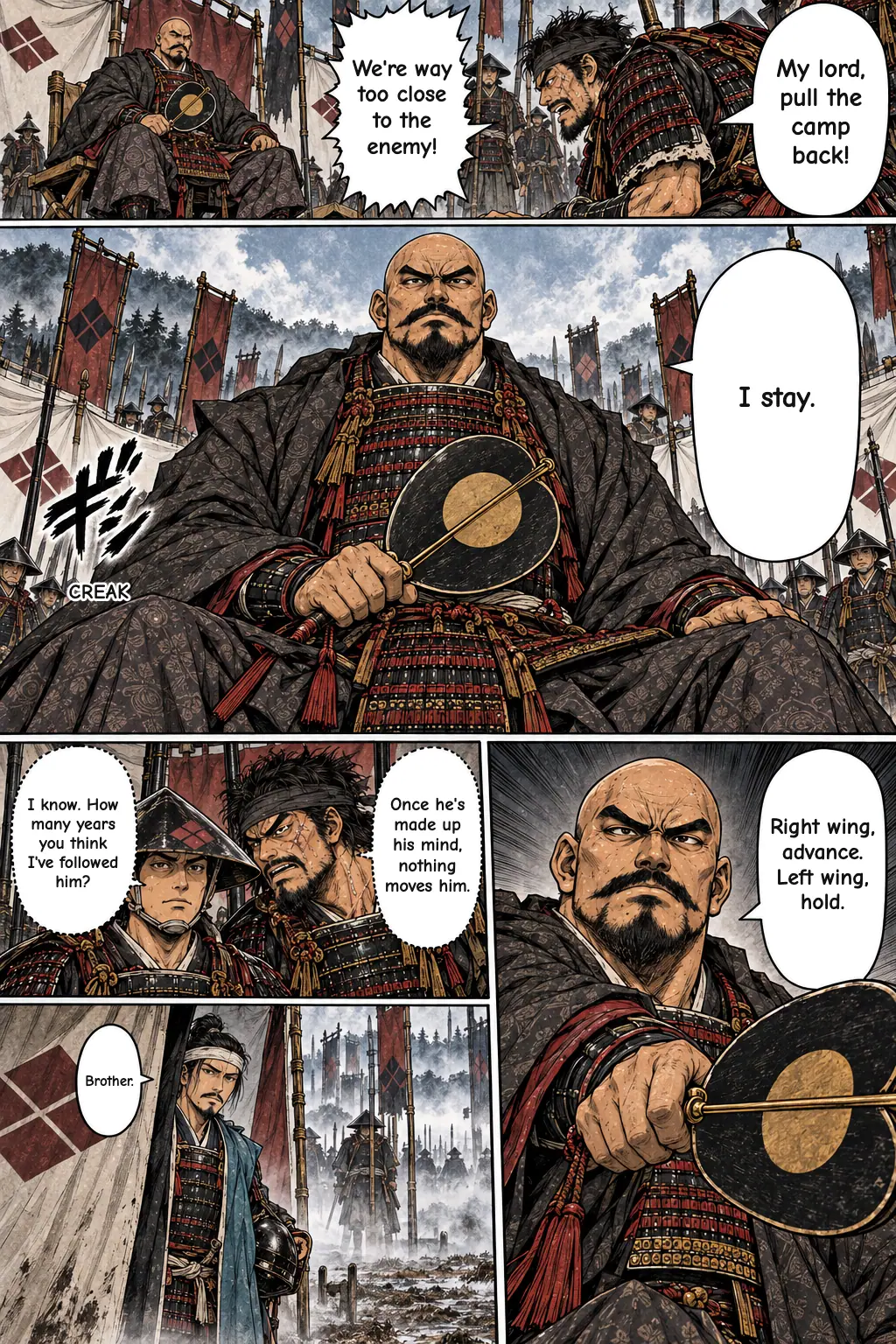
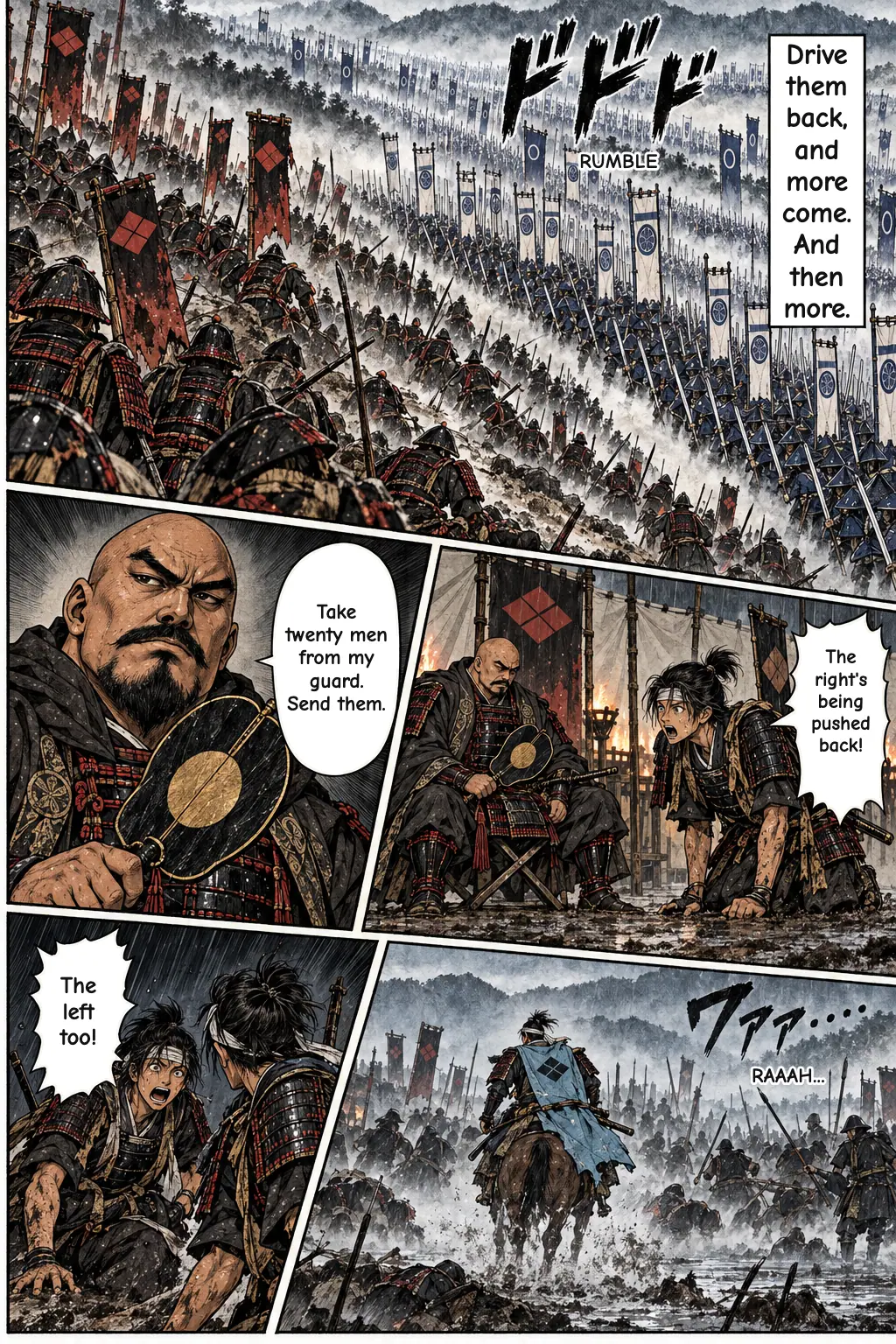
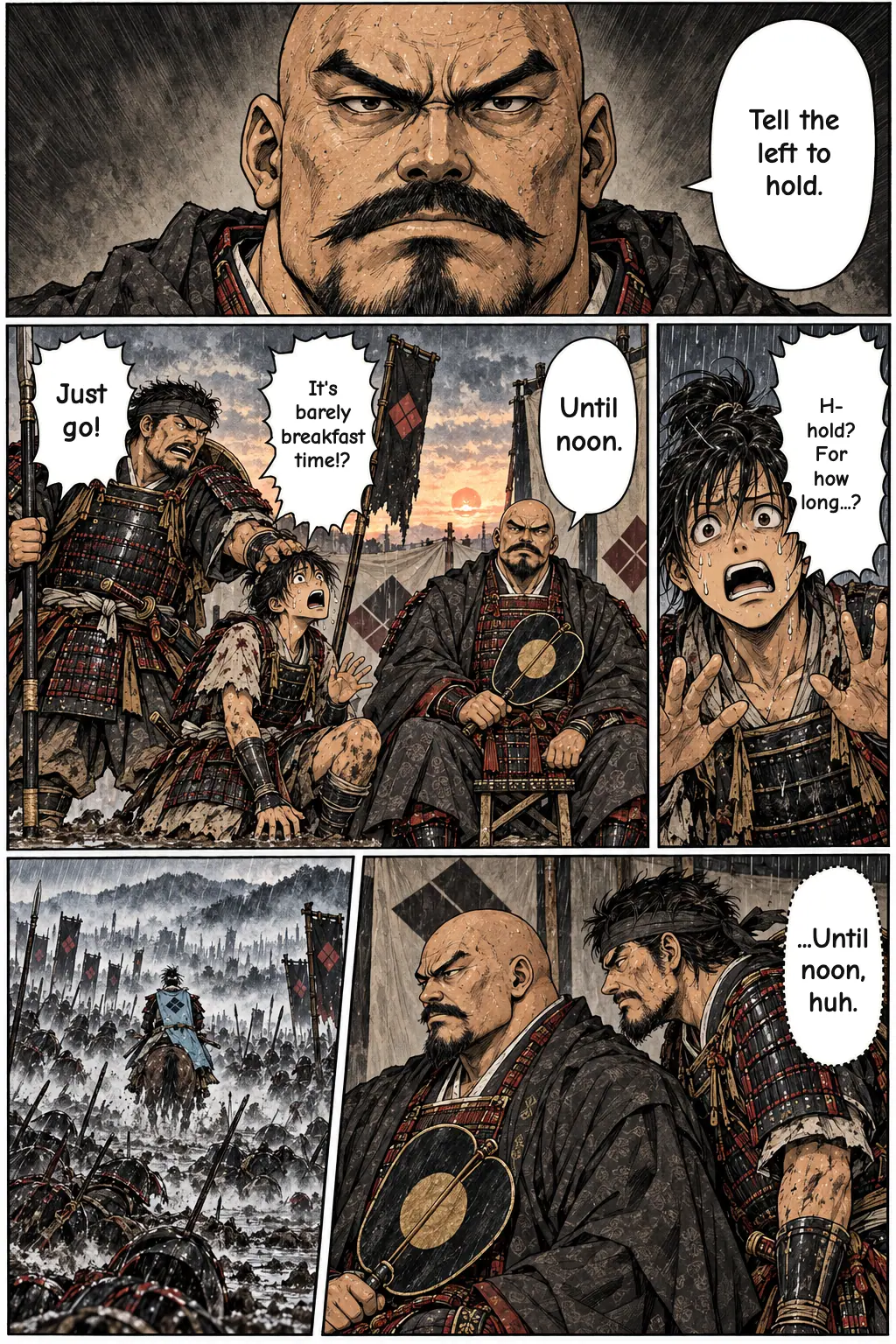
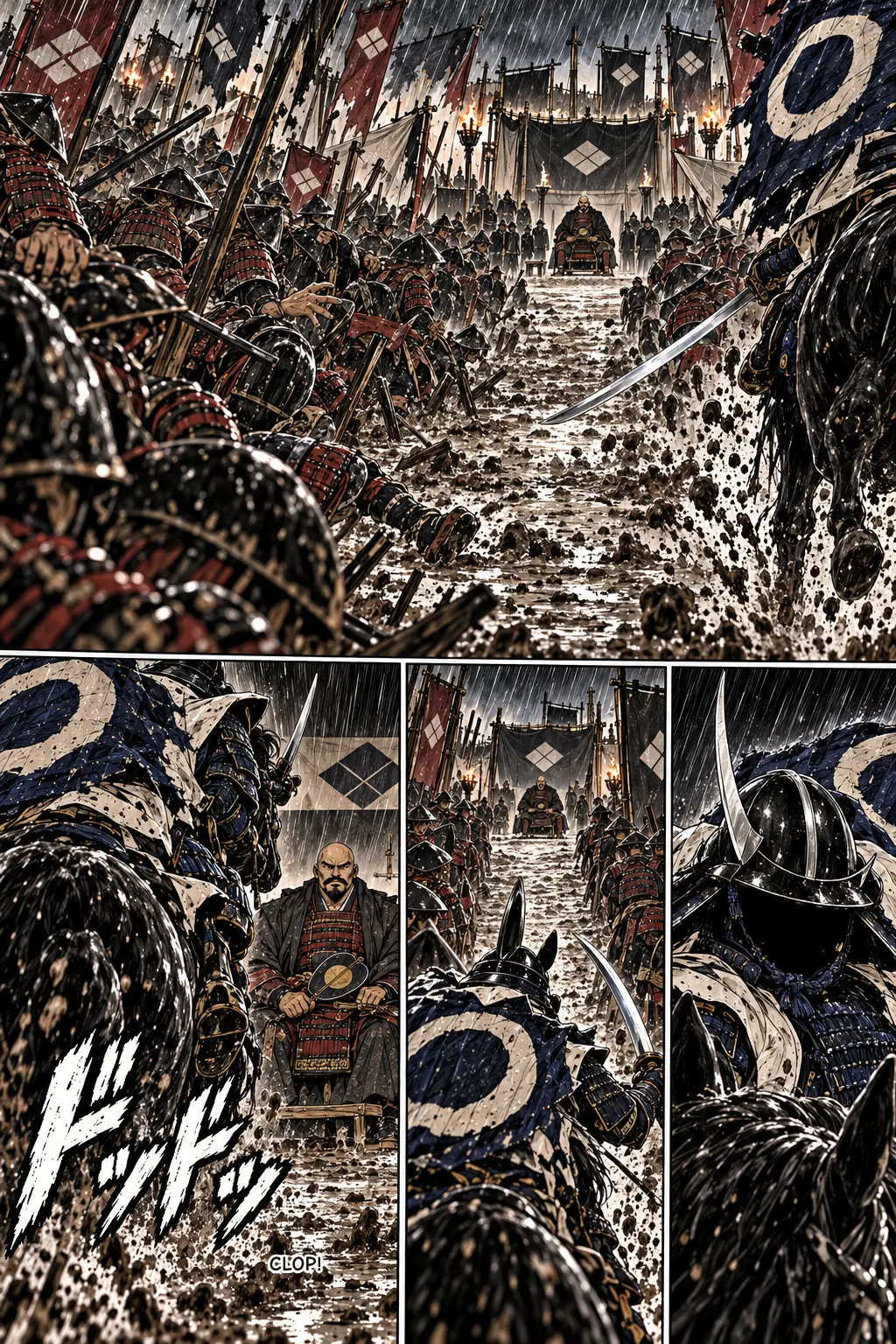
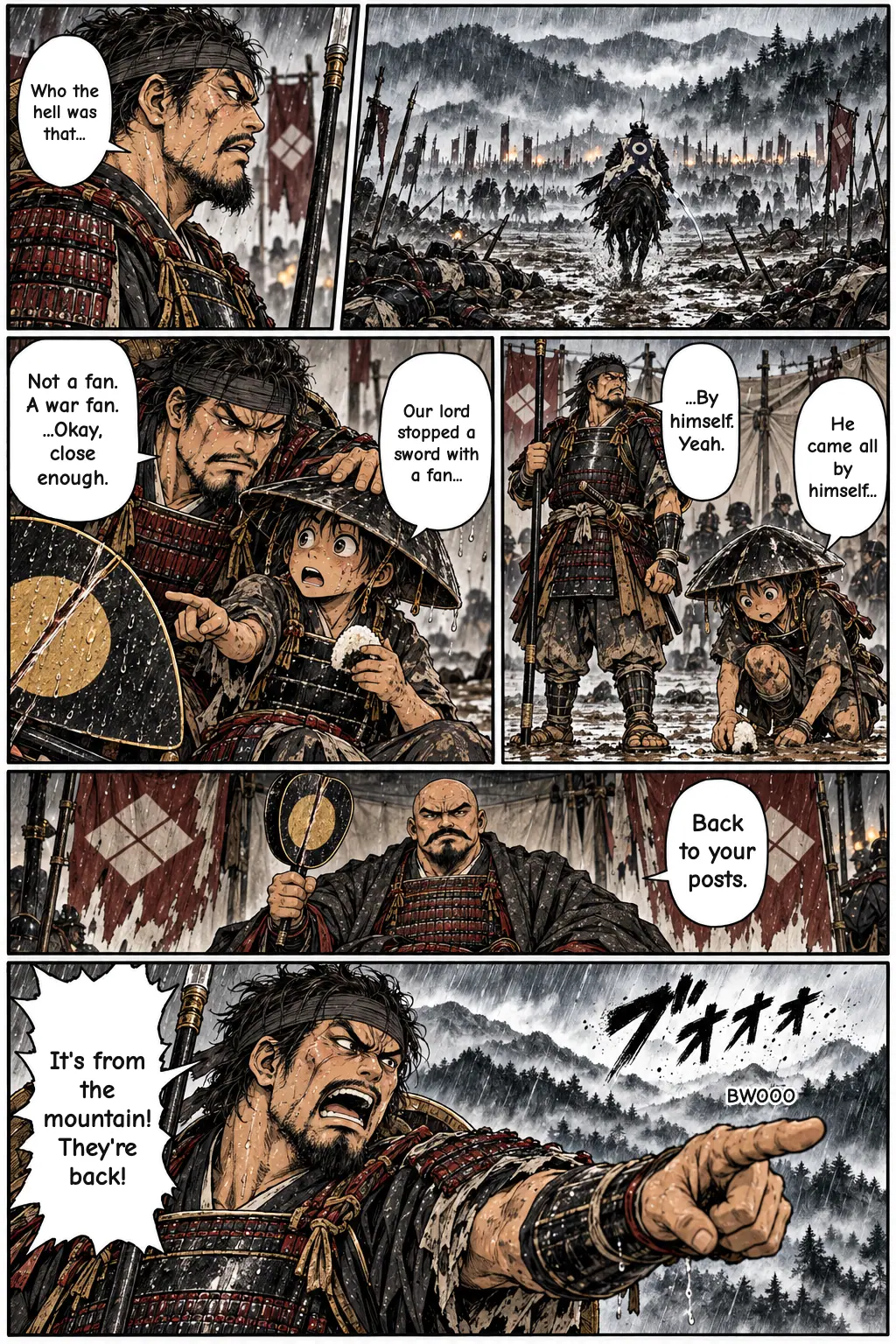
Kawanakajima, autumn 1561. The fog lifts, and the entire Uesugi army is right in front of them. As word comes that Shingen has lost his brother and his strategist, he still won't leave his camp stool. Then a rider who never gives his name charges straight into the command camp.
Bookmark the series page so you can jump back in when the next episode is out: SAMURAIRSS for this series
Get new episodes in your feed. Follow us on:ThreadsBluesky
Story summary
In the autumn of 1561, Uesugi Terutora, better known today as Uesugi Kenshin, the warlord of Echigo, camped his army on Mount Saijo (Saijōsan). The mountain looks over the plain where the Chikuma and Sai rivers meet, in northern Shinano (today's Nagano Prefecture). His rival Takeda Shingen, lord of Kai, moved into nearby Kaizu Castle, and the two armies settled in to face each other. The Takeda took up a plan proposed by Yamamoto Kansuke, Shingen's strategist, and others. A large detached force, including the commander Kōsaka Danjō, would march by night and attack Mount Saijo.
Battle of Kawanakajima 1561 Explained: Shingen vs. Kenshin Story
In short: The Battle of Kawanakajima (1561) was a clash in northern Japan between two warlords, Takeda Shingen and Uesugi Kenshin. Shingen's surprise plan went wrong, and Kenshin's army came out of the morning fog right in front of Shingen's main force. In the Kōyō Gunkan, a Takeda military chronicle, an unnamed rider charges into Shingen's command camp and slashes at him three times. Only afterward did the Takeda hear that the rider was Kenshin himself.
What Happens at Kawanakajima in the Kōyō Gunkan
In the autumn of 1561, Uesugi Terutora, better known today as Uesugi Kenshin, the warlord of Echigo, camped his army on Mount Saijo (Saijōsan). The mountain looks over the plain where the Chikuma and Sai rivers meet, in northern Shinano (today's Nagano Prefecture). His rival Takeda Shingen, lord of Kai, moved into nearby Kaizu Castle, and the two armies settled in to face each other.
The Takeda took up a plan proposed by Yamamoto Kansuke, Shingen's strategist, and others. A large detached force, including the commander Kōsaka Danjō, would march by night and attack Mount Saijo. Meanwhile Shingen's main army would wait on the plain of Hachimanbara. When the Uesugi were driven down the mountain, they would be caught between the two Takeda forces. Traditional accounts give the detached force about 12,000 men and the main army about 8,000. These figures are usually traced to the Gunkan, but they should not be taken as exact.
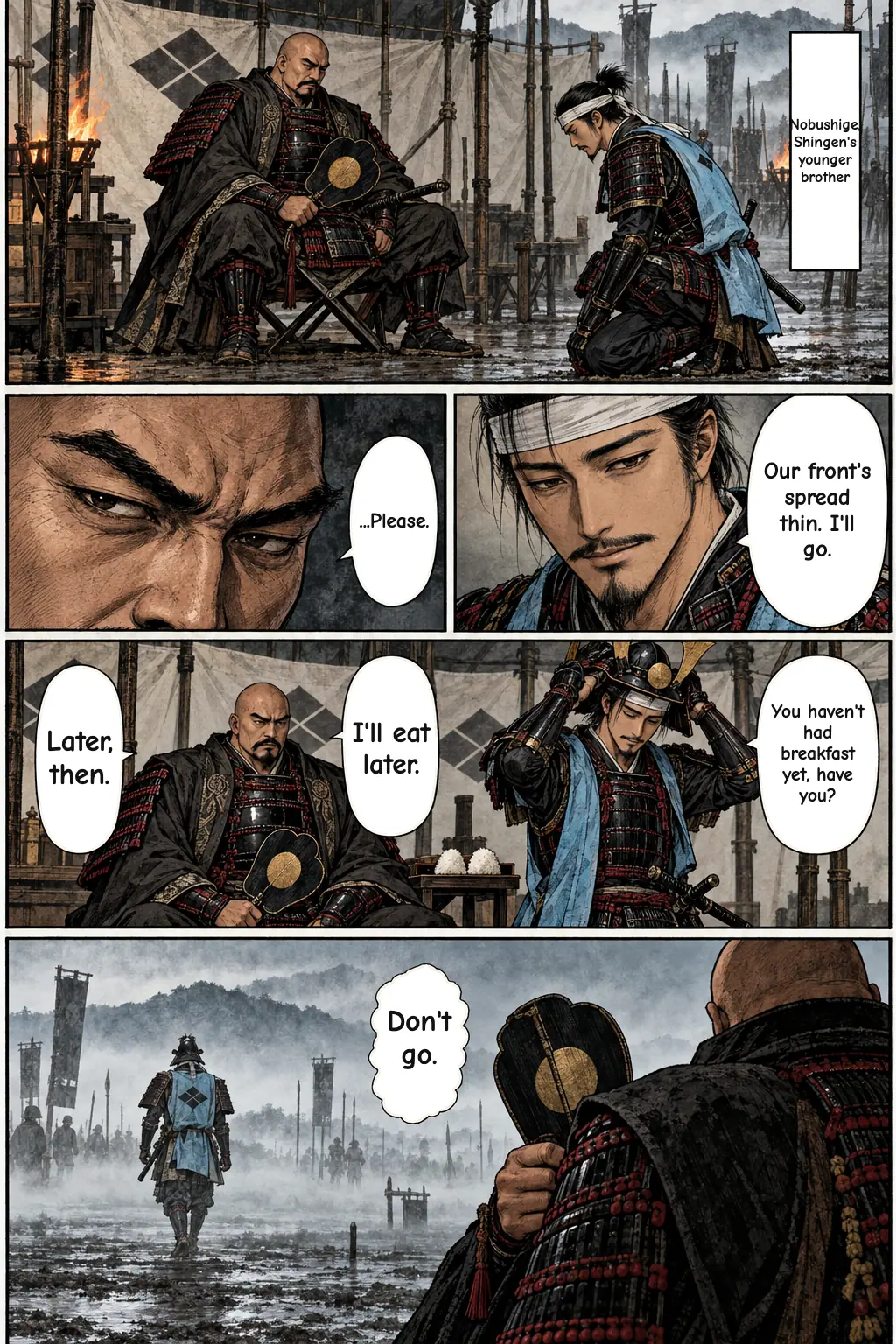
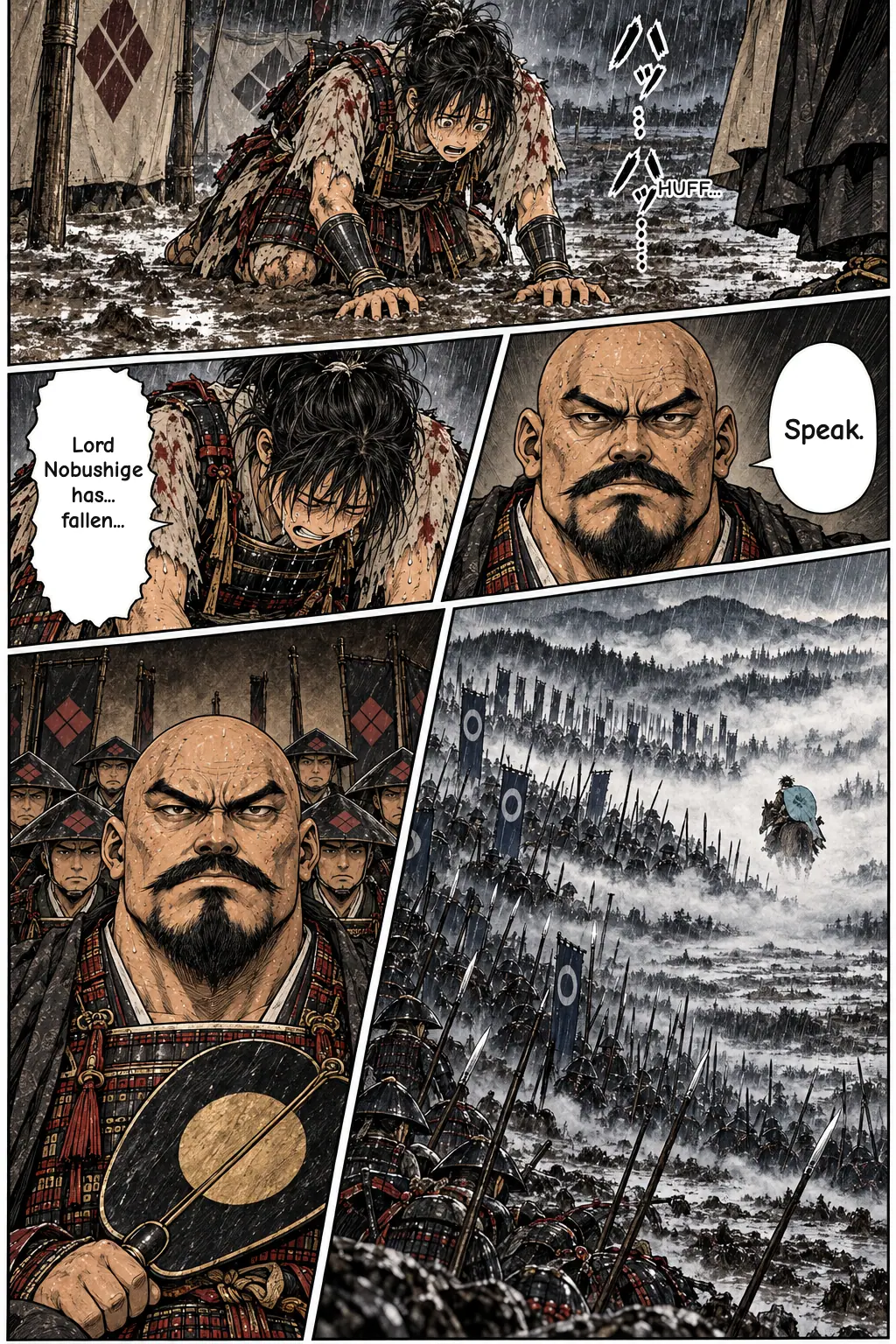
Kenshin didn't wait to be trapped. That night he led his army down the mountain and across the Chikuma River. When the dawn fog lifted, Shingen's main army found the whole Uesugi force right in front of it. The fighting went badly for the Takeda. Shingen's younger brother Takeda Nobushige, the strategist Yamamoto Kansuke, and the veteran retainer Morozumi Bungo were all killed.
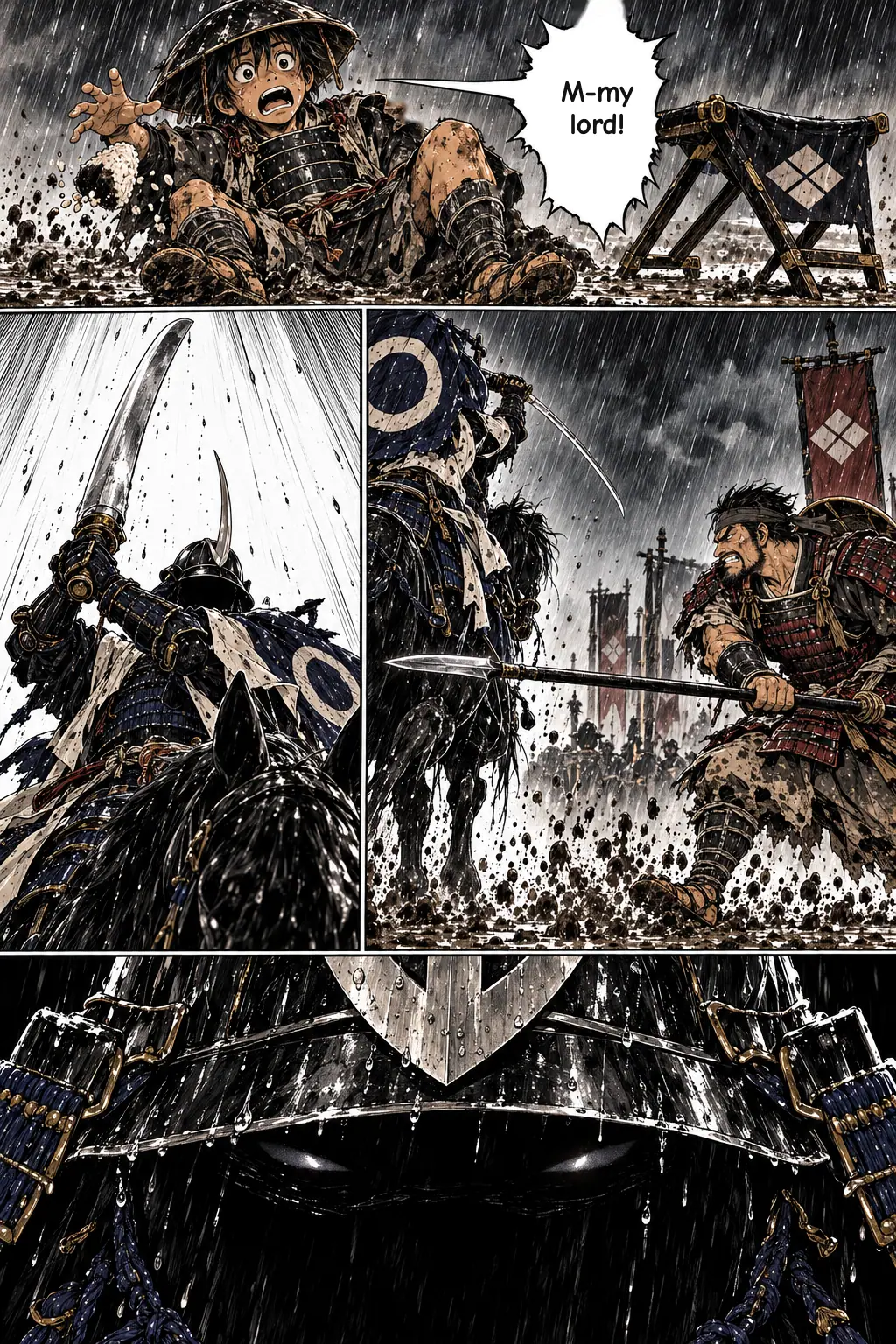
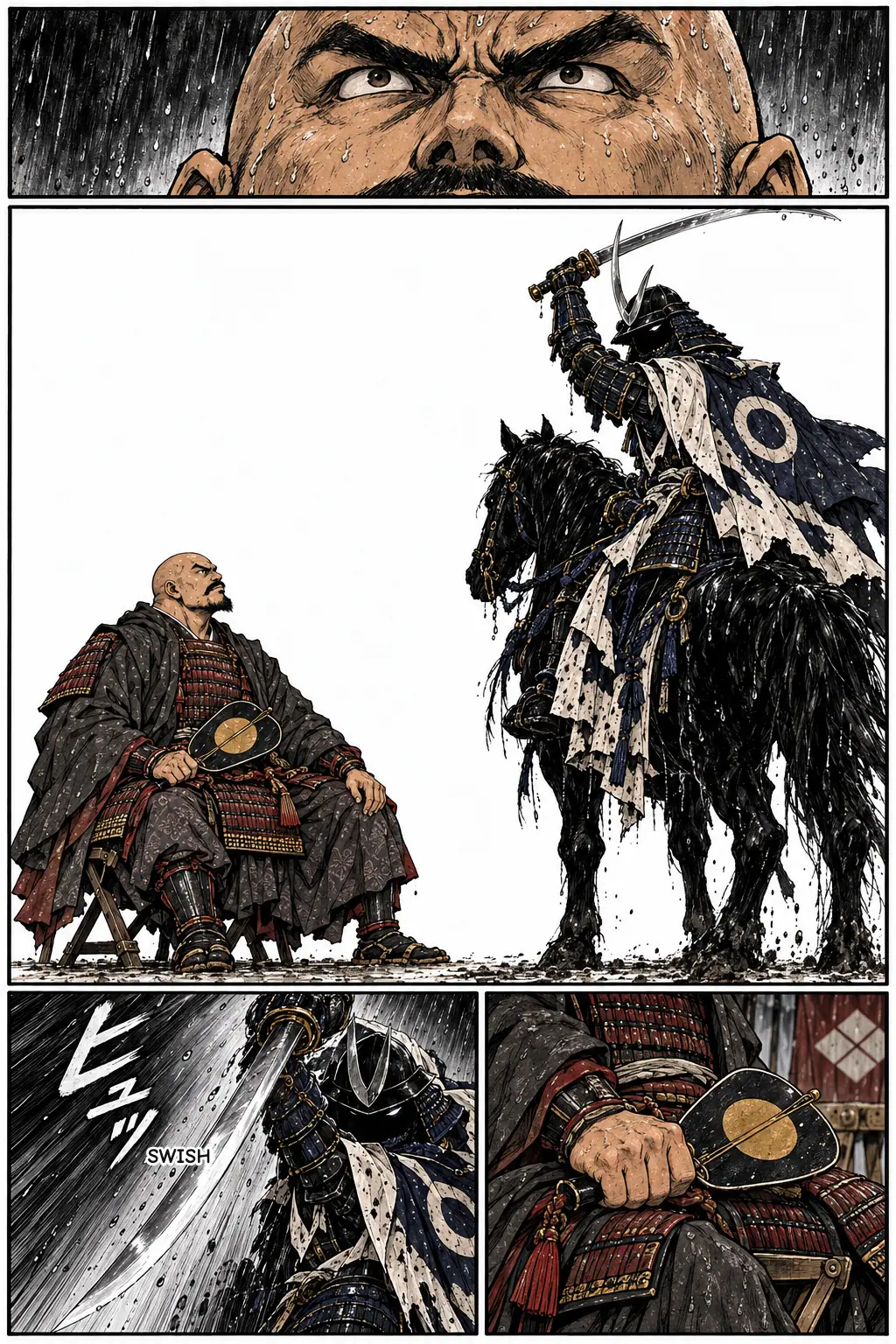
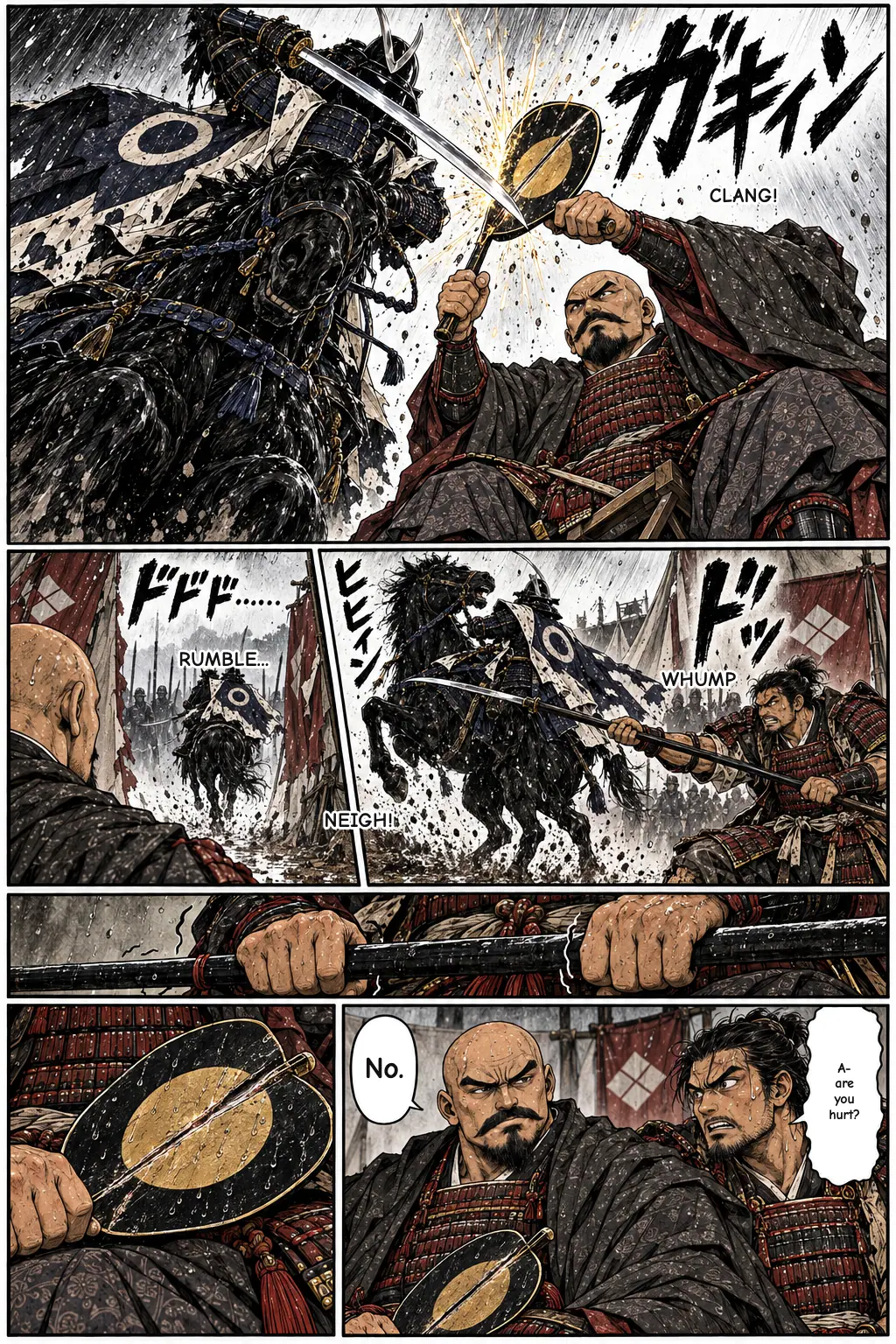
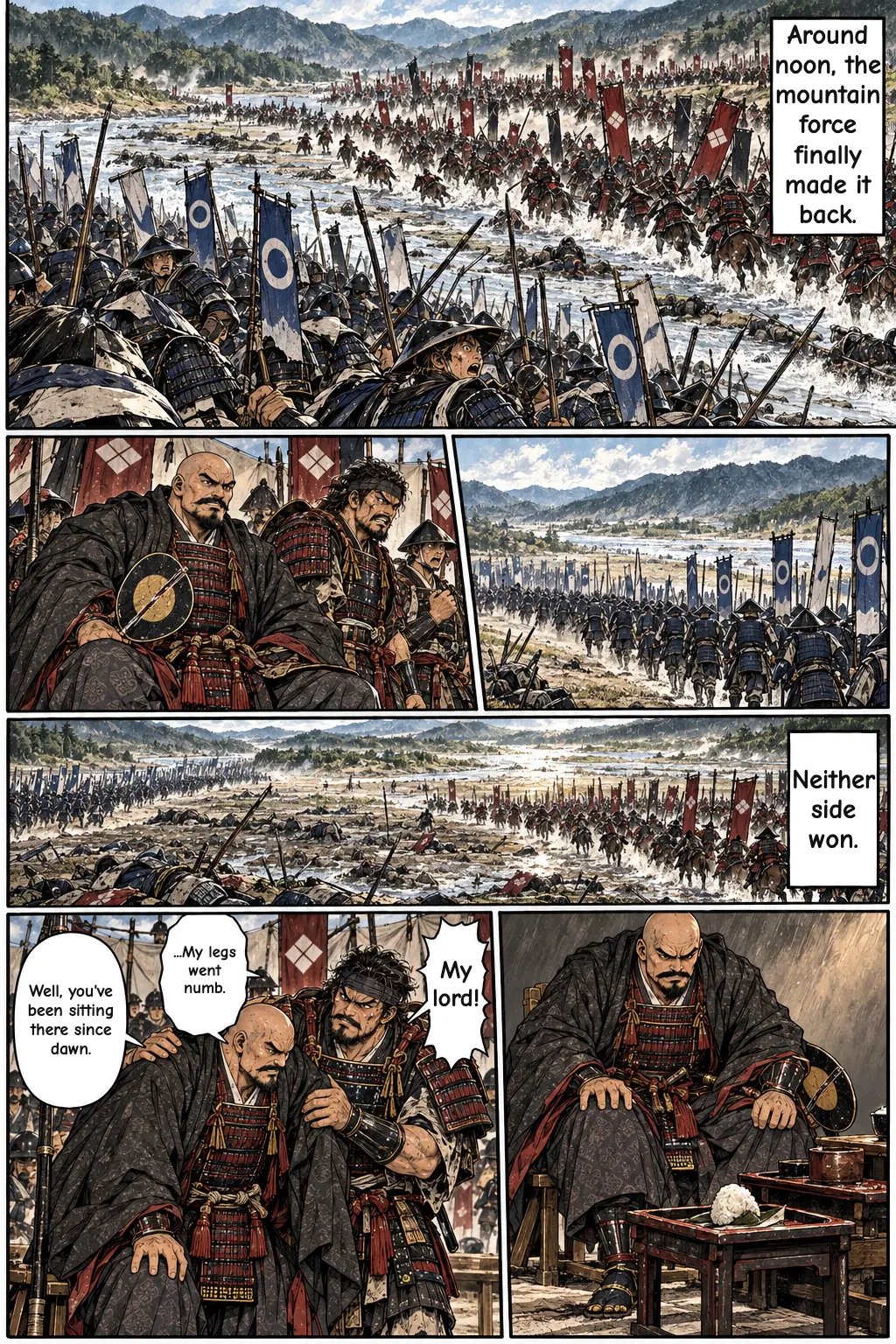
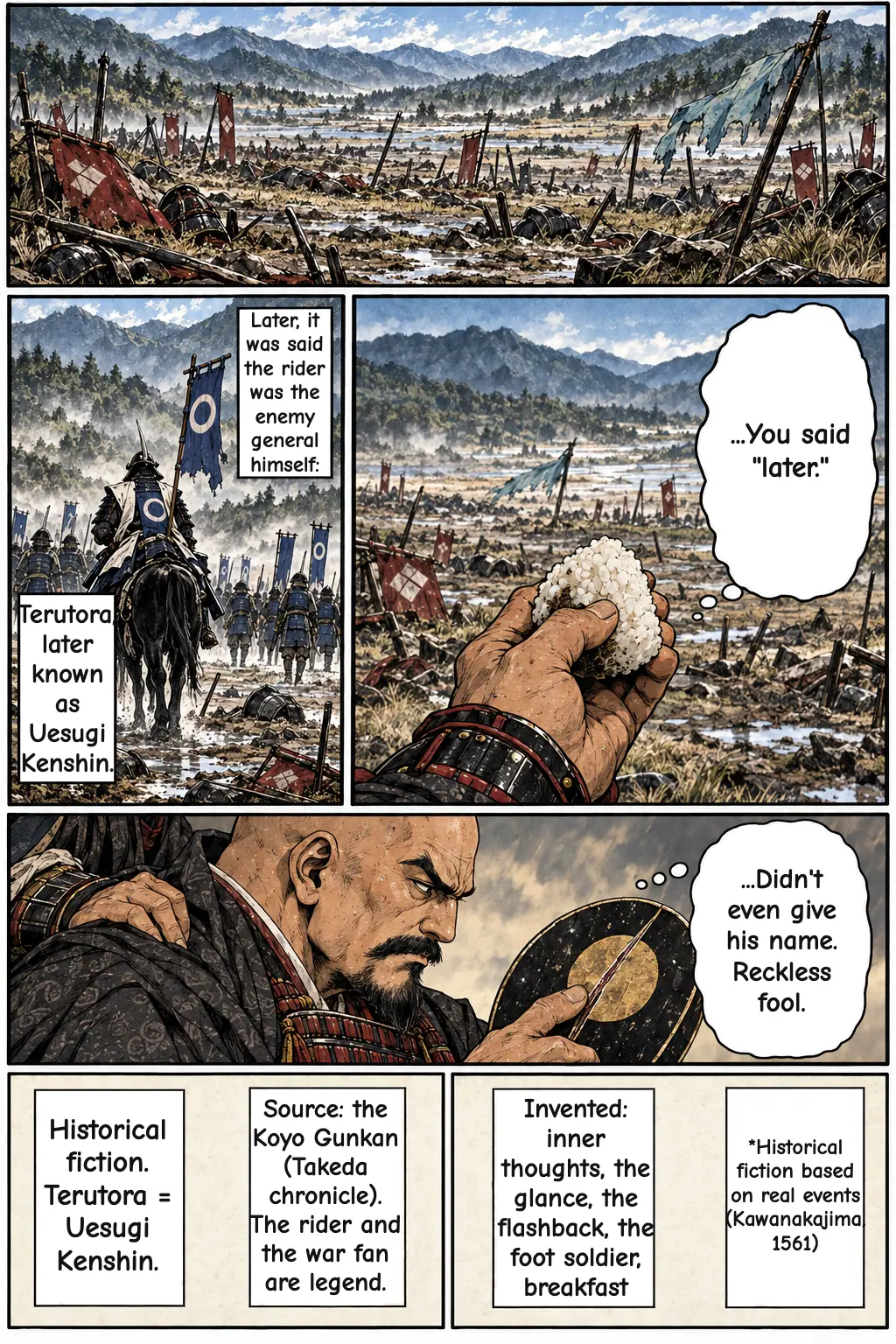
In the chaos, a single horseman rode straight at the camp stool where Shingen sat and struck at him three times with a drawn sword. One of Shingen's guards thrust a spear at him but hit the horse instead. The horse bolted and carried the rider away. Only later, the Gunkan says, did the Takeda hear that the rider was Terutora himself. Then the detached force came back from Mount Saijo and hit the Uesugi from behind, and the Uesugi pulled back toward Zenkōji.
The Two Rivals and Their Long Feud
Shingen and Kenshin fought over northern Shinano for more than a decade. Their clashes at Kawanakajima are usually counted as five, and the 1561 battle is the fourth and by far the bloodiest. Neither man ever fully defeated the other. That stalemate is a big reason the pair became Japan's classic image of two great rivals.
The Gunkan calls Kenshin "Terutora," a name he used later in life. In 1561 his name was actually Masatora, and he took the name Kenshin later still. Many retellings simply call him Kenshin throughout.
Famous Details: Text vs. Later Tradition
Several of the best-known parts of this story are hard to pin down. The Takeda plan is famous as the "woodpecker strategy" (kitsutsuki no senpō): like a woodpecker tapping a tree to scare insects out the other side. That name is a later popular label. The tale that Kenshin guessed the plan by spotting unusual cooking smoke rising from Kaizu Castle is also widely told, but we have not matched its exact wording in the original text.
The Uesugi are often said to have attacked in a "kuruma-gakari" (rotating wheel) formation, sending in fresh units one after another. The name is linked to the Gunkan tradition, but historians disagree about what the formation really was. Some retellings say Kansuke rode into the enemy on purpose because he blamed himself for the failed plan. That is a later emotional reading, not something we can confirm.
The most famous image is Shingen rising from his stool and blocking the sword with his iron war fan (gunbai). Later the fan supposedly had eight cuts in it. This scene is often credited to the Kōyō Gunkan, but we have not yet confirmed it in the edition our manga follows. The same goes for the rider's clothes (a light-green surcoat, a white cloth wrapped around his head, a pale dun horse) and for the guard's name, often given as Hara Ōsumi. These details appear in commonly circulated versions, but they still need checking. The Gunkan is often summarized as saying the Uesugi won the morning and the Takeda won the afternoon. In other words, it was close to a draw.
What the Story Tells Us About Its Time
The Kōyō Gunkan is a chronicle of the Takeda clan and its way of war. It comes down to us under the name of Kōsaka Masanobu (Kōsaka Danjō), a senior Takeda commander. It is said to have been put into its final form by Obata Kagenori, a military scholar of the early Edo period. It was written partly to teach and to honor the Takeda, so historians handle its details with care. Still, it shaped how later Japan pictured the Warring States period (Sengoku, roughly 1467–1600).
Notice how the duel is told: as hearsay, not as a heroic boast. The rider never gives his name, and the Takeda learn who he was only afterward. That uncertainty is part of why the scene has lasted for centuries. It is a story about a leader who survives the worst morning of his life, and about losses (a brother, a strategist, an old retainer) that no final verdict can make up for.
What the Manga Changed
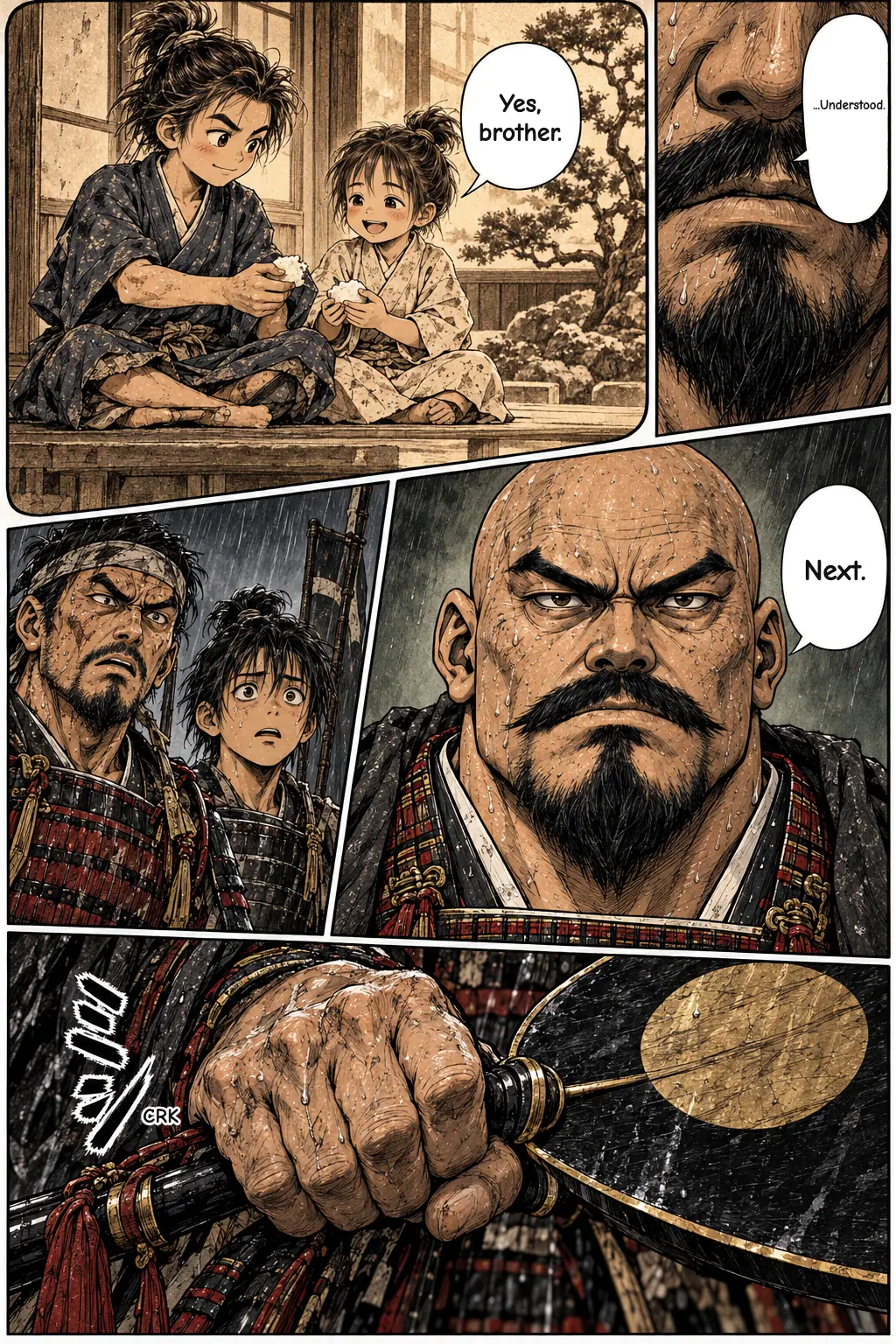
Our episode follows the events and the dead as the Gunkan records them, seen from Shingen's command camp from morning to early afternoon. Some things are our own additions. These include Shingen's inner voice and his face as each report arrives, and the moment the rider and Shingen lock eyes. The fog, sounds, and morning light, the messengers' words and the order of their reports, and the reactions of nameless guards are dramatized too.
The original says very little about Shingen's feelings, so showing him calmly refusing to leave his camp stool is our interpretation. The ending, where Shingen thinks about the rider who rode away without a name, is invented; the source has nothing like it. When the manga stages a big sword-against-war-fan clash, it does so as historical fiction based on the account, not as confirmed fact.
Where to Read It
If you want to watch the fog lift over Hachimanbara and see the lone rider break through the guards, read Episode 4 of SAMURAI: Legends of the Warring States right here on Manga Portal. Every episode is free, with no sign-up needed, so you can start from the beginning or jump straight into Kawanakajima.
Characters in this episode
Takeda Shingen (Harunobu)
Lord of Kai and commander of the Takeda army, who led from his camp stool at Hachimanbara and survived a sword attack in his own command camp.
Uesugi Kenshin (Terutora)
Warlord of Echigo who slipped down Mount Saijo by night and surprised the Takeda main army; the Gunkan says he was later identified as the lone rider.
The Unnamed Rider
A horseman who broke through Shingen's guards, struck at him three times, and rode off without ever giving his name.
Takeda Nobushige (Tenkyū)
Shingen's younger brother, praised in the Gunkan as a fine commander, who was killed in the battle.
Yamamoto Kansuke
Takeda strategist who proposed the night attack plan and died at Kawanakajima when it went wrong.
Kōsaka Danjō (Masanobu)
Takeda commander in the detached force that returned to hit the Uesugi from behind, and the man the Kōyō Gunkan is traditionally attributed to.
FAQ
Did Uesugi Kenshin really fight Takeda Shingen one-on-one?
The Kōyō Gunkan says a lone rider slashed at Shingen in his camp, and that the Takeda later heard it was Kenshin (Terutora). The source tells this as hearsay, and historians can't confirm it. So it's best understood as a famous tradition, not a proven fact.
Who won the Battle of Kawanakajima in 1561?
Neither side won outright. The Uesugi had the upper hand in the morning. Once the Takeda detached force returned, the Uesugi withdrew. The Gunkan is often summarized as calling it an Uesugi win in the first half and a Takeda win in the second.
What is the woodpecker strategy at Kawanakajima?
It is the popular name for the Takeda plan: a night attack on Mount Saijo would drive the Uesugi down onto Shingen's waiting main army. The name, comparing it to a woodpecker scaring insects out of a tree, came later. Kenshin avoided the trap by leaving the mountain during the night.
What is the Kōyō Gunkan?
It is a chronicle of the Takeda clan and its military teachings. It is traditionally linked to the Takeda commander Kōsaka Masanobu and was compiled by Obata Kagenori in the early Edo period. It is a key source for the Kawanakajima story, though historians read its details with caution.
Why did Yamamoto Kansuke die at Kawanakajima?
His night attack plan failed when Kenshin moved first, and he was killed in the fighting that followed. A popular version says he charged into the enemy because he blamed himself, but that is a later dramatic reading.