Episode 6The Army That Lost to a Flock of BirdsBattle of Fujigawa / Death of Kiyomori
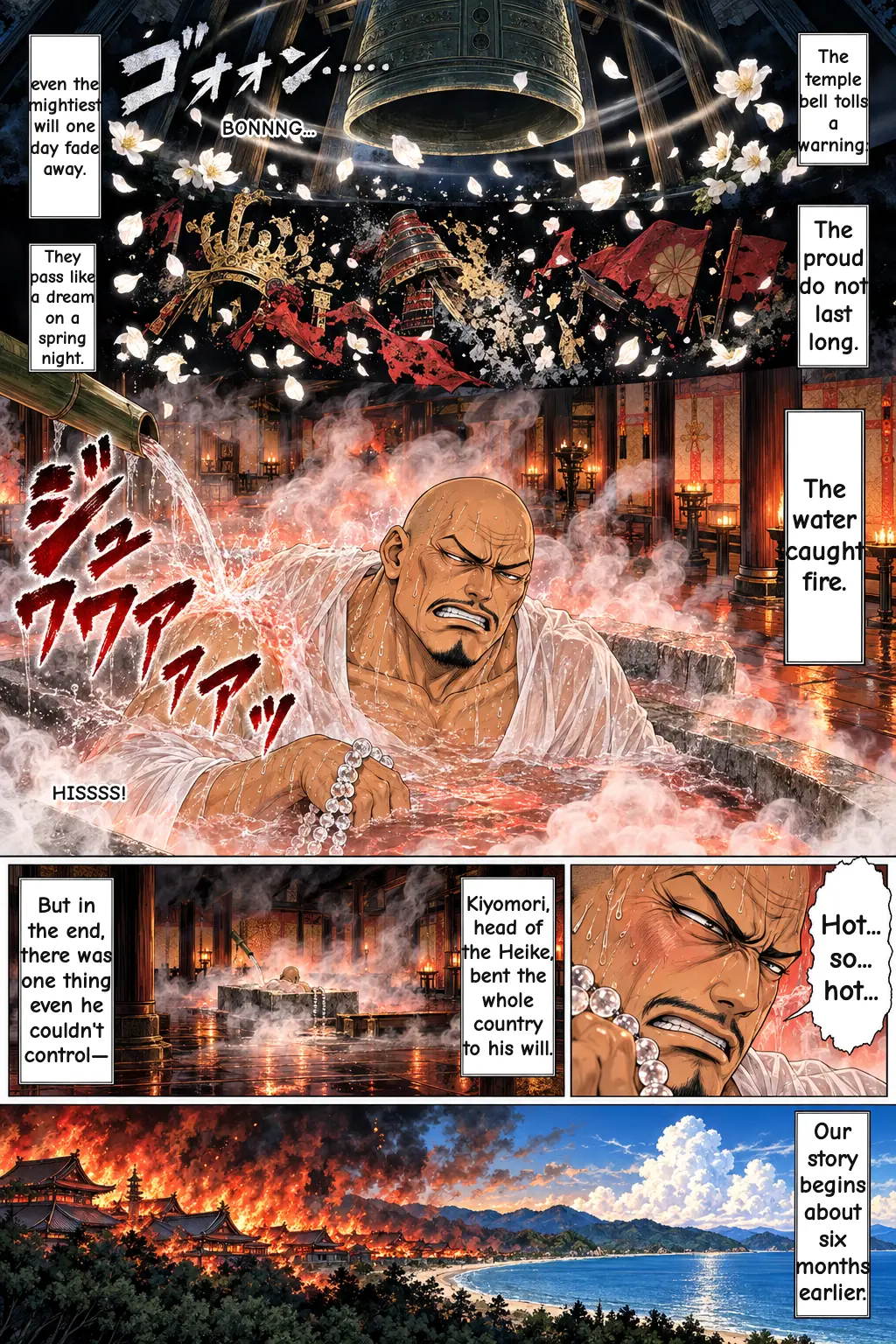
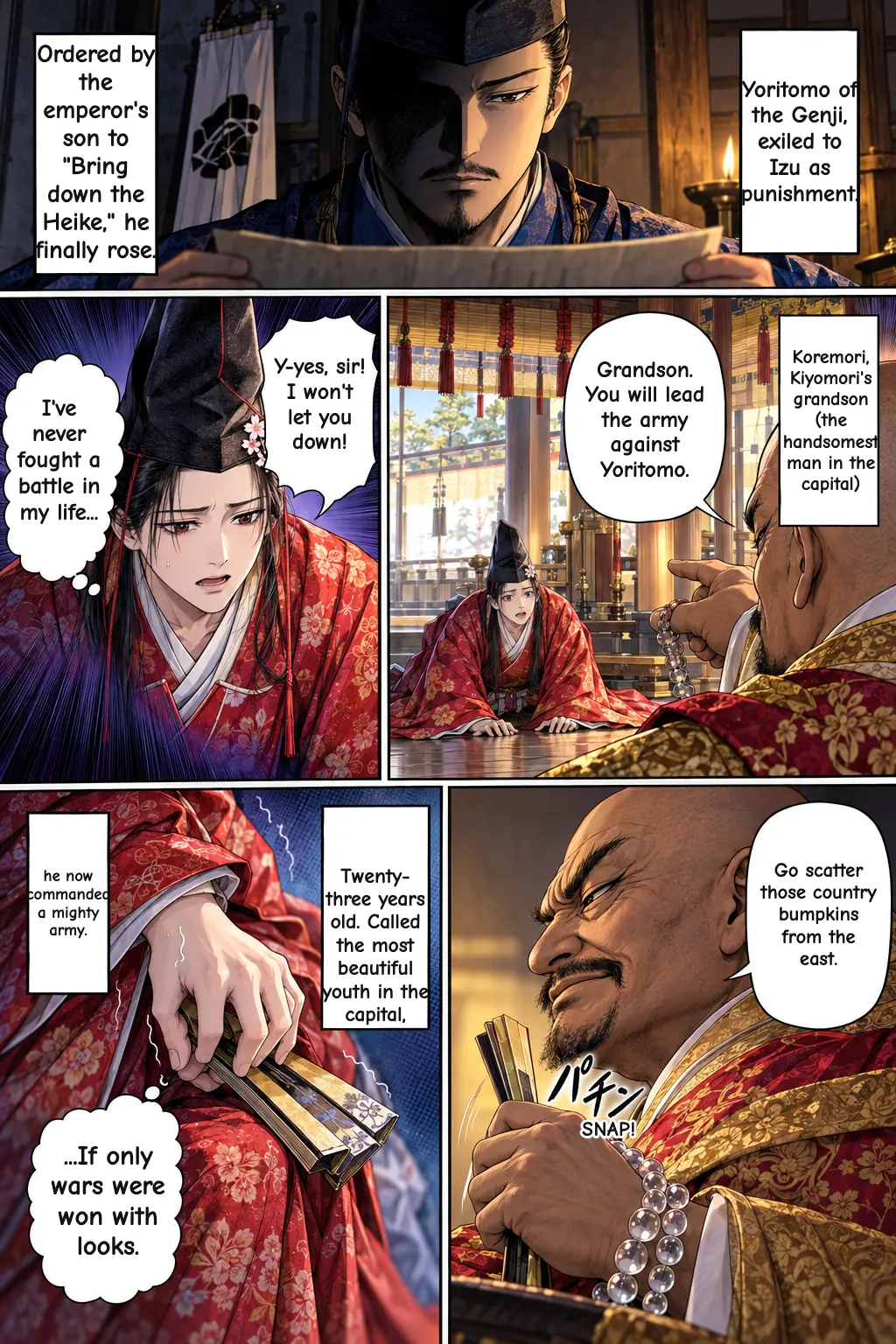
Having moved the capital to Fukuhara, Taira no Kiyomori hands a vast army to his grandson Taira no Koremori to crush Minamoto no Yoritomo's uprising. But the Heike troops, already shaken by the old warrior Saitō no Sanemori's tales of eastern fighters, flee without a fight when a flock of waterfowl takes off in the night. The year after Nara's Great Buddha Hall burns, Kiyomori, a tyrant who still had a soft spot for his own family, is seized by a fever like fire. His last command: "Hang Yoritomo's head before my grave."
Battle of Fujigawa & Kiyomori's Death | Tale of the Heike Explained
Background: A Capital Moved on One Man's Will
The Tale of the Heike (Heike Monogatari) is a medieval Japanese war epic about the rise and fall of the Taira clan, also called the Heike, during the Genpei War of the 1180s. It was performed aloud by blind reciters who played the biwa, a Japanese lute. The text most people read today, the Kakuichi version, is the one this episode follows. Episode 6 draws on Book 5 (the capital move and the Battle of Fujigawa, plus the chapters around them) and the chapter on Kiyomori's death in Book 6.
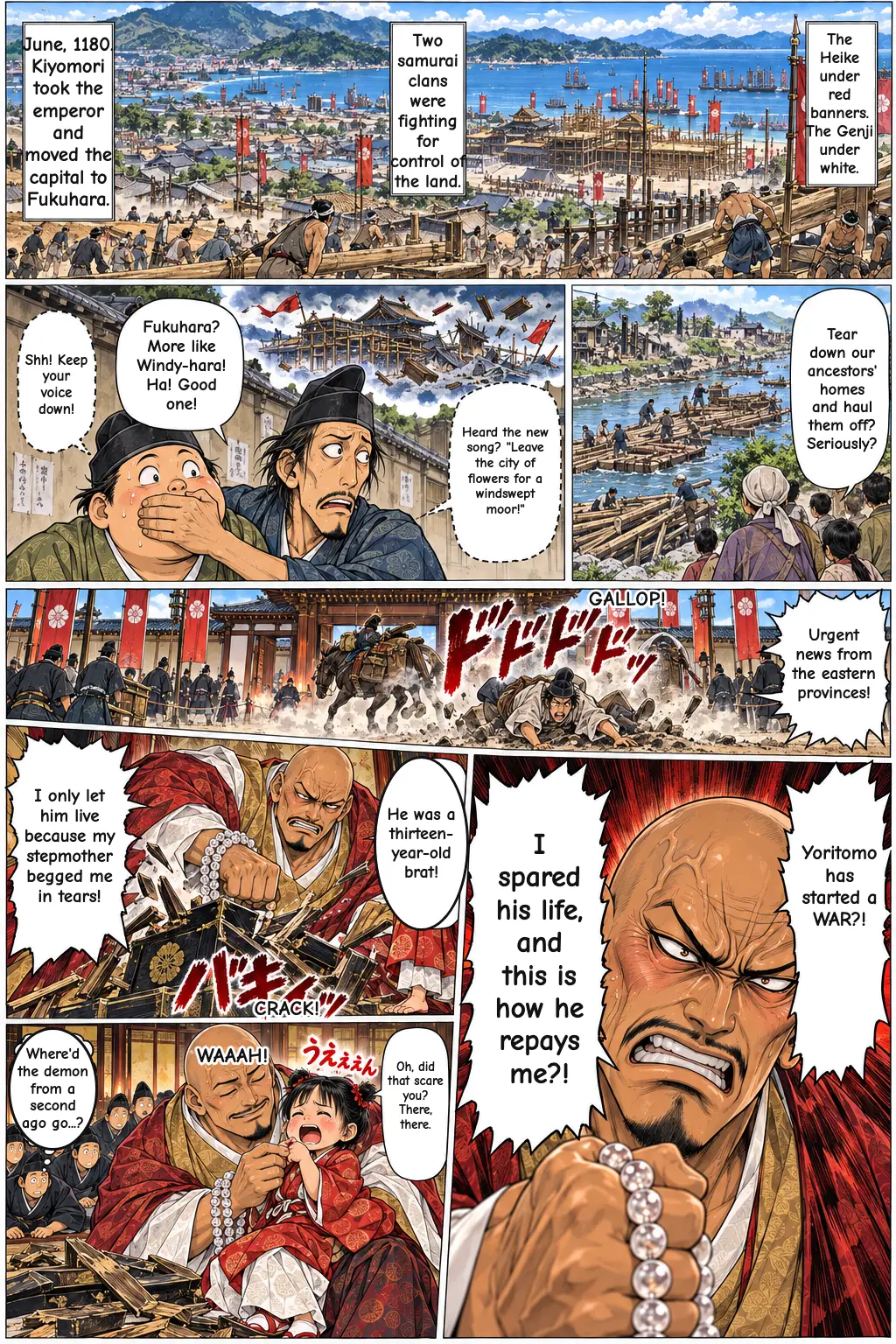
In the sixth month of 1180, Taira no Kiyomori, the head of the clan, a former chancellor who had taken Buddhist vows, suddenly moves the capital from Heian-kyō (today's Kyoto) to Fukuhara, near modern Kobe. Nearly everyone objects, but he takes the child emperor Antoku and the retired emperors Go-Shirakawa and Takakura with him anyway. The narrator recalls how Emperor Kanmu founded Heian-kyō as an ideal capital centuries earlier, and says that abandoning it makes no sense. Houses in the old city are pulled down and floated away by river, the cramped new site never quite gets built, and people pass around anonymous poems mocking the move.
In the ninth month, a messenger on horseback arrives with alarming news. Minamoto no Yoritomo, an exile in Izu whose life Kiyomori had spared after an earlier uprising, the Heiji Disturbance, has raised an army. Kiyomori is furious that Yoritomo has repaid that mercy with rebellion.
The Battle of Fujigawa: An Army Beaten by Birds
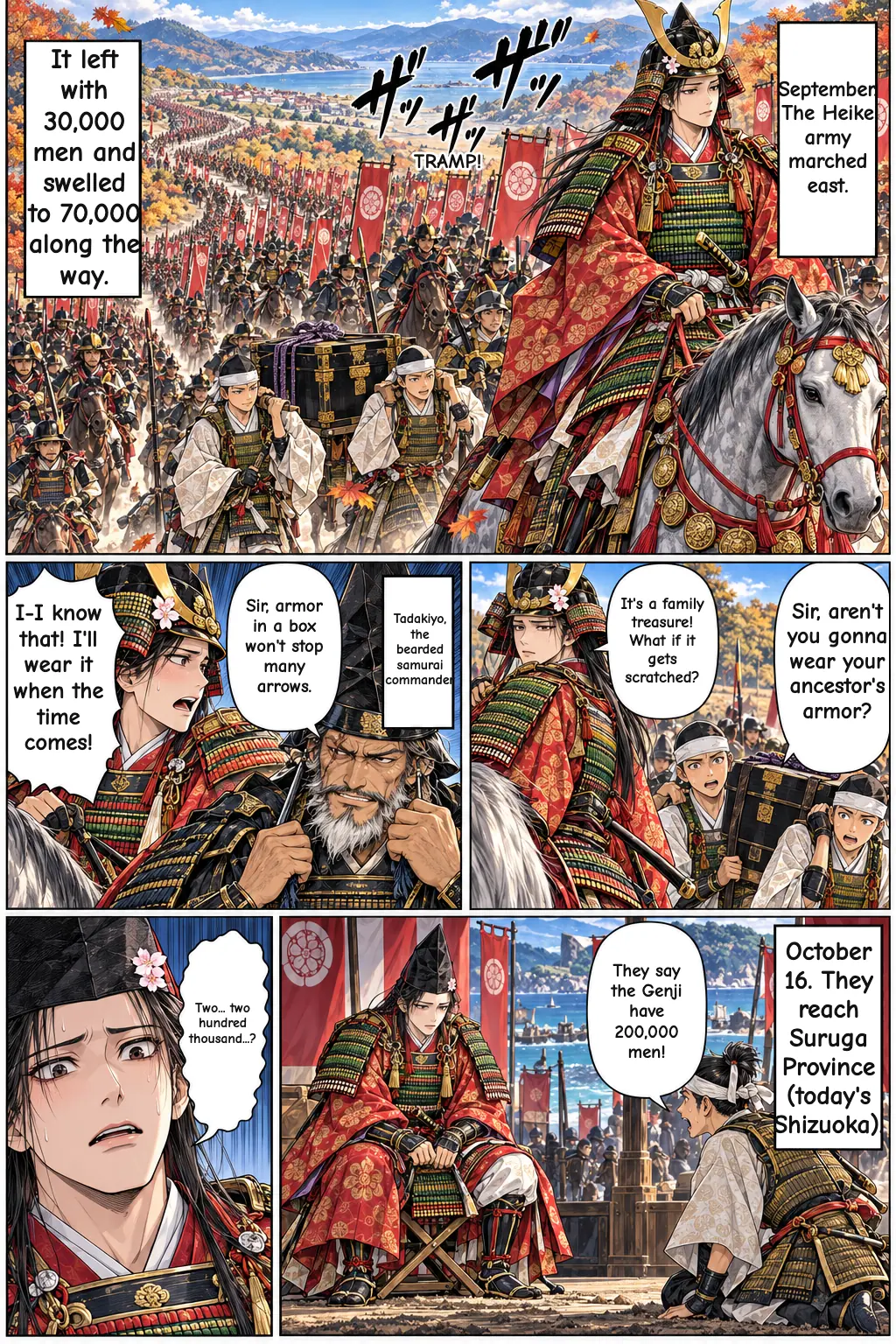
The Taira send an army east under Kiyomori's grandson Taira no Koremori, with Kiyomori's youngest brother Taira no Tadanori, a gifted poet, as second in command. According to the tale, the army left with about 30,000 riders and grew to 70,000 on the march, while the Minamoto were rumored to have 200,000. Numbers like these are typical of war tales and shouldn't be taken literally.
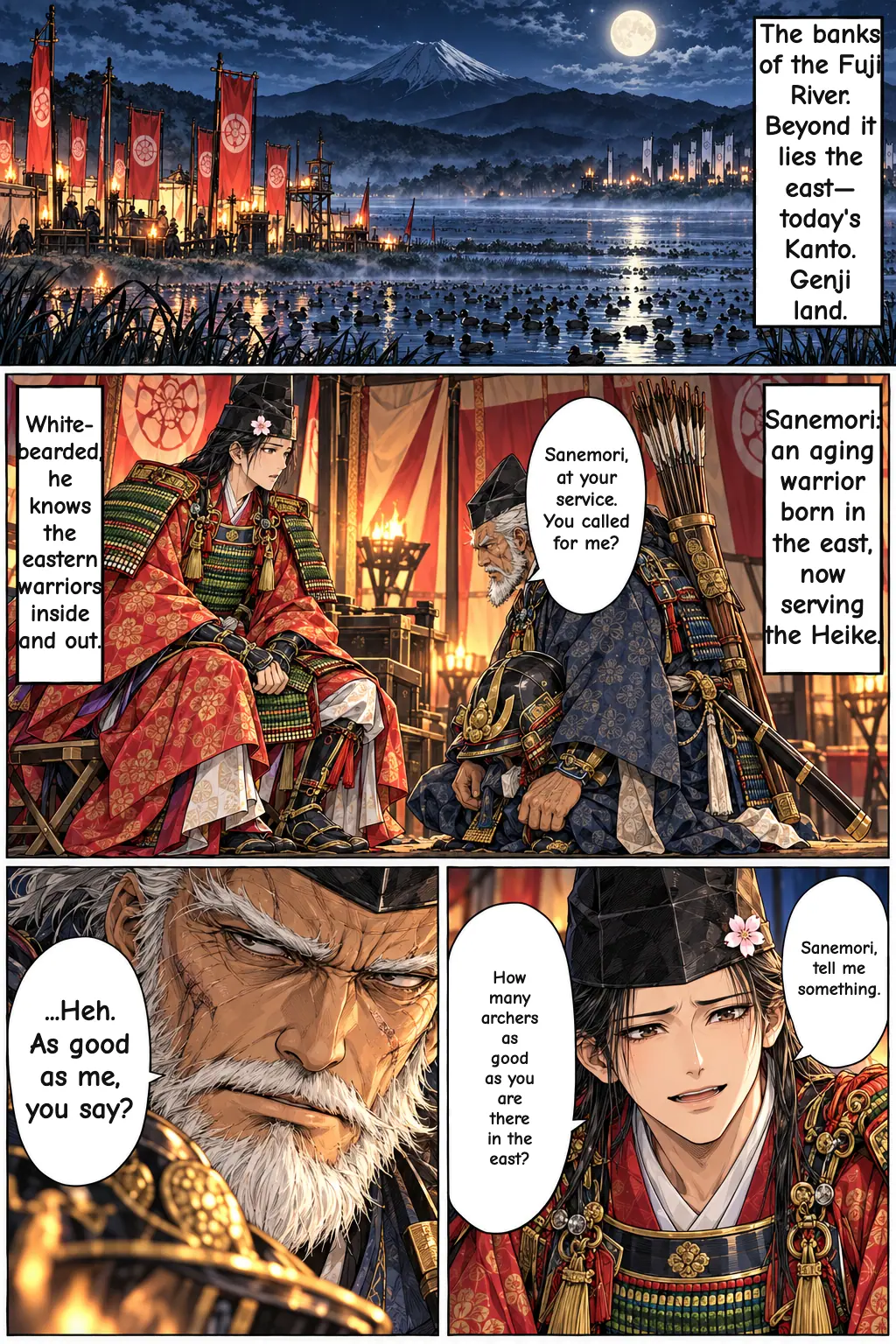
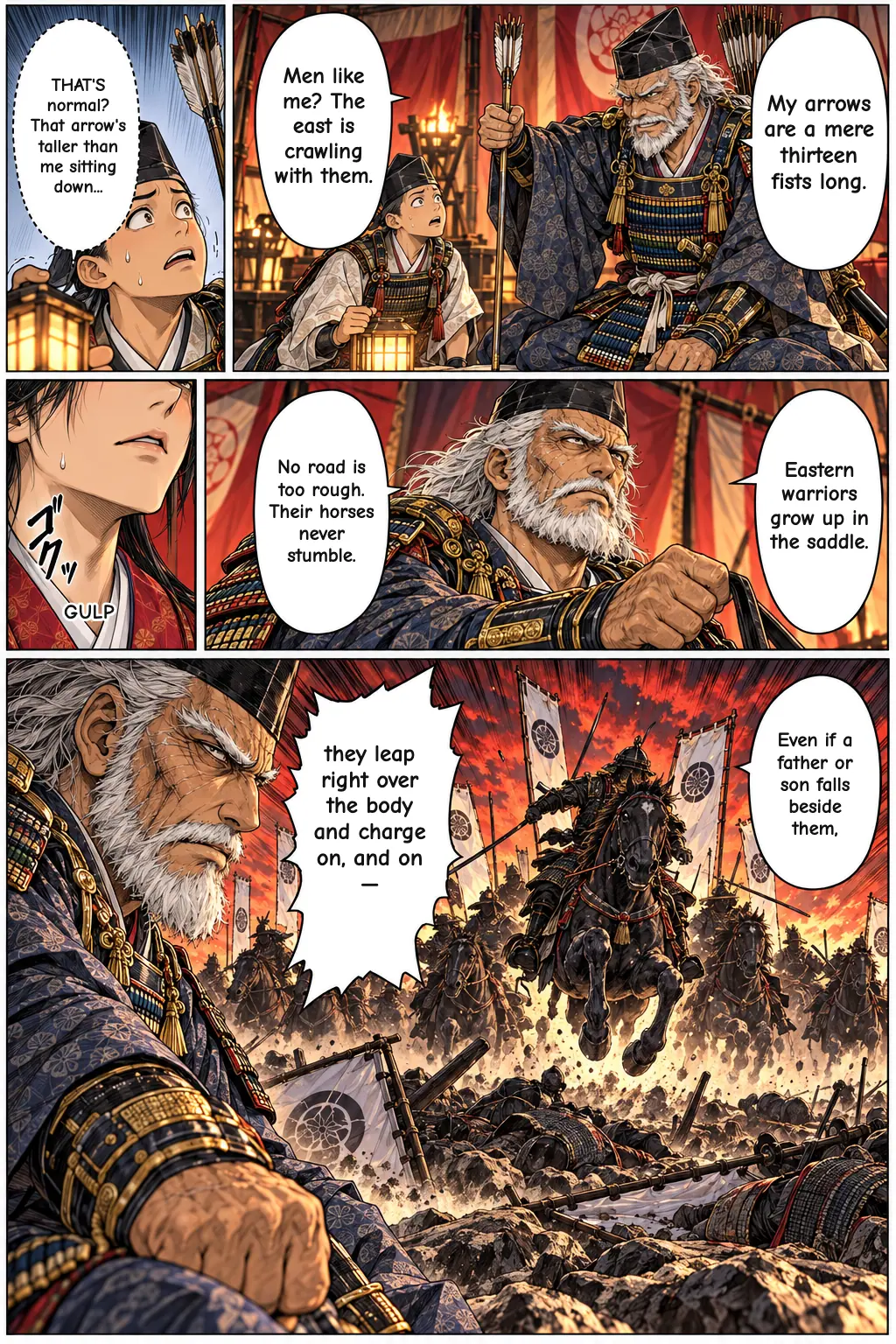
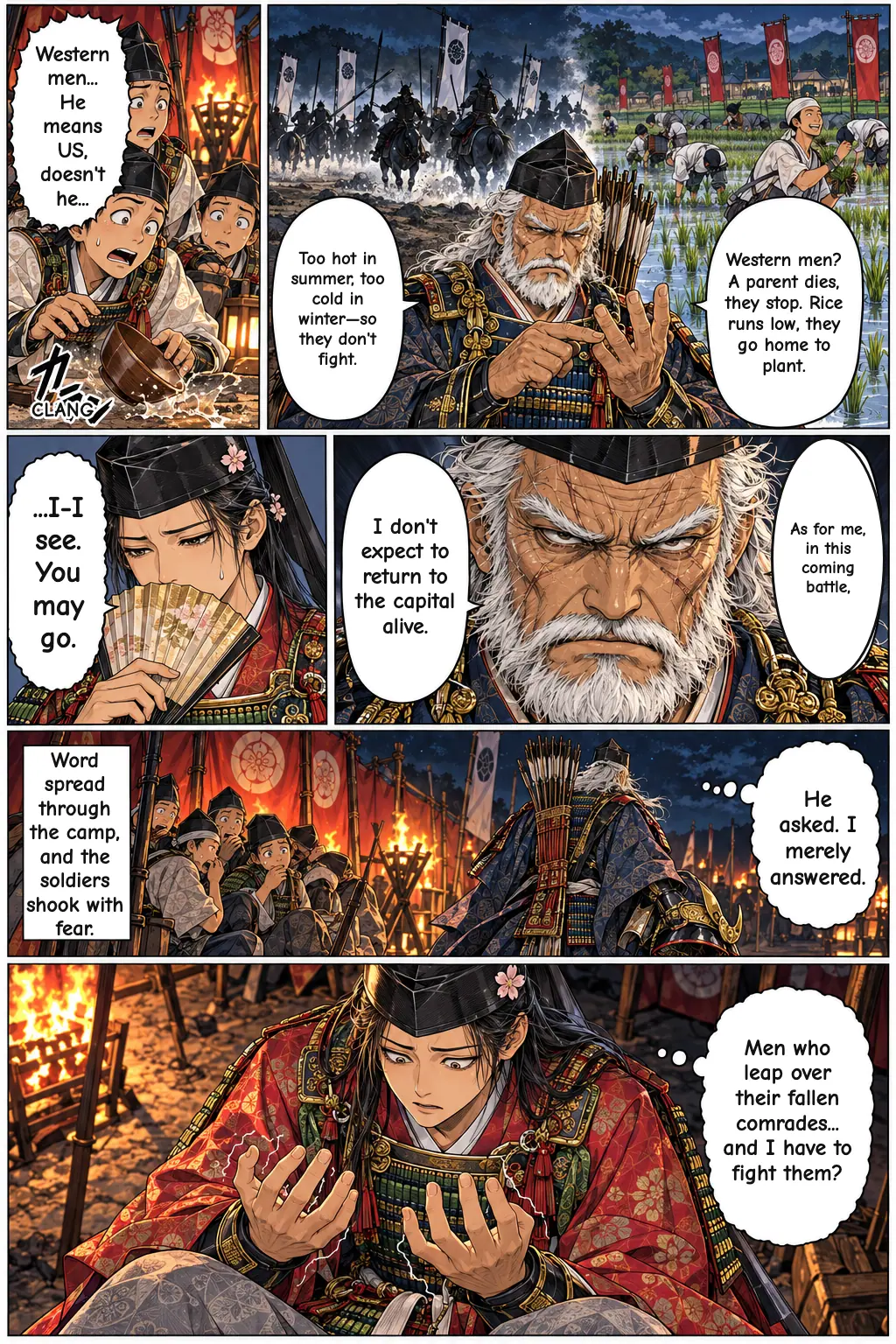
In Suruga province, Koremori asks Saitō no Sanemori, an eastern-born warrior serving the Taira, how many archers as strong as him the eastern provinces have. Sanemori almost laughs. His own bow is nothing special, he says, and men like him are everywhere in the east. Eastern warriors are superb riders who keep fighting even over the bodies of their fathers and sons. Western warriors, by contrast, stop to mourn their dead, go back to farming when food runs out and complain about heat and cold. He adds that he doesn't expect to come home alive this time. The Taira soldiers who hear him are terrified.
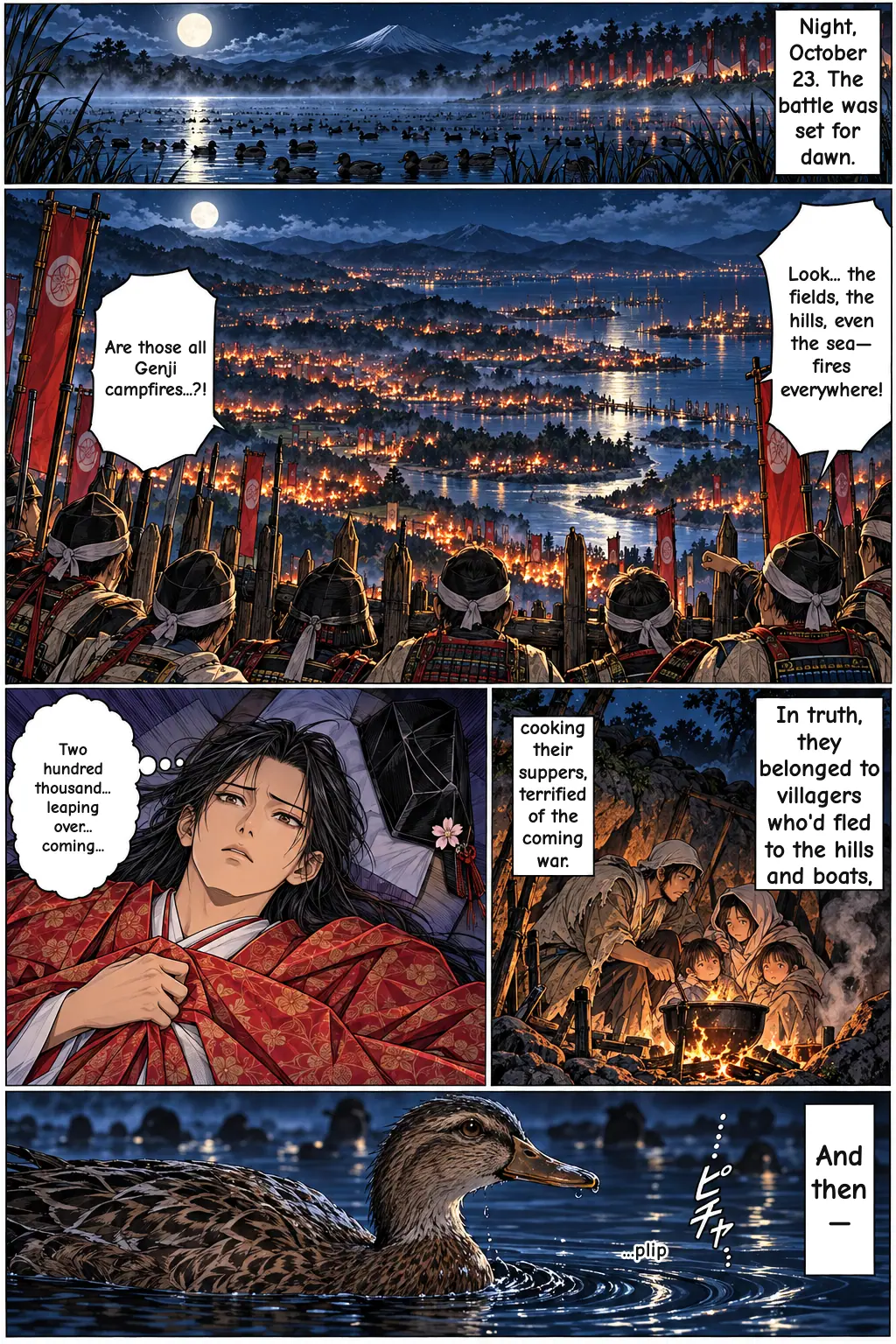
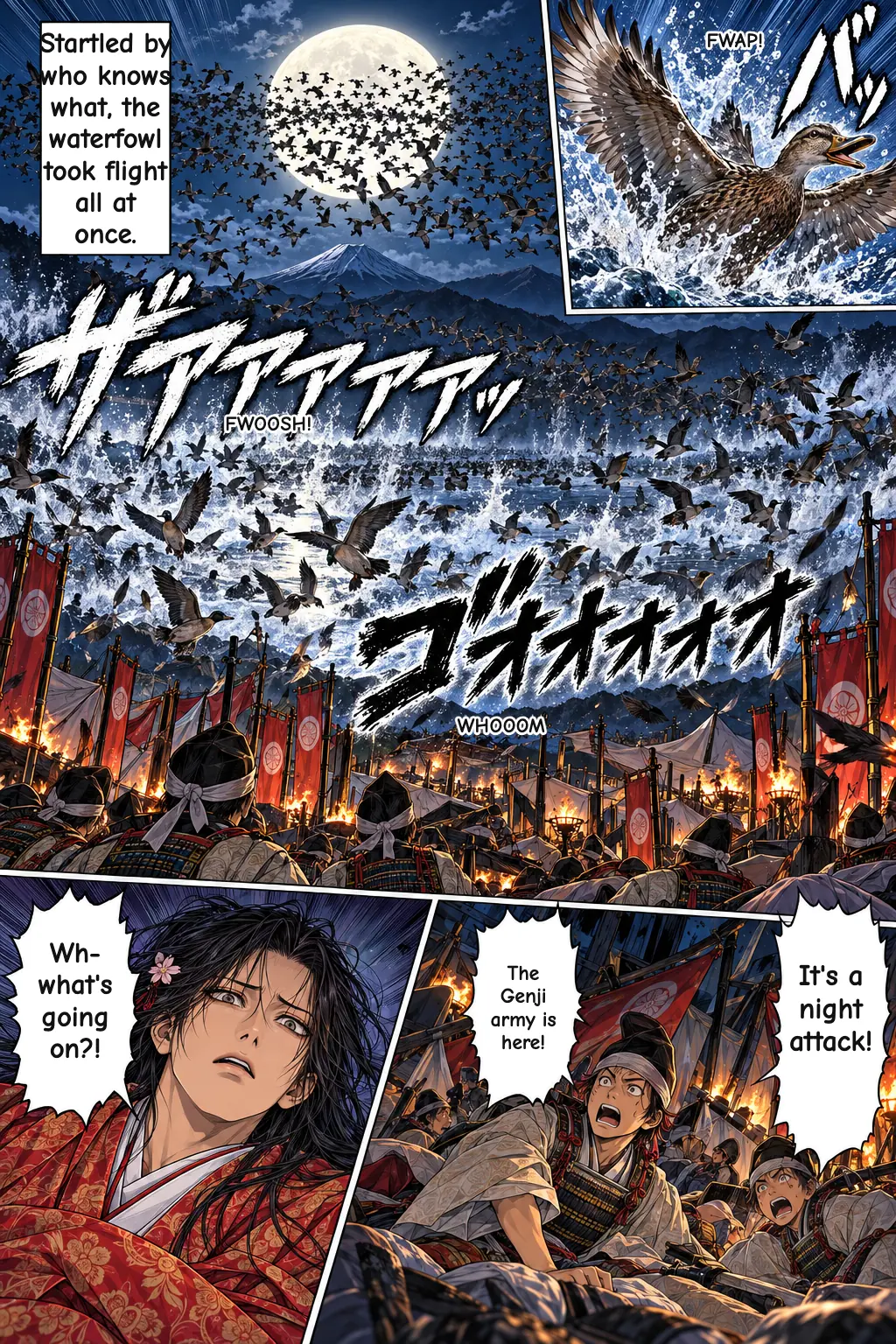
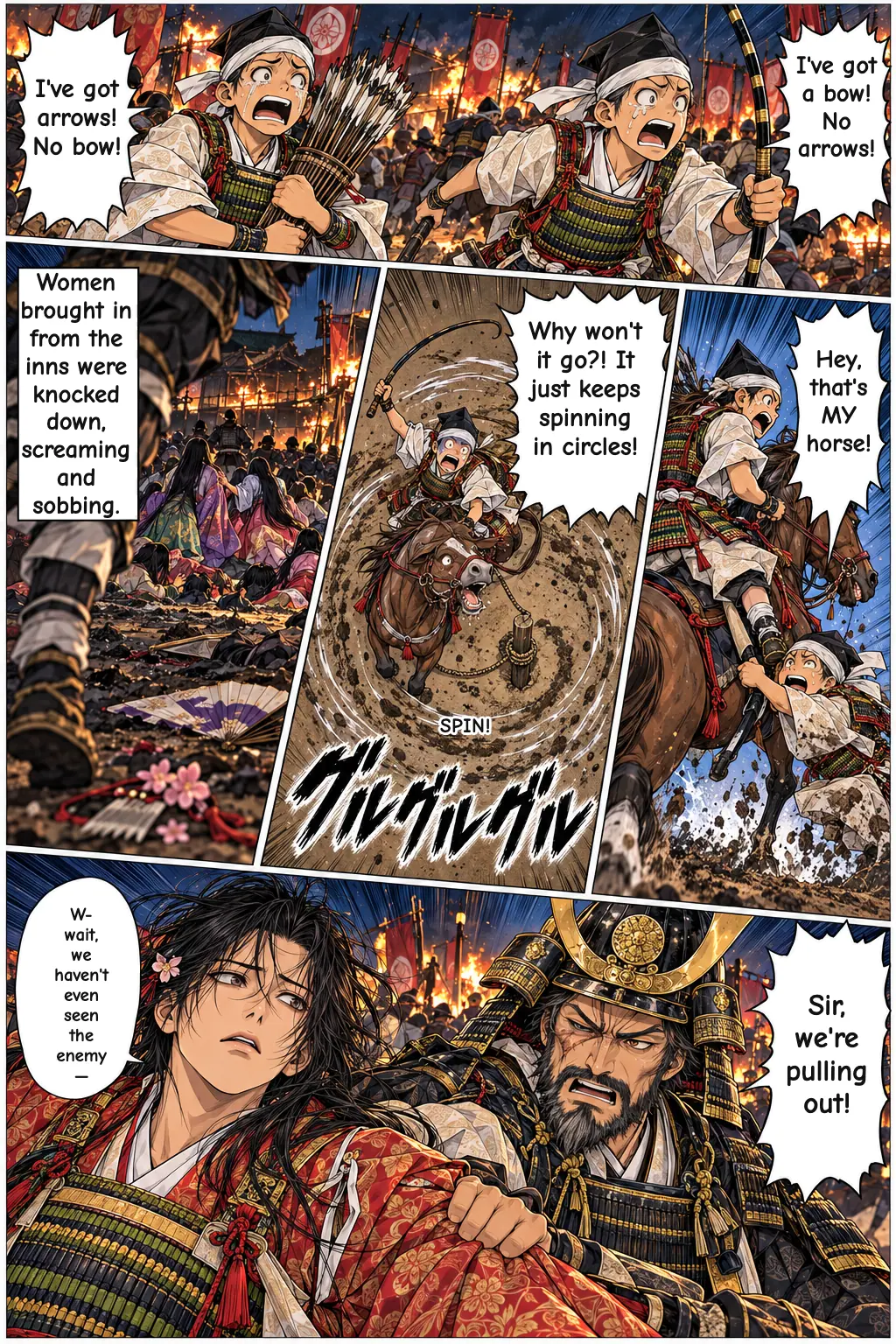
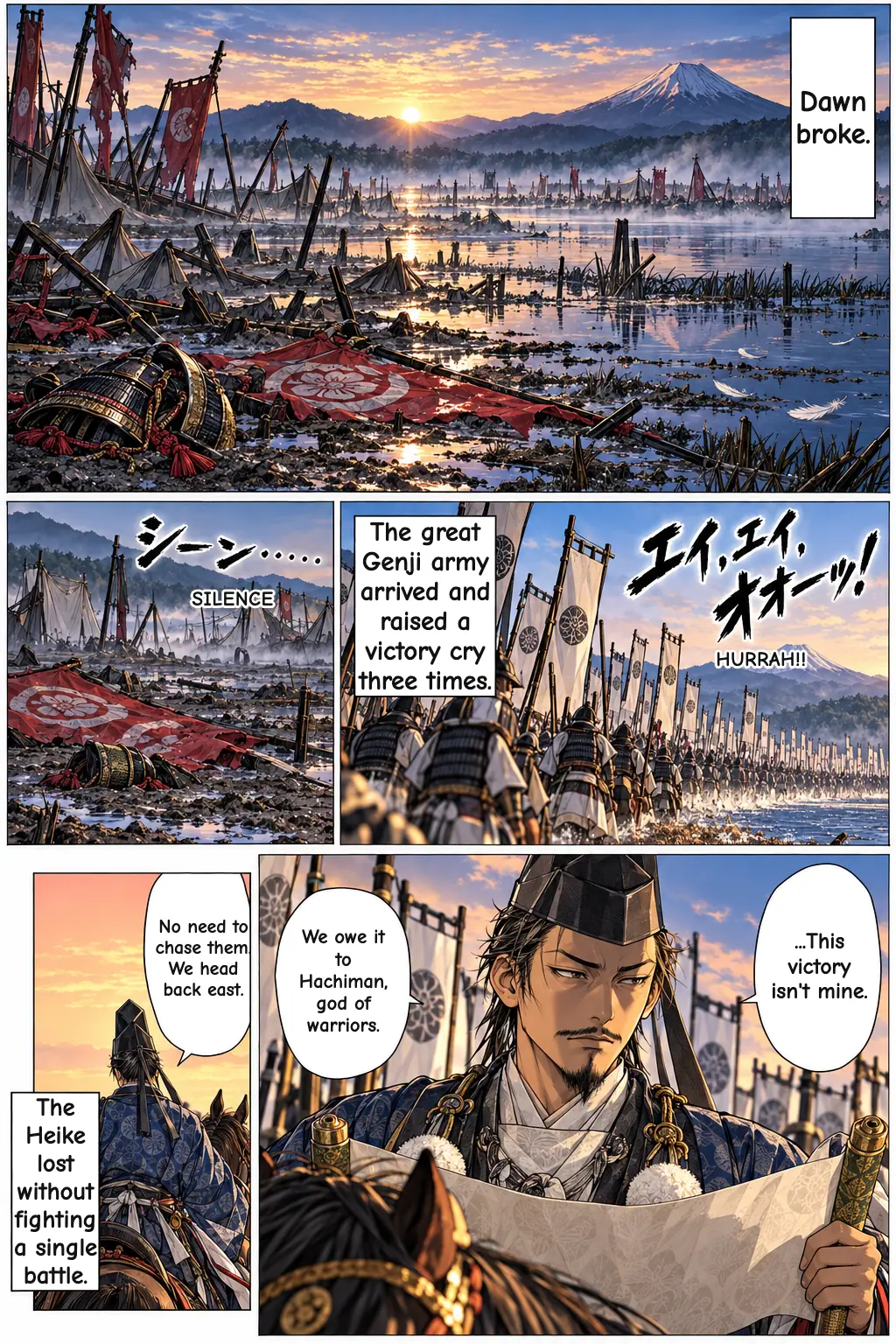
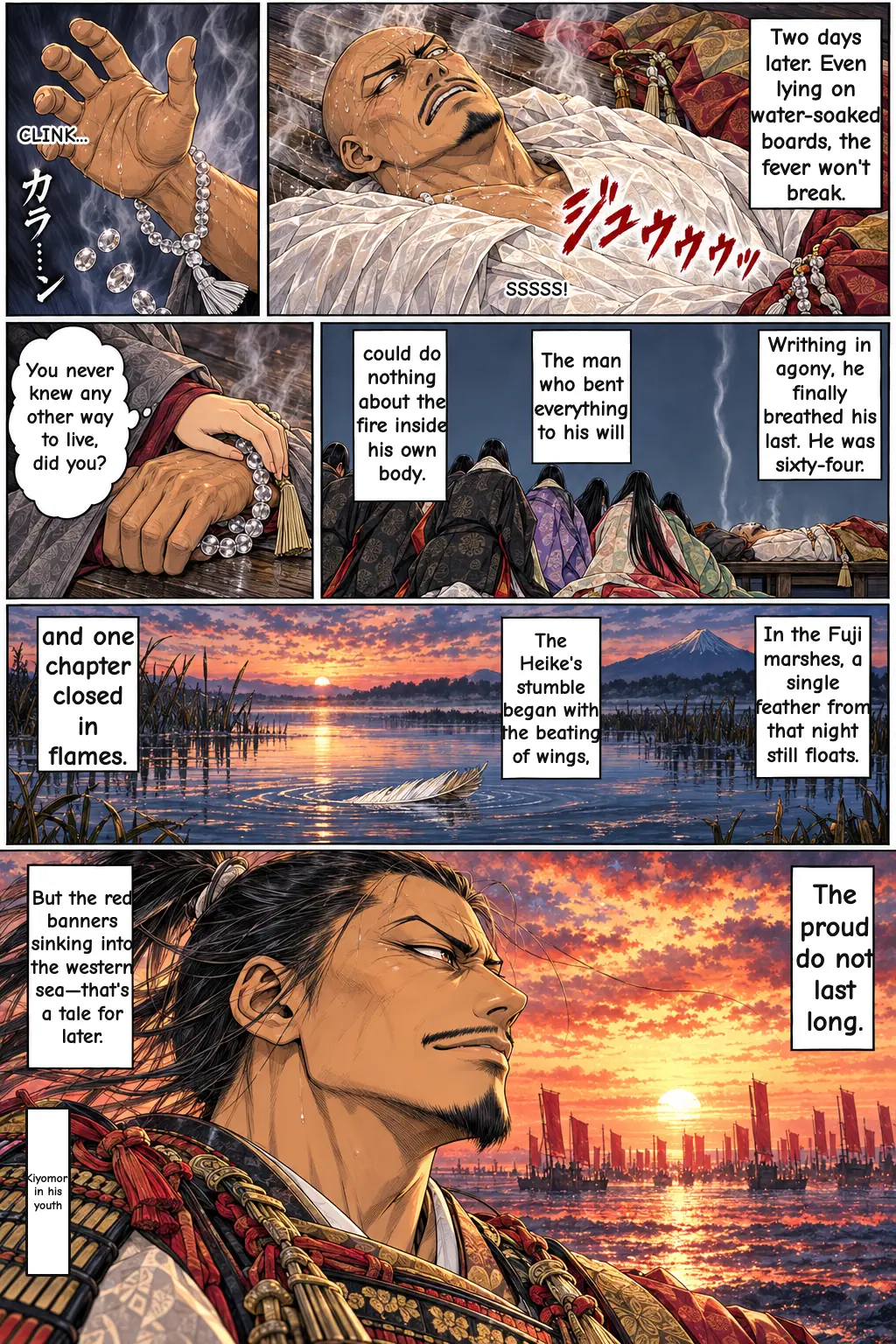
On the night of the 23rd day of the tenth month, the night before the battle was due, the Taira mistake the cooking fires of local people hiding in the hills and on boats for enemy campfires. Around midnight, a huge flock of waterfowl on the marshes near Mount Fuji suddenly takes off. The tale deliberately leaves open what startled them. The roar of wings sounds like a storm or thunder. Convinced that a night attack has begun, the Taira run in panic: men grab bows but forget their arrows, jump on other men's horses, or ride in circles on horses still tied to posts. The next morning, the Minamoto raise their war cry at an empty camp. Yoritomo credits Hachiman, the god of war, and heads back east without chasing them.
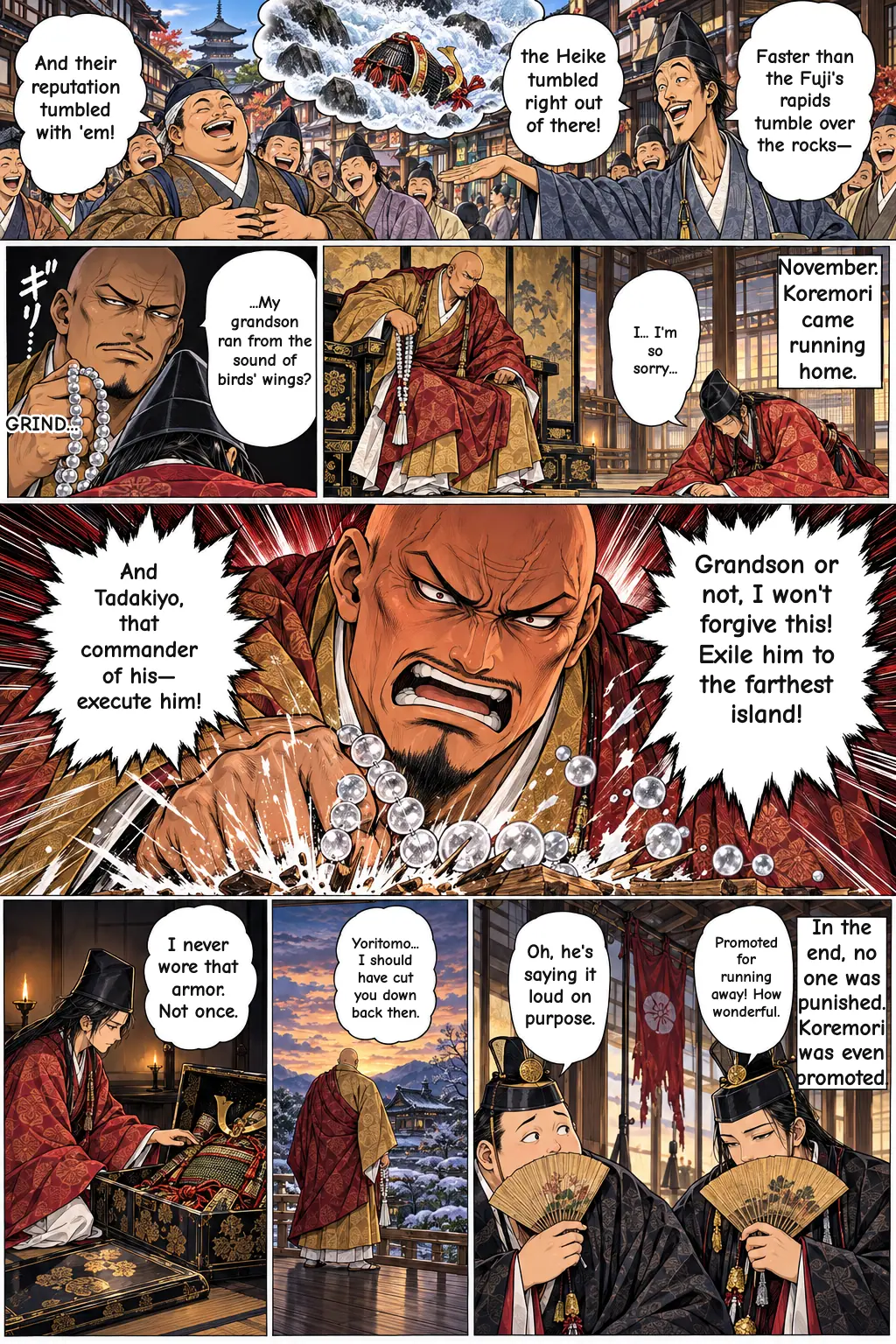
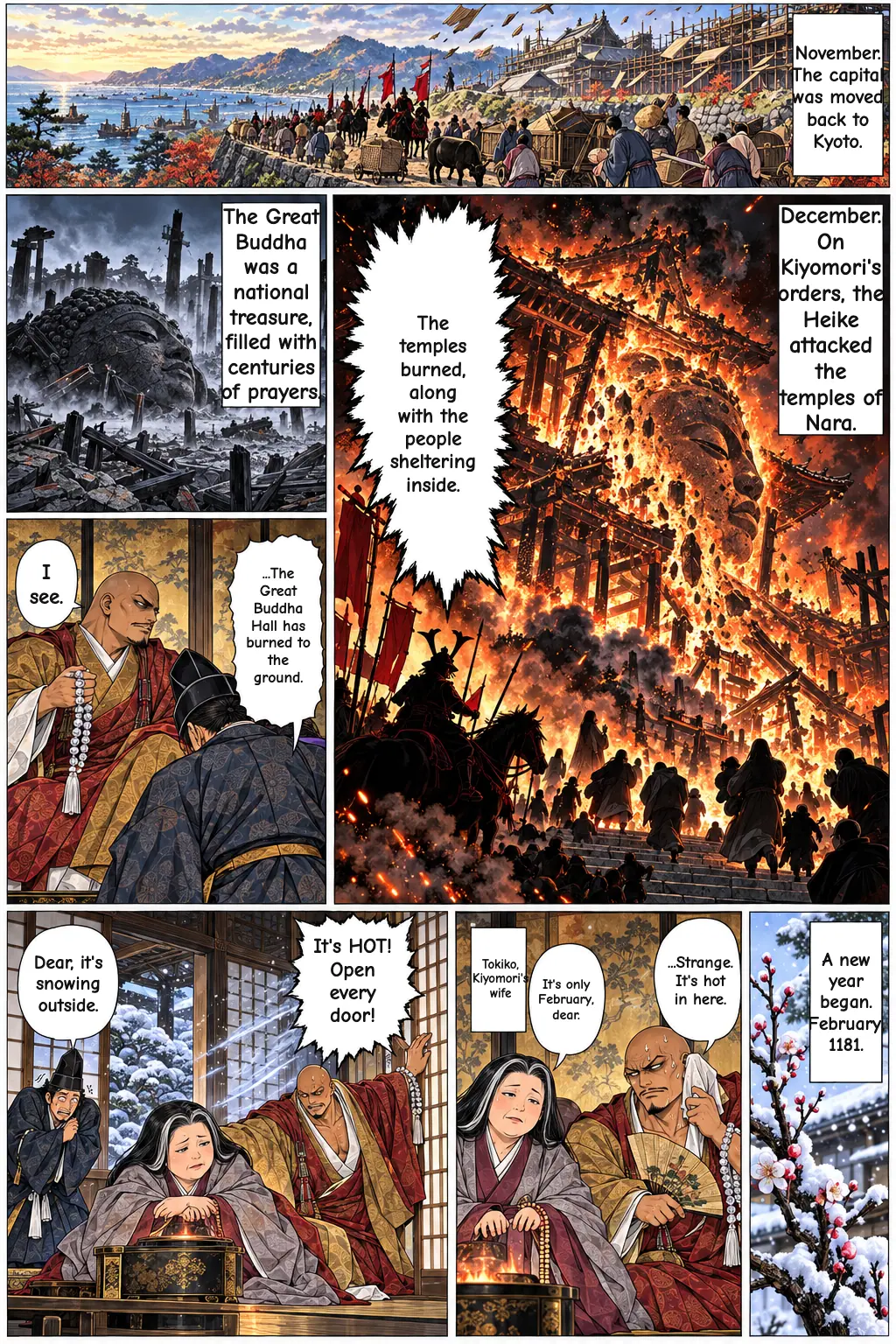
In the capital, people make up poems joking that the Taira fell back faster than the river's rapids. Kiyomori orders Koremori exiled and his samurai commander, Tadakiyo, executed, but neither order is carried out. Koremori is even promoted, which only brings more ridicule. In the twelfth month the capital returns to Kyoto, and Kiyomori's son Taira no Shigehira burns the great temples of Nara, including the Great Buddha Hall of Tōdai-ji.
The Death of Kiyomori: A Fever Like Fire
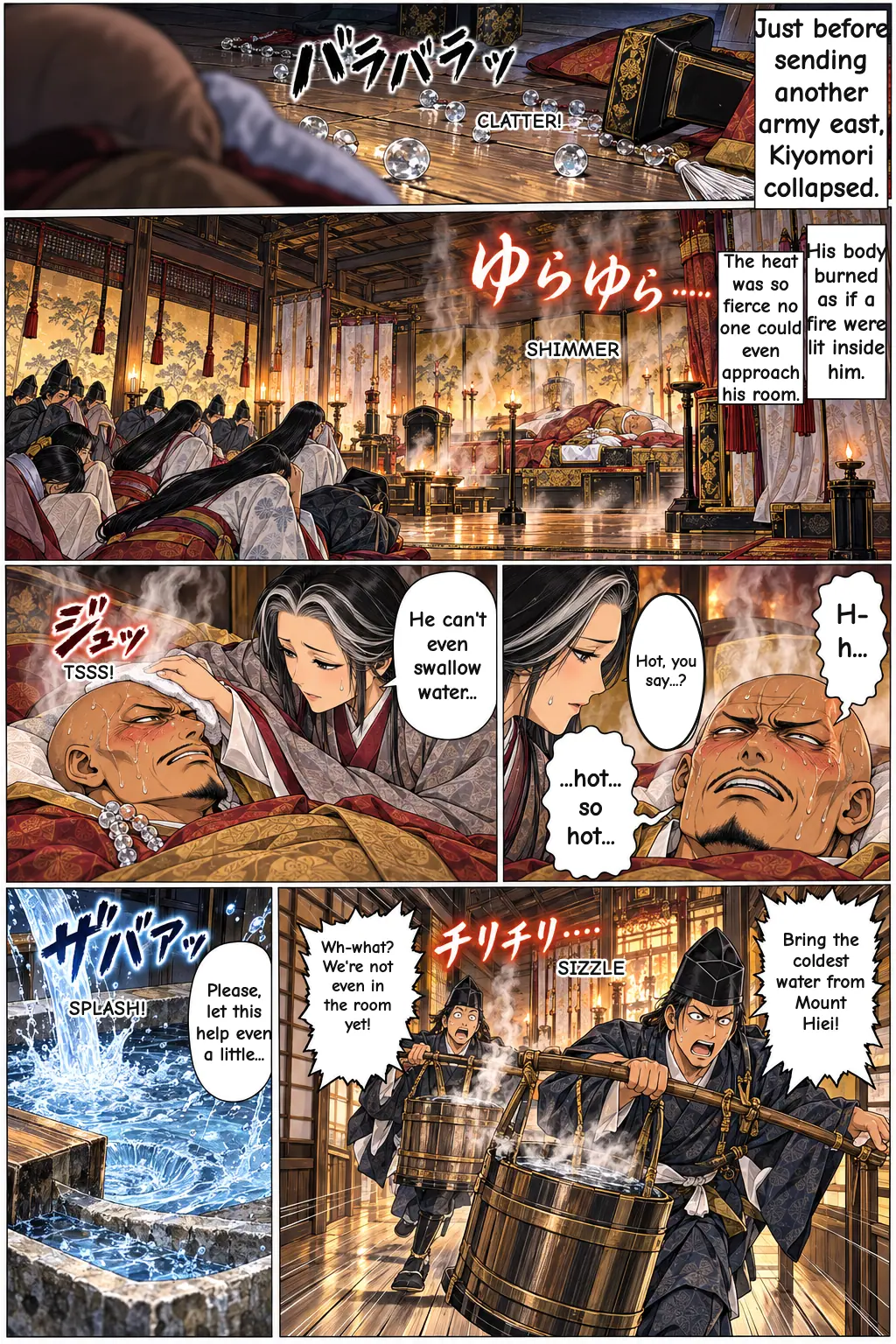
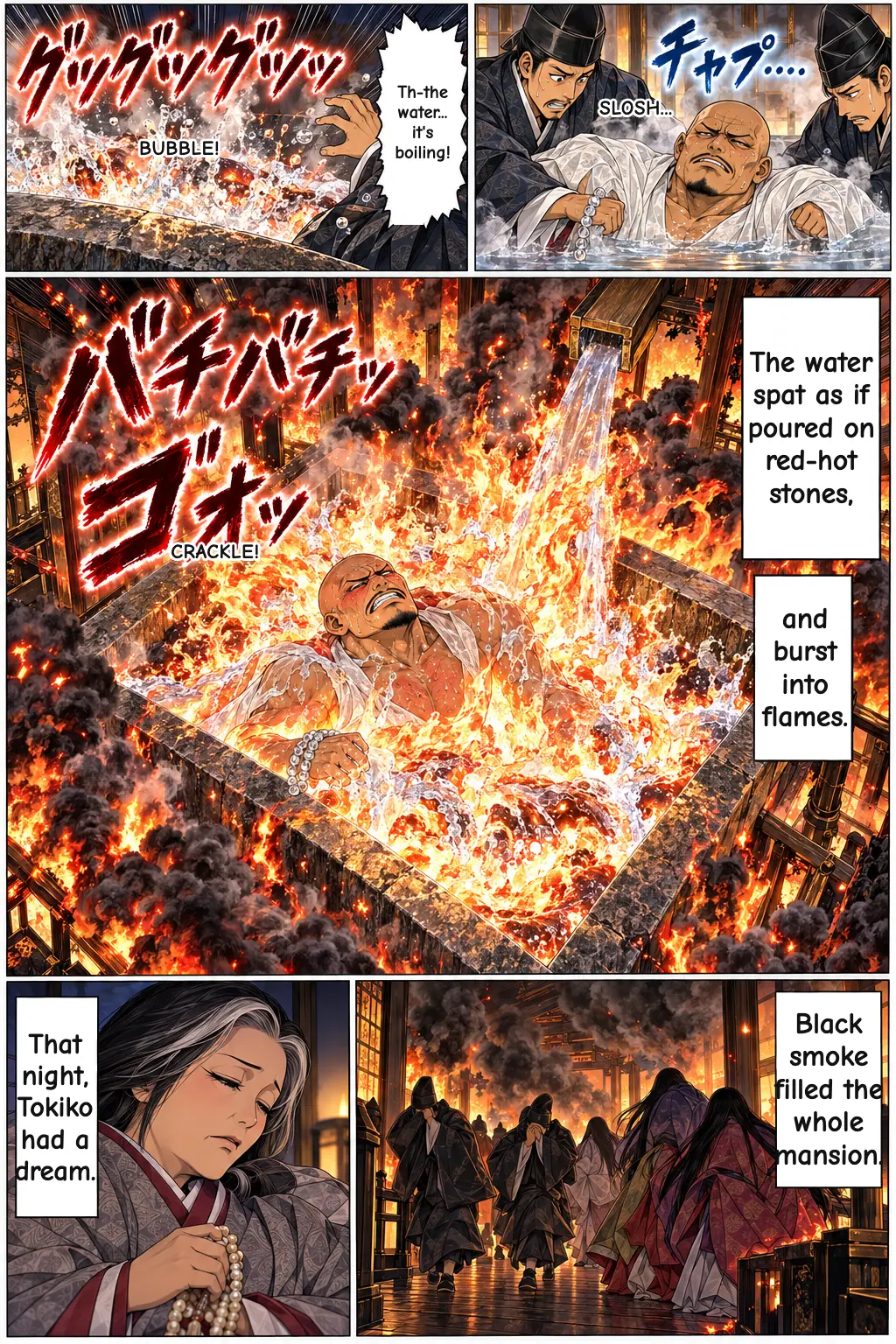
Early in 1181, as Kiyomori's heir Munemori is about to march east, Kiyomori falls ill. He can't swallow even water. His body gives off so much heat that nobody can come near him, and all he can say is that he is burning. Water carried down from a spring on Mount Hiei boils as soon as he lies in it. Water poured over him bounces off as if it had hit red-hot iron, bursts into flame and fills the mansion with black smoke.
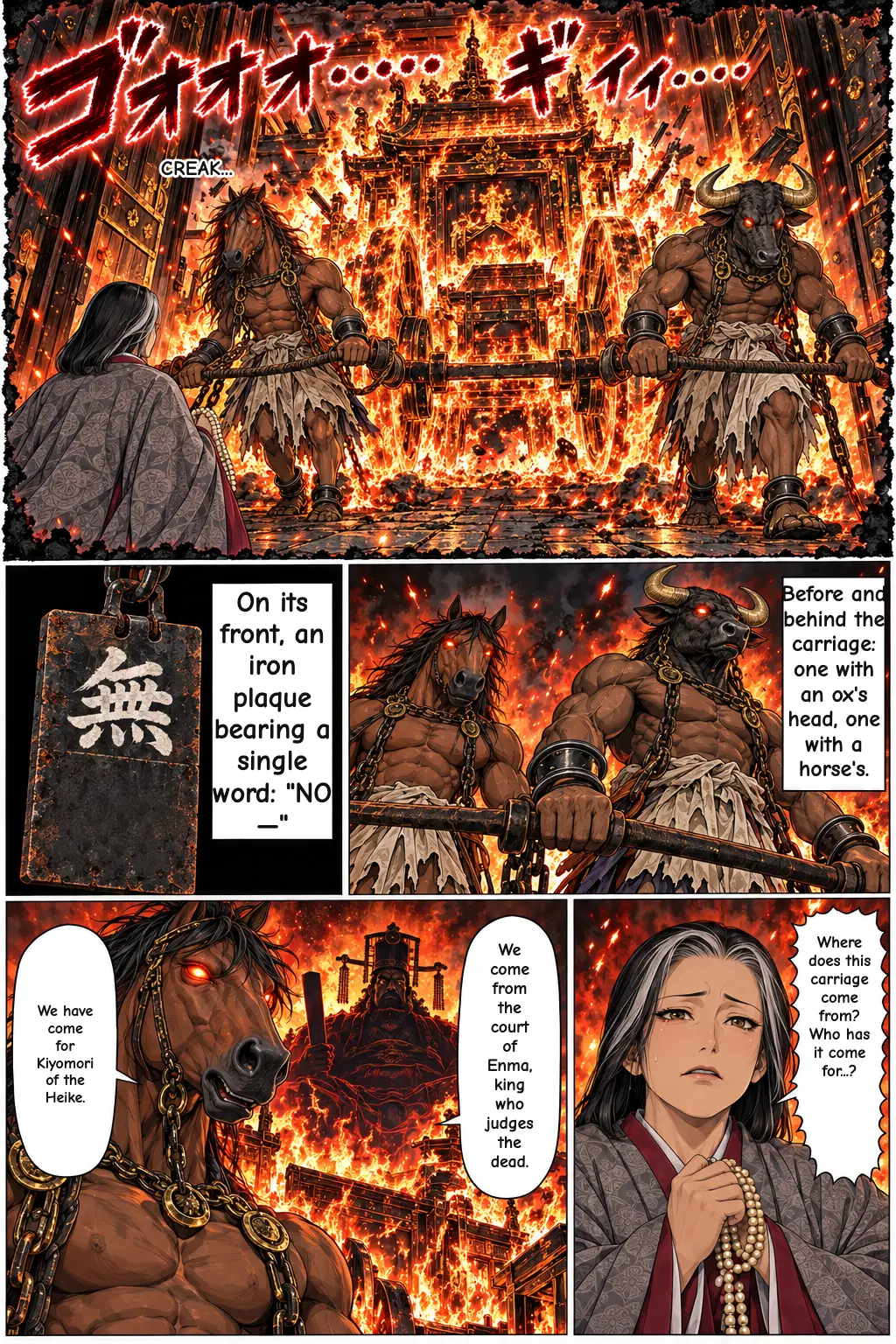
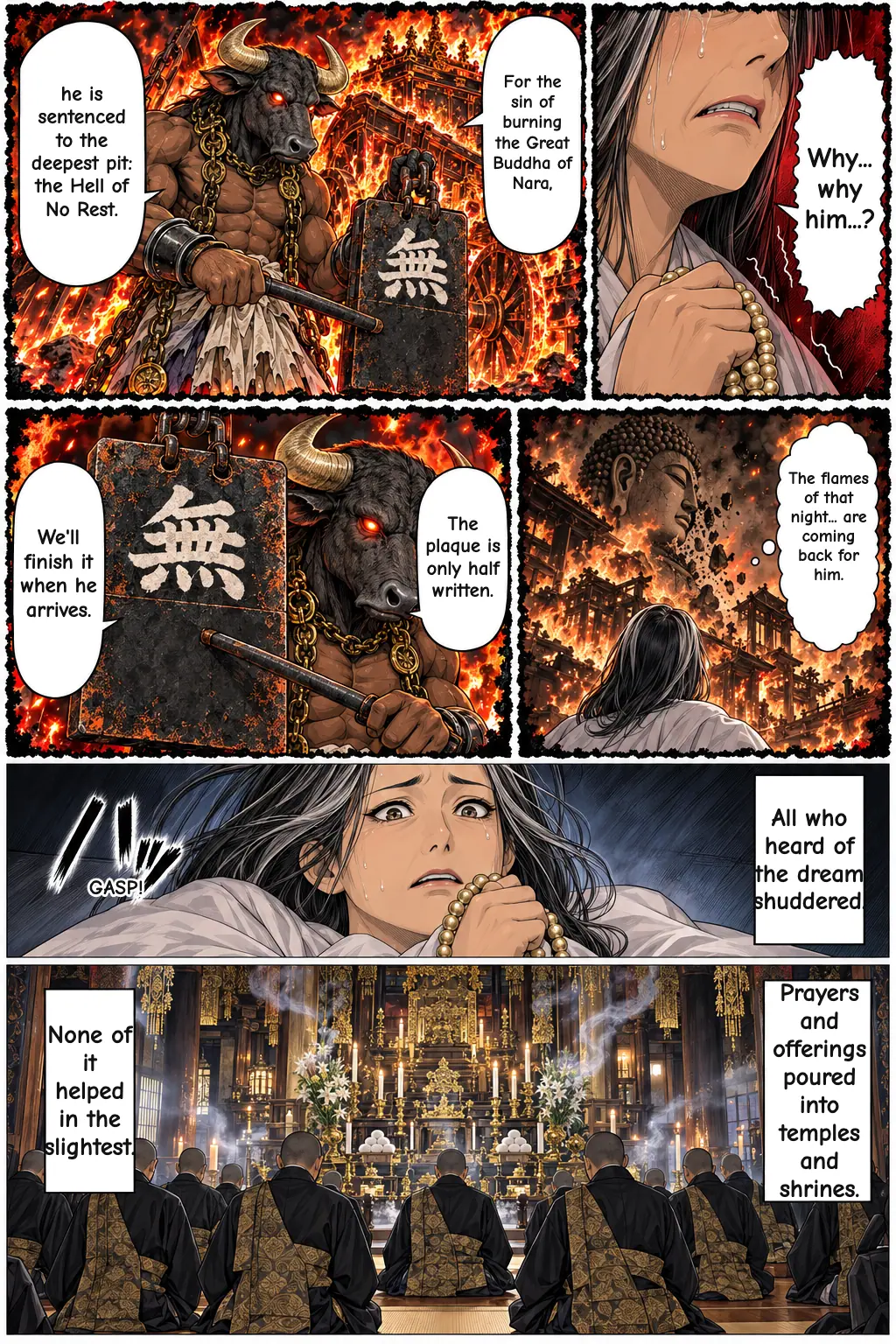
His wife, the Lady of the Second Rank (Taira no Tokiko, later called the Nun of the Second Rank), has a dream. A carriage wrapped in flames is pulled through the gate, attended by figures with the faces of horses and oxen. In front of it stands an iron plaque with one character written on it: "mu." The attendants explain that they have come from the court of Enma, king of the underworld, to collect Kiyomori. For burning the Great Buddha, he has been sentenced to Muken, the deepest hell, and they have written the first character of its name but not yet the second.
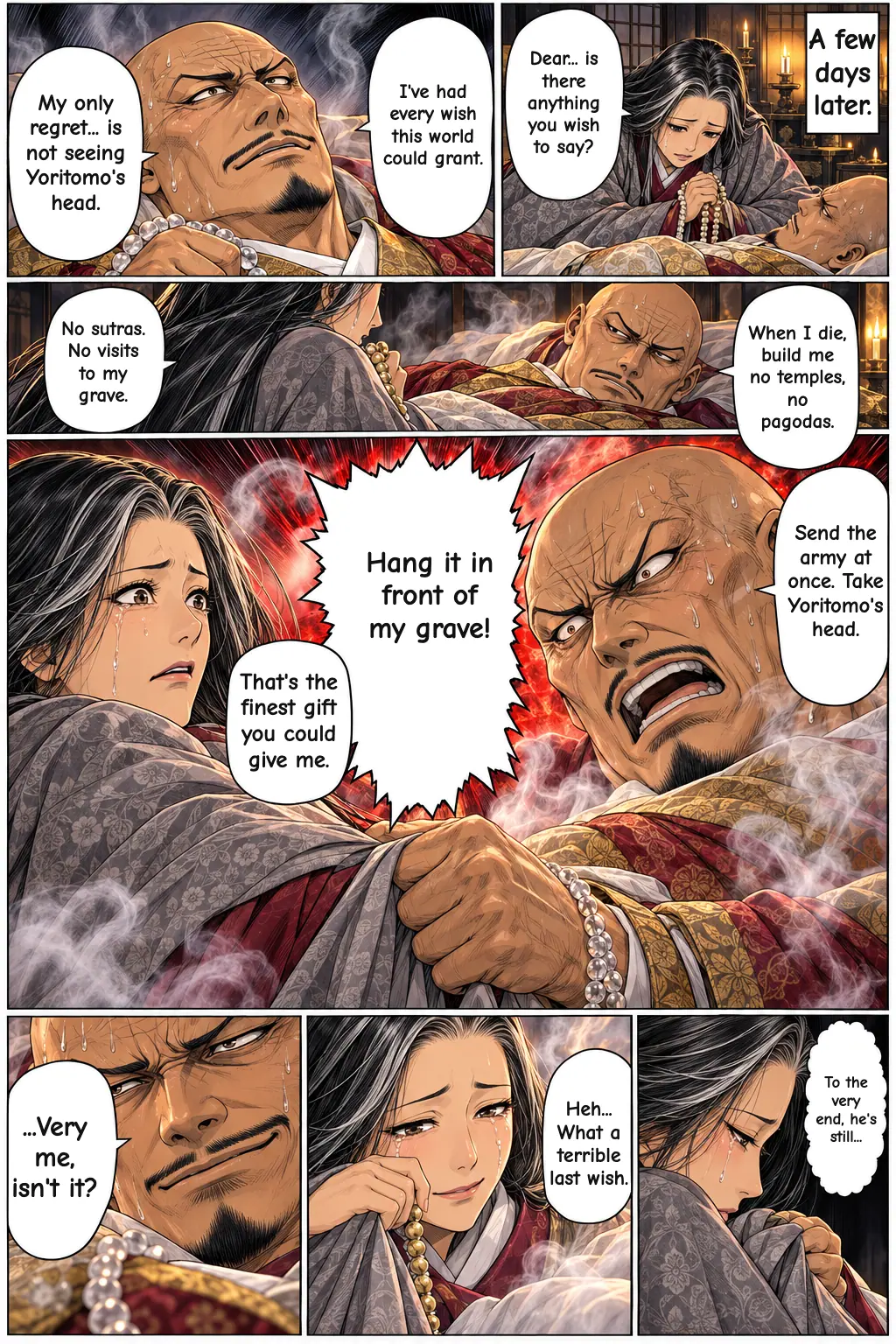
Prayers and offerings at temples and shrines do no good. When asked for his last wishes, Kiyomori says that everything he wanted in this life has come true and that his one regret is never seeing Yoritomo's head. He orders that the head be hung in front of his grave. He dies in agony on the 4th day of the intercalary second month, at sixty-four by the tale's count. Later, a monk named Enjitsu carries his remains to Kyō-no-shima, the harbor island Kiyomori had built at Fukuhara.
What the Story Is Telling Us
The Heike's central theme is impermanence: pride and power never last. The rout at Fujigawa is the first clear sign of the Taira's decline. Sanemori's speech sets the courtly, comfort-loving Taira of the west against the hardened warriors of the east, a contrast that runs through the rest of the epic.
Kiyomori's death reads as a Buddhist lesson about karma. The man who burned the Great Buddha burns from the inside, and a fiery carriage comes to take him to a hell of fire. Yet the tale doesn't make him a pure villain. He is a tyrant who is fiercely loyal to his own family, as his refusal to actually punish his grandson shows.
Historians treat these chapters as literature rather than a battle report. Some argue that the real Fujigawa campaign hinged on Minamoto allies from Kai province and on desertions and supply problems in the Taira army, and that the waterfowl story is exaggerated or embellished. Some have guessed that Kiyomori's fever was a severe infection such as malaria, but that is only speculation.
What the Manga Changes
The manga fits about four months, from the defeat in the tenth month of 1180 to Kiyomori's death in early 1181, into one episode. In the original, Koremori's return, the capital's move back to Kyoto and the burning of Nara all come in between. If the episode seems to suggest that news of the defeat brought on Kiyomori's illness, that link is a dramatic choice: the original says only that he was furious and never connects the defeat to his sickness.
Sanemori's face, voice and age as drawn are the artist's invention. The Fujigawa chapter doesn't describe what he looks like. Showing him as an old warrior is consistent with Book 7, where he dyes his white hair before his last battle. Other details are also the manga's own: the kind of birds and the size of the flock, the night scenery, the soldiers' frightened talk, the look of Kiyomori's sickroom, and the designs of the horse-faced and ox-faced messengers. Kiyomori's final command, though, follows the original.
Where to Read It
To see Sanemori's chilling speech, the night the sky filled with wings and Kiyomori's fiery last days drawn panel by panel, read Episode 6 of THE TALE OF THE HEIKE: The Samurai War of Genpei here on Manga Portal. Every episode is free and needs no registration, so you can start from the beginning or go straight on to see how the Taira face the war without Kiyomori.
Characters in this episode
Taira no Kiyomori
The all-powerful head of the Taira clan, who forces the capital move to Fukuhara and dies of a burning fever, demanding Yoritomo's head for his grave.
Taira no Koremori
Kiyomori's grandson and commander of the army that flees at Fujigawa without fighting, yet escapes punishment and is even promoted.
Saitō no Sanemori
An eastern-born warrior serving the Taira, whose blunt description of eastern fighters terrifies the army.
Lady of the Second Rank (Taira no Tokiko)
Kiyomori's wife, who dreams of a burning carriage sent from the king of the underworld to collect her husband.
Minamoto no Yoritomo
The exiled Minamoto leader whose uprising sparks the campaign; he credits the war god Hachiman for his bloodless victory at Fujigawa.
Taira no Tadanori
Kiyomori's youngest brother and second in command of the army, known as a fine poet.
FAQ
What happened at the Battle of Fujigawa?
In late 1180, a Taira army camped at the Fuji River to face Minamoto no Yoritomo. According to The Tale of the Heike, a flock of waterfowl suddenly took off in the night, and the Taira took the noise for an enemy attack and fled without fighting. The Minamoto found the camp empty the next morning.
Why did the Heike army flee from birds?
The soldiers were already frightened after the warrior Saitō no Sanemori described how fierce eastern warriors were, and they had mistaken villagers' fires for a huge enemy camp. When the birds' wings roared like thunder in the dark, they panicked. Historians think the real retreat also involved desertions and supply problems.
How did Taira no Kiyomori die?
In 1181 he fell ill with a fever so intense that, in the tale, the water used to cool him boiled and burst into flame. He died in agony at sixty-four by the tale's count. The story presents his suffering as punishment for the burning of Nara's Great Buddha.
What were Kiyomori's last words?
He said he had achieved everything he wanted in life and that his only regret was not seeing Yoritomo's head. He ordered that Yoritomo's head be hung in front of his grave.
Why did Kiyomori move the capital to Fukuhara?
The Tale of the Heike presents the move as Kiyomori forcing his own will on the court, against the objections of nearly everyone. Historians offer several explanations, such as his base of power and trade interests around the Fukuhara harbor, but the tale itself mainly treats it as an act of arrogance. The capital returned to Kyoto after about six months.