The Odyssey, Book 9: The Cyclops and the Lotus-Eaters – Manga, Summary and Lesson Plan
A teacher-ready page for Book 9 of Homer’s Odyssey: the Lotus-Eaters and the Cyclops Polyphemus. It has a plain-English summary, characters, background, a 45-minute lesson flow, four discussion questions and a one-page printable worksheet. Students read two 19-page manga episodes, free and with no sign-up, and you can post them straight to Google Classroom. The manga is an adaptation based on the original, so it works best as an entry point before or alongside the text.
Read the manga · Share to Classroom
Summary (following the original)
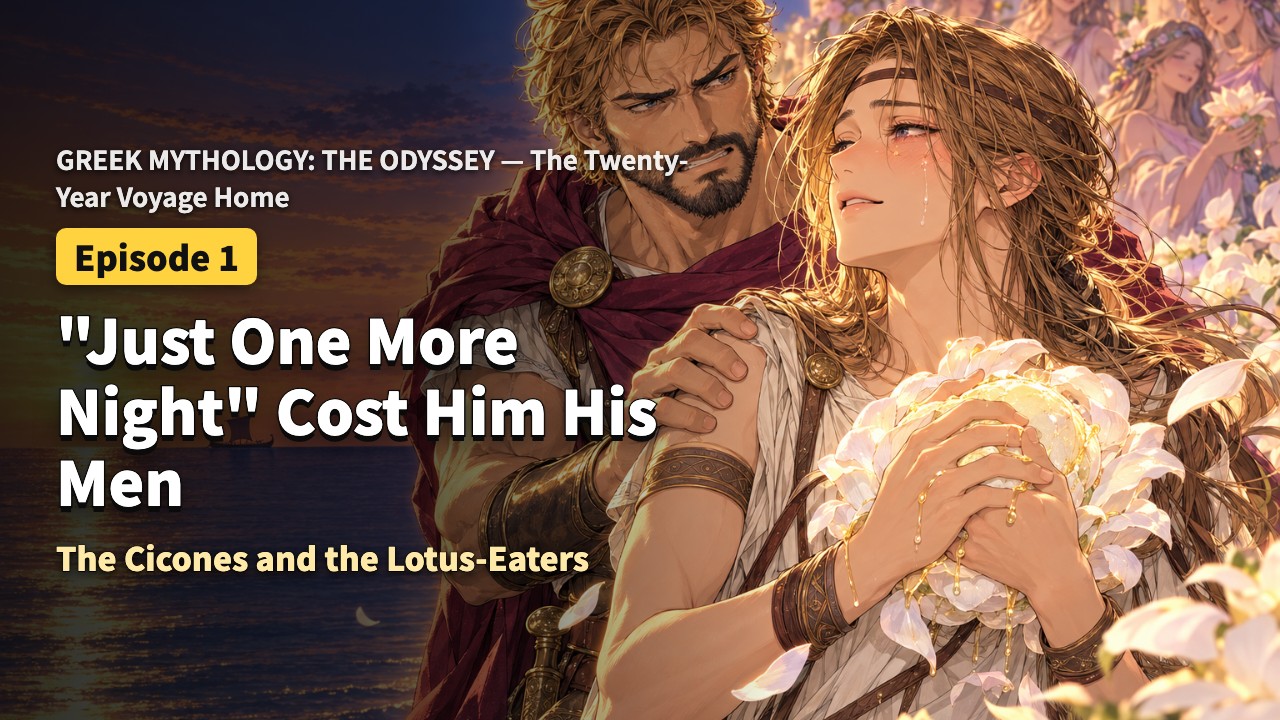
In Book 9, Odysseus has been welcomed at the court of the Phaeacians and, asked who he is, begins to tell the story of his voyage himself. His account opens after the fall of Troy. He and his men sack the city of the Cicones. Odysseus wants to leave at once, but his men stay to feast on the shore. The Cicones bring reinforcements, and the Greeks lose several men from every ship.
A storm then carries the fleet to the land of the Lotus-Eaters. Three of Odysseus’s men who go inland to scout eat the lotus and lose any wish to return home. Odysseus has to drag them back to the ships, weeping, and tie them in.
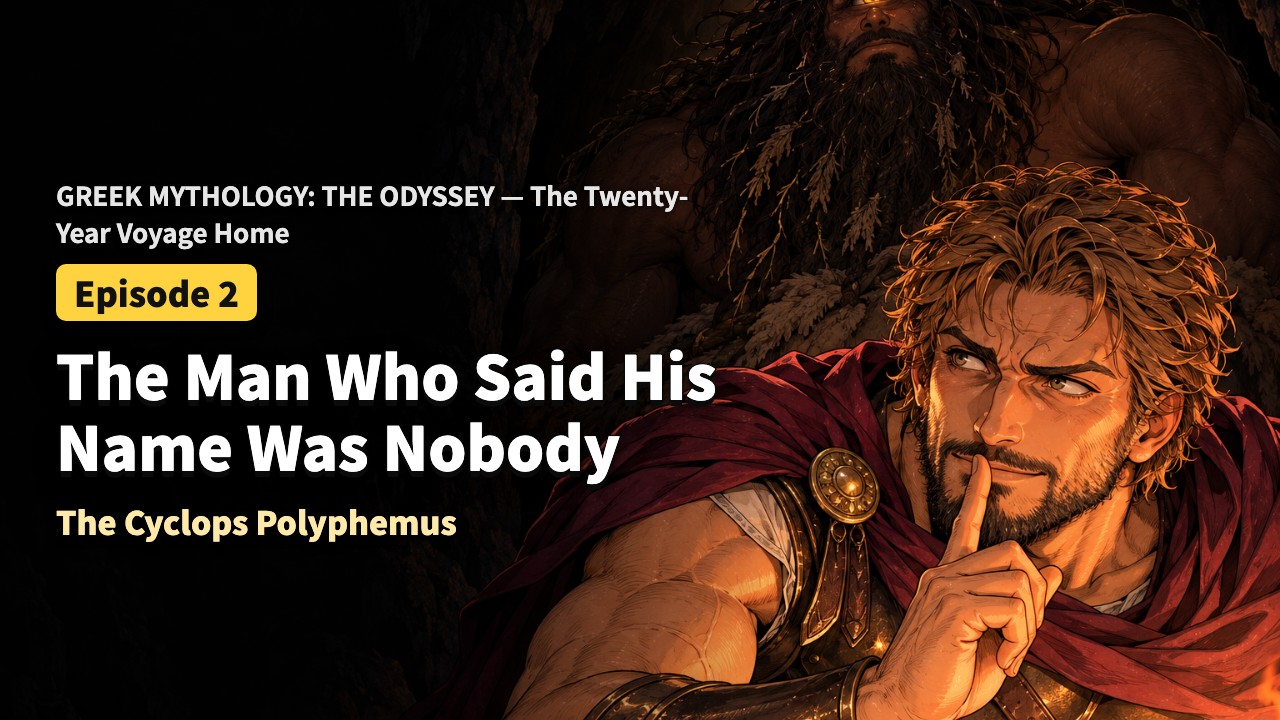
The fleet next reaches the land of the Cyclopes. Odysseus takes twelve men into a cave full of cheese and livestock. Its owner, the Cyclops Polyphemus, returns, seals the entrance with an enormous stone and eats two of the men. Odysseus offers him strong wine. Asked his name, he answers “Nobody.” Once Polyphemus is drunk and asleep, the men heat a sharpened olive-wood stake and blind him.
Polyphemus calls for help, but when his neighbors ask who is hurting him he answers “Nobody,” and they go away. In the morning the men escape clinging beneath the bellies of Polyphemus’s rams, Odysseus under the biggest one.
Safe at sea, Odysseus cannot resist calling back, and over his crew’s protests he shouts his real name: Odysseus, son of Laertes, of Ithaca. Polyphemus hurls rocks at the ship and prays to his father, the sea god Poseidon, that Odysseus never reach home or, if he does, that he arrive late, alone, and find trouble waiting. That prayer shapes the rest of the poem.
Characters
- Odysseus
- King of Ithaca, famous for his cunning. In Book 9 he is the narrator as well as the hero.
- Odysseus’s crew
- Soldiers home from Troy. They disobey, give in to temptation and are lost in the next adventures.
- Polyphemus
- A Cyclops, a one-eyed giant shepherd, and a son of Poseidon. He eats his guests.
- Poseidon
- God of the sea and father of Polyphemus. His anger keeps Odysseus from home.
- The Lotus-Eaters
- People who eat the sweet lotus plant. Anyone who tastes it forgets the way home.
Background
The Odyssey is an ancient Greek epic poem in 24 books, traditionally attributed to Homer and usually dated to around the 8th–7th century BCE. It follows Odysseus’s long journey home to Ithaca after the Trojan War.
Books 9–12 are told as a flashback: Odysseus himself recounts his adventures to his hosts. Students can ask whether a narrator who is also the hero tells the story in a way that flatters him.
Hospitality (xenia) was a central value in the Greek world, with Zeus as protector of guests and strangers. Polyphemus’s cave scene turns that value upside down: the host eats his guests.
Lesson flow (about 45 minutes)
- Hook (5 min): Ask, “Would you give up your own name to stay alive? What would it cost you?” Take a few answers aloud.
- Read the manga (12 min): Students read both episodes on their own devices (each is 19 pages). As they read, they jot down one moment where Odysseus is clever and one where he is reckless.
- Close reading (18 min): In your class translation of Book 9, find the “Nobody” trick, the moment Odysseus shouts his real name, and Polyphemus’s prayer to Poseidon. In pairs, list which details the manga keeps and which it adds or changes. This supports Common Core RL.9-10.9 (how a later work draws on and transforms source material).
- Discussion and exit ticket (10 min): Choose one question below for a whole-class talk, then have students answer one question on the printable worksheet.
Discussion questions
- Odysseus’s men stay to feast on the Cicones’ shore, then are tempted by the lotus. What do these two episodes suggest about the limits of a leader’s control?
- Why does the trick with the name “Nobody” work? What does Odysseus risk by giving up his real name, even for a moment?
- Odysseus shouts his real name as he sails away, ignoring his crew’s pleas. Is it pride, courage or a mistake? What are the consequences in the poem?
- Odysseus arrives in the cave as a guest, and Polyphemus is the host. Who follows the rules of hospitality, and who breaks them?
Printable worksheet
Three questions with answer lines on one printable page. The manga links are printed on it too.
GREEK MYTHOLOGY: THE ODYSSEY: all episodes
All classroom-ready manga for teachers
This manga is drawn and produced with AI. It follows the original texts, but dialogue and details include creative additions for the comic. Use it as a way into the characters and scenes, not as a replacement for the text. About us
Name: ______________________ Class: ____________ Date: ____________
The Odyssey, Book 9: reading questions
Manga: https://manga-portal.com/en/read/2026-10-30-odyssey-7d2e/ https://manga-portal.com/en/read/2026-10-24-odyssey-fc6d/
1. In your own words, how does Odysseus trick Polyphemus and escape from the cave?
2. Odysseus shouts his real name as he sails away. Why do you think he does it, and what happens because of it? Use evidence from the manga or the text.
3. Choose one: Is Odysseus a good leader in this book, or a bad one? Explain with two examples.
This manga is drawn and produced with AI. It follows the original texts, but dialogue and details include creative additions for the comic. Use it as a way into the characters and scenes, not as a replacement for the text.