Episode 8Fleeing a Burning City, He Turned BackTadanori Leaves the Capital
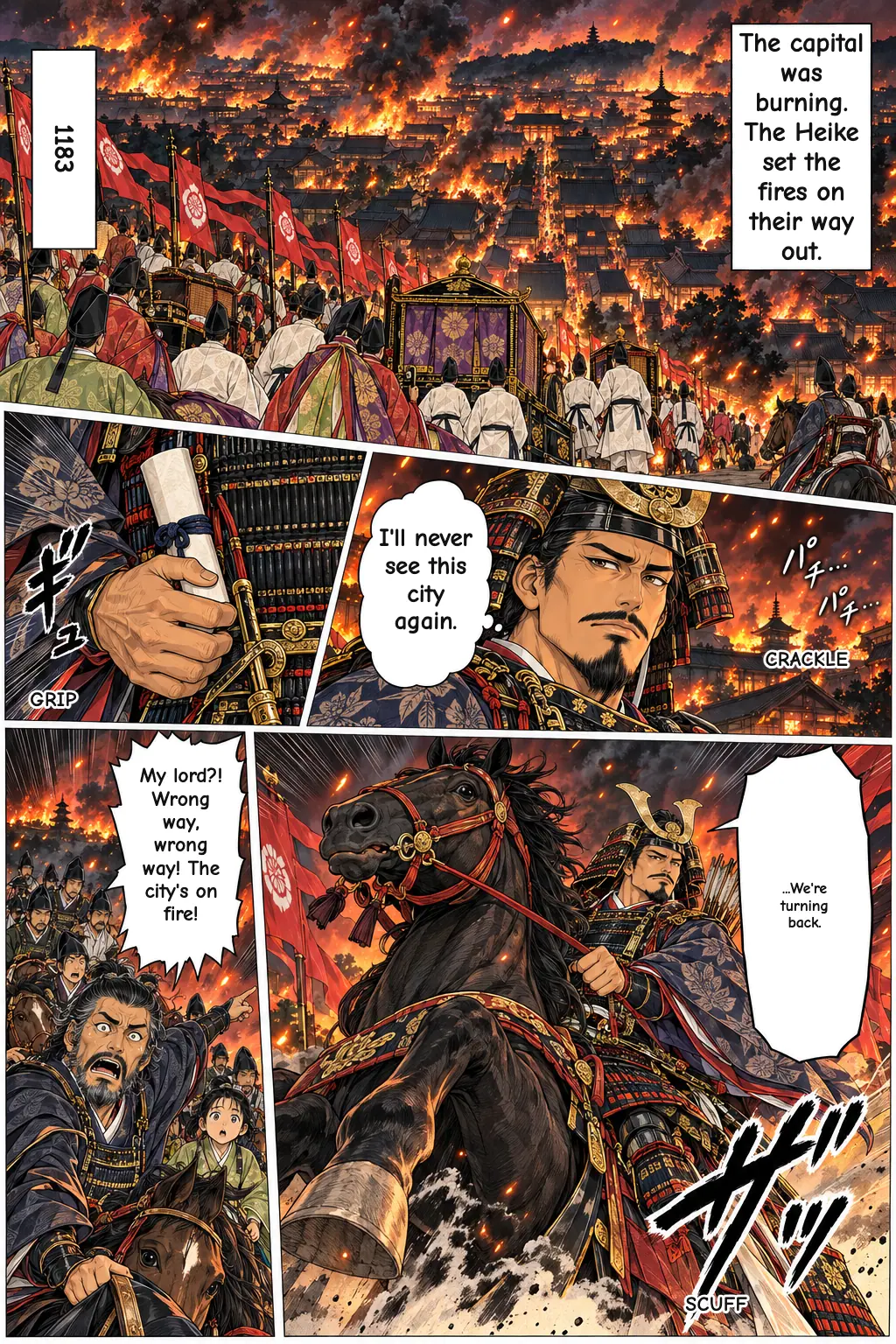
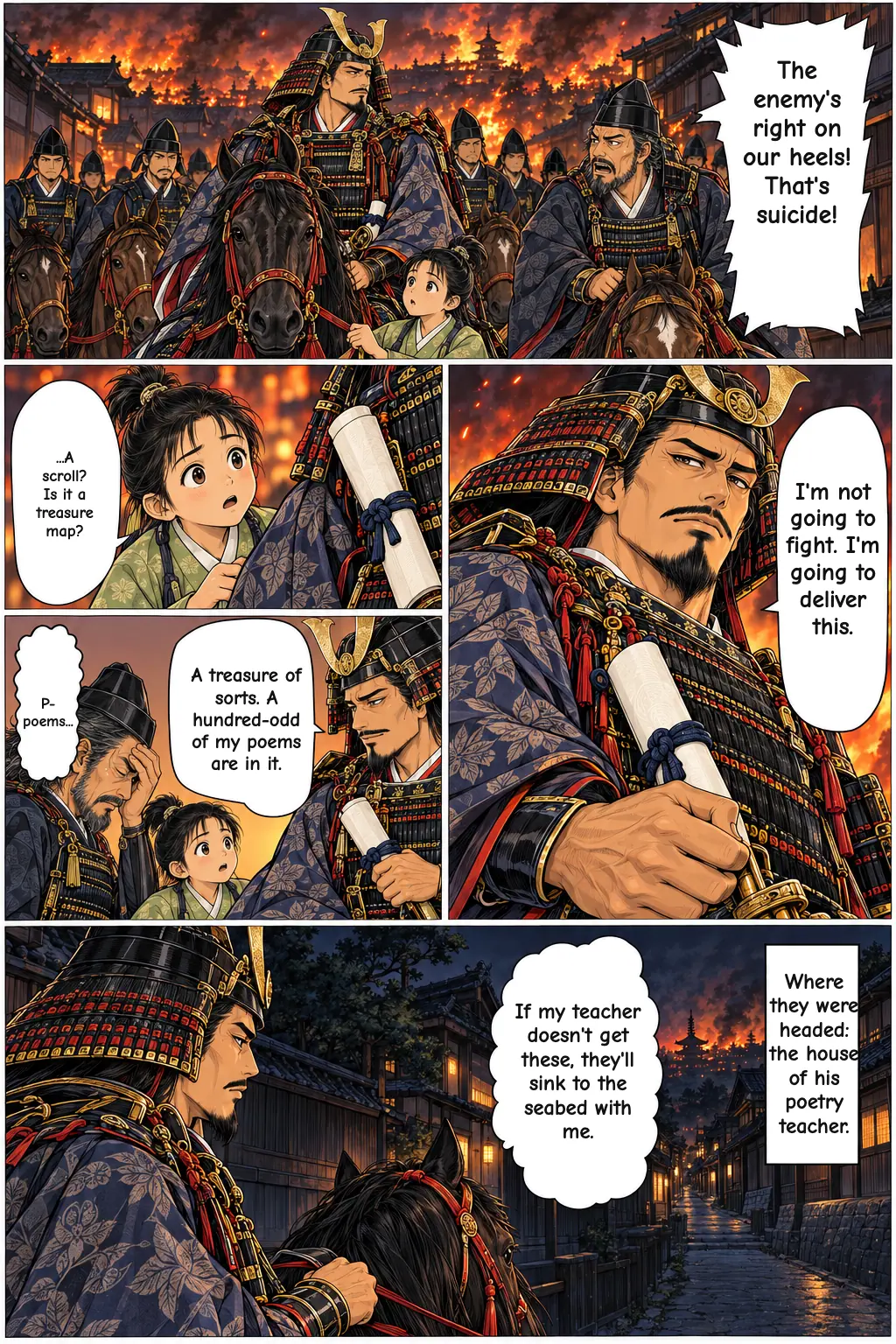
As the Heike flee west from the burning capital, the warrior-poet Taira no Tadanori turns back with a handful of retainers. At the barred gate of his poetry teacher, Fujiwara no Shunzei (Toshinari), he hands over a scroll of more than a hundred of his poems. Years later, Shunzei keeps his promise and places one poem in the realm's greatest anthology. But the poet's name has to be hidden as "Poet Unknown." It takes a very long time for that name to come home.
Tadanori Leaves the Capital: Tale of the Heike Story Explained
The Original Story: The Heike Abandon the Capital
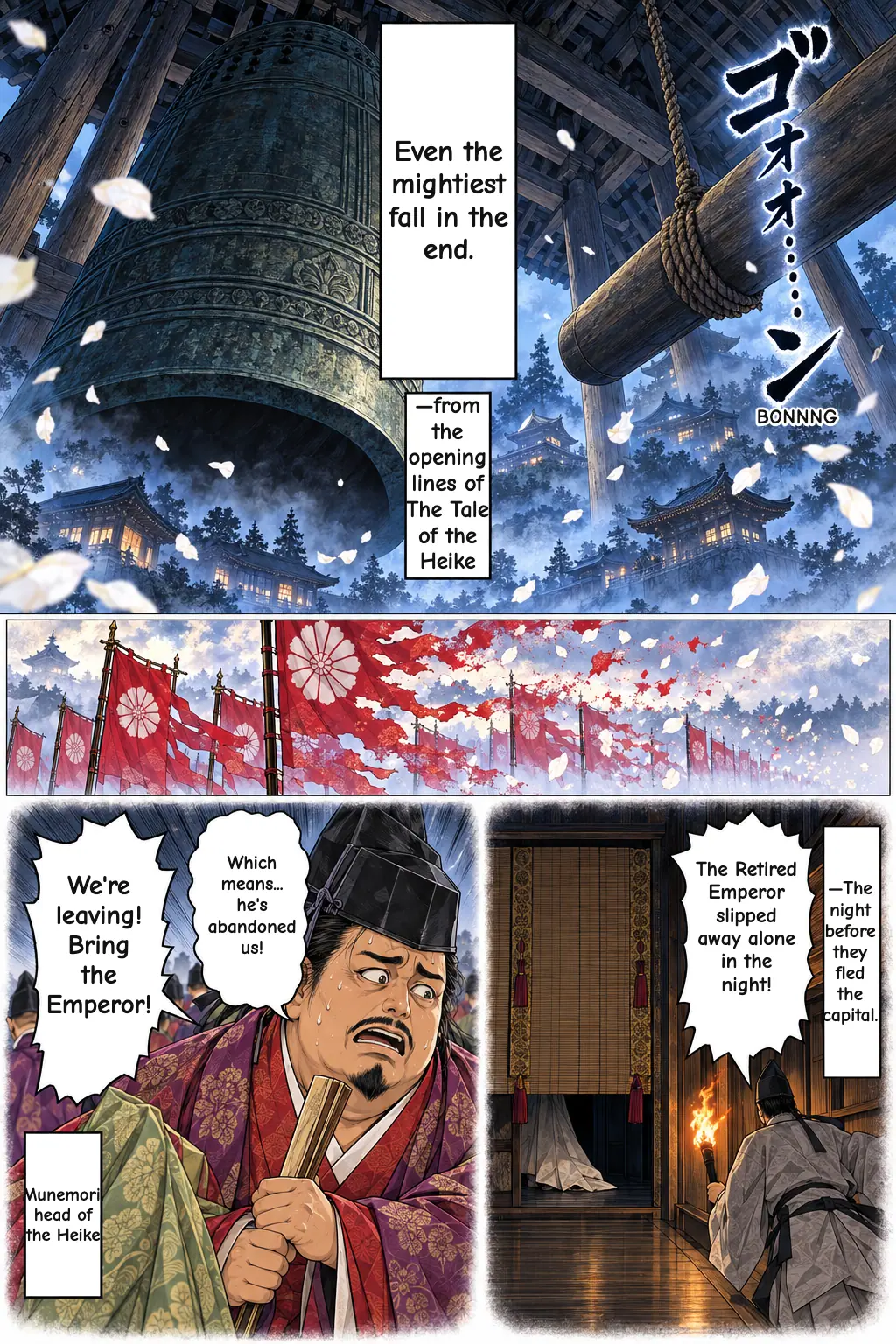
The Tale of the Heike is a medieval Japanese war chronicle about the fall of the Taira (also called Heike), the warrior clan that ruled the court until the Genpei War (1180–1185). This article follows the Kakuichi version, the text long chanted by blind lute-playing storytellers. Episode 8 of the manga is drawn from Book 7, which tells how the clan lost the capital, Kyoto, in the summer of 1183.
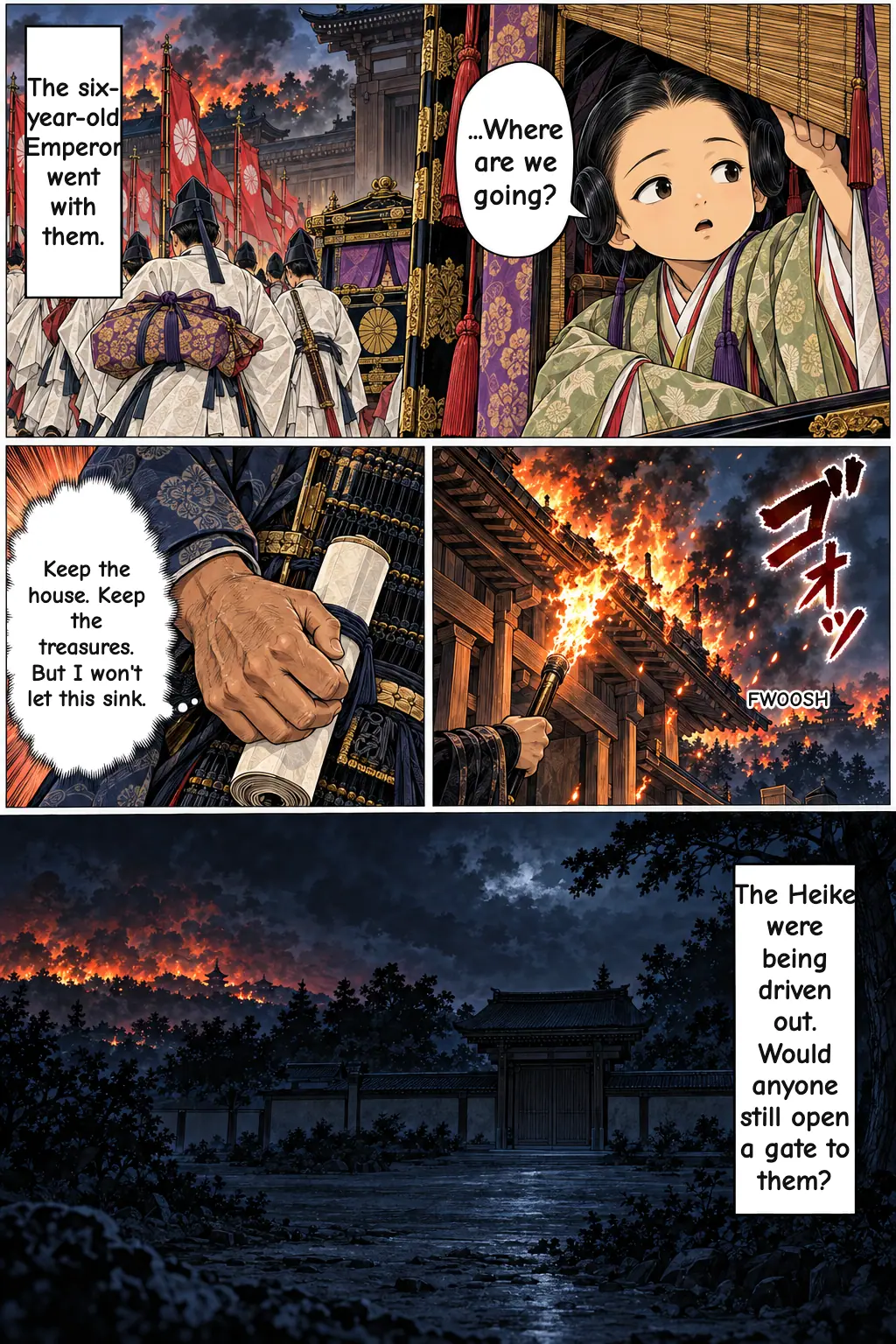
As the army of Kiso no Yoshinaka, a rival general of the Minamoto clan, closes in, the retired emperor Go-Shirakawa, the most powerful figure at court, slips out of his palace at night with just one attendant. The Taira find him gone the next morning and panic. Their leader, Taira no Munemori, takes the child emperor Antoku (the tale says he is six) and his mother, Kenreimon-in, in a single palanquin, along with the three sacred treasures of the throne: the jewel, the sword and the mirror. In the confusion, the tale says, some treasures were simply left behind.
Not everyone stays loyal. The regent Fujiwara no Motomichi sees a boy whose sleeve bears the name of the Kasuga deity, protector of the Fujiwara family, takes it as a sign, and turns back. The Taira set fire to their own mansions, and the city fills with smoke.
Tadanori's Last Visit to His Poetry Teacher
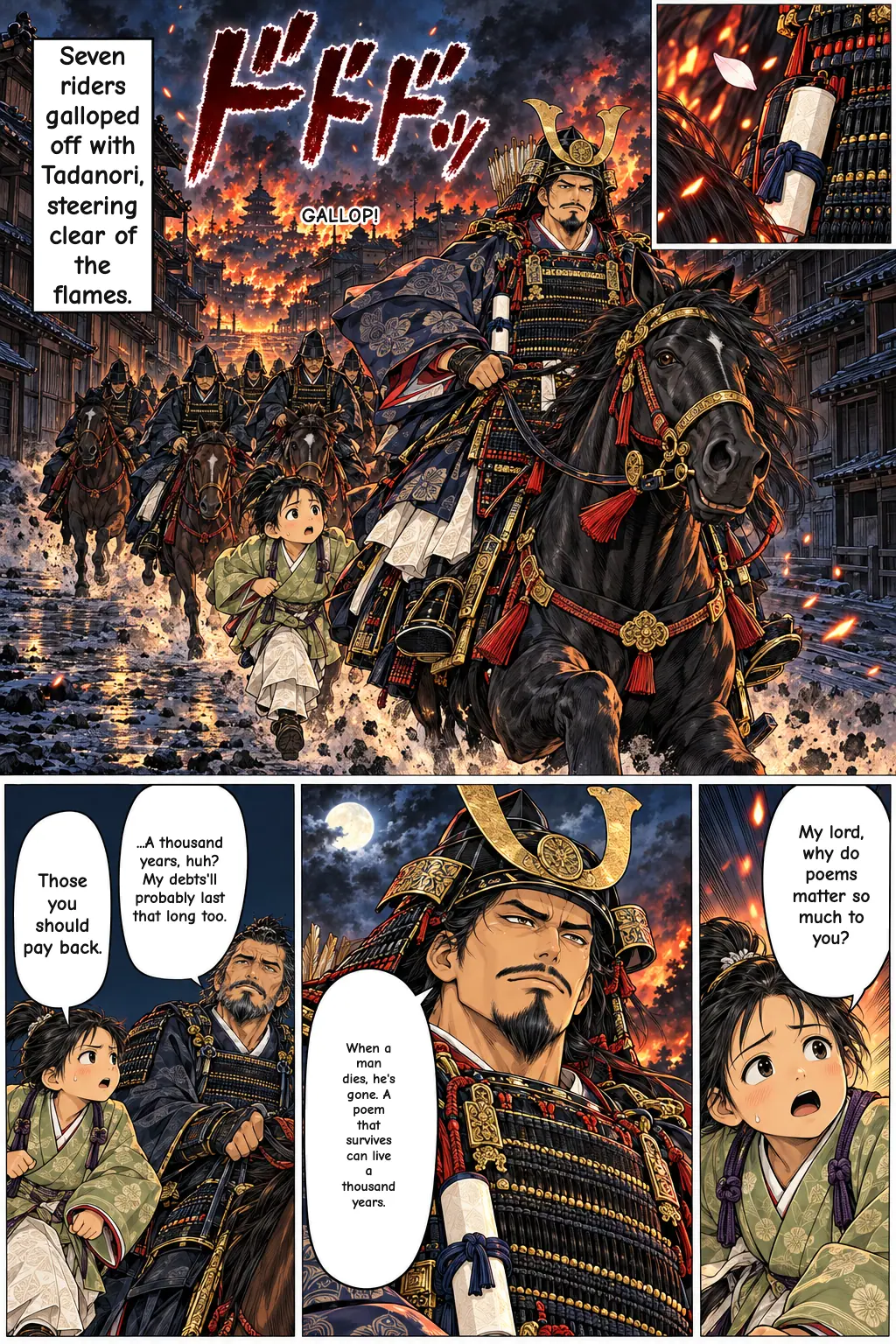
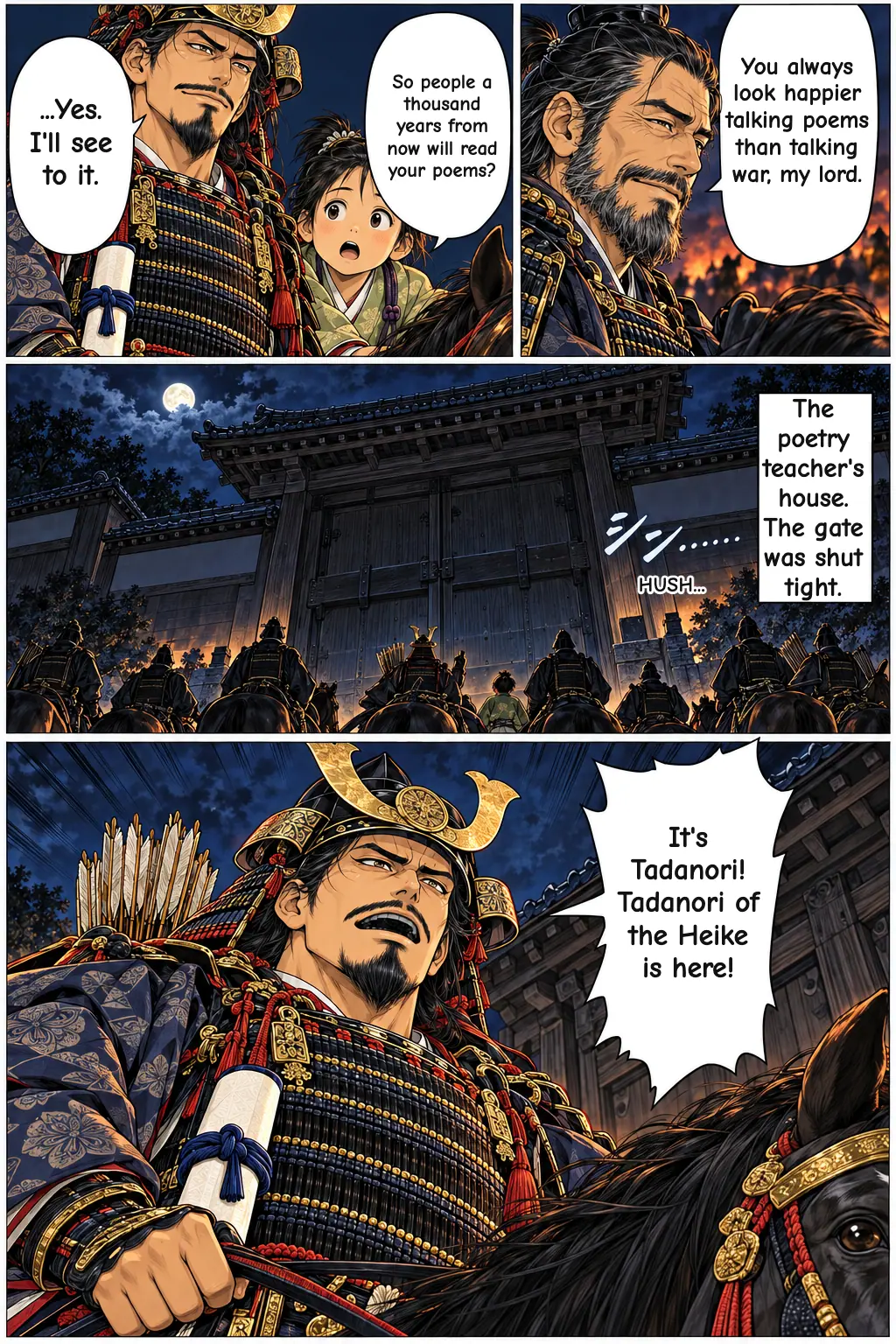
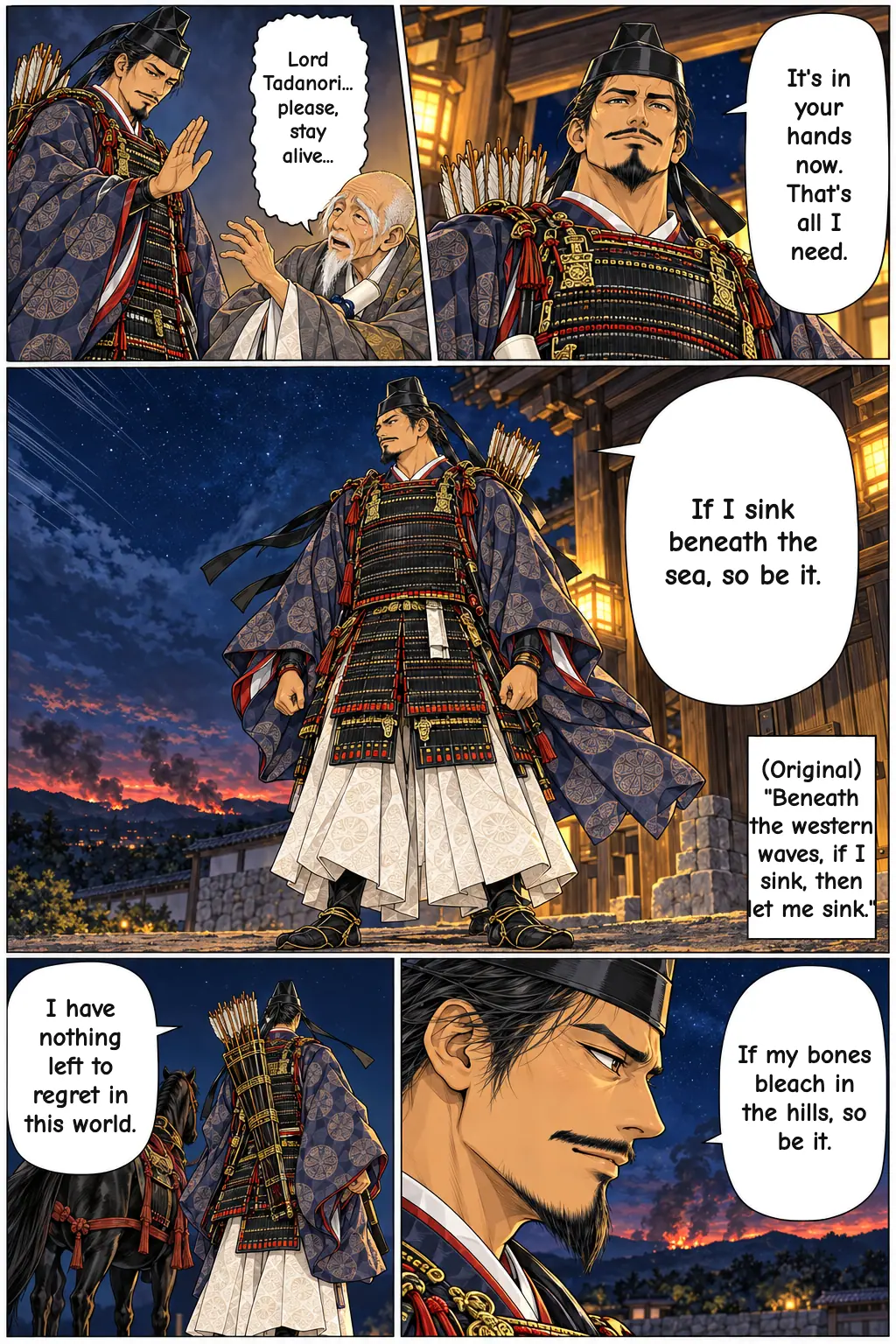
In the middle of this collapse comes one of the most loved scenes in Japanese literature. Taira no Tadanori, governor of Satsuma and a respected poet, rides back into the city with only seven horsemen: five retainers, a page boy and himself. The original does not say where he turned back from. He goes to the house of Fujiwara no Shunzei (also read Toshinari), his longtime teacher of waka, the classical 31-syllable poem.
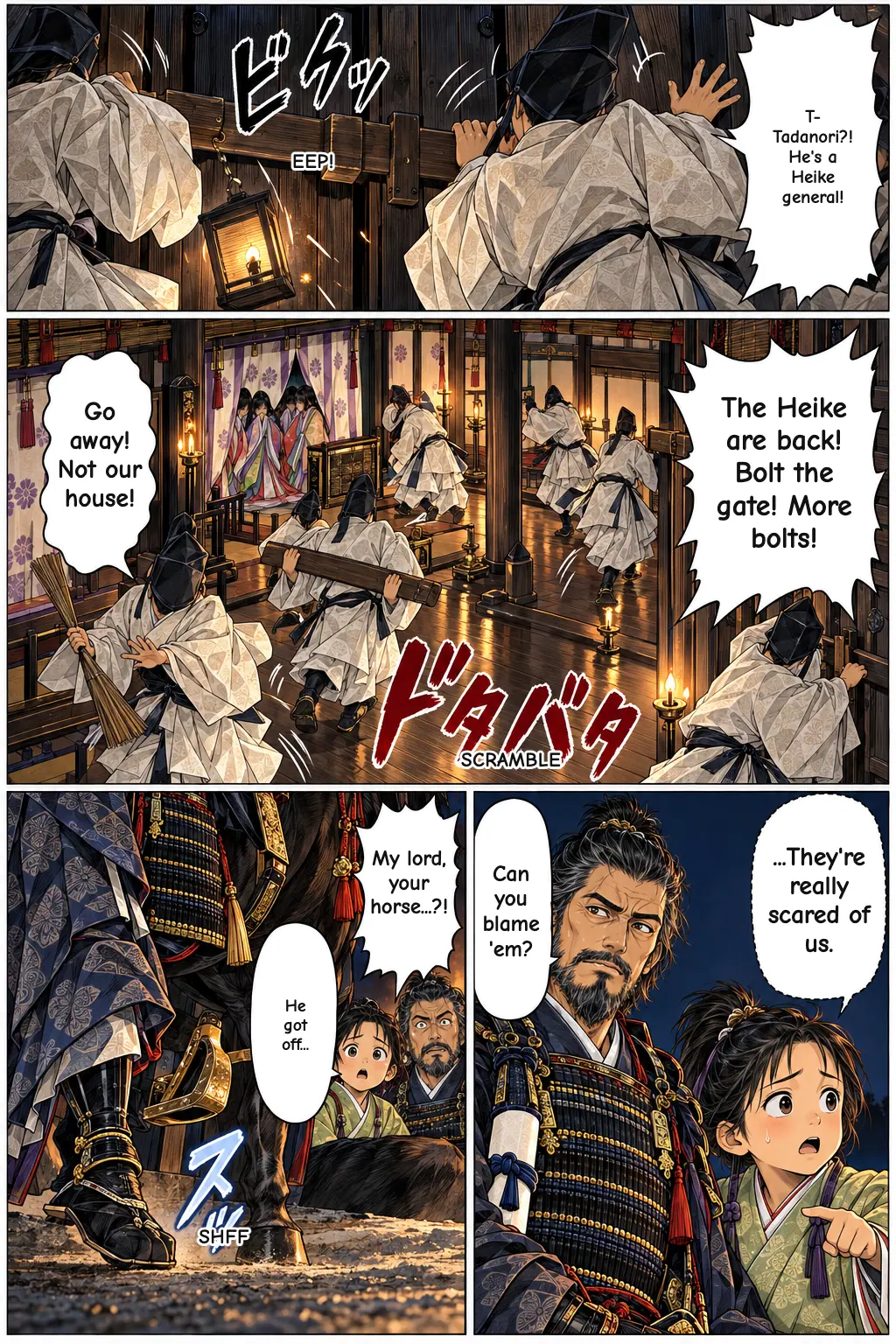
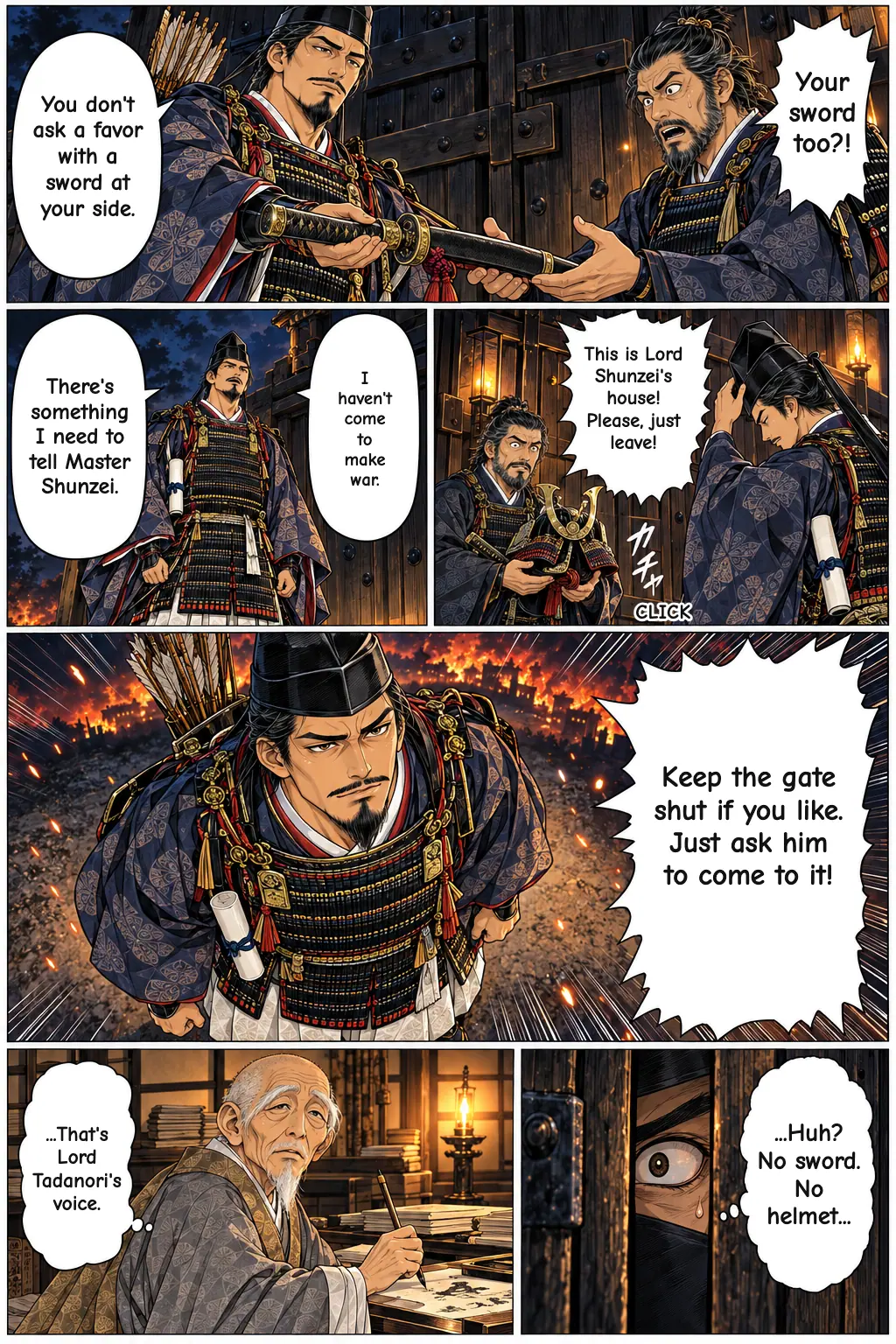
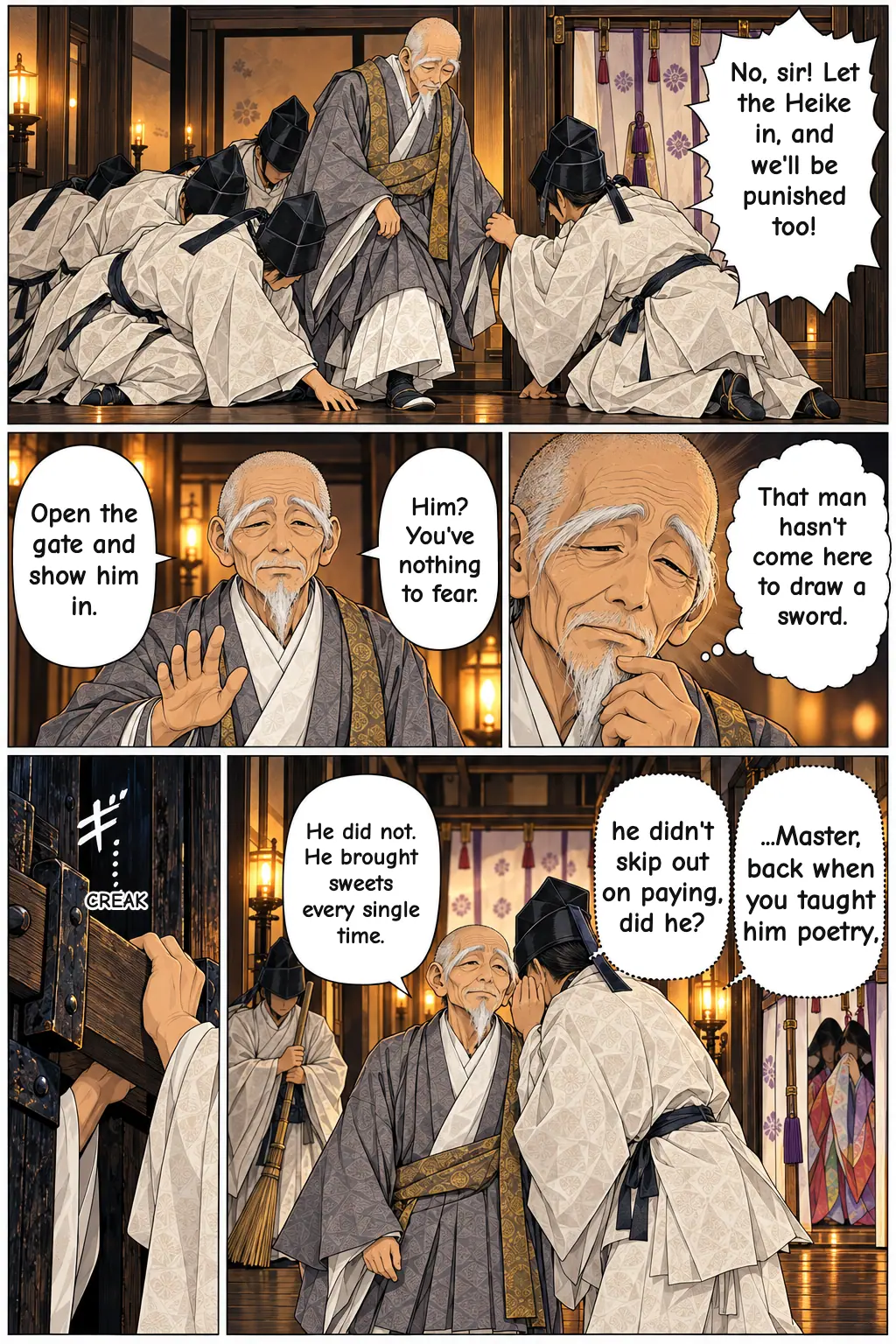
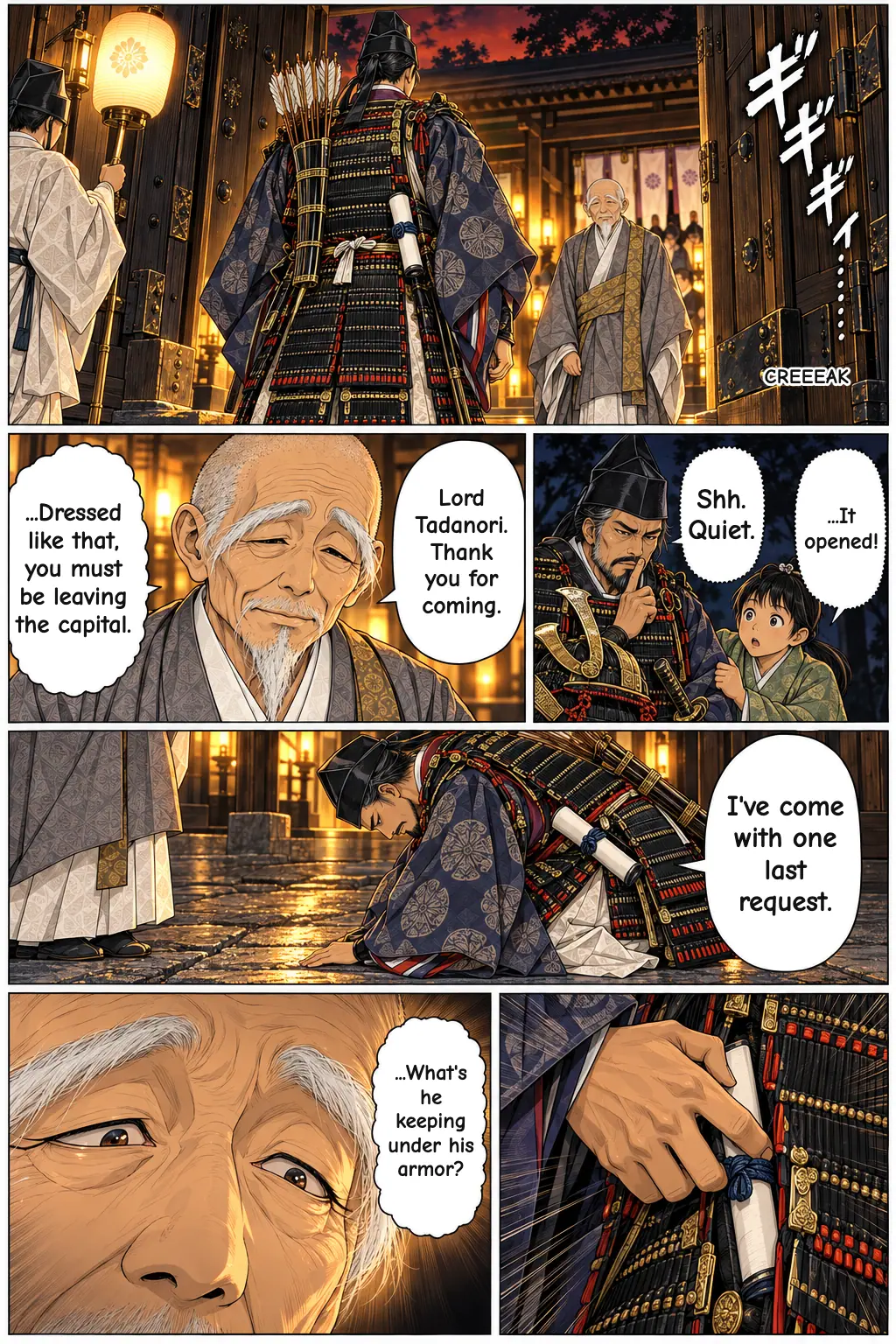
The gate is barred, because everyone fears stragglers from a defeated army. When Tadanori calls out his name, the household is alarmed. He dismounts and says he has no other purpose than to speak to his teacher, even through the gate. Shunzei answers that this man is safe to admit, and the gate is opened.
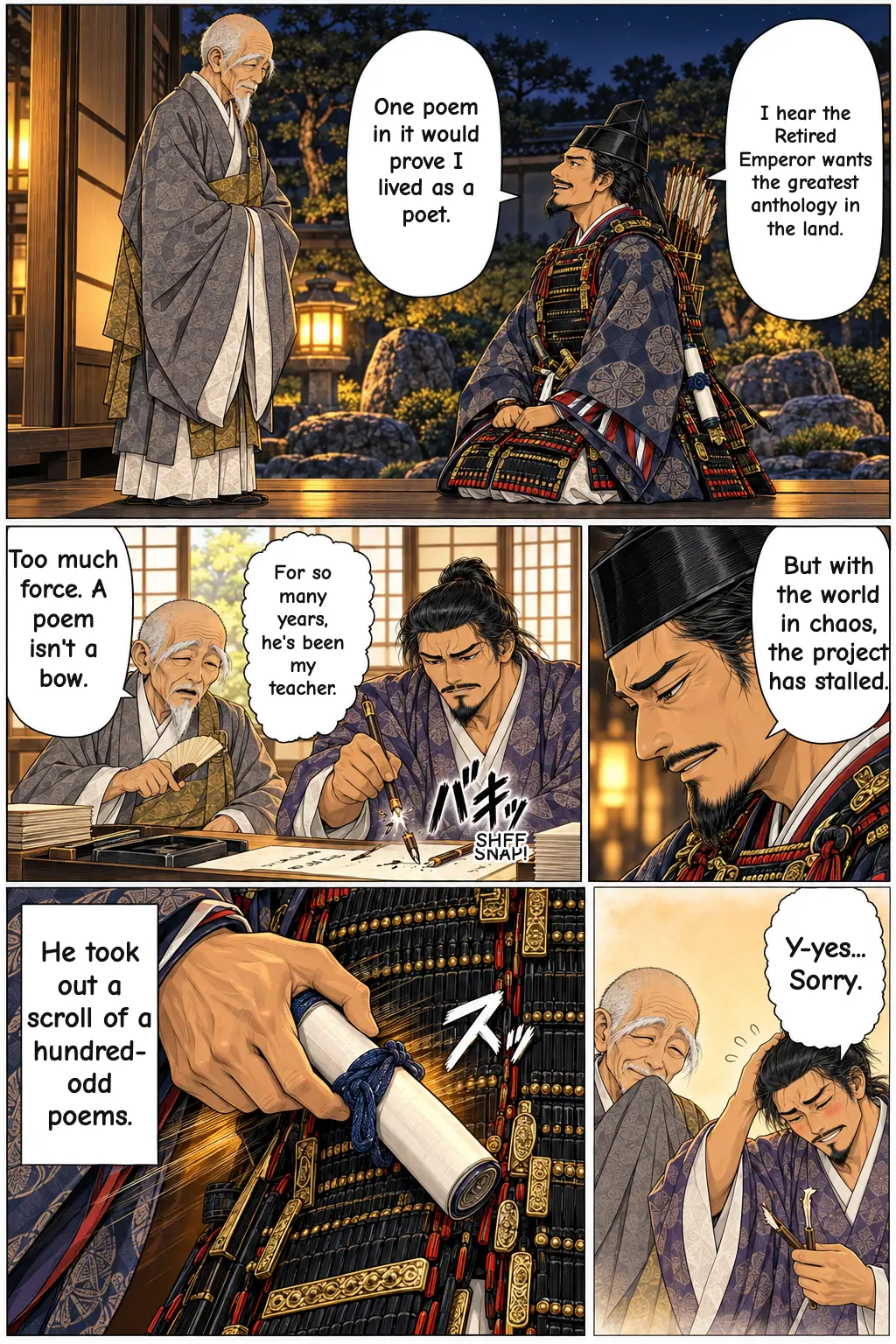
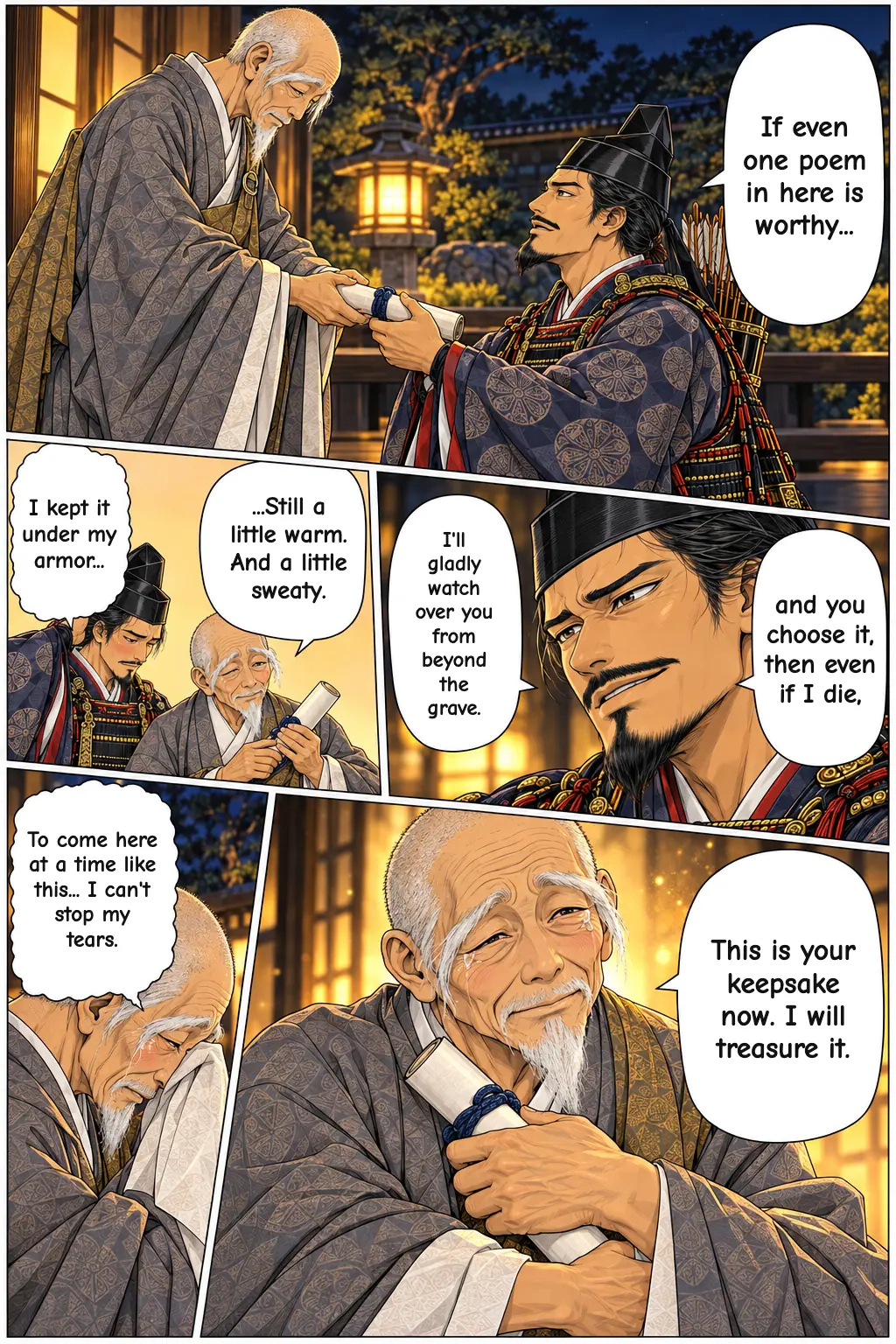
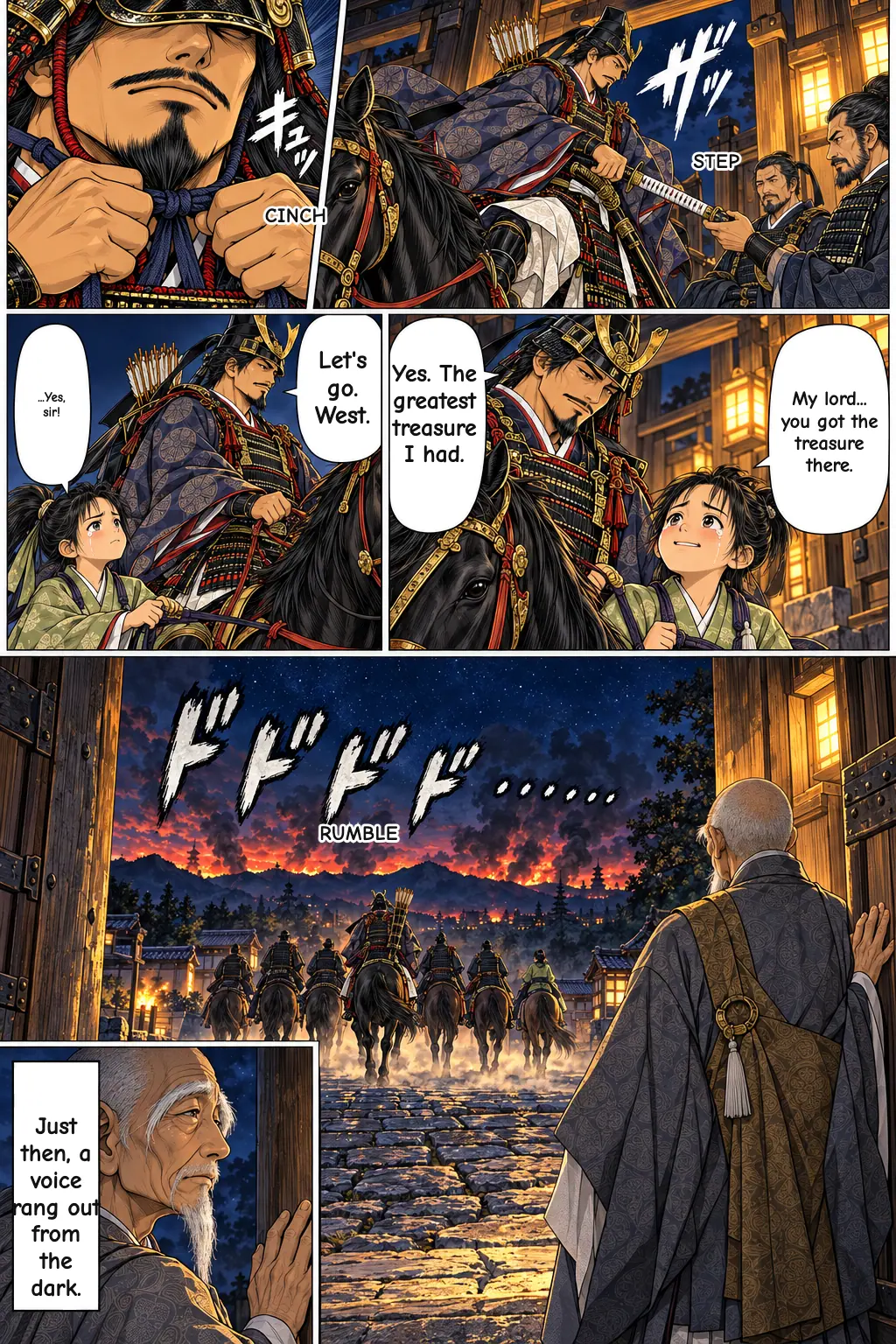
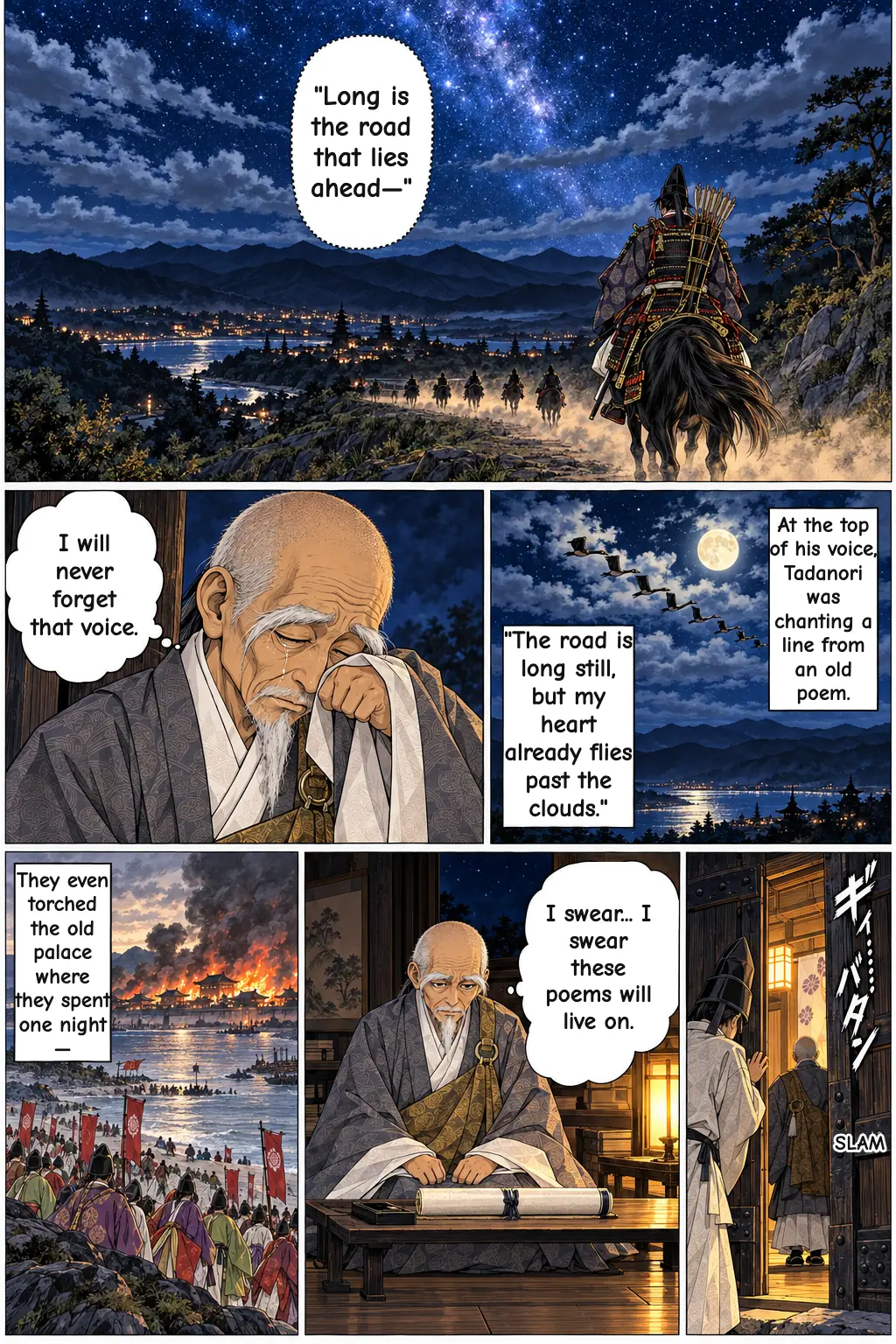
Tadanori explains that he had heard an imperial anthology was being planned before war stopped the work. From inside his armor he draws out a scroll of more than a hundred of his poems and asks that, if even one is worthy, it be included. Then, he says, he could rest happy in the grave. Shunzei promises never to treat this keepsake lightly and cannot hold back tears. Tadanori declares he has nothing left to regret, whether his body ends up beneath the western sea or in the open fields. He ties his helmet cord and rides west, chanting a line of classical Chinese verse about a long road ahead. Shunzei watches until he is gone.
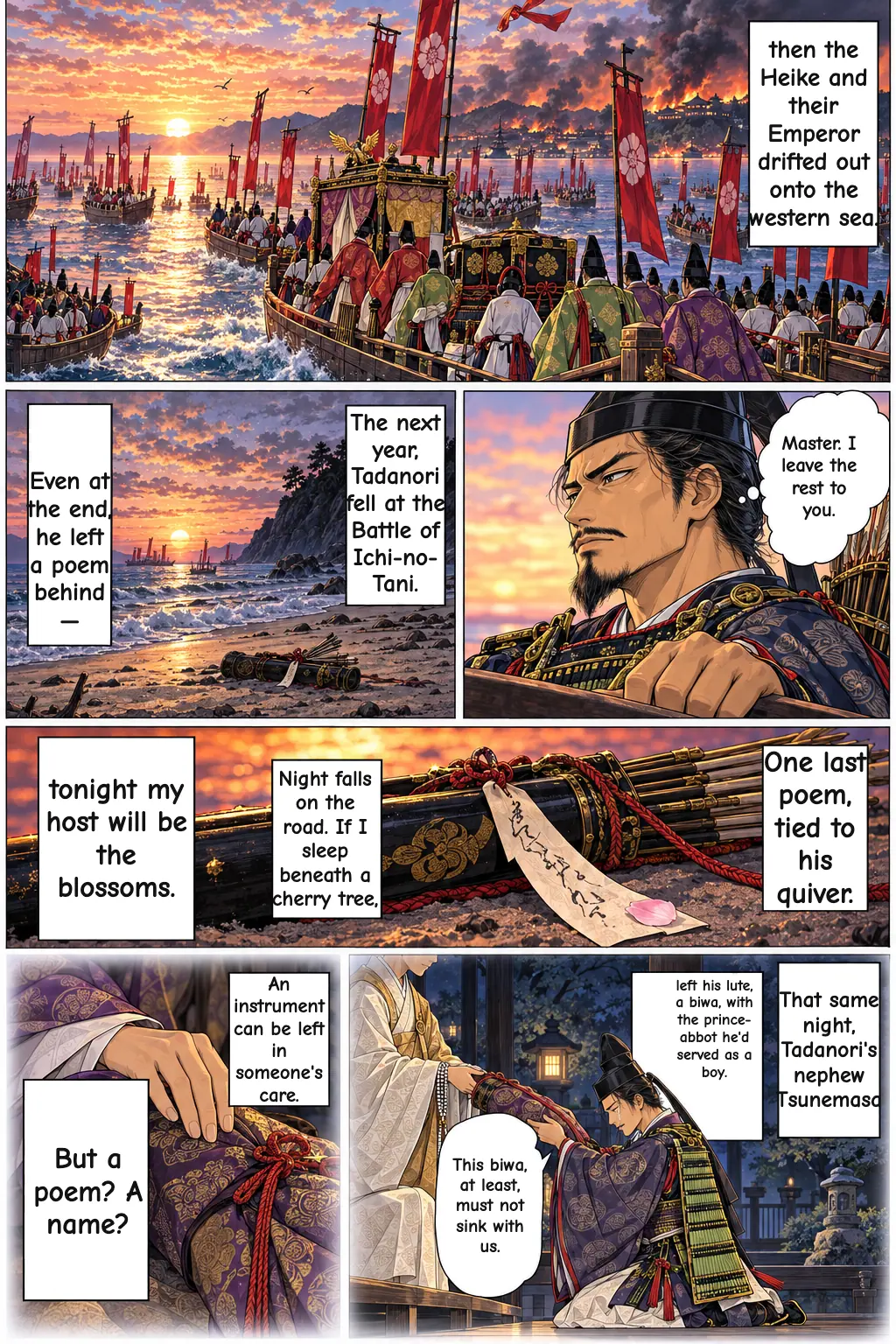
The same book also tells of Taira no Tsunemasa, who returns a famous lute named Seizan to the temple prince of Ninna-ji, his old master, and exchanges farewell poems. The clan then spends a night at their former capital of Fukuhara, burns it, and sets out by ship onto the western sea.
The Poem by "Poet Unknown"
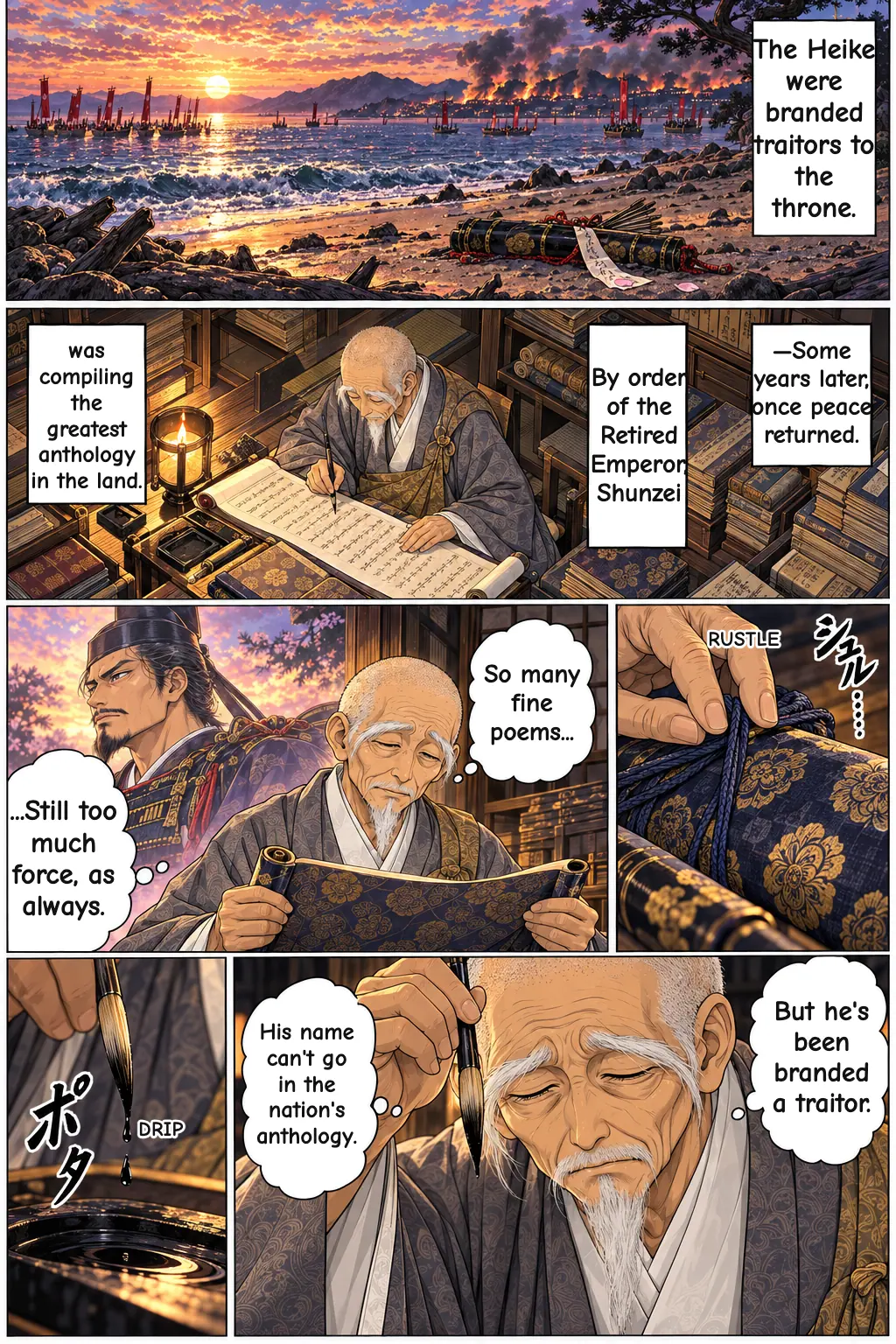
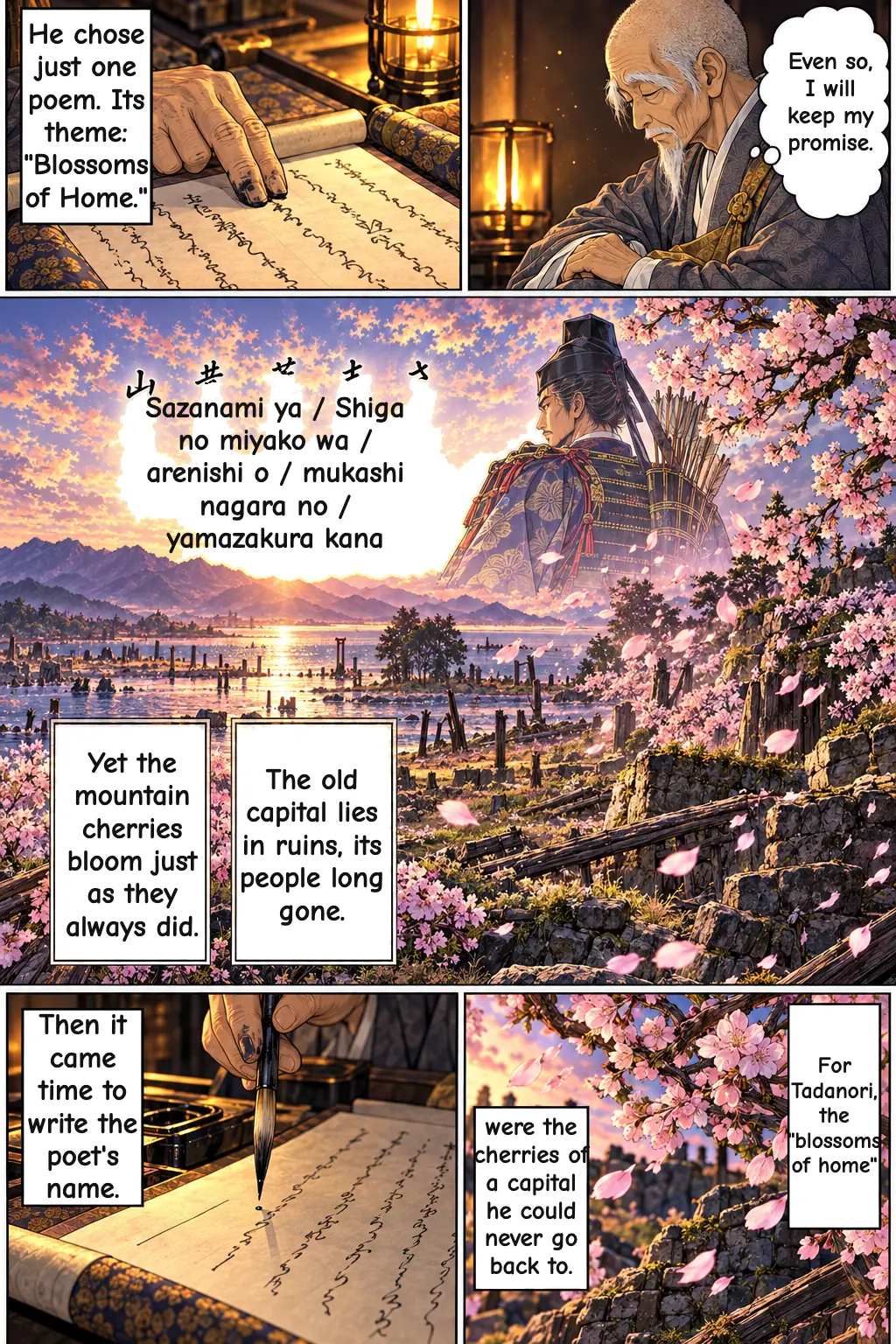
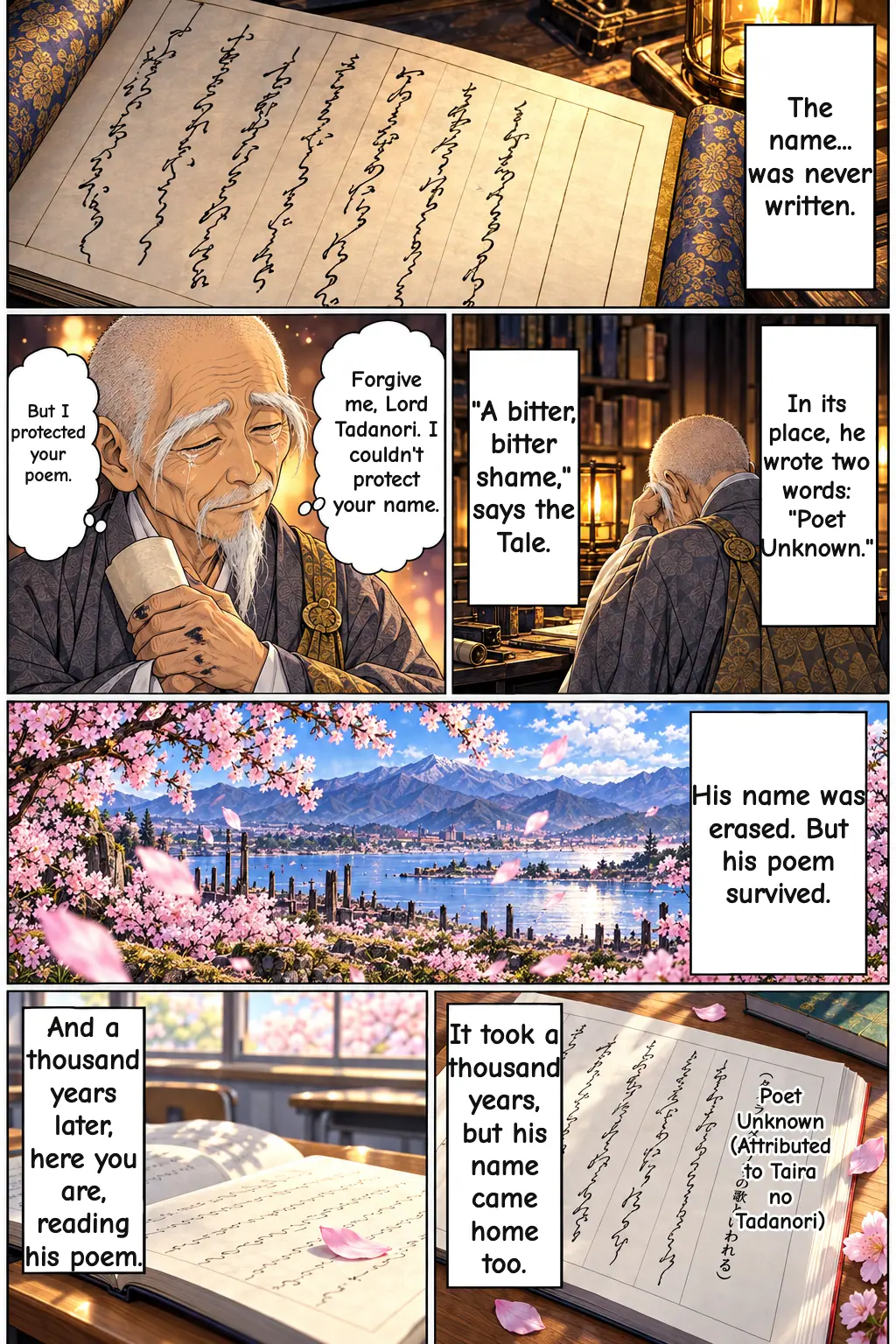
When peace returned, Shunzei compiled the anthology called the Senzaishū. He remembered Tadanori and found many poems worth choosing. But Tadanori had been declared an enemy of the court, so his name could not appear. Shunzei included just one poem, on the theme of blossoms at an old capital, and labeled it "author unknown." In it, the ancient capital of Shiga by Lake Biwa has fallen to ruin, yet the mountain cherries bloom just as they always did. The narrator closes by calling this a bitter shame.
A note on history: the order for the anthology was issued in early 1183, before the flight, and the finished work was presented in 1188. Tadanori himself died in battle at Ichi-no-Tani in 1184, an event told later in the tale.
What This Story Means: Warriors, Poetry and Impermanence
The Tale of the Heike is built around the Buddhist idea that all things pass away and the proud are brought low. Tadanori's scene shows that idea at a human scale. Facing almost certain death, he does not ask for safety or wealth, only that something he made might last. To be chosen for an imperial anthology was the highest honor a poet could receive, and the Taira were as proud of their court culture as of their swords.
The episode also shows the bond between teacher and student crossing the line between victors and losers. Shunzei keeps his word, but the political order forces him to erase the name. Many readers find the quiet sadness of that small compromise more moving than any battle scene.
What the Manga Changes or Adds
The manga follows the main events of the original closely, but some parts are the artist's creation. The names, ages and faces of Tadanori's companions are invented, as are the characters' looks, the colors of the armor, and the design of the scroll. The time of day and weather at Shunzei's gate are not given in the tale. Showing Tadanori turning back with burning Rokuhara behind him is a dramatic combination of two separate passages, since the original never says where he came from.
Shunzei's expressions and thoughts after Tadanori leaves, and the scene of him compiling the anthology, are also imagined; the tale only says he held back tears and later included the poem. Describing it as "years later" or "after the war" draws on history rather than the tale's own wording. Tsunemasa's farewell and the burning of Fukuhara are shortened to keep the focus on Tadanori.
Where to Read It
If you want to see this farewell at the gate unfold panel by panel, Episode 8 of THE TALE OF THE HEIKE: The Samurai War of Genpei is right here on Manga Portal. Every episode is free to read, with no sign-up needed, so you can start from the beginning of the Genpei War or jump straight to Tadanori's story.
Characters in this episode
Taira no Tadanori
A Taira warrior and gifted poet who turns back during the clan's flight to entrust his poems to his teacher.
Fujiwara no Shunzei (Toshinari)
A leading court poet and Tadanori's teacher, who later places one of his poems in an imperial anthology without his name.
Emperor Antoku
The child emperor, six years old in the tale, carried out of the capital by the Taira.
Taira no Munemori
Head of the Taira clan, who leads the flight west with the emperor and the sacred treasures.
Retired Emperor Go-Shirakawa
The powerful retired emperor who secretly escapes the night before, leaving the Taira behind.
Taira no Tsunemasa
A young Taira noble who returns the famous lute Seizan to Ninna-ji temple before leaving.
FAQ
Why did Taira no Tadanori go back to the capital?
He returned to give his poetry teacher, Fujiwara no Shunzei, a scroll of more than a hundred of his poems. He hoped at least one would be chosen for an imperial anthology so that something of him would survive the war.
Why was Tadanori's poem published as "author unknown"?
The Taira had been branded enemies of the court, so a poem could not be credited to Tadanori by name. Shunzei included one poem anonymously in the Senzaishū, which the tale treats as a painful loss.
What happened when the Heike left Kyoto in 1183?
With Minamoto forces approaching, the Taira took the child Emperor Antoku and the three sacred treasures and fled west, burning their mansions behind them. Retired Emperor Go-Shirakawa had already escaped, and some court nobles turned back.
What happened to Tadanori after he left?
He died in battle at Ichi-no-Tani the following year, 1184. His death is told in a later book of The Tale of the Heike.
Is the Tadanori story in The Tale of the Heike true?
Tadanori and Shunzei were real people, and an anonymous poem attributed to Tadanori does appear in the Senzaishū. The farewell scene itself, however, is told as literature, so its exact details cannot be confirmed.