Episode 3Why the Sun Goddess Met Her Brother in ArmorThe Oath of Amaterasu and Susanoo
Episode 3. Cast out by his father, Susanoo climbs to Heaven to say goodbye to his sister Amaterasu, but she meets him in full battle gear. They settle it with a sacred oath in which each brings forth children. Susanoo shouts "I win!" and goes on a rampage, and his sister keeps covering for him. Then a weaving maiden dies, and Amaterasu, now afraid, shuts herself away in the Rock Cave.
Amaterasu and Susanoo's Oath: The Kojiki Myth Explained
The Original Myth: A Summary from the Kojiki
This story comes from the first volume of the Kojiki ("Record of Ancient Matters"), Japan's oldest surviving chronicle, compiled by Ō no Yasumaro in 712. It opens with a god who refuses to do his job. Izanagi, the creator god, has given his son Susanoo, the storm god, the sea to rule. Susanoo ignores it and simply weeps and howls, even after his beard has grown down to his chest. His crying withers green mountains and dries up rivers and seas, evil spirits swarm like summer flies, and disasters of every kind break out.
When Izanagi asks why, Susanoo says he wants to go to the land of his dead mother, Ne-no-Katasu-kuni. Izanagi, enraged, banishes him. Susanoo decides to say goodbye first to his sister Amaterasu, the sun goddess who rules the High Plain of Heaven (Takamagahara). As he climbs, mountains and rivers shake and the whole land trembles. Amaterasu concludes he has come to take her realm. She ties her hair into warrior-style loops, winds long strings of curved magatama jewels around her hair and arms, straps on two huge quivers and an archer's arm guard, raises her bow, and stamps the hard ground until it scatters like powdery snow.
Susanoo insists he has no hostile intent. To prove it, the two perform an ukehi, a sacred oath in which each brings forth children, standing on either side of the Heavenly Peaceful River (Ame-no-Yasu-no-Kawa). Amaterasu breaks Susanoo's sword into three, chews the pieces, and breathes out a mist from which three goddesses are born. Susanoo does the same with her jewels, and five gods appear. Amaterasu declares that the five gods are hers, since they came from her jewels, and the three goddesses are his.
Susanoo then announces that his gentle daughters prove his heart is pure, so he has won. Carried away by this "victory," he wrecks the ridges of her rice fields, fills in the ditches, and smears excrement in the hall where she holds the harvest feast. Amaterasu makes excuses for him, suggesting he was drunk or simply thought the land was being wasted. But he only gets worse. At last he breaks through the roof of her sacred weaving hall and drops in a heavenly dappled horse he has skinned backward. A weaving maiden, startled, strikes herself with her shuttle and dies. Frightened, Amaterasu shuts herself away in the Heavenly Rock Cave.
Main Characters
Susanoo is a strange kind of hero. In the Kojiki he was not born from a mother at all: he appeared when Izanagi washed his nose after escaping the underworld, in the same purification that produced Amaterasu from his left eye. The "mother" he longs for is usually understood to be Izanami, Izanagi's late partner. His power is enormous, since his tears alone ruin the land, but he has little self-control.
Amaterasu acts as a ruler first. She suspects a threat at once, arms herself, then asks a sensible question: how can she know his heart is clean? She calls Susanoo by a word women used for a brother or husband, one hint in the text that she is a goddess, although the Kojiki never states her sex outright. Her path in this episode goes from suspicion to patience to fear.
What This Myth Tells Us
Susanoo's offenses are not random. He attacks rice paddies, irrigation, the harvest feast, and the weaving of sacred garments for the gods, the things early Japanese communities and their rituals depended on. Many readers point out that these acts look like the "heavenly sins" listed in later Shinto purification prayers, which suggests the myth helped explain why such acts were seen as deeply polluting.
The oath also does genealogical work. The text notes that the three goddesses are worshipped at the three Munakata shrines in Kyushu, and that several of the five gods became ancestors of noble clans. The eldest, Ame-no-Oshihomimi, later becomes the father of Ninigi, the grandson of Amaterasu who comes down to rule the earth in the Kojiki's account of the imperial line.
Amaterasu's looped hairstyle, called mizura, is often said to have been a men's style in ancient Japan, so a common reading is that she dresses as a male warrior. The original text simply describes the hairstyle and does not say she is dressing as a man.
Who Really Won the Oath?
Retellings often say Susanoo won and proved his innocence. The Kojiki itself is less clear. It never says beforehand which outcome would prove a pure heart, and the only voice declaring victory is Susanoo's. Neither the narrator nor Amaterasu confirms it.
In the Nihon Shoki, Japan's other early chronicle (720), some versions set the rule in advance that male children would show a pure heart, and many modern summaries borrow that rule. So how the contest should be judged is a matter of interpretation, and the rampage that follows makes his claim of a "clean heart" look even more doubtful.
What the Manga Version Changes
The manga follows the Kojiki's order of events, but the original is very brief. Apart from his long beard, it never describes what Susanoo looks like, what he feels when he refuses the sea, what the evil spirits look like, or why Amaterasu keeps forgiving him. Those emotions, motives, and visuals are the manga's own creation. Her armor contains the items the text lists (jewels, quivers, arm guard, bow), but their design and color are invented, as are the landscapes of Heaven, the weaving hall, and the appearance of the maiden. The Kojiki doesn't even say how many weavers were there.
The dialogue is also newly written. Susanoo's "I win!" is a punchy, modern take on his boast. Where the source says nothing, for example about how Amaterasu reacts to that boast, any expression or mood you see on the page is the artist's interpretation, not something recorded in the Kojiki.
Where to Read It
The original story is in the first volume of the Kojiki, which has several complete English translations, including those by Basil Hall Chamberlain (1882), Donald L. Philippi (1968), and Gustav Heldt (2014). Comparing them is a good way to see how translators handle the harder passages.
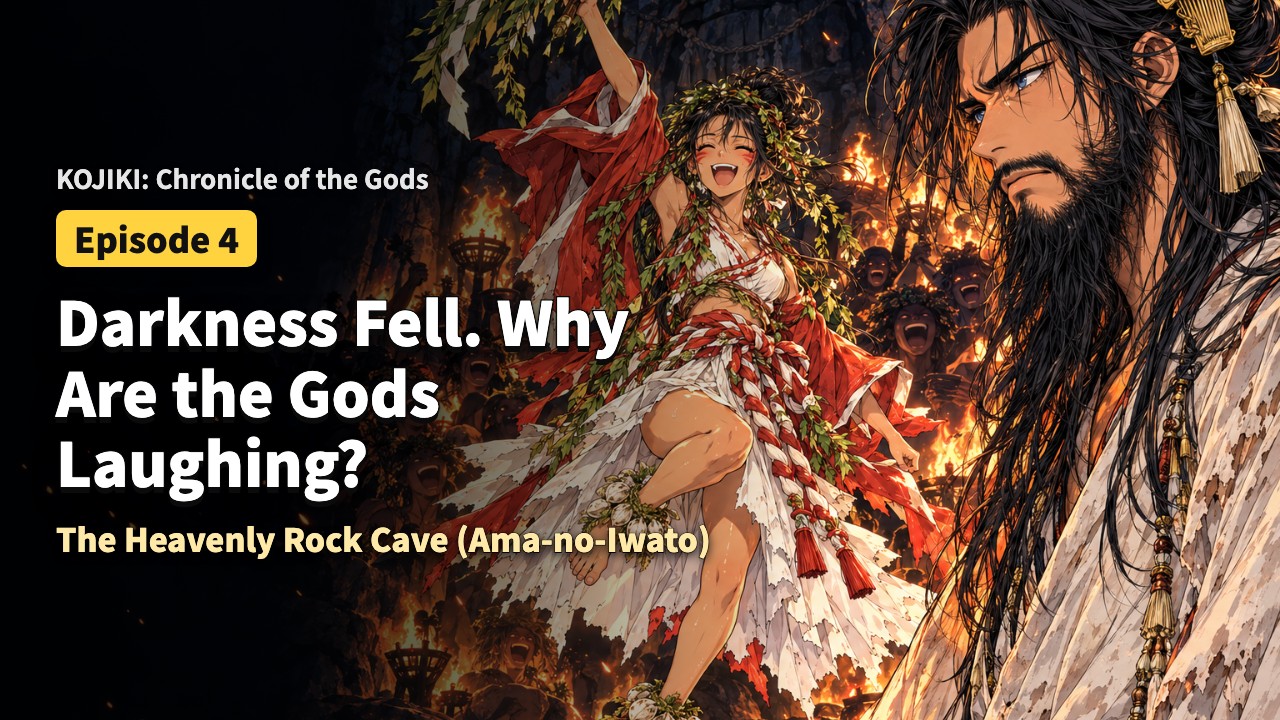
If you'd like to see the story first, Episode 3 of KOJIKI: Chronicle of the Gods tells it from Susanoo's tears to the weaving maiden's death. Every episode is free to read, with no sign-up needed, and the next one picks up as Heaven goes dark when the sun goddess hides in the Rock Cave.
Characters in this episode
Susanoo (Takehaya-Susanoo)
The storm god, banished by his father for wailing instead of ruling the sea, who claims victory in the oath and then runs wild in Heaven.
Amaterasu
The sun goddess and ruler of the High Plain of Heaven, who meets her brother armed for battle, forgives his early misdeeds, and finally hides in the Rock Cave.
Izanagi
The creator god and Susanoo's father, who asks why his son keeps crying and banishes him in anger.
The Heavenly Weaving Maiden
A nameless weaver of sacred garments who dies of shock when Susanoo drops a skinned horse into the weaving hall.
The Three Munakata Goddesses
Takiri-bime, Ichikishima-hime, and Tagitsu-hime, born from Susanoo's sword during the oath and later worshipped at the Munakata shrines.
Ame-no-Oshihomimi and the Five Gods
The five male gods born from Amaterasu's jewels and claimed as her children; Oshihomimi later becomes the father of Ninigi.
FAQ
Why was Susanoo banished from the world?
Izanagi gave Susanoo the sea to rule, but he only wept, and his crying dried up rivers and brought disaster. When he said he wanted to go to his dead mother's land, Izanagi angrily banished him.
Why did Amaterasu wear armor to meet Susanoo?
His climb to Heaven shook the mountains and the land, so she thought he had come to take her realm. She armed herself with a bow, quivers, and jewels, and waited for him ready to fight.
Who won the oath between Amaterasu and Susanoo?
In the Kojiki, Susanoo declares himself the winner because daughters came from his sword, but the text never set the rules in advance, and no one else confirms his claim. Many retellings say he won by borrowing a rule from the Nihon Shoki, so the outcome is open to interpretation.
What is ukehi in Japanese mythology?
Ukehi is a sacred oath or divination in which the outcome is meant to reveal the truth. In this myth, Amaterasu and Susanoo each bring forth children from the other's belongings to test whether Susanoo's heart is pure.
Why did Amaterasu hide in the Rock Cave?
After Susanoo ruined her rice fields and fouled her feast hall, he threw a skinned horse into her sacred weaving hall, and a weaving maiden died of the shock. Frightened, Amaterasu shut herself inside the Heavenly Rock Cave.